
Britain’s border management framework has come under fierce criticism from Henry Bolton, who revealed alarming figures about deportation rates.
Speaking to GB News, the International Border Security and Border Control expert claimed Sir Keir Starmer’s “one in, one out” deal with France currently removes approximately one individual for each 263 people entering the country.
GB News can reveal that the total migrant crossings so far this year has passed the grim milestone of total crossings for 2024.
More than 200 migrants crossed the Channel today alone, taking the total for this year to 36,956.
Stories
Videos
Your Say

Henry Bolton has offered stark deportation figures as he tears into Keir Starmer’s ‘one in, one out’ deal with France
GB NEWS / PA
Delivering his verdict on the exchange deal with the French, Mr Bolton told GB News: “It’s not working at all, and nor was it ever going to.
“And the entire thing I couldn’t help feeling, and I said it many times when it was first being introduced, that actually it’s just a political sort of way of appeasing the British population who was saying ‘for God’s sake, do something about it’.”
Offering his stark calculations of the deportation rate, he added: “It was never going to be effective. It’s basically working out at the moment to around about for every 263 that are brought in, we’re sending one out, something like that, so it’s not one in, one out by any means.
“And the deterrent factor is zero, and the smashing the business gangs model is laughable.”
LATEST DEVELOPMENTS:
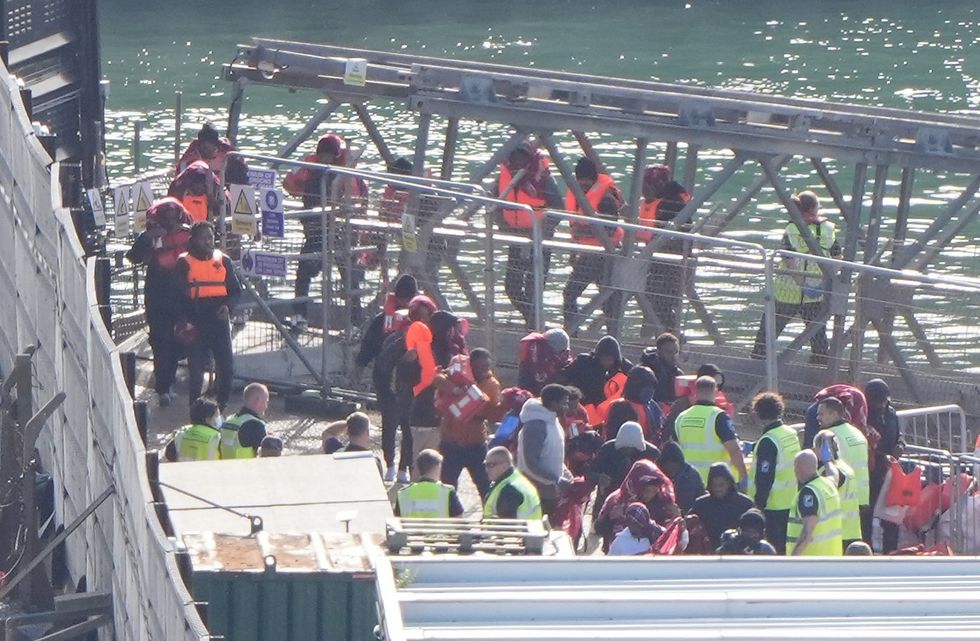 The total number of arrivals so far this year has exceeded 36,886PA
Mr Bolton raised questions about the Government’s genuine commitment to addressing border issues.
He stated: “Does the Government actually want to do this or not?
“It’s a difficult one, because I think some people in the Labour Party do want to address this, but there are others whose votes and constituency is absolutely in a different camp.”
Highlighting one aspect of border control that Britain “lacks”, the expert explained: “One of the things that the United Kingdom lacks and many other countries have got, I’ve helped 14 different other countries to do this, is to develop and implement a fully integrated and comprehensive cross-Government national strategy to manage our borders.
“Now how that happens, it’s got to incorporate land, sea, and we have got land, the tunnel is a land border, crossing land, sea and air borders, but also at the international, regional and national levels as well as locally.”

Mr Bolton told GB News that Labour needs a ‘whole Government approach’ to protecting Britain’s borders
GB NEWS
Me Bolton continued: “Because every part of our coast is different, there’s a whole range of different threats, it’s not just about people. I keep reminding people about that, all of the cocaine, all of the heroin in this country comes across our borders.
“So we’ve got to have a whole of Government approach here. And to do that, you’ve got to have somebody who is above one single Government department to pull it together.”
He concluded: “Because otherwise, in my experience, what you have is you have different Government people, subordinate people, whether they’re police officers or working for a border agency or an intelligence agency subordinate to a junior minister, it’s subordinate to a secretary of state, subordinate to whoever, all trying to to coordinate something.
“It doesn’t work because they have to keep sending decisions up their chains.”
Border Expert Pinpoints ‘Laughable’ Migrant Deportations as He Criticises Keir Starmer’s ‘One In, One Out’ Deal
The United Kingdom’s immigration policy has come under renewed scrutiny after a border expert criticised the government’s migrant deportation arrangements, describing the number of removals under the controversial ‘one in, one out’ agreement as insufficient. The criticism has intensified the political debate surrounding Prime Minister Keir Starmer’s approach to irregular migration, with questions being raised about whether the policy can effectively reduce Channel crossings and restore public confidence in border security. As the government continues to face pressure over immigration, opposition politicians and border specialists are demanding clearer evidence that its strategy is producing meaningful results.
First of all, illegal migration across the English Channel has become one of the most significant challenges facing successive British governments. Thousands of people have attempted to reach the United Kingdom in small boats, frequently relying on criminal smuggling networks to organise dangerous journeys. These vessels are often overcrowded and unsuitable for crossing one of Europe’s busiest shipping routes. The journeys expose migrants to serious risks, including drowning, hypothermia and other life-threatening dangers.
The issue has attracted considerable political attention because of its impact on border security, public finances and the asylum system. Many British taxpayers are concerned about the costs of processing asylum applications and providing temporary accommodation for people arriving through irregular routes. Others are worried about the ability of local authorities to manage additional pressure on housing and public services. Consequently, immigration has become a major subject of disagreement between Labour, the Conservatives and Reform UK.
When Keir Starmer became Prime Minister in July 2024, he promised to introduce a different approach to controlling irregular migration. His government abandoned the previous Conservative administration’s Rwanda deportation scheme, arguing that it had failed to deliver the expected results despite substantial expenditure. Instead, Labour focused on strengthening cooperation with European partners, improving intelligence sharing and targeting the criminal organisations responsible for arranging dangerous Channel crossings.
One of the most significant elements of this strategy was the ‘one in, one out’ agreement with France. Introduced in 2025, the arrangement allows certain migrants arriving irregularly in Britain to be returned to France. In exchange, Britain can accept an equivalent number of eligible individuals through an authorised legal migration route. The agreement was intended to create a controlled system that combines immigration enforcement with legal pathways.
Supporters of the arrangement argue that it represents an important development in cooperation between Britain and France. By returning certain individuals who arrive through irregular routes, the government hopes to demonstrate that crossing the Channel does not automatically provide the right to remain in the United Kingdom. At the same time, legal entry arrangements are intended to offer an alternative to dangerous journeys organised by smugglers.
However, the policy has attracted criticism because of the limited number of people involved compared with the overall scale of Channel arrivals. Border specialists have questioned whether removing relatively small numbers of migrants can significantly influence the decisions of people considering the journey. Critics argue that the government needs a more comprehensive strategy involving faster asylum decisions, effective deportation procedures and stronger international enforcement.
The border expert’s reported description of the deportation figures as ‘laughable’ reflects concerns about the gap between political promises and practical results. Critics believe that a policy should be judged by measurable outcomes rather than announcements or diplomatic agreements. They argue that the government must demonstrate how many people have been returned, how many have entered through legal pathways and whether the arrangement has contributed to reducing irregular crossings.
Nevertheless, it is important to consider the practical and legal difficulties involved in deportation. Not every person arriving in Britain can automatically be removed. Some individuals may have legitimate asylum claims because they are escaping persecution, conflict or serious threats to their safety. Their applications must be examined individually under British law and international obligations. Furthermore, authorities must establish identities, obtain travel documents and coordinate with receiving countries before removals can take place.
Another major challenge concerns the criminal smuggling networks operating across Europe. These organisations frequently change their methods to avoid law enforcement and exploit vulnerable people who are desperate to reach Britain. Arresting individual migrants does not necessarily dismantle the organisations responsible for arranging crossings. Therefore, effective immigration enforcement requires cooperation between police forces, intelligence agencies and border authorities in several countries.
The financial implications are also important. Britain spends considerable public money on asylum accommodation, administrative processing, border operations and immigration enforcement. Long delays in processing applications can increase these expenses because individuals may remain in temporary accommodation for extended periods. The government therefore faces pressure to improve efficiency while ensuring that decisions are legally sound and that genuine refugees receive appropriate protection.
Keir Starmer has also faced criticism from political opponents who argue that Labour has failed to establish a convincing deterrent. Reform UK leader Nigel Farage has repeatedly called for significantly tougher immigration measures, while Conservative politicians have questioned whether the government’s cooperation with France is sufficient. Both parties have attempted to highlight the continuing arrival of small boats as evidence of the difficulties facing Labour’s immigration strategy.
On the other hand, the government maintains that tackling people-smuggling organisations requires sustained international cooperation rather than relying exclusively on deportation figures. Ministers argue that criminal networks operate across borders and that disrupting their financial operations, communications and recruitment activities is essential. They have also emphasised the importance of improving asylum processing so that people who have no legal right to remain can be removed more efficiently.
There are several measures that could improve Britain’s immigration system. Firstly, the government should publish transparent figures showing the number of migrants returned under international agreements. Secondly, asylum applications should be processed more quickly without compromising fairness or accuracy. Thirdly, police cooperation with France and other European countries should be strengthened to investigate smuggling networks. Finally, immigration enforcement should focus on individuals who have no legal right to remain, while ensuring that genuine refugees receive the protection required by law.
Public confidence will also depend on honest communication. British citizens want to understand how immigration policies operate, how much they cost and whether they are achieving their stated objectives. Regular reporting and independent scrutiny could help determine whether the ‘one in, one out’ arrangement is delivering practical benefits or requires significant changes.
In conclusion, criticism of Keir Starmer’s ‘one in, one out’ agreement highlights the continuing difficulties facing Britain’s immigration system. While the arrangement represents an attempt to strengthen cooperation with France and discourage irregular migration, questions remain about its scale, effectiveness and long-term impact. The government must demonstrate that its policies can deliver measurable improvements rather than relying solely on political promises. Ultimately, Britain needs an immigration system that protects its borders, disrupts criminal smuggling networks, treats asylum applications fairly and maintains public confidence. Achieving these objectives will require consistent enforcement, international cooperation and transparent accountability.