
The Home Office has spent just £15,000 on a deterrent campaign to warn migrants about the “one-in, one-out” returns deal with France, GB News can reveal.
According to a Freedom of Information request by The People’s Channel, Labour has spent a total of £14,692 on the creation and distribution of physical and digital adverts which warn migrants they will be deported if they attempt to cross the English Channel illegally.
Leaflets, posters, billboards and digital ads on YouTube and Facebook have all been used in the advertising blitz, appearing on would-be asylum seekers’ accounts should they meet certain criteria.
It is understood the Home Office ads, which required the approval of the French government, target users based on location, and demographics such as gender and nationality.
One advert seen by The People’s Channel shows a man being escorted onto a plane by officers in high-vis jackets and reads in English and French: “YOU NOW FACE BEING DETAINED AND RETURNED TO FRANCE IF YOU ARRIVE IN THE UK ON A SMALL BOAT.”
This broadcaster understands that the nearly £15,000 figure is equivalent to how much three asylum seekers would pay to people smugglers to help them make the perilous journey to Dover.
GB News can reveal that just £8,897 of the £14,692 was spent on the physical ad campaign between the inception of the campaign and the date of GB News’ request on September 9 – just days after Yvette Cooper was replaced by Shabana Mahmood as Home Secretary in Sir Keir Starmer’s mini-reshuffle.
Speaking to this broadcaster about the data, Shadow Home Secretary Chris Philp took aim at the “paltry” amount spent.
Mr Philp said: “This so-called ‘one-in, one-out’ deal is having no deterrent effect whatsoever.
“Since it was announced, well over 15,000 people have crossed the English Channel, yet only 42 have been sent back to France.
“Quite clearly, if you have an almost 100 per cent chance of staying and pretty much a one per cent chance or less than one per cent chance of getting returned to France, that is not going to be a deterrent at all.
“That is why the numbers are continuing to flood in record numbers of illegal immigrants entering the United Kingdom this year.
“So far, the first nine months of this year have been the worst in history because Keir Starmer’s first gimmick to smash the gangs didn’t work.
“And now his second gimmick, this so-called ‘one-in, one-out’ deal isn’t working either.
“To compound that, GB News has uncovered the fact they’ve spent pretty much no money. A paltry £15,000 on advertising the returns programme.
“So it’s no surprise at all that there is no deterrent effect whatsoever.”
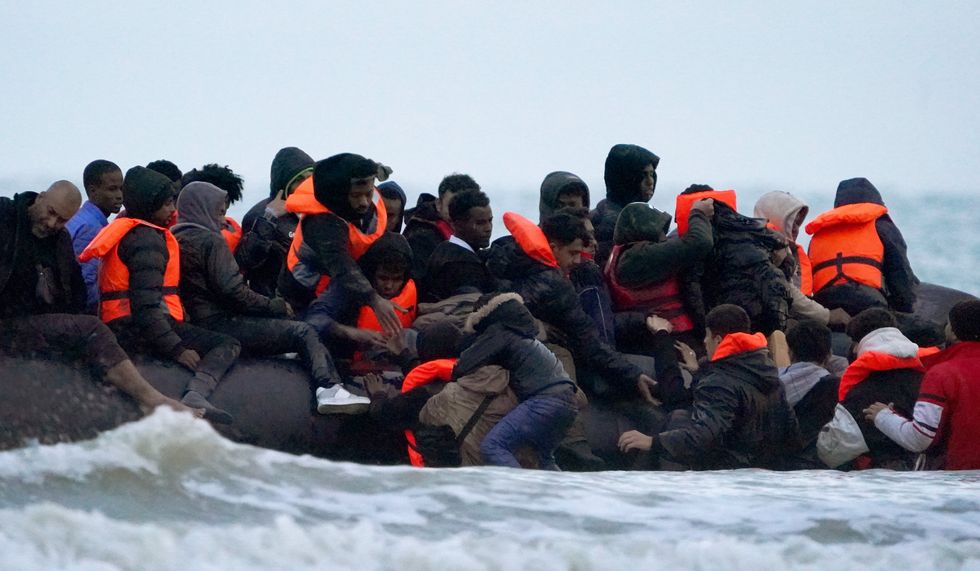
Chris Philp told GB News that the ‘one-in, one-out’ deal is having ‘no deterrent effect whatsoever’
PA
GB News understands that the ad campaign’s focus is to raise awareness among migrants of the consequences of entering the UK illegally by small boat.
The People’s Channel also understands that the campaign’s rollout has been informed by several pieces of information, including migrant routes and common spoken languages.
The FOI revealed just 2,100 leaflets – printed in English, French, Arabic, Tigrinya, Pashto, Farsi, Somali, Vietnamese and Kurdish-Sorani – and 90 physical posters in English and French have been printed.
In addition, 114 printed billboards and 13 digital billboards have been used.

GB News’ FOI revealed just 2,100 leaflets, 90 physical posters, 114 printed billboards, and 13 digital billboards have been used to advertise the Home Secretary’s scheme
PA
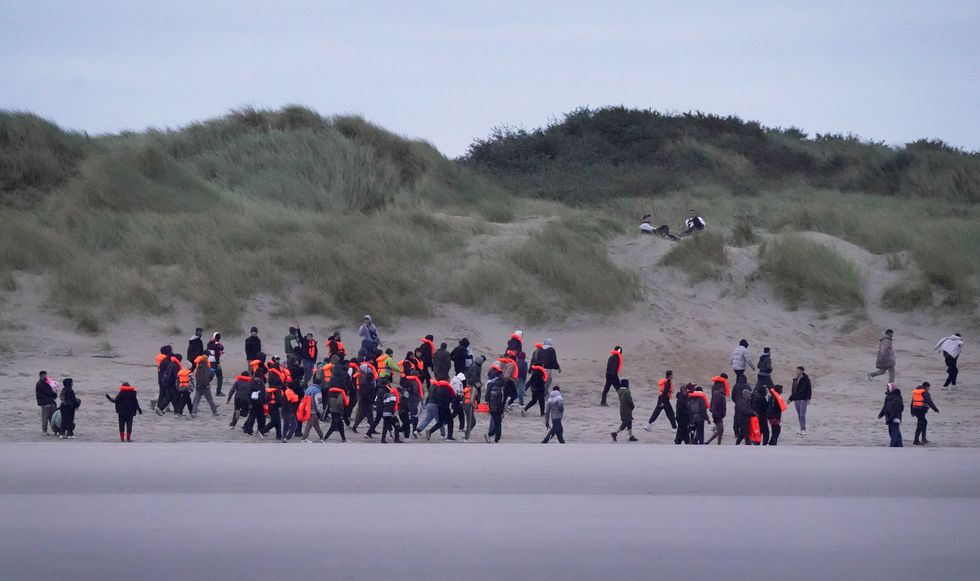
The People’s Channel understands the ad campaign’s rollout has been informed by several pieces of information, including migrant routes and common spoken languages
PA
The comments come just days after one failed asylum seeker who was sent back to France under the ‘one-in, one-out’ deal returned to the UK.
The illegal migrant said France was not safe for him and claims to be a victim of modern slavery in northern France.
“If I had felt that France was safe for me I would never have returned to the UK,” the man told the Guardian.
He added that when “we returned to France we were taken to a shelter in Paris”.
“I didn’t dare to go out because I was afraid for my life. The smugglers are very dangerous.”
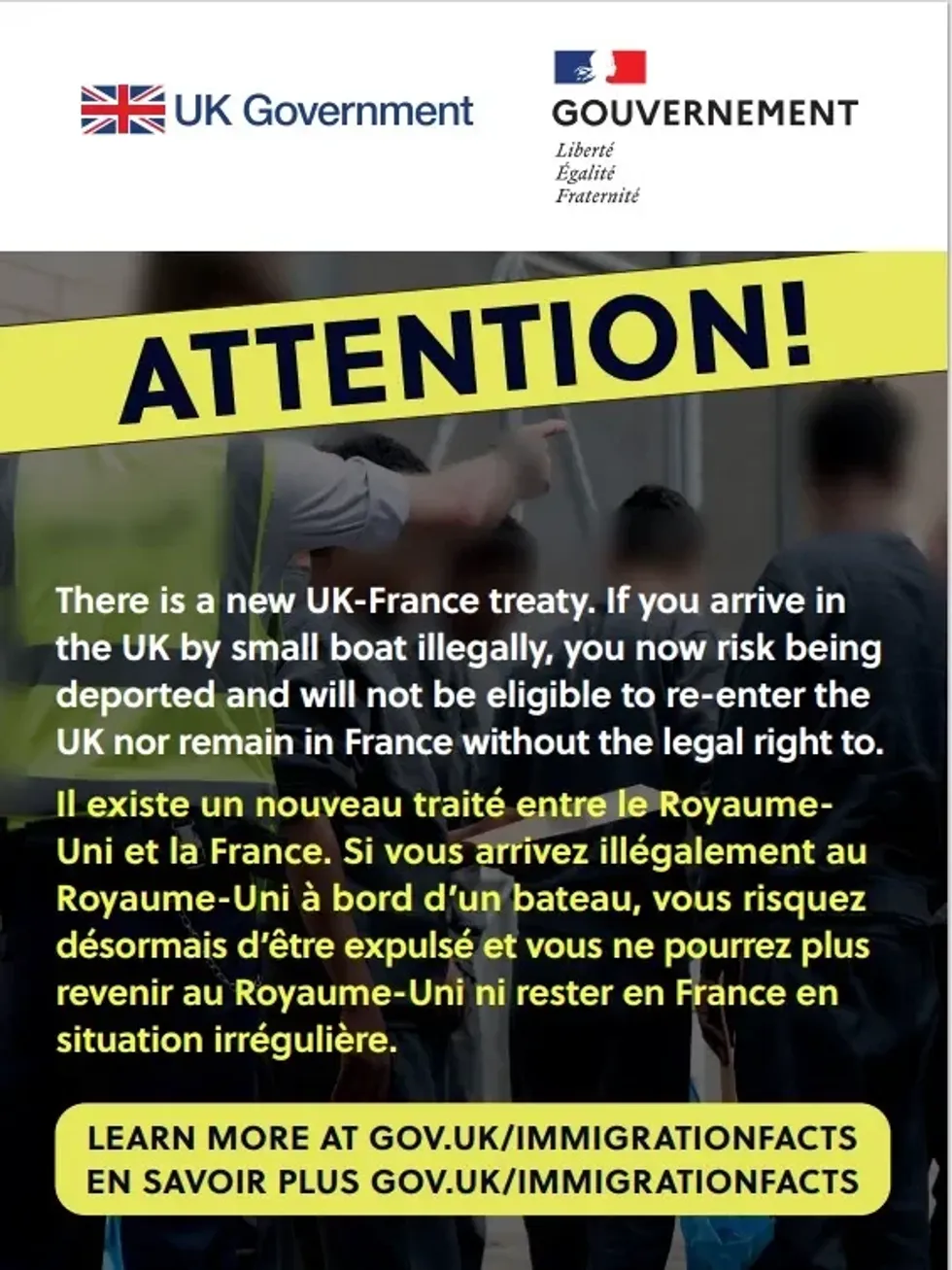
To the date of GB News’ request, digital adverts were shown to migrants in northern France a total of 143,717 times and cost £5,795
UK GOVERNMENT/HOME OFFICE
However, Robert Bates, Research Director at the Centre for Migration Control, points out that views do not mean migrants are engaging with the material.
Mr Bates said: “Conversion rates with these kinds of things are always infinitesimally small.
“Less than 10 per cent actually even stop to really engage with it.
“And then a smaller percentage still actually then take any sort of direction from what is being said to them.”
The Home Office has used digital advertising in the past to warn potential migrants about returns agreements, which is understood to have led to a significant decline in arrivals.
In the last two years, the Home Office spent £430,000 on advertisements in Vietnam and £134,000 in Albania in 2023.
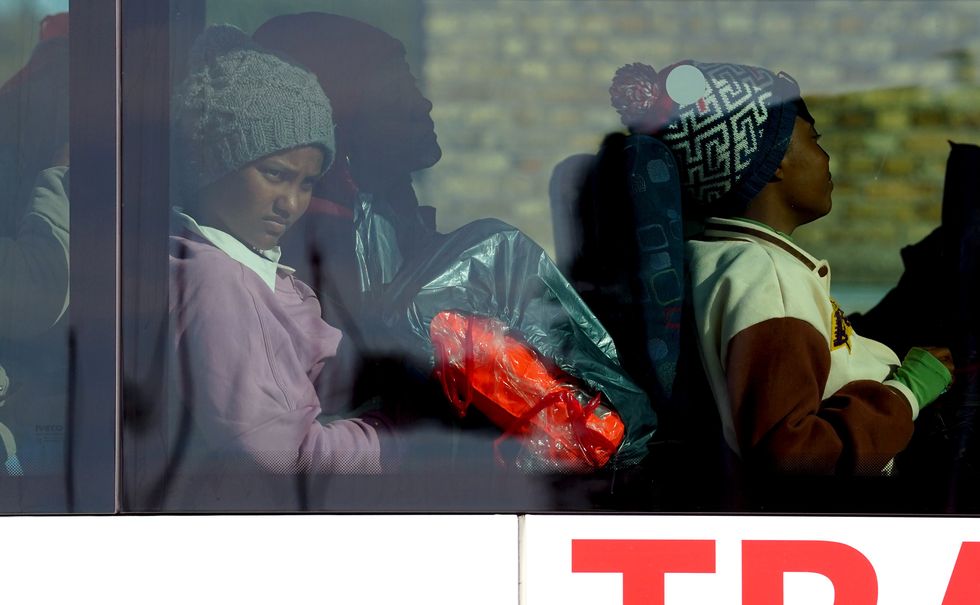
GB News revealed this week that the number of migrants arriving illegally by small boat has passed the total for the whole of last year
PA
On Wednesday, GB News revealed the number of migrants arriving illegally by small boat has passed the total for the whole of last year.
After 220 migrants crossed around midday on October 22, the total number of arrivals so far this year came to 36,956.
The figure is 70 higher than the 36,816 migrants who crossed the Channel illegally during the whole of 2024.
Responding to the data, a Home Office spokesman told GB News: “We will stop at nothing to break the business model of vile people smuggling gangs and to ensure migrants are not deceived by their lies.
“These adverts make clear that anyone entering the UK illegally by small boat risks being detained immediately and returned under the UK-France treaty.”
In a statement on the small boat crisis and the passing of the latest milestone, Home Secretary Shabana Mahmood said: “The previous Government left our borders in crisis, and we are still living with the consequences.
“These figures are shameful – the British people deserve better.“This Government is taking action. We have detained and removed more than 35,000 who were here illegally.
“Our historic deal with the French means those who arrive on small boats are now being sent back.
“But it is clear we must go further and faster – removing more of those here illegally, and stopping migrants from making small boat crossings in the first place.
“And I have been clear: I will do whatever it takes to restore order to our border.”
Labour Spending ‘Paltry’ £15,000 on Campaign to Deter Small Boat Migrants, GB News Reveals
The Labour government has faced fresh criticism after revelations that the Home Office reportedly spent just £15,000 on a campaign designed to discourage migrants from crossing the English Channel in small boats. The disclosure has sparked questions about the effectiveness of Britain’s immigration strategy, particularly as ministers continue to promise tougher action against people-smuggling networks. Opposition politicians have questioned whether such a limited financial commitment can make any meaningful difference to the number of people attempting dangerous journeys to the United Kingdom.
First of all, illegal migration across the English Channel remains one of the most controversial political issues facing Britain. Thousands of migrants have attempted to reach British shores in overcrowded inflatable boats, often relying on criminal organisations to arrange their journeys. These crossings are extremely dangerous because of unpredictable weather, strong currents and heavy maritime traffic.
The small boat crisis has become a major test for Prime Minister Keir Starmer, who promised to tackle irregular migration after Labour entered government in July 2024. His administration abandoned the previous Conservative government’s Rwanda deportation scheme and introduced a new strategy focused on international cooperation, stronger border enforcement and investigations targeting criminal smuggling networks.
However, the reported £15,000 expenditure on a deterrent campaign has raised questions about whether the government is dedicating sufficient resources to communicating its immigration policies. According to GB News, the campaign was designed to warn potential migrants about the consequences of attempting to enter Britain through irregular routes, including the possibility of being returned to France under the ‘one in, one out’ agreement.
Critics have described the amount as surprisingly small when compared with the wider financial costs associated with Britain’s asylum system. They argue that the government spends substantial sums on temporary accommodation, administrative procedures and immigration enforcement, yet appears to have allocated only a relatively modest amount to discouraging dangerous crossings before they happen.
One of the central questions is whether advertising campaigns can genuinely influence the decisions of people considering travelling to Britain. Migrants may receive information from family members, friends, social media networks and people-smuggling organisations. Some may already have made significant financial commitments before deciding to attempt the journey. Consequently, a government advertising campaign may have limited influence unless it is supported by wider enforcement measures.
The government’s ‘one in, one out’ arrangement with France has also attracted considerable attention. Introduced in 2025, the agreement allows certain migrants who arrive irregularly in Britain to be returned to France, while an equivalent number of eligible individuals can enter Britain through an authorised legal route.
Supporters argue that the arrangement sends an important message that irregular entry does not automatically provide the right to remain in Britain. However, opponents question whether the relatively limited number of returns can provide a sufficiently strong deterrent. They believe that the government needs to demonstrate that its policies are producing measurable results rather than relying on political announcements.
Another major concern involves the criminal organisations responsible for organising Channel crossings. These networks exploit vulnerable individuals by promising journeys to Britain in exchange for substantial payments. Migrants are frequently placed aboard overcrowded vessels that may be poorly maintained and unsuitable for navigating the Channel.
Disrupting these criminal operations should therefore be a central priority for British and French authorities. Effective cooperation requires intelligence sharing, financial investigations, surveillance and the prosecution of individuals who organise dangerous crossings. Targeting the organisers may be more effective in the long term than focusing exclusively on the individuals travelling in the boats.
The financial consequences of irregular migration have also generated public concern. The government must provide accommodation and process asylum applications while determining whether individuals have a legal right to remain in Britain. Delays can increase expenditure and create additional pressure on local authorities.
Many taxpayers are particularly concerned about the use of hotels to accommodate asylum seekers. They argue that public money should be managed carefully, especially when families across Britain are experiencing rising housing costs, energy bills and everyday expenses. The government therefore faces pressure to demonstrate that immigration spending is producing practical benefits.
Nevertheless, it is important to recognise that people arriving through irregular routes have different circumstances. Some are escaping war, persecution and serious threats to their lives, while others may be seeking better economic opportunities. Every asylum application must be considered individually, and genuine refugees must receive the protection required under British and international law.
The government also faces a difficult communication challenge. Deterrence campaigns must provide accurate information about immigration rules and the consequences of irregular entry. They should not rely on misleading claims or create confusion about the legal rights of people seeking asylum. Clear information is particularly important because migrants may otherwise become dependent on misinformation provided by criminal smugglers.
Opposition parties have continued to criticise Labour’s approach. Reform UK leader Nigel Farage has repeatedly demanded tougher border controls, while Conservative politicians have questioned whether the government’s strategy is sufficiently effective. Both parties argue that the continued arrival of small boats demonstrates the need for stronger enforcement and faster removal procedures.
However, the government maintains that there is no simple solution to irregular migration. Ministers argue that international cooperation, action against criminal networks and improvements to the asylum system must operate together. They also point out that reducing dangerous crossings requires sustained work rather than a single advertising campaign.
There are several measures that could improve Britain’s approach. Firstly, the government should publish transparent information about the objectives and results of deterrence campaigns. Secondly, cooperation with France should be strengthened to disrupt people-smuggling operations. Thirdly, asylum applications should be processed more efficiently while protecting the rights of genuine refugees. Finally, immigration enforcement should be supported by clear communication and measurable performance targets.
In conclusion, the reported £15,000 expenditure on Labour’s campaign to deter small boat migrants has reignited debate about the government’s priorities and its ability to control irregular migration. Although public information campaigns may form part of a wider strategy, their effectiveness must be assessed through evidence rather than political claims. Britain faces a complicated challenge involving border security, criminal exploitation, public spending and humanitarian responsibilities. Keir Starmer’s government must demonstrate that its immigration policies deliver practical improvements and provide taxpayers with value for money. Ultimately, reducing dangerous Channel crossings will require more than advertising: it will demand effective enforcement, international cooperation and a fair, efficient asylum system.