
Kemi Badenoch has come out swinging at Jess Phillips after four grooming gangs survivors quit the national inquiry panel earlier this week.
Dubbing the Labour MP the “worst Safeguarding Minister ever”, the Conservative leader suggested that the ordeal would be improved by someone “serious” in the job.
Earlier this week, the Birmingham Yardley MP faced numerous calls to resign after four survivors of historic child abuse stepped away from their roles in the Government inquiry.
One of the survivors, Fiona Goddard, quit on Monday, citing “condescending and controlling language used towards survivors”.
Mrs Badenoch called Jess Phillips the “worst Safeguarding Minister ever”
She, alongside three other survivors, expressed concern that the inquiry was being “watered-down” by officials, a claim denied by Sir Keir Starmer and his top officials.
As a result, concerns over political interference and treatment of survivors were raised, leading to calls for Mrs Phillips to resign from her role.
Asking the leader if there might be a concern at all that if the Minister resigns, the whole inquiry could collapse, Mrs Badenoch firmly refuted the claim.
“No, not at all,” Mrs Badenoch responded curtly.
“She is the worst Safeguarding Minister we have ever had. And actually things will be better when we have someone serious doing the job.”
“This has been a national scandal. It needs a lot of work. The fact that four of the victims have lost confidence in the Government is a serious issue.”
The Tory leader added that a judge ought to be leading the national inquiry, adding: “We need people whose hands are clean, who can look at the whole issue from top to bottom.
“Leave no stone unturned and get justice for all the victims and survivors.”
But GB News Political Editor Christopher Hope pointed out that in her role as Women and Equalities Minister from 2022 to 2024, Mrs Badenoch held power to “sort out this issue once and for all”.
Mrs Badenoch responded: “We had an inquiry, and the inquiry had started long before I had become a minister.
She added: “It was ongoing. And that was supposed to be the thing that solved the problem. And when the inquiry reported, we saw that it hadn’t done enough.
“So we set up a task force, a grooming gang task force that found about 500 perpetrators. And since we’ve left Government, I think another 300. So we did do something,” she insisted.
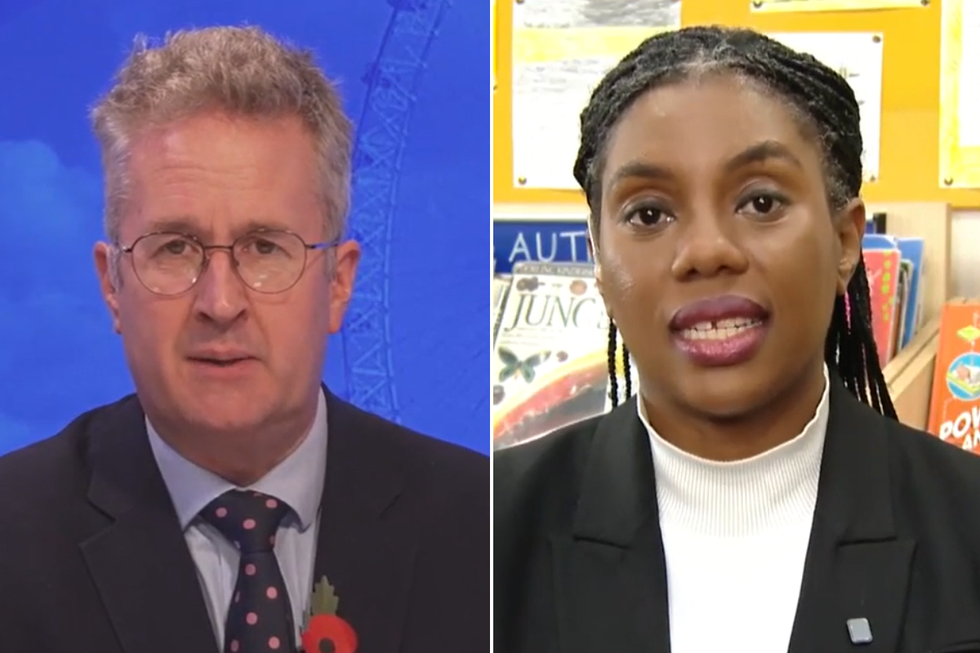
Mrs Badenoch held power to ‘sort out this issue once and for all’ as Equalities Minister from 2022 to 2024
GB NEWS
“And people talking about us not doing anything or trying to distract from the fact that we have a Labour Government that don’t want you to look into an issue which involves many, many Labour councils.”
One of the most prevalent areas where the extent of the impact of grooming gangs has been exposed is Rochdale, in Greater Manchester.
Since the national scandal came to light, however, the Labour Government resisted calls for a national inquiry on three occasions until they gave in.
“They are afraid of what will be found and so they are dragging their feet,” Mrs Badenoch said. “They didn’t even want to have this inquiry. We’re the ones who forced them to do it.”\
Kemi Badenoch Lambasts ‘Worst Ever’ Jess Phillips as Grooming Gang Survivors Quit Inquiry En Masse
The controversy surrounding Britain’s grooming gangs scandal has intensified after Conservative Party leader Kemi Badenoch launched a fierce criticism of Labour safeguarding minister Jess Phillips, following the mass resignation of survivors from the government’s national inquiry. The dramatic developments have raised serious questions about the government’s commitment to delivering justice for victims of organised child sexual exploitation. With survivors expressing deep disappointment and demanding changes to the inquiry, Prime Minister Keir Starmer is facing growing pressure to intervene and restore confidence in a process that was supposed to uncover the truth behind one of Britain’s darkest scandals.
First of all, the grooming gangs scandal remains a deeply disturbing issue in British society. For many years, vulnerable children, particularly teenage girls, were targeted by organised groups of men who manipulated, threatened and sexually exploited them. Numerous victims suffered repeated abuse while the institutions responsible for protecting them failed to recognise the seriousness of their situations or respond effectively to their complaints.
Cases in Rotherham, Rochdale, Telford and other towns exposed serious failures within local authorities, police forces and social services. Some victims reported abuse but were dismissed, blamed or treated as unreliable. In several cases, offenders continued their activities despite repeated warning signs. These failures have left survivors with lasting psychological trauma and a profound loss of trust in public institutions.
The controversy surrounding Jess Phillips has become particularly significant because of her ministerial responsibility for safeguarding and violence against women and girls. Phillips has spent much of her political career campaigning against abuse and supporting victims. However, her handling of disagreements surrounding the national inquiry has attracted intense criticism from some survivors and opposition politicians.
Kemi Badenoch has been particularly outspoken, describing Phillips as the ‘worst ever’ safeguarding minister and arguing that the government has failed to demonstrate sufficient commitment to the victims. The Conservative leader has accused Labour of allowing political considerations to overshadow the need for accountability. She has also insisted that survivors must be listened to rather than challenged or dismissed when they raise concerns about the investigation.
The crisis escalated in October 2025 when several survivor representatives resigned from the inquiry’s victims and survivors liaison panel. Among them were Fiona Goddard and Ellie-Ann Reynolds, who raised concerns about what they described as a toxic and fearful environment. Their departures were followed by further resignations, bringing the number of women leaving the panel to four.
In a joint letter to Home Secretary Shabana Mahmood, the four survivors explained that they had initially joined the process believing their experiences would finally receive proper recognition. However, they said that disagreements about the inquiry’s direction and the government’s response had destroyed their confidence.
One of their main concerns involved the proposed scope of the investigation. The survivors wanted the inquiry to remain specifically focused on grooming gangs and group-based child sexual exploitation. They feared that expanding its remit could weaken attention on the particular crimes and institutional failures they wanted investigated.
Another major disagreement concerned Jess Phillips’s response to their complaints. The survivors accused the minister of publicly dismissing their accounts and undermining their credibility. They argued that such treatment reminded them of the experiences they had suffered when institutions previously failed to believe their allegations.
The women subsequently established several conditions for considering a return to the process. These included Phillips resigning as safeguarding minister, survivors being consulted about the appointment of an inquiry chair, greater freedom to communicate with support networks, maintaining a clear focus on grooming gangs and replacing the existing victim liaison lead with an independent mental health professional. <Cite refs={[“turn474542search0″,”turn474542search4″,”turn474542search1”]}/>
The situation became even more complicated when potential candidates to lead the inquiry withdrew from consideration. Former senior police officer Jim Gamble stepped aside amid concerns about the increasingly difficult appointment process, following the withdrawal of former social worker Annie Hudson. Gamble criticised the atmosphere surrounding the selection process, describing political point-scoring and a lack of trust as significant problems.
These withdrawals raised concerns about how quickly the national inquiry could begin its substantive work. Survivors have already waited many years for comprehensive answers, and further delays risk undermining confidence in the government’s promises. Every additional setback creates more frustration among people who believe that previous investigations have failed to deliver sufficient accountability.
Prime Minister Keir Starmer has defended the government’s approach and insisted that the inquiry will not be watered down. He has emphasised that survivors must remain at the centre of the process and that the investigation must examine the evidence wherever it leads. Home Secretary Shabana Mahmood has also maintained that the government remains committed to establishing a full statutory national inquiry.
However, the disagreement has demonstrated that survivors do not necessarily share the same views about how the investigation should operate. While some have demanded Phillips’s resignation, other survivor representatives have publicly supported her remaining in office. Five survivors, for example, wrote to the Prime Minister expressing confidence in Phillips and arguing that her experience was valuable to the inquiry. <Cite refs={[“turn474542search9″,”turn474542search8”]}/>
This difference of opinion is important because victims should never be treated as a single political group. Every survivor has individual experiences, concerns and expectations. A successful inquiry must create an environment in which different perspectives can be heard without intimidation or political pressure.
Another sensitive issue concerns the ethnicity and backgrounds of offenders involved in particular grooming gang cases. Previous investigations have highlighted failures by authorities to properly understand and record patterns of offending. Survivors and campaigners have argued that investigators must be prepared to examine uncomfortable evidence, including possible racial or religious motivations, without allowing political sensitivities to prevent the truth from emerging.
At the same time, investigations must distinguish between individual criminal networks and wider communities. Criminal responsibility belongs to offenders, not entire ethnic or religious groups. The purpose of the inquiry should be to establish the facts, identify institutional failures and ensure that those responsible are held accountable under the law.
There are several important steps the government must now consider. Firstly, it should establish an independent leadership structure that commands the confidence of survivors. Secondly, the inquiry must have sufficient powers to examine the actions of police forces, local authorities and other public institutions. Thirdly, survivors should receive appropriate psychological and practical support throughout the process. Finally, the investigation’s findings must lead to meaningful reforms rather than simply another collection of recommendations.
In conclusion, Kemi Badenoch’s fierce criticism of Jess Phillips and the mass resignation of grooming gang survivors have exposed a serious crisis of confidence surrounding Britain’s national inquiry. The scandal concerns vulnerable children whose lives were devastated by organised sexual exploitation and institutions that repeatedly failed to protect them. Political disagreements must not become more important than the pursuit of justice. The government must demonstrate transparency, independence and genuine respect for survivors. Ultimately, the success of the inquiry will depend on whether it uncovers the truth, holds responsible individuals and institutions accountable, and ensures that no child suffers similar abuse because authorities fail to act.