

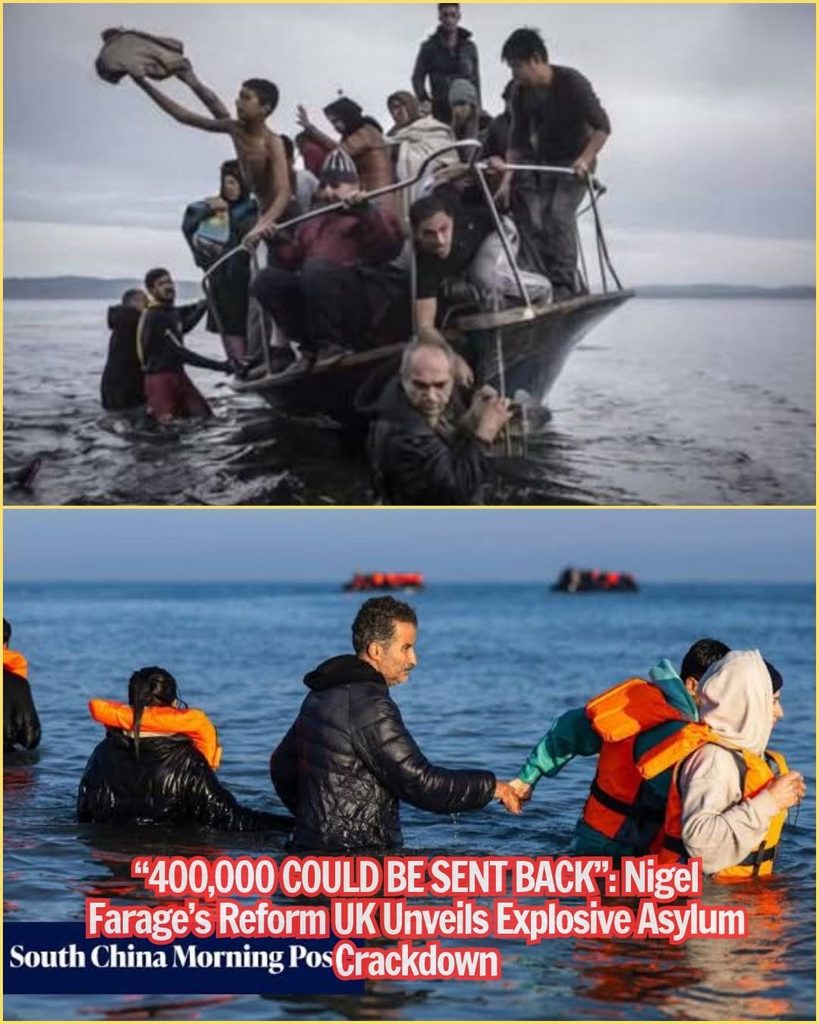
Reform UK pledges to deport 400,000 asylum seekers and ‘reverse the invasion of Britain’
Nigel Farage is set to announce that a Reform UK Government would deport as many as 400,000 asylum seekers who broke into Britain illegally.
The Reform chief is set to commit to an immediate examination of all asylum decisions made over the past five years.
Home Office staff under a Reform Government would be tasked with investigating three key factors under the proposed scheme.

They would also assess whether an individual’s country of origin is now considered safe by Government standards.
Those affected would be allocated an unspecified timeframe to depart voluntarily.
Mr Farage will commit to an immediate examination of all asylum decisions made over the past five years
The overwhelming majority of those seeking asylum reached Britain via small boat, vehicle, or by switching to refugee claims after entering on work, study or tourist visas.
Anyone refusing to leave of their own accord would face detention and forced removal through Reform’s proposed Deportation Command.
The party estimates that over 400,000 people would fall within the scope of this retrospective policy.
Reform UK estimates that over 400,000 migrants would fall within the scope of the policy
Stripping status from those who have already had their asylum granted marks a radical doubling-down on the party’s earlier position of simply blocking illegal arrivals from making claims.

Is the UK border hiding a deadly secret? Nigel Farage just went on GB News with a claim that has Tep
Politicalcommentary platform
Mr Yusuf said: “For years, Tory and Labour governments have presided over an invasion of Britain.
“They have effectively operated an open borders policy. Instead of upholding the law, they have rewarded those who broke it by entering Britain illegally.”
Zia Yusuf accused successive governments of overseeing ‘an invasion of Britain’
He added: “Reform will reverse this. Today we announce that a Reform government will review the previous five years of asylum grants, and anyone who broke into the country illegally or overstayed on another visa will be stripped of their status and deported. We will do what it takes to restore justice in Britain.”
But the party is bracing for backlash, with the proposals expected to draw fury from NGOs and refugee organisations.
In the face of potential court challenges, Reform UK is also pledging to change the law and exit international refugee agreements.
The party has committed to leaving the controversial European Convention on Human Rights (ECHR) and abandoning the 1951 Refugee Convention.
A proposed Illegal Migration (Mass Deportation) Act would legally compel the Home Secretary to expel any migrant lacking residence rights.
“400,000 Could Be Sent Back”: Nigel Farage’s Reform UK Unveils Major Asylum Crackdown Proposal
Nigel Farage and Reform UK have placed immigration enforcement back at the centre of Britain’s political debate with a hard-line asylum agenda reportedly involving the potential removal of as many as 400,000 people. The headline figure has attracted attention because of the scale of the proposed action and the practical, legal and humanitarian questions that any programme of this size would raise.
For Reform UK, tougher immigration controls are a central political priority. Farage has argued that the government must regain control of the country’s borders, accelerate decisions on asylum applications and remove people who have no lawful basis to remain in Britain. Supporters say the existing system has failed to deliver timely decisions and effective enforcement. Critics question whether large-scale removal targets can be achieved without substantial financial costs, legal challenges and difficult negotiations with other countries.
The key issue is what the reported figure of 400,000 actually represents. It should not automatically be interpreted as the number of people who could legally be deported immediately. The figure would need to be checked against Reform UK’s published policy, the categories of people included and the legal status of the individuals concerned.
Farage’s Plan to Change Britain’s Asylum System
Reform UK’s approach reflects its broader argument that immigration rules must be enforced consistently and that decisions to refuse asylum should have practical consequences.
The party has advocated substantially tougher action against irregular migration, including faster removals and changes to the procedures that govern asylum claims. Its supporters argue that prolonged casework and repeated legal proceedings can make enforcement more difficult while increasing the public cost of accommodation and administration.
Under a major crackdown, the government would need to identify the people covered by the policy, establish their identities, assess their individual legal circumstances and determine which removals could lawfully proceed. These steps can be complicated when documentation is missing, identity is disputed or a person’s country of origin will not cooperate with repatriation arrangements.
A credible proposal would therefore need more than a headline number. It would require clear eligibility rules, a timetable, an operational plan and an explanation of how decisions would be reviewed.
Without those details, it is impossible to establish how many people could actually be removed, how quickly the programme could operate or what the total cost would be.
What Does the Figure of 400,000 Mean?
One of the most important questions is whether the figure refers to people whose asylum applications have been refused, individuals with outstanding immigration cases, people who have exhausted their appeal rights or a broader population identified under a proposed policy.
Those categories are not interchangeable.
A person whose asylum application has been refused may still have a lawful appeal or another outstanding legal issue. Someone whose appeal has been dismissed may nevertheless face practical barriers to removal. Other people may have permission to remain under a different immigration route and would not necessarily fall within an asylum-removal policy.
The distinction matters because the government cannot determine the legality of every case simply by applying a single headline figure.
If Reform UK intends to remove a large number of people, it would need to explain which cases qualify, what happens to pending appeals and how authorities would assess claims involving risks of persecution or serious harm.
It would also need to clarify whether the number represents a proposed target, an estimate of people potentially affected or an existing government figure. Until the underlying documentation is available, the claim should be treated as a policy headline rather than a verified count of people ready for removal.
The Legal Obstacles to Mass Removals
Removing people from the United Kingdom involves legal and administrative requirements that cannot be eliminated merely by announcing a tougher policy.
The government must determine whether an individual has a lawful basis to remain, whether relevant appeal rights have been exhausted and whether removal would comply with applicable domestic and international obligations.
For people seeking asylum, an important consideration is whether returning them would expose them to persecution or other serious harm. The assessment depends on the individual’s circumstances and the evidence available, including conditions in the country to which they would be returned.
Reform UK could propose legislative changes designed to accelerate procedures or narrow certain routes of challenge. However, the effects would depend on the precise wording of the legislation, its compatibility with applicable legal obligations and the decisions of the courts.
Legal scrutiny can take time, but it also provides a mechanism for identifying mistakes and ensuring that decisions are made according to established rules.
The challenge for any government is to make the system efficient without treating every applicant as though their circumstances were identical.
The Financial Cost of a Major Crackdown
Reform UK presents tougher enforcement as a response to public concern about the cost of irregular migration and the use of taxpayer-funded accommodation.
The financial argument is significant. Long-running cases can generate expenditure on accommodation, administration, legal proceedings and support services. If cases are resolved more quickly and people without a lawful right to remain are removed, some of those costs could potentially be reduced.
However, a large-scale removal programme would also require substantial resources.
Authorities would need staff to review cases, verify identities, arrange travel and coordinate with foreign governments. Secure transportation, detention where lawfully authorised, legal proceedings and the development of return agreements could add to the overall bill.
The cost-effectiveness of the policy would depend on how many removals could be completed, how long the programme took and whether the savings outweighed the additional expenditure.
A responsible assessment would compare the projected costs of the proposed system with those of the current arrangements. It would also consider whether money spent on enforcement could produce better results if invested in faster initial decisions, more efficient case management and improved cooperation with countries of origin.
Without a detailed financial assessment, neither the promised savings nor the total cost of the proposal can be established reliably.
The Challenge of Securing Cooperation From Other Countries
Even when a person has no lawful basis to remain in Britain, removal may depend on cooperation from another country.
Authorities may need to confirm nationality, obtain travel documents and agree arrangements for receiving the individual. Some governments cooperate readily, while others may delay or refuse assistance in particular cases.
A government pursuing a large-scale programme would therefore need effective diplomatic agreements and reliable administrative channels.
It would also need to consider how removals would be handled when identity documents are unavailable or when a receiving country disputes the individual’s nationality. These issues can delay cases even when the British authorities have completed their own procedures.
A strong enforcement policy must address these practical barriers. Setting a numerical target without demonstrating how the necessary agreements and infrastructure would be secured risks creating expectations that may be difficult to meet.
The Humanitarian Questions
The prospect of large-scale removals raises concerns about the treatment of people who have sought protection in Britain.
Some applicants may have fled conflict, political persecution or other serious dangers. Others may have arrived through irregular routes but have claims that require careful examination. The circumstances differ, and a fair system must be able to distinguish between them.
Supporters of stricter enforcement argue that effective controls are necessary to preserve public confidence in asylum and to discourage dangerous journeys. Critics warn that broad removal programmes could put vulnerable people at risk if cases are processed too quickly or relevant evidence is overlooked.
These concerns are not necessarily incompatible. A system can enforce immigration law while maintaining safeguards for people who qualify for protection.
The crucial question is whether decisions are made accurately, promptly and transparently. Clear procedures can help prevent both prolonged uncertainty and wrongful removal.
How Labour and Other Parties May Respond
A proposal of this scale would place pressure on the government to explain how its own immigration strategy compares with Reform UK’s approach.
Labour would need to address concerns about the speed of asylum decisions, the cost of accommodation, the removal of people with no right to remain and the protection of those entitled to asylum. It would also need to explain which measures are operationally achievable and what resources are required.
The Conservatives would face questions about their own record in government and how their proposals differ from those advanced by Reform UK.
For all parties, the challenge is to move beyond headline figures and explain how policy would work in practice. Voters may reasonably ask how many cases could be resolved, how many removals could lawfully be completed, what the programme would cost and how the government would measure success.
Those questions are particularly important because immigration policy involves competing objectives: border enforcement, public expenditure, legal compliance, humanitarian protection and community confidence.
Could the Proposal Transform Britain’s Immigration Debate?
Reform UK’s plan could intensify the political debate by placing a specific, large number at the centre of its message. But the political significance of that figure will depend on whether the party can explain what it means and how the proposed measures would operate.
A policy announcement is not the same as a law, and a stated target is not the same as a completed removal. The practical outcome would depend on parliamentary decisions, administrative capacity, legal challenges and international cooperation.
The proposal also highlights a wider question about public confidence. Many voters want reassurance that immigration rules are applied consistently and that the state can enforce its decisions. Others are concerned that a strong focus on removals could overshadow the rights of people fleeing genuine danger.
A durable policy would need to address both concerns with evidence and clear procedures.
Conclusion: A Big Number Requires a Detailed Plan
Nigel Farage’s reported proposal involving as many as 400,000 people has brought renewed attention to the future of Britain’s asylum system. Reform UK argues for stronger enforcement and faster removals, while critics question the legal, financial and humanitarian implications of an operation on this scale.
The central question remains what the 400,000 figure actually includes. Without a verified policy document defining the affected population, it cannot be assumed that all those people could be removed immediately or that every case would have the same legal status.
Any government pursuing such a programme would need a clear legal framework, sufficient administrative capacity, cooperation from receiving countries and safeguards for people entitled to protection. It would also need to publish realistic cost estimates and explain how success would be measured.
Britain’s immigration debate is unlikely to be settled by a single announcement. The lasting test will be whether the policies proposed can deliver timely, lawful and effective decisions while protecting taxpayers and meeting the country’s legal responsibilities.