

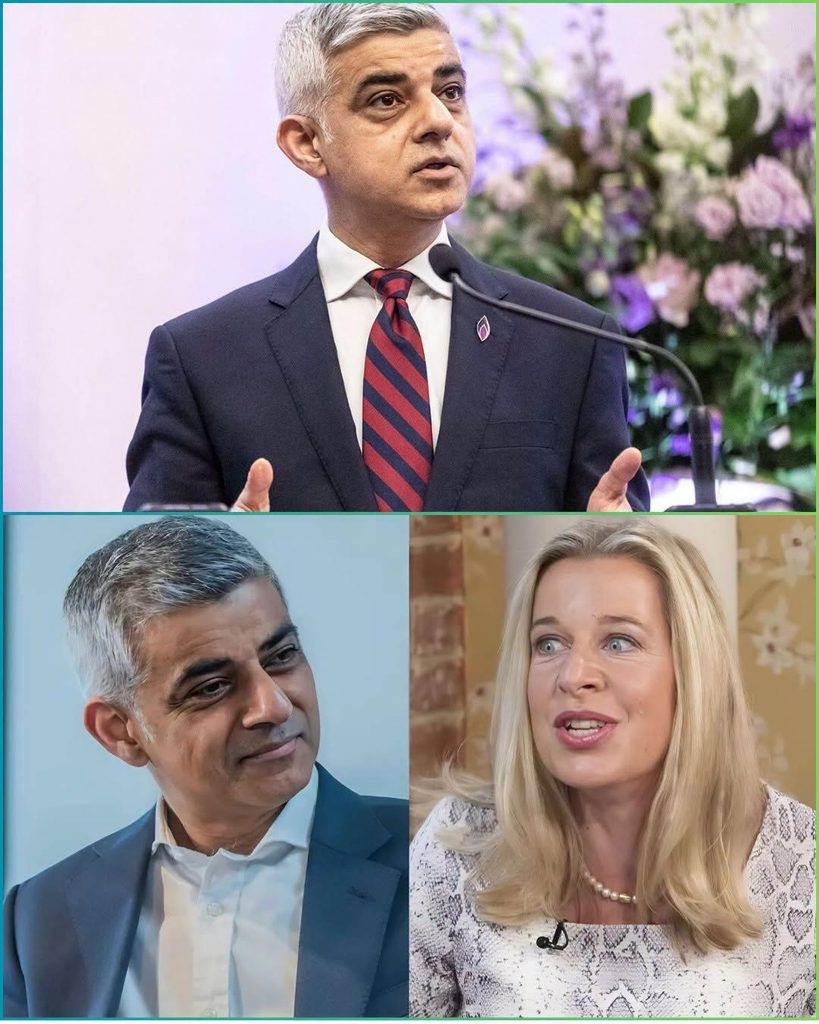
BREAKING NEWS: Katie Hopkins Targets Sadiq Khan in Controversial Speech on National Identity

A newly surfaced speech by British media commentator Katie Hopkins has ignited a wave of controversy across the United Kingdom, drawing sharp reactions from political figures, commentators, and the public alike. Known for her provocative rhetoric, Hopkins delivered remarks that directly criticized London Mayor Sadiq Khan, placing him at the center of a broader argument about national identity, cultural values, and security.
Speaking to an audience in what appeared to be a charged and highly opinionated address, Hopkins framed her argument around what she described as concerns over “radical Islamist influence” in Britain. Her most striking line—“our country would be safer without radical Islamist influence — starting with Sadiq Khan”—quickly spread across social media platforms, triggering both condemnation and support within hours.
The Language That Sparked Backlash
Hopkins’ speech did not unfold in vague generalities. Instead, it was marked by pointed language and a clear identification of political targets. In her remarks, she stated: “This country welcomes people of goodwill. But what we receive in return — from some — is contempt for our culture, values and laws. Perhaps it’s time we started speaking up for the silent majority.”
The inclusion of Sadiq Khan’s name elevated the speech from a general critique into a personal and political flashpoint. As one of the most prominent Muslim politicians in the United Kingdom and a key figure within the Labour Party, Khan has long been a symbol of London’s multicultural identity. By singling him out, Hopkins effectively reframed the discussion into a direct confrontation over representation, religion, and leadership.
Critics were quick to respond, describing the remarks as divisive, inflammatory, and potentially harmful in an already polarized political climate. Many argued that the rhetoric risked deepening social divisions and unfairly targeting Muslim communities.
Supporters Frame It as “Speaking the Unspeakable”
Despite widespread criticism, Hopkins’ speech also found a receptive audience among her supporters. On social media, defenders of the commentator argued that she had articulated concerns that are often left unspoken in mainstream discourse.
Supporters characterized her remarks as a form of “truth-telling,” suggesting that issues surrounding cultural integration, national identity, and security are frequently avoided by political leaders. For this group, Hopkins’ speech represented a challenge to what they perceive as political correctness or institutional silence.

This divide in reaction underscores a broader tension within British society—between those who see such rhetoric as dangerous and exclusionary, and those who interpret it as a necessary, if uncomfortable, conversation.
Sadiq Khan at the Center of a Larger Political Narrative
For Sadiq Khan, the controversy adds to an already complex political landscape. As Mayor of London since 2016, Khan has often been at the intersection of debates over policing, immigration, and social cohesion. His identity as a Muslim leader in a major Western capital has also made him a frequent subject of both praise and criticism.
While Khan has not always responded directly to individual attacks of this nature, his broader political messaging has consistently emphasized inclusivity, diversity, and unity. The renewed focus on his role—triggered by Hopkins’ remarks—once again places him in the spotlight as a symbol of modern Britain’s evolving identity.
The Broader Implications for Public Discourse
The rapid spread of Hopkins’ speech highlights the evolving nature of political in the digital age. What might once have been a localized or limited-address speech now becomes a national—and even global—conversation within hours.
This incident also raises questions about the boundaries of free speech, the responsibilities of public figures, and the role of media platforms in amplifying controversial viewpoints. As reactions continue to unfold, it is clear that the debate extends far beyond the individuals involved.
At its core, the controversy reflects deeper societal questions: Who defines national identity? How should political leaders respond to polarizing rhetoric? And where is the line between open debate and harmful discourse?
In a media environment increasingly shaped by viral moments and emotionally charged narratives, the speech by Katie Hopkins serves as a reminder of how quickly words can reshape public conversation—and how deeply they can divide it.
Katie Hopkins Sparks Controversy With Remarks About Sadiq Khan and Radical Islamist Influence in Britain
Katie Hopkins has sparked renewed debate over immigration, religious extremism and the future of British society after reportedly making provocative remarks about what she describes as the influence of radical Islamism in the United Kingdom. Her comments, which singled out London Mayor Sadiq Khan, have reignited arguments about the boundaries of political criticism, the responsibilities of public figures and the importance of distinguishing extremist ideologies from the wider Muslim community.
The headline attributed to Hopkins — “Our Country Would Be Safer Without Radical Islamist Influence – Starting with Sadiq Khan!” — captures the confrontational tone that has frequently characterised Britain’s arguments over national security, integration and political leadership. However, the precise context of the statement and whether it was delivered exactly as quoted would need independent verification. Its central themes nevertheless reflect long-running disagreements in British public life.
At the heart of the controversy lies a difficult question: how can a country confront religious extremism while protecting democratic freedoms and ensuring that individuals are not judged simply because of their religion or background?
A Controversial Intervention in Britain’s Political Debate
Katie Hopkins is known for outspoken commentary on immigration, cultural identity and public affairs. Her style has repeatedly generated fierce reactions, with supporters describing her as a provocative critic of political orthodoxy and opponents arguing that her rhetoric can deepen social divisions.
Remarks linking national security to a prominent Muslim politician are particularly likely to provoke debate. Sadiq Khan, who became London’s mayor in 2016, is one of the most recognisable political figures in the United Kingdom. As a Labour politician and the capital’s mayor, he has been involved in debates about policing, transport, public safety, housing and London’s wider social challenges.
Khan’s Muslim faith and family background have also made him a recurring subject in arguments about identity and representation. Critics of the mayor have questioned various aspects of his record, including public safety and the direction of London’s policies. Supporters, meanwhile, argue that legitimate scrutiny of his decisions should be separated from claims that associate him with extremism without evidence.
That distinction is central to the latest debate. Criticising a politician’s decisions is a normal part of democratic life. Suggesting that a person represents a dangerous religious influence, however, raises a different question and requires specific evidence rather than assumptions based on faith.
What Does Radical Islamism Mean?
The phrase “radical Islamist influence” can refer to several different concerns, including extremist organisations, attempts to justify violence through religious ideology, the promotion of anti-democratic political systems, or efforts to intimidate people who reject extremist doctrines.
These issues should not be confused with Islam itself. Muslims in Britain hold a wide range of religious, cultural and political views, and the overwhelming majority are not involved in terrorism. Muslim communities include people who work in public services, run businesses, participate in local government, serve in the armed forces and contribute to charities and civic organisations.
Islamist extremism is a legitimate subject for public discussion when the debate focuses on identifiable organisations, statements, actions or security threats. Authorities have a responsibility to investigate credible threats and prevent politically or religiously motivated violence, regardless of the ideology involved.
The challenge arises when criticism moves from specific conduct to broad claims about an entire religious group. Such generalisations can undermine trust, make constructive discussion more difficult and risk treating innocent people as responsible for actions they have neither supported nor committed.
For this reason, political arguments about extremism are strongest when they identify the precise threat, explain the evidence and distinguish between peaceful religious practice and advocacy of violence.
Why Sadiq Khan Remains a Target of Political Criticism
As mayor of one of the world’s most internationally recognised cities, Sadiq Khan occupies a prominent position in Britain’s political landscape. Decisions made by his administration attract attention well beyond London, particularly when they concern crime, transport, economic pressures and the city’s reputation.
His supporters point to the importance of London’s diversity and argue that a mayor should represent residents regardless of their religion, ethnicity or political beliefs. They also maintain that a person’s religious identity should not be treated as evidence of sympathy for extremist organisations.
His critics have a different emphasis. Some question the effectiveness of his policies, argue that the city needs a different approach to public safety or object to his positions on national and international issues. Those criticisms can be examined through policy decisions, official figures and public statements.
However, a claim that the mayor himself represents radical Islamist influence is not established merely by identifying his religious background. Such an allegation would require clear, credible evidence of the conduct being alleged.
A healthy political debate should allow robust examination of Khan’s decisions without treating his faith as proof of wrongdoing. Equally, public office should not shield any politician from evidence-based criticism if specific actions warrant scrutiny.
Public Safety and the Fight Against Extremism
Public safety remains an important concern for communities across Britain. Terrorist attacks, threats of politically motivated violence and the activities of extremist networks have demonstrated the need for effective intelligence, policing and prevention.
The government’s approach to counterterrorism has included efforts to identify individuals at risk of radicalisation, disrupt terrorist activity and protect potential targets. Such work requires cooperation between security agencies, local authorities, schools, community organisations and members of the public.
But effective counterterrorism cannot depend on religious profiling or collective blame. Intelligence-led investigations focus on behaviour, credible threats, evidence and links to extremist activity. A person’s name, religion or family background does not independently demonstrate that they pose a danger.
Community relationships also matter. Residents who trust the authorities may be more willing to report suspicious activity, provide information and help prevent vulnerable individuals from being drawn into violent networks. Broad accusations against entire communities can weaken those relationships.
This creates a difficult balance for politicians and commentators. They must be able to discuss uncomfortable security concerns openly while avoiding language that makes peaceful citizens feel that they are being treated as suspects because of their identity.
Free Speech and the Limits of Political Rhetoric
The controversy also highlights Britain’s continuing argument about freedom of expression. Public figures have considerable latitude to criticise politicians, question government policies and express controversial opinions. Robust debate is an essential part of democratic society, particularly when it concerns national security or the performance of elected officials.
Yet freedom of speech does not make every claim accurate, and public criticism inevitably invites scrutiny. When a commentator makes a serious allegation about a named individual, audiences should ask what evidence supports it and whether the language reflects the available facts.
The same principle applies across the political spectrum. Claims about terrorism, discrimination, corruption or the misuse of public office should be examined consistently, regardless of the political identity of the person making them.
There is also a difference between criticising an ideology and portraying an entire religious population as dangerous. The former can be a legitimate contribution to public debate. The latter risks replacing specific analysis with collective suspicion.
Hopkins’ reported wording, therefore, raises questions not only about the subject of her criticism but also about the standards applied to political commentary. Does the statement identify a demonstrable problem? Does it provide evidence connecting the named politician to that problem? Or does its impact depend primarily on provocative phrasing?
Those questions are relevant to any public figure who uses dramatic language to attract attention.
The Broader Debate Over Integration
Britain’s population has changed considerably over recent decades, and questions about integration, national identity and social cohesion remain politically significant. People disagree over the responsibilities of newcomers, the role of religious institutions, the teaching of shared civic values and the extent to which government should intervene when communities experience tension.
Some argue that integration requires stronger expectations around the English language, respect for democratic institutions and equality before the law. Others emphasise the need to tackle discrimination, improve economic opportunities and ensure that public institutions treat citizens fairly.
These positions are not necessarily incompatible. A society can insist that everyone obeys the law while protecting freedom of religion. It can challenge extremist preaching while recognising the contributions of peaceful Muslim communities. It can also debate immigration policy without assuming that migrants or religious minorities are responsible for every national difficulty.
The most productive discussions focus on measurable outcomes: whether people can access education and employment, whether discrimination is addressed, whether extremist recruitment is disrupted and whether public services protect residents effectively.
Political slogans may attract immediate attention, but they rarely provide the detailed answers required to resolve these challenges.
What Should the Public Expect From Its Leaders?
The argument surrounding Hopkins and Khan also raises expectations about political accountability. Elected officials should explain their decisions, respond to criticism and provide evidence when challenged on important issues. Mayors, ministers and other public figures should be judged on their actions and the responsibilities attached to their offices.
At the same time, commentators who make allegations about public officials should be prepared to substantiate them. Public debate becomes less reliable when accusations are repeated as facts without evidence or when religious identity is used as a substitute for examining a person’s record.
Voters have an important role in this process. Rather than accepting a dramatic headline at face value, they can examine the original statement, its context, the evidence offered and any response from the person criticised. They can also distinguish between an allegation, an established fact and an opinion.
This approach does not require people to avoid strong views. It simply ensures that strong views are evaluated according to the quality of the arguments behind them.
A Debate That Is Unlikely to Disappear
Britain’s arguments over extremism, immigration, religious identity and public safety are unlikely to disappear soon. International conflicts, domestic security incidents and disputes over cultural integration can quickly bring these issues back to the centre of political discussion.
For Hopkins, the reported remarks fit the confrontational style associated with her public commentary. For Khan, they place renewed attention on the distinction between criticism of his political record and allegations tied to his religious identity.
Ultimately, the most important question is not whether a provocative statement generates attention. It is whether the discussion that follows helps the public understand a genuine problem and identify practical solutions.
Britain has a clear interest in preventing terrorism, confronting violent extremism and protecting everyone who lives in the country. It also has an interest in maintaining equal treatment under the law, preserving freedom of religion and ensuring that public accusations are supported by evidence.
Those goals need not contradict one another. A country can oppose radical ideologies without condemning an entire faith, and it can scrutinise a mayor without assuming that his religion determines his politics.
As the controversy develops, the public debate should remain focused on verifiable statements, specific policies and demonstrable conduct. That is the standard that allows difficult questions about national security and social cohesion to be addressed without sacrificing fairness, accuracy or democratic accountability.