

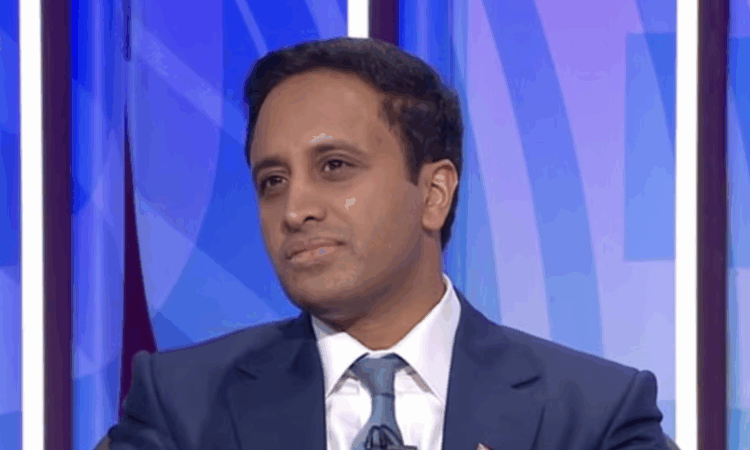
Zia Yusuf will make his fourth Question Time appearance of 2026 this evening when he appears on the panel of the BBC current affairs programme.
The public has never elected Yusuf to a position in politics. The public have never even had the chance to vote for the multi-millionaire and former Conservative Party member.
But ever since he became Reform’s chairman in July 2024 and then head of policy (with a two-day resignation sandwiched in the middle), Yusuf has become one of Reform’s main mouthpieces.
Through press conferences and controversial social media posts, Yusuf is arguably Reform’s most incendiary voice – something that the BBC seem to quite like.
This evening (19 October), the businessman will make yet another appearance on Question Time, when he appears on the programme alongside Labour’s Emma Reynolds, the Tories’ James Cartlidge, the Lib Dems’ Daisy Cooper and former Downing Street director of communications Alastair Campbell.
This will be the fourth time in 2026 that Yusuf has appeared on the show, the most of anyone. It will also be his ninth Question Time appearance since the 2024 general election, which is another record.
Reacting on social media, people have been left baffled as to why Yusuf is making another appearance on the programme.
Yusuf’s previous appearances on Question Time haven’t tended to go brilliantly for him.
In the past, he’s been booed for his response to an audience member, skewered by Green Party leader Zack Polanski, been stunned into silence by reminders about the ‘skeletons in Reform’s closet’ and repeatedly refused to answer questions,
Let’s see how he fares on tonight’s show…
Unelected Millionaire Zia Yusuf to Make Yet Another Question Time Appearance
Zia Yusuf, one of Reform UK’s most prominent political figures, is preparing to make yet another appearance on BBC Question Time, prompting fresh criticism over the broadcaster’s repeated decision to give him a platform despite the fact that he has never been elected to public office.
The Reform UK spokesperson will appear on the popular political discussion programme for the fourth time in 2026, making him one of the most frequent guests since the 2024 general election.
The announcement has sparked considerable debate, particularly among viewers who question why an unelected political businessman is receiving so much airtime while elected representatives from other parties appear less frequently.
Yusuf has become an increasingly familiar face on British television since joining Reform UK. As the party’s chairman and later head of policy, he has developed a reputation for making provocative statements, defending controversial positions and engaging in heated exchanges with political opponents.
However, his repeated appearances on Question Time have raised questions about the BBC’s approach to political representation and whether the programme is providing a sufficiently balanced range of voices.
Zia Yusuf Becomes a Regular Face on Question Time
According to The London Economic, Yusuf’s latest appearance will be his ninth since the 2024 general election and his fourth during 2026 alone.
This makes him one of the most frequently invited political figures on the programme during that period.
The businessman, who previously belonged to the Conservative Party, has never been elected as an MP. Nevertheless, he has become one of Reform’s most important public representatives.
His growing television presence reflects the party’s increasing influence in British politics and Nigel Farage’s strategy of placing trusted allies in prominent media positions.
For Reform, Yusuf provides an opportunity to defend the party’s policies without requiring Farage himself to appear in every political discussion.
However, critics argue that the frequency of his appearances is difficult to justify when the party has elected MPs who could also represent its supporters.
The issue has become particularly controversial because Reform has only a relatively small parliamentary group compared with Labour and the Conservatives.
Viewers Question the BBC’s Decision
The announcement quickly generated criticism on social media, with several viewers questioning why the BBC continues to invite Yusuf so frequently.
One viewer expressed frustration at seeing the same unelected Reform representative repeatedly appearing on the programme.
Others questioned why elected Reform MPs, including Lee Anderson and Sarah Pochin, had not received comparable opportunities to participate in the discussion.
Some viewers also suggested that the BBC should provide greater representation to other political movements, particularly the Green Party, which has experienced growing support.
The criticism reflects a wider debate about political balance on Question Time.
The programme is designed to bring together politicians, commentators and public figures to discuss the most important issues facing Britain.
However, the selection of panellists can influence which political voices receive national exposure.
Critics argue that repeatedly inviting the same individual risks creating an imbalance, particularly when other parties have representatives who could offer different perspectives.
Supporters of Yusuf, however, may argue that he is an effective spokesperson for Reform and that his appearances reflect the party’s growing political significance.
Why Is an Unelected Businessman Representing Reform?
One of the central questions surrounding Yusuf’s appearances is his political position within Reform UK.
Although he has never been elected to Parliament, he has become one of the party’s most influential figures.
He previously served as Reform’s chairman before moving into a senior policy role.
His responsibilities have included defending the party’s political positions, communicating its proposals and responding to criticism from journalists and political opponents.
His influence demonstrates that modern political parties do not rely exclusively on elected representatives to communicate their messages.
Senior advisers, strategists and party officials can play equally important roles in shaping political debate.
Nevertheless, critics believe there should be greater transparency about the distinction between elected politicians and unelected party officials.
When Yusuf appears on national television, he is effectively representing a political organisation whose supporters have elected MPs to Parliament.
However, he does not personally hold an electoral mandate.
This distinction has become a major part of the criticism surrounding his repeated appearances.
Previous Question Time Appearances Have Been Controversial
Yusuf’s previous appearances have not always gone smoothly.
On several occasions, he has faced difficult questions from audience members and heated disagreements with other panellists.
His exchanges with Green Party leader Zack Polanski have attracted attention, while other appearances have seen him challenged over Reform’s policies and the party’s wider political record.
Critics have also accused him of avoiding direct answers when questioned about controversial issues.
These moments have helped establish his reputation as one of the more confrontational figures in Reform’s media operation.
However, repeated television appearances also provide him with an opportunity to become more familiar to voters.
For a party seeking to expand its influence, regular exposure on major political programmes can be valuable.
The challenge for Yusuf is ensuring that these appearances strengthen Reform’s public image rather than generate further controversy.
Reform’s Growing Influence Raises Questions About Political Representation
The debate surrounding Yusuf also reflects broader concerns about how British broadcasters select political representatives.
Question Time has traditionally invited senior politicians from the main political parties alongside journalists, academics, campaigners and other public figures.
The objective is to provide a range of opinions and encourage meaningful discussion.
However, the growing influence of Reform has changed the political landscape.
The party has attracted considerable attention through its positions on immigration, taxation, national sovereignty and Britain’s relationship with Europe.
Its increasing presence in national political debate means that its representatives are likely to receive more invitations to television programmes.
Nevertheless, critics argue that the BBC should avoid allowing one party’s unelected spokesperson to dominate the discussion.
They believe elected MPs should receive more opportunities to explain their policies and answer questions directly from the public.
The issue is not simply about Yusuf personally.
It concerns the wider responsibility of public-service broadcasting to provide fair and meaningful political representation.
BBC Faces Questions Over Its Editorial Choices
The controversy has also renewed debate about the BBC’s editorial decisions.
As a publicly funded broadcaster, the BBC is expected to maintain appropriate standards of impartiality and ensure that its political coverage is fair.
This does not necessarily mean that every political party must receive exactly the same number of appearances.
Editorial decisions can legitimately take account of political relevance, current events, public interest and the availability of suitable representatives.
However, repeated invitations to the same individual can create the impression that certain voices are receiving preferential treatment.
The BBC must therefore consider whether its selection of guests provides viewers with a genuinely broad range of political perspectives.
For some critics, Yusuf’s frequent appearances represent an example of Reform receiving substantial media exposure despite its relatively small parliamentary representation.
Others argue that his role as a senior party official makes him a legitimate guest, regardless of whether he has personally been elected.
Ultimately, the broadcaster must balance political relevance with the need to maintain public confidence in its impartiality.
Zia Yusuf’s Position Within Nigel Farage’s Political Movement
Yusuf’s growing prominence also raises questions about the internal structure of Reform UK.
Nigel Farage remains the party’s most recognisable figure, but he increasingly relies on senior colleagues to communicate its policies and defend its political decisions.
Yusuf has become one of those key figures.
His background in business and his outspoken approach have helped him develop a distinctive public profile.
However, his influence also means that controversies involving him can quickly become controversies for Reform as a whole.
Every appearance on Question Time provides an opportunity to promote the party’s agenda, but it also exposes him to difficult questions about its policies, candidates and leadership.
For Farage, having a loyal and recognisable spokesperson is politically useful.
But the repeated focus on Yusuf may also invite criticism that Reform is relying too heavily on unelected personalities rather than allowing its elected MPs to take centre stage.
Conclusion: Why Does Question Time Keep Inviting Zia Yusuf?
Zia Yusuf’s latest Question Time appearance has reignited a debate about political representation, media impartiality and the influence of unelected figures within British politics.
His ninth appearance since the 2024 general election highlights how frequently the BBC has selected him to represent Reform UK.
For critics, the repeated invitations raise legitimate questions about why an unelected businessman receives so much television exposure while other elected politicians struggle to secure comparable opportunities.
For Reform supporters, however, Yusuf is an important party representative who has every right to defend its policies in national political discussions.
The BBC faces the challenge of ensuring that its programme provides a balanced range of political perspectives without unnecessarily excluding prominent representatives of emerging political movements.
Ultimately, the controversy highlights a wider issue in modern British democracy: political influence is no longer limited to elected politicians.
Party officials, wealthy businessmen, advisers and media personalities can all shape national political debate.
But when public-service broadcasters repeatedly give certain individuals a national platform, viewers are entitled to question the editorial decisions behind those choices.
And with Zia Yusuf preparing to make yet another appearance, that debate is unlikely to disappear anytime soon.