
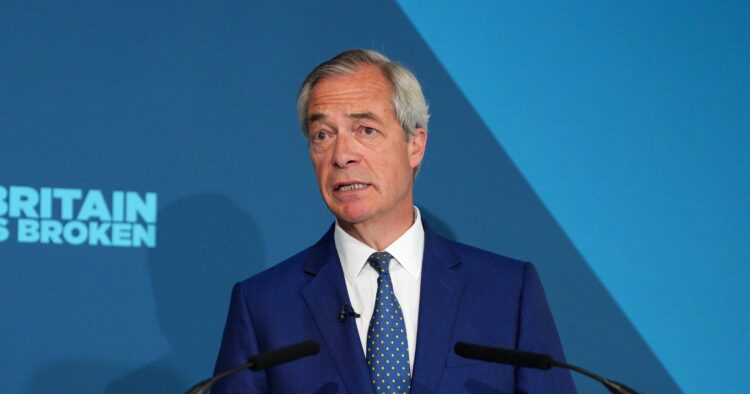
Nigel Farage’s reason for not being in the chamber for the Budget has been rubbished by MPs from all sides of the house, whilst reports have cast doubt on his claims as well.
On Wednesday, chancellor John Healey delivered his first budget to the House of Commons.
But one person who wasn’t present in the chamber for one of the biggest days in the parliamentary calendar was the man aiming to become the country’s next prime minister, Nigel Farage.
It was reported by the Telegraph that Farage didn’t attend the budget because his prayer card – a green slip of paper that reserves a backbencher’s seat on the Commons benches – had been removed.
Later in the day, Farage was asked about the story and why he wasn’t present for the budget.
The Reform UK leader claimed that he feared he would have been involved in a “physical altercation” if he had tried to take his seat in the Commons.
Farage claimed that his prayer card being removed meant that he was “heading towards another physical altercation.”
“Sometimes, it’s better to avoid conflict,” he added.
But since then, his story has been completely debunked by both MPs and the House of Commons.
In response to the claims, a House of Commons spokesperson told the London Economic that Farage’s prayer card had in fact been moved because it did not display the correct date stamp.
The spokesperson said: “There are clear and long-established arrangements for Members to reserve their own seats in the Chamber using Prayer Cards displaying a valid date stamp. Today, a Prayer Card placed on a seat did not display a valid date stamp and was removed in line with the usual Chamber protocol.”
They added that Farage had not attended Prayers and did not approach House staff regarding a seat reservation.
Along with this, several MPs have rubbished Farage’s excuses for not attending the budget.
Shadow foreign secretary Tom Tugendhat said his claims about a “physical altercation” were not “credible,” writing in a post on X: “If you want to be in the chamber for the budget, there’s always a way.”
Labour MP Daniel Francis asked why Farage’s Reform colleagues had not made space for their leader, claiming they had done exactly this for Danny Kruger.
Meanwhile, Lib Dem Caroline Voaden said Farage’s “physical altercation” allegation was “not true.”
And deputy Tory leader Alex Burghart simply labelled it “complete guff.”
Plenty of other MPs from all sides of the house cast doubt on Farage’s excuses, with some describing them as “total bull,” “fake news,” and the “weakest excused I’ve ever heard.”
Farage’s Excuse for Not Attending Budget Has Been Completely Debunked
Nigel Farage has come under intense criticism after his explanation for missing the Chancellor’s Budget speech was challenged by the House of Commons and MPs from across the political spectrum. The Reform UK leader claimed he stayed away because he feared becoming involved in another physical altercation after discovering that his parliamentary prayer card had been removed. However, new details about what actually happened have seriously undermined his explanation.
The controversy erupted on Wednesday, 28 October 2026, when Chancellor John Healey delivered his first Budget in the House of Commons. While MPs gathered in the chamber to hear the government’s major financial announcements, Farage was noticeably absent.
His absence was particularly surprising given his position as leader of Reform UK and his repeated claims that his party represents a serious alternative government.
When journalists questioned him about the decision, Farage offered an extraordinary explanation. He suggested that a dispute over his reserved parliamentary seat had created the possibility of another physical confrontation.
However, the explanation quickly attracted criticism, with several politicians questioning why he could not simply have found another seat.
Farage Claims He Wanted to Avoid a Physical Altercation
Speaking after the Budget, Farage explained that his parliamentary prayer card had been removed, meaning he no longer had a reserved seat in the chamber.
Prayer cards are used by MPs to reserve seats during important parliamentary occasions. According to Farage, the removal of his card created an uncomfortable situation that could potentially have escalated into another confrontation.
He referred to an earlier incident during the State Opening of Parliament in May, claiming that he had become involved in a physical altercation with another MP.
Farage insisted that he had not wanted to repeat that experience.
He said: “At the State Opening of Parliament, I got involved, I didn’t want to, but I got involved in a physical altercation with an MP in the chamber.”
He continued by explaining that the removal of his prayer card had made him concerned about another confrontation.
“Sometimes it’s better to avoid conflict,” he added.
Farage also joked that he was a “very quiet, shy, modest kind of person” and suggested that staying away from the chamber was the sensible option.
However, his comments immediately raised questions about whether the situation was genuinely serious enough to justify missing one of Parliament’s most important annual events.
House of Commons Delivers a Different Explanation
The biggest problem for Farage emerged when the House of Commons provided its own explanation for why his prayer card had been removed.
A parliamentary spokesperson confirmed that the card did not display the required valid date stamp.
The spokesperson explained that MPs must follow clear and long-established arrangements when reserving seats in the chamber.
Any prayer card without the appropriate date stamp can be removed in accordance with normal parliamentary procedures.
More importantly, the spokesperson also confirmed that Farage had not attended Prayers and had not approached House staff about reserving a seat.
This information significantly weakened the suggestion that parliamentary staff had unfairly removed his reservation.
Instead, the explanation indicated that the card had been removed because it did not satisfy the established requirements.
The distinction is important. Farage presented the removal of his prayer card as a reason he believed another confrontation might occur. However, the Commons explanation suggested that the situation resulted from ordinary parliamentary procedures rather than deliberate action against him.
The question now is why Farage did not simply follow the usual arrangements or ask his colleagues to help him find a seat.
MPs From Different Parties Challenge Farage
Farage’s explanation was quickly criticised by MPs from across the political spectrum.
Shadow Foreign Secretary Tom Tugendhat was among those who questioned the credibility of the Reform leader’s claims.
Writing on social media, he said: “Sorry, this isn’t credible. If you want to be in the chamber for the Budget, there’s always a way.”
His comments reflected a wider criticism that Farage could have attended the Budget if he had genuinely wanted to participate.
Labour MP Daniel Francis also questioned why Reform colleagues had not made room for their leader.
He pointed out that MPs had previously rearranged themselves to accommodate Danny Kruger, suggesting that similar arrangements could easily have been made for Farage.
Conservative MP Alicia Kearns was even more dismissive.
She argued that there were plenty of available seats and questioned when Farage had actually entered the chamber looking for one.
Deputy Conservative leader Alex Burghart also criticised the explanation, describing it as “complete guff”.
Meanwhile, Liberal Democrat MP Josh Babarinde said he had been near the front of the queue for a prayer card early that morning and had not seen Farage there.
The criticism was particularly damaging because it came from politicians belonging to different parties, rather than being limited to Reform’s traditional opponents.
Caroline Voaden Disputes Farage’s Account of the Earlier Incident
The controversy became even more complicated when Liberal Democrat MP Caroline Voaden responded to Farage’s reference to the earlier physical confrontation.
Voaden accused the Reform leader of giving a misleading account of what happened during the State Opening of Parliament.
She claimed that Farage had physically pushed her during the incident and said that she was still waiting for an apology.
In a message directed at Farage, she wrote: “And we both know that’s not true Nigel don’t we?”
She also referred to an apology she said he had been required to write.
The allegations added another dimension to the dispute because Farage had used the earlier confrontation as part of his justification for missing the Budget.
Voaden’s response suggested that she strongly disputed his version of events.
However, it is important to distinguish between the competing accounts. Her allegations and Farage’s explanation are separate claims, and the disagreement should not be treated as a settled finding about what happened.
Nevertheless, the exchange has created further political difficulties for the Reform leader.
Why Couldn’t Reform Simply Save Him a Seat?
Another question repeatedly raised by MPs was why Farage’s own colleagues had not helped him secure a place in the chamber.
Reform has several MPs who were present during the Budget proceedings.
Daniel Francis specifically questioned why the party had been able to make arrangements for Danny Kruger but apparently could not do the same for its own leader.
Other politicians also pointed out that MPs regularly adjust their seating arrangements during important parliamentary events.
This makes Farage’s decision to stay away particularly difficult to explain.
If the issue was simply the removal of a prayer card, critics argue that there were several straightforward alternatives.
He could have contacted parliamentary staff, attended Prayers and followed the normal reservation process, or asked another Reform MP to make room.
Instead, he chose to remain outside the chamber.
For a politician who frequently criticises the government and demands accountability from other public figures, the decision has raised questions about his own approach to parliamentary responsibilities.
Farage Attempts to Turn Attention Back to the Budget
Despite the controversy, Farage attempted to redirect attention towards the Chancellor’s economic proposals.
He watched the Budget alongside Reform’s team of economists before holding a press conference with Treasury spokesperson Robert Jenrick.
Farage argued that studying the Chancellor’s announcements in his office had been more useful than listening to the speech in Parliament.
He also criticised the government’s economic strategy, describing the Budget as an attempt to appeal to voters ahead of a future general election.
Jenrick was similarly critical, arguing that the government had failed to provide meaningful solutions to Britain’s economic problems.
However, the discussion was repeatedly overshadowed by questions about Farage’s absence.
Rather than dominating the political conversation with Reform’s economic policies, the party leader found himself defending his own decision not to attend Parliament.
A Growing Problem for Reform’s Political Credibility
The incident comes during a difficult period for Reform UK.
The party has faced declining polling figures, criticism over its internal organisation and several controversies involving campaign activities.
Farage has repeatedly insisted that Reform is ready to challenge the established political parties and potentially form the next government.
However, critics argue that leading a national political organisation requires discipline, accountability and the ability to deal with difficult situations.
Missing an important Budget debate because of a dispute over a parliamentary seat is unlikely to strengthen the party’s image.
The incident also raises questions about whether Reform’s leadership is sufficiently prepared for the everyday responsibilities of parliamentary politics.
Farage may remain an influential political figure, but voters will increasingly expect him to demonstrate that he can operate effectively within the institutions he hopes to lead.
Conclusion: Farage’s Explanation Faces Serious Questions
Nigel Farage’s explanation for missing the Budget has been seriously undermined by the House of Commons’ clarification and criticism from MPs across the political spectrum.
His claim that the removal of his prayer card created the possibility of another physical altercation has been challenged by evidence that the card lacked a valid date stamp and was removed under normal parliamentary procedures.
Questions have also been raised about why Farage did not attend Prayers, contact parliamentary staff or ask his Reform colleagues to arrange another seat.
Meanwhile, Caroline Voaden’s allegations about their earlier confrontation have added further controversy to the situation.
Although Farage insists that avoiding conflict was the sensible decision, his critics argue that the explanation does not stand up to scrutiny.
For the Reform leader, the immediate challenge is to move beyond the controversy and restore attention to his party’s political programme.
However, the episode has created an uncomfortable question that will be difficult to ignore: if Farage wants to become Britain’s Prime Minister, why was he unable to find a way to attend one of Parliament’s most important political events?