
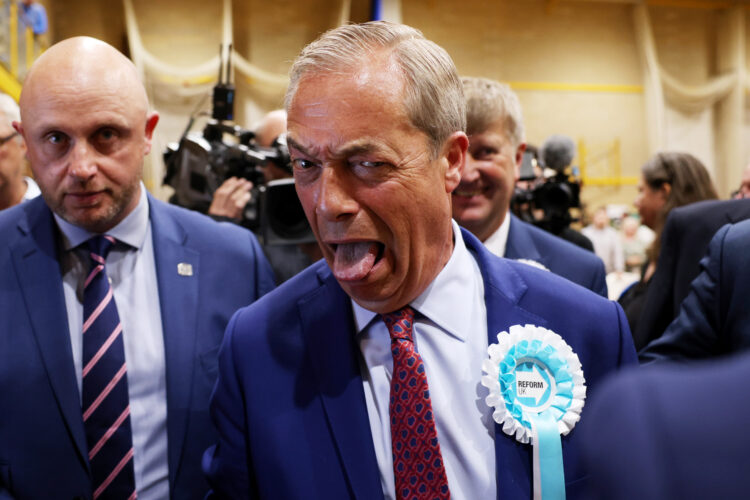
Support for Reform UK is continuing to plummet across the polls, with the party falling further behind Labour and now under threat from the Tories.
Reform have been in polling free fall for weeks now, having given up their lead to Labour a while ago now.
But, after the Conservative Party conference, it seems Reform are now leaking support to Kemi Badenoch.
The week started with Reform dropping into third place in YouGov’s latest polling after a three point bounce for the Tories combined with a one-point drop for the party full of ex-Tories.
Now, two more polls released have reported a similar trend.
The latest data from Freshwater Strategy recorded a two point drop in support for Reform along with a two point jump for the Tories.
Labour increased their polling lead to six points in this poll thanks to a three point increase. This is the latest significant lead in a poll for Labour as it is beyond the three-point margin of error.
But whilst Reform just about held onto second in this poll, this wasn’t the case in More in Common’s latest polling.
Here, the party haemorrhaged three points, as the Tories experienced a three point increase. This put the Conservatives three points clear of Reform in second place, and four points behind Labour in first.
The remarkable fall in support for Reform is laid bare when compared to their polling with More in Common this time last year.
In October 2025, Reform were at their high point of 33%, a huge 13 points clear of Labour.
But after a year of chaos, controversy and recruiting failed Tories, it seems Reform will do well to get more seats than the Conservatives at the next election, let alone win it.
Andy Burnham Rules Out Deal with Greens over ‘Zionism Is Racism’ Motion
The relationship between the Labour Party and the Green Party in Britain has come under renewed pressure after Labour leader and Prime Minister Andy Burnham ruled out any political partnership with the Greens while they maintain their controversial policy describing Zionism as racism. His announcement, made during Prime Minister’s Questions on 14 October 2026, has intensified a political dispute over antisemitism, freedom of political expression, Palestinian rights and the future of cooperation between progressive parties.
The controversy began after members of the Green Party of England and Wales approved a motion at their annual conference in Brighton on 4 October 2026. The motion declared Zionism to be a form of racism and supported the establishment of a single democratic Palestinian state across historic Palestine. The decision has divided the Green Party itself and prompted criticism from Jewish organisations, Labour politicians and several senior Green representatives.
The motion passed by 1,022 votes to 813, revealing a significant disagreement within the Green Party over its position on Israel and Palestine. Although the result represented a majority among those voting, the supporters of the motion accounted for approximately 0.4 per cent of the party’s total membership. This distinction is important because the decision has become a major political controversy despite being supported by a relatively small proportion of the Green Party’s overall membership.
The policy defines Zionism as a political ideology supporting the creation and continuation of an ethnonationalist Jewish state in historic Palestine. It argues that such a political project involves the exclusion or domination of non-Jewish communities. The motion also rejects the traditional two-state solution and supports the creation of a single Palestinian state with equal rights for everyone.
However, Zionism has different meanings for different people. Historically, it developed as a movement supporting Jewish national self-determination and the establishment of a Jewish homeland. For many Jewish people, it represents the right of the Jewish people to national security and self-determination in their ancestral homeland. Others interpret Zionism through the historical experience of Palestinian displacement and the political consequences of establishing Israel in 1948.
This distinction lies at the centre of the current controversy. Critics of the Green Party’s motion argue that describing Zionism as racism risks treating Jewish national identity and aspirations for self-determination as inherently discriminatory. They also fear that the policy could create an environment in which Jewish members who identify as Zionists face exclusion or discrimination.
Supporters of the motion, meanwhile, argue that opposing Zionism is not equivalent to hostility towards Jewish people. They maintain that criticism of the political structure of Israel, its treatment of Palestinians and its policies in the occupied territories should be protected as legitimate political expression. According to this perspective, supporting Palestinian equality and opposing the occupation should not automatically be interpreted as antisemitism.
The disagreement demonstrates why the distinction between criticism of Israeli government policies, opposition to Zionism and hostility towards Jewish people requires careful consideration. These concepts are related in political debates but are not necessarily identical. Criticism of a government or political ideology does not automatically constitute racism, although language and political positions can become discriminatory when they target people because of their Jewish identity or beliefs.
Andy Burnham has taken a firm position on the issue. Speaking in the House of Commons, he condemned the Green Party’s motion in unequivocal terms, describing it as wrong and antisemitic. He stated that Labour would not enter into a political partnership with a party maintaining such a position.
His announcement represented a change in tone from his earlier comments. During a visit to Berlin on 8 October, Burnham had called on the Green Party leadership to reverse the policy but had avoided explicitly ruling out future cooperation. By the time of Prime Minister’s Questions six days later, he had adopted a much clearer position.
Burnham’s decision also has a wider political dimension. Britain operates under a parliamentary system in which parties may need to negotiate with one another when no single party secures an overall majority. Cooperation between political parties can take several forms, including formal coalitions, confidence-and-supply agreements and informal arrangements on specific legislation.
By ruling out an agreement with the Greens while the motion remains party policy, Burnham has potentially restricted Labour’s options in a future hung parliament. His position indicates that certain principles concerning antisemitism and equality will take priority over possible political cooperation.
The Green Party leader, Zack Polanski, strongly rejected Burnham’s criticism. Polanski, who is Jewish, accused the Prime Minister of confusing criticism of Israel with antisemitism. He argued that the Labour leader’s comments were dangerous and irresponsible because they risked discouraging legitimate criticism of Israeli government policies.
Polanski also pointed to the suffering of Palestinians in Gaza and criticised the British government’s approach to the conflict. He maintained that support for Palestinian human rights should not be treated as incompatible with the protection of Jewish communities.
However, Polanski’s position has not eliminated disagreements within his own party. Four of the Green Party’s five MPs opposed the motion or publicly expressed concerns about its wording. Former Green Party leader Caroline Lucas also criticised the decision, describing it as divisive and potentially damaging to the party’s ability to promote peace and justice.
These disagreements reveal that the controversy is not simply a conflict between Labour and the Greens. It also reflects a wider debate within the Green Party about how to balance support for Palestinian rights with the protection of Jewish members and the party’s commitment to opposing all forms of racism.
The issue has subsequently extended into local government. On 15 October, Labour Party chair Bridget Phillipson instructed Labour groups involved in local power-sharing arrangements with Green councillors to review their agreements. She said local Green groups would be expected to make clear that they rejected the controversial motion and call on their national leadership to reconsider the policy.
The Equality and Human Rights Commission also contacted the Green Party to request further information about the motion and assess its practical implications. The commission indicated that it had received complaints concerning potential discrimination against Jewish people who hold Zionist beliefs. However, this request for information should not be interpreted as a formal finding that the party has broken equality legislation.
On 2 November 2026, Labour announced that it would end cooperation with Green groups in 11 English councils where the local parties had declined to condemn the motion. These included Sheffield, Stafford, Warwick, Lewes, Havant and West Suffolk. Cooperation would continue in six other council arrangements where local Green groups had rejected the policy. The developments demonstrate that the disagreement has moved beyond national political rhetoric and begun affecting the practical administration of local authorities. <Cite refs={[“turn118539search2″,”turn118539search4”]}/>
The Green Party criticised Labour’s decision, arguing that ending local partnerships could damage public services and undermine successful cooperation between councillors. Green representatives maintained that national political disagreements should not automatically destroy working relationships that benefit local communities.
There are legitimate questions about both approaches. Labour argues that political partnerships require shared commitments to equality and opposition to antisemitism. The Greens argue that local representatives should retain the ability to cooperate on practical issues even when national parties disagree. Ultimately, the debate concerns how political principles should influence cooperation across different levels of government.
The controversy also has implications for Britain’s wider political landscape. The Green Party has sought to attract voters who are dissatisfied with the traditional political establishment, particularly younger voters and those concerned about environmental protection, economic inequality and international human rights. Its position on Gaza and Palestine has also become an increasingly prominent part of its political identity.
Labour, meanwhile, faces the challenge of maintaining relationships with voters who support Palestinian rights while demonstrating that it takes antisemitism seriously. These objectives are not necessarily incompatible, but political leaders must communicate their positions carefully and consistently.
The wider international context makes the disagreement even more sensitive. The war in Gaza has generated intense debate across Britain, with demonstrations, parliamentary discussions and public campaigns calling for different approaches to the conflict. Many people are concerned about civilian casualties, humanitarian conditions and the future of Palestinian statehood. At the same time, Jewish communities have expressed concerns about antisemitism and their security amid heightened political tensions.
Political parties therefore face the difficult task of addressing international human rights issues without contributing to hostility against religious or ethnic communities at home.
Ultimately, Andy Burnham’s decision to rule out a deal with the Greens represents a significant moment in British politics. It demonstrates that disagreements over Israel, Palestine, Zionism and antisemitism can have direct consequences for domestic political relationships and local government cooperation.
For Labour, the priority is to maintain its stated commitment to tackling antisemitism while continuing to engage with legitimate criticism of Israeli government policies. For the Greens, the challenge is to explain how their anti-Zionist position can coexist with their commitment to equality and the protection of Jewish members. For both parties, the question is how to maintain political cooperation without compromising principles that they consider fundamental.
The central issue is not whether criticism of Israel should be permitted. In a democratic society, governments and political ideologies must remain open to criticism. Equally, Jewish people must be able to express their religious, cultural and political identities without facing discrimination. Supporting Palestinian rights and protecting Jewish communities should not be treated as mutually exclusive objectives.
The future relationship between Labour and the Green Party will therefore depend partly on whether they can resolve their disagreement over the motion and establish a shared understanding of equality, political expression and antisemitism. Until then, Burnham’s refusal to cooperate with the Greens signals that this dispute will remain an important dividing line in British politics.