
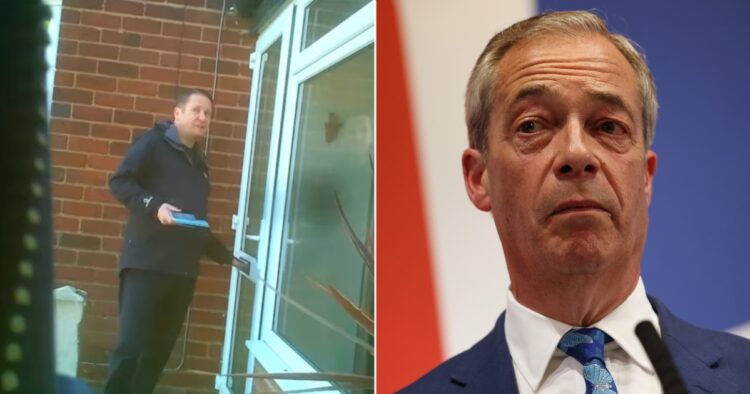
An undercover investigation from ITV has captured shocking footage of Reform UK councillors using racist, violent and sexist language.
The film, Undercover: A Year in Reform, included secretly recorded footage of a Reform councillor and deputy mayor of Solihull labelling Asian homeowners “parasites”.
Later in the film, the councillor, Alan Feeney, says the local area has been “infested” with Asian families, and that he believes “no more than one per cent of the British population can be non-white.”
Reform has said “there is no room for racism” in the party following the first broadcast of the ITV News investigation.
A Reform spokesman said: “Where members, activists and councillors have clearly behaved inappropriately, investigations have commenced” and that in some cases there had been suspensions.”
ITV News says it had reporters undercover with Reform UK candidates and councillors across England and Wales running up to the elections in May and four by-election campaigns this year and last.
ITV’s filming involved eight figures in Reform.
Feeney’s comments were captured as he was campaigning to retain his seat on the council, having defected from the Conservative Party in 2025.
Other shocking comments recorded in the investigation include Reform candidates making sexually aggressive comments about a female Reform candidate, joking about how to stop a mosque being built in the local area, and saying of Asian people “drag them out of their homes, stick them on planes and f*** them off to Pakistan.”
You can watch the footage below.
Reform says the people filmed by ITV are all under investigation, and have already either resigned or been suspended.
ITV reports that Feeney has “mutually agreed” to resign from Reform UK, citing “personal reasons,” and would be continuing as an independent councillor.
The footage has been roundly condemned by Reform’s political opponents, with Labour describing the investigation as “truly sickening.”
They said Nigel Farage “can’t shrug these latest revelations off as being a few bad apples.”
The Conservatives said the investigation was proof Farage has “failed” to make Reform ready for government, whilst Lib Dem leader Sir Ed Davey said the footage was “chilling.”
A Green Party spokesman said: “Vilifying migrants and Muslims is Reform’s main focus, and these racist comments reflect party policy.”
Even Talk’s Julia Hartley-Brewer could not ignore the investigation, describing it as “clear and blatant racism.”
ITV Investigation Uncovers ‘Clear and Blatant’ Racism at the Heart of Reform UK
A major undercover investigation by ITV News has raised serious questions about the political culture of Reform UK, the party led by Nigel Farage, after secretly recorded footage revealed several councillors and candidates making racist, Islamophobic, sexist and violent remarks. The investigation, conducted over approximately a year, has exposed disturbing conversations involving individuals holding elected positions or seeking political office under the Reform UK banner. The revelations have triggered widespread criticism from political opponents and renewed debate about whether the party has adequately addressed extremism and discrimination within its ranks.
The investigation, broadcast under the title Undercover: A Year in Reform, examined Reform UK’s activities across England and Wales. ITV journalists went undercover during local election campaigns and parliamentary by-elections in 2025 and 2026. Their findings suggest that the problem may extend beyond isolated inappropriate comments, raising questions about candidate selection, internal accountability and the political standards maintained by the party.
One of the most shocking examples involved Alan Feeney, a Reform councillor and former deputy mayor of Solihull. During conversations with undercover reporters, he described Asian families in his local area as an “infestation” and called Asian homeowners “parasites”. He also suggested that the proportion of non-white people in Britain should be limited to approximately one per cent. These statements demonstrate explicit hostility towards people because of their ethnic backgrounds.
In another recorded conversation, Feeney reportedly advocated removing Asian residents from their homes and deporting them to Pakistan. He also admitted that he deliberately avoided campaigning at homes with Asian names, claiming that such residents would not vote for Reform. His approach was described by him as “Alan’s racist canvassing”.
These revelations are particularly concerning because elected councillors are expected to represent everyone in their communities, regardless of ethnicity, religion or political opinion. Their responsibilities extend beyond supporting the interests of people who voted for them. They must also respect the rights and dignity of residents who hold different backgrounds and beliefs.
The investigation also exposed comments made by Dean Miller, a Reform councillor in Bromley, south London. He claimed that white British residents had been effectively driven out of parts of London because of growing Nigerian communities. In another conversation, he referred to black children using an offensive animal-related description. Miller also made controversial claims about King Charles III and Islam.
Elsewhere, reporters recorded sexually aggressive comments directed towards female political candidates. One Reform councillor made an explicit remark about sexually assaulting a woman if given the opportunity to hug her. Such language has raised concerns about misogyny and the treatment of women within the party’s political organisation.
The investigation also revealed statements suggesting that some Reform representatives were prepared to conceal controversial political positions until after winning elections. During a conversation with an undercover reporter, one councillor reportedly said that candidates should present themselves as acceptable to mainstream voters before implementing policies that might generate opposition.
Other comments suggested that certain political ideas should not be announced publicly because doing so could damage the party’s electoral prospects. These recordings have intensified concerns about transparency and whether voters are receiving an accurate picture of the political intentions of some candidates.
Perhaps most seriously, one Reform councillor in Greater Manchester discussed deporting legal migrants as well as people without permission to remain in Britain. He also suggested training young men in military-style tactics to remove migrants from their homes. Such statements have generated alarm because they appear to go beyond conventional debates about immigration policy and enter the territory of intimidation and potential violence.
Reform UK has responded by stating that it has begun investigations into individuals identified in the documentary. The party said that inappropriate behaviour would not be tolerated and that some individuals had already been suspended or had resigned. It also maintained that its candidate-vetting procedures had been improved, although it acknowledged that people who did not share the party’s values could occasionally pass through the screening process.
However, the controversy raises an important question: how effective are these procedures if individuals with such extreme views are able to obtain positions representing the party?
Nigel Farage has previously promised to remove extremists and bigots from Reform UK. In 2024, he said that the party needed to become more professional and improve its candidate-selection system. The latest investigation therefore places considerable pressure on his leadership because the footage challenges the effectiveness of those promises.
Farage has argued that political parties cannot predict everything their members might say in private conversations. He has also suggested that undercover reporters may have encouraged individuals to make controversial statements. Nevertheless, critics argue that the issue cannot be dismissed as a problem involving a few isolated individuals, particularly when the investigation has identified multiple councillors and candidates across different regions.
Another important aspect of the investigation concerns the behaviour of senior party officials. In a separate report, ITV revealed that Reform officials had discussed how difficult it was to defend some of the individuals facing accusations of racism. One senior communications figure reportedly described a candidate as racist and argued that he should be removed from the party, while Farage was shown resisting immediate dismissal.
The footage raises questions about whether political considerations have sometimes taken priority over the party’s stated commitment to eliminating discrimination. It also suggests that internal disagreements may exist over how seriously allegations against prominent candidates should be treated.
The political reaction has been widespread. Labour representatives described the revelations as deeply disturbing and argued that Farage must accept responsibility for the standards within his organisation. The Conservative Party also questioned Reform’s claim that it was ready to govern, while Liberal Democrat leader Ed Davey expressed concern about the impact of such language on communities affected by racism.
The Green Party also criticised the investigation’s findings, arguing that hostility towards migrants and Muslims had become an important feature of Reform’s political messaging. Reform, however, has rejected accusations that the party itself promotes racism and insists that discriminatory behaviour is incompatible with its values.
It is important to distinguish between criticism of immigration policies and discrimination against individuals. Political parties have every right to debate border controls, asylum procedures, national security and immigration levels. These are legitimate subjects of democratic discussion. However, attacking entire ethnic or religious communities, advocating collective punishment or using threatening language against civilians is fundamentally different from discussing government policy.
The investigation has also highlighted the responsibilities of Britain’s equality institutions. On 2 November 2026, the Equality and Human Rights Commission (EHRC) confirmed that it had written to Reform UK following complaints relating to the ITV documentary. The commission requested information about the party’s actions to comply with the Equality Act 2010, including its responsibilities concerning racial, religious and sexual discrimination.
This development indicates that the controversy may have consequences beyond political criticism. Although the commission’s request does not establish that Reform UK has committed a legal violation, it demonstrates the importance of examining whether political organisations have appropriate procedures to prevent discrimination and harassment.
For Reform UK, the timing of the controversy is particularly significant. The party has sought to present itself as a credible alternative to Britain’s established political organisations. Its electoral appeal has been built around immigration control, dissatisfaction with Westminster, economic concerns and promises to challenge the political establishment.
However, a party aspiring to national government must demonstrate that it can represent the entire population. Britain’s communities are ethnically, culturally and religiously diverse. Political representatives must therefore understand that their responsibilities extend to all citizens, including those who disagree with their policies or do not share their backgrounds.
The investigation does not establish that every Reform member or voter holds racist or sexist views. Many people support political parties for a variety of reasons, and individual misconduct should not automatically be attributed to every supporter. Nevertheless, the repeated appearance of discriminatory statements among elected representatives raises legitimate questions about organisational culture and accountability.
Ultimately, the ITV investigation represents a serious challenge for Nigel Farage and Reform UK. The party must demonstrate that its commitment to opposing racism and extremism is reflected in its candidate-selection procedures, disciplinary decisions and everyday political conduct. Simply describing the individuals involved as isolated exceptions will not resolve concerns unless meaningful action follows.
A healthy democracy depends on political competition, freedom of expression and the ability to challenge government policies. However, these principles must exist alongside respect for equality, human dignity and the rights of all communities. Political representatives should be judged not only by their election promises but also by the standards they demonstrate in public life.
The central question is therefore not whether Reform UK can attract voters through promises of political change. It is whether the party can establish the standards of responsibility, transparency and equality expected of an organisation seeking to govern a diverse country. The findings of ITV’s investigation have made that question more urgent than ever.