
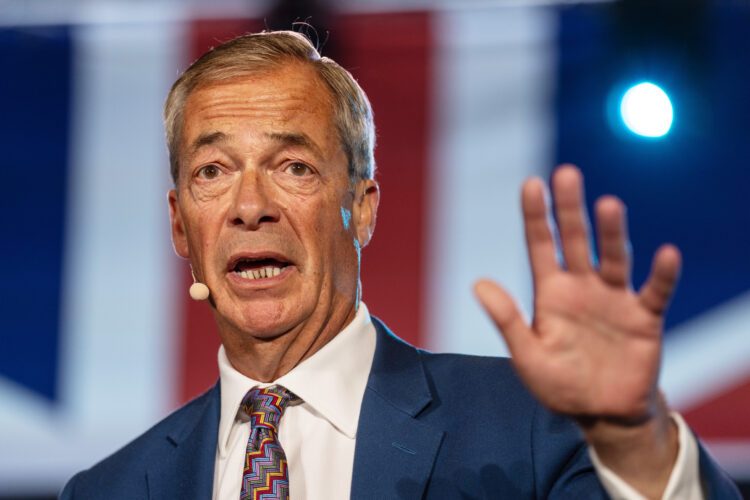
Nigel Farage has seemed to claim that racist and sexist comments made by Reform candidates are because they did not go to Oxford University or Eton College.
Reform have once again become embroiled in scandal this week ahead after an undercover investigation from ITV News recorded councillors for the party making racist and sexually aggressive comments.
Undercover: A Year in Reform included secretly recorded footage of a Reform councillor and deputy mayor of Solihull labelling Asian homeowners “parasites”.
Later in the film, the councillor, Alan Feeney, says the local area has been “infested” with Asian families, and that he believes “no more than one per cent of the British population can be non-white.”
Other footage shows candidates making sexually aggressive comments about a female Reform candidate, joking about how to stop a mosque being built in the local area, and saying of Asian people “drag them out of their homes, stick them on planes and f*** them off to Pakistan.”
On Thursday, new clips released by ITV showed Farage talking with senior party officials about accusations of racism against party figures.
Officials are captured telling Farage they have to “defend the indefensible” and explain to him how he would be “protecting” a Reform candidate from being sacked.
Addressing accusations of racism from Reform candidate Chris Parry against Labour MP David Lammy, Farage pushes back against calls from head of communications Chris Sumner to sack Parry.
Now, Farage has attacked ITV over the investigation in which he claims similar comments are made by people “everywhere” and suggested it was just a case of people not being able to “express themselves in very carefully formulate language.”
In a statement to the Express, Farage claimed ITV had captured him “telling a joke” and that the broadcaster would “not do this to any other party.”
After spouting usual claims about establishment bias against Reform, Farage said: “Maybe what I’ll do is I’ll commission a team of undercover [operatives], and we’ll go and speak to a thousand Tory councillors. You’ll find worse. You’ll find it everywhere. You’ll find it in the pub tonight.
“It’s people, and particularly if they’re provoking conversation. Not everyone’s been to Oxford University. Not everyone’s been to Eton. Not everyone expresses themselves in very carefully formulated language”
The suggestion that a lack of high-end education is the reason for Reform candidates making horrific racist and sexist comments has been mocked by many.
Farage Puts Reform Racism and Sexism Down to ‘Not Going to Oxford or Eton’
The controversy surrounding Nigel Farage and Reform UK has intensified after the party leader appeared to suggest that racist and sexist remarks made by some of his party members could be explained by their lack of elite educational backgrounds. His comments followed an undercover investigation by ITV News, which exposed several Reform councillors and candidates making offensive statements about ethnic minorities, Muslims and women.
The remarks have raised wider questions about political accountability, the culture within Reform UK and Farage’s approach to dealing with discrimination. They have also sparked debate about whether the party is attempting to portray itself as a representative of ordinary working-class people while failing to establish clear standards of behaviour among its elected representatives.
The controversy emerged after ITV broadcast an investigative documentary entitled Undercover: A Year in Reform, which examined the behaviour and political culture of individuals associated with Reform UK. The investigation involved undercover reporters who spent approximately a year observing party members, councillors and candidates across England and Wales. The footage revealed several disturbing conversations involving racist, Islamophobic and misogynistic language.
One of the most controversial individuals featured in the investigation was Alan Feeney, a Reform councillor and deputy mayor of Solihull. He was filmed describing Asian homeowners as “parasites” and claiming that the local area had been “infested” with Asian families. In another conversation, he reportedly suggested that no more than one per cent of the British population should be non-white. Such comments have attracted criticism because they target entire communities on the basis of their ethnic backgrounds rather than addressing specific political or social issues.
Other footage revealed similarly controversial attitudes. Some Reform figures made offensive remarks about Muslims, questioned whether Muslims could genuinely be British and discussed the possibility of placing asylum seekers in concentration camps. The investigation also exposed sexually aggressive comments directed towards women. These revelations have increased concerns about the standards of conduct expected from individuals representing a political party seeking national power. <Cite refs={[“turn407508search1″,”turn407508search2”]}/>
Farage’s response has become a major part of the controversy. Rather than simply acknowledging the seriousness of the allegations and focusing on the party’s disciplinary procedures, he suggested that some individuals might lack the ability to express themselves in carefully formulated language because they had not received an elite education.
In a statement to the Daily Express, Farage said: “Not everyone has been to Oxford University. Not everyone has been to Eton. Not everyone expresses themselves in very carefully formulated language.” He also argued that similar comments could be found in ordinary social environments, including pubs, and suggested that an undercover investigation involving councillors from other political parties might uncover equally offensive statements.
His remarks have attracted criticism because they appear to connect inappropriate behaviour with educational background and social class. Oxford University and Eton College are widely associated with Britain’s political establishment and elite education. By referring to these institutions, Farage appeared to contrast the language of ordinary people with the more polished communication expected from traditionally educated politicians.
However, the central issue is not whether someone has attended an elite university or an expensive private school. Racism and sexism are matters of attitudes and behaviour, not educational qualifications. People from every social and economic background can understand that insulting ethnic minorities, promoting discrimination or making sexually aggressive comments is unacceptable. A lack of formal education cannot reasonably be used as a general explanation for such behaviour.
The response has also created an uncomfortable question for Farage himself. Reform UK has built much of its political identity around representing people who feel ignored by Britain’s established political institutions. Its message frequently emphasises ordinary citizens, dissatisfaction with Westminster and opposition to what it describes as an out-of-touch political establishment. Yet suggesting that offensive language is somehow understandable because people have not attended Oxford or Eton risks reinforcing negative stereotypes about working-class communities.
Many working-class people have no connection with elite educational institutions but strongly reject racism, sexism and religious intolerance. It is therefore important not to confuse criticism of individual politicians with criticism of an entire social class.
Another important aspect of the controversy concerns Reform UK’s candidate selection and vetting procedures. Farage has defended the party’s screening system, arguing that it is difficult to predict what candidates might say in private conversations after drinking alcohol or being encouraged by others. He has maintained that the party cannot completely control individuals’ future behaviour.
There is some validity to the argument that political parties cannot anticipate every statement made by their members. Vetting procedures can examine candidates’ previous records, public statements and social media activity, but they cannot guarantee that misconduct will never occur. Nevertheless, political organisations have a responsibility to establish clear standards, investigate credible allegations and take appropriate action when unacceptable behaviour becomes known.
The controversy is particularly significant because Farage previously promised to remove bigots and extremists from his party. Consequently, critics argue that the latest investigation raises questions about whether Reform has fulfilled its commitment to maintaining appropriate standards among its representatives.
ITV’s investigation also captured conversations involving senior Reform officials discussing how to respond to accusations against party figures. In one recording, officials reportedly discussed the difficulty of defending a candidate and used the expression “defend the indefensible”. The footage has raised questions about whether party leaders are sufficiently concerned with investigating misconduct or are primarily focused on protecting Reform’s public image. <Cite refs={[“turn407508search4″,”turn407508search8”]}/>
The political reaction has been considerable. Government representatives have called on Reform to take stronger action against individuals making discriminatory comments. Health minister Chris McDonald argued that the party clearly had a problem with racism and misogyny and needed to address it. Other political figures have also criticised the apparent failure to establish sufficiently effective safeguards.
Meanwhile, Reform representatives have defended the party, arguing that the actions of individual councillors should not automatically be attributed to the entire organisation. Laila Cunningham, a Reform politician, argued that a political party should not be judged entirely by the behaviour of a small number of individuals. This position highlights an important distinction between individual responsibility and organisational accountability. While individual members should be held responsible for their own statements, party leadership must also demonstrate that its policies and disciplinary systems are effective.
The issue has also attracted attention from Britain’s Equality and Human Rights Commission (EHRC). On 2 November 2026, the commission wrote to Reform UK seeking information about its compliance with the Equality Act following the allegations raised by the ITV investigation. The commission said it had received complaints and would assess the information before deciding whether further action was necessary. Reform stated that it was confident it had complied with the law and maintained that racism had no place in the party. <Cite refs={[“turn407508search6”]}/>
This development demonstrates that the controversy is no longer simply a political disagreement between competing parties. It also raises questions about the legal responsibilities of political organisations to prevent discrimination and harassment. Political parties are entitled to express controversial opinions about immigration, national identity and public policy. However, freedom of political expression does not remove their responsibility to comply with equality legislation.
Furthermore, the controversy could affect Reform UK’s attempts to expand its electoral appeal. The party has sought to attract voters dissatisfied with the Conservative Party and Labour, particularly those concerned about immigration, economic difficulties and public services. However, voters may also expect political representatives to demonstrate professionalism, respect and responsibility.
It would be inaccurate to assume that every Reform voter supports the comments revealed by ITV. Electoral support can reflect a wide range of motivations, and individuals may vote for a party because of its economic, immigration or constitutional policies without agreeing with every statement made by its members. Nevertheless, repeated controversies involving elected representatives could make it more difficult for the party to persuade undecided voters that it is ready for greater political responsibility.
Ultimately, Nigel Farage faces a challenge that goes beyond defending himself against criticism from political opponents and the media. He must demonstrate that Reform UK has clear standards of conduct and that those standards apply equally to every member, regardless of their political influence or social background.
The debate should not be reduced to a question of whether politicians have attended Oxford University or Eton College. Education does not determine whether someone respects other people, and social class should never be used to excuse discriminatory behaviour. The fundamental issue is whether political representatives understand their responsibility to serve all members of society, including people from different ethnic, religious and cultural backgrounds.
Britain is a diverse country, and political parties seeking to govern it must recognise that diversity as a reality of modern democratic life. Criticism of immigration policies or government decisions can be legitimate, but it should not become an excuse for hostility towards entire communities.
In conclusion, Farage’s comments have intensified an already serious controversy surrounding Reform UK’s political culture and candidate selection. His reference to Oxford and Eton has shifted attention towards questions of education and class, while leaving the central issue of racism and sexism unresolved. The party now faces the responsibility of demonstrating that its commitment to equality and professional standards is reflected in the behaviour of its elected representatives.
A political movement should be judged not only by the promises made by its leader but also by the standards it expects from its members. If Reform UK wants to establish itself as a credible alternative government, it must show that respect, equality and accountability are fundamental principles rather than optional expectations.