
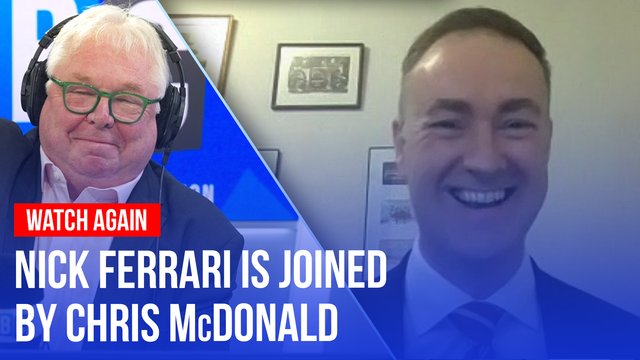
NEETs, Reform exposed, French protests: Health Minister Chris McDonald joins Nick Ferrari
Reform UK has ‘clearly got a problem’ with racism and misogyny, the health minister has told LBC, in the wake of a year-long undercover sting involving the party.
Loading audio…
Speaking with Nick Ferrari at Breakfast, Chris McDonald insisted “Clearly people in and around the party have views that are racist and misogynistic”.
Highlighting that claims of racism have surfaced “time and again”, he added: “Clearly the party has a problem, and we need to deal with the problem”.
It comes as Reform face growing criticism over the undercover recordings, conducted as part of the ITV documentary Undercover: A Year in Reform.
The documentary, filmed by activists, depicts members claiming asylum seekers should be put in “concentration camps” and that Muslims could not be British.
In a separate clip, Reform MP Sarah Pochin described the party as “chauvinistic”, adding: “They just exclude you if you’re a woman.”
Read more: Ex-Reform spokesman ‘disgusted’ after activists filmed making racist and sexist comments
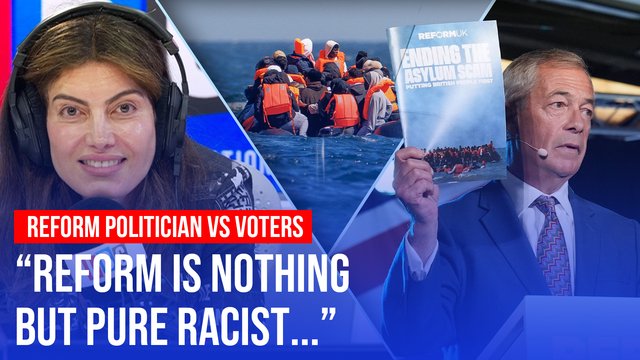
LBC callers take on Reform politician over migration policy
Admitting he hadn’t seen the full documentary but had viewed several clips from the sting aired last night on ITV, Mr McDonald said it was Farage’s responsibility to “deal with the problem”.
“Clearly the party’s got a problem and they need to deal with the problem. And I think if someone points out something like that to you, the important thing is that you, first of all, you thank them for pointing it out, and then you deal with it.
“And that’s not the response that we’ve seen, so I think they do need to get a grip.”
The bombshell footage also showed Reform’s Director of Communications Ed Sumner, former Nigel Farage adviser Dan Jukes, and a senior press officer discussing comments made by the party’s mayoral candidate for Hampshire and the Solent, Dr Chris Parry.

It comes as one Reform UK councillor and prospective Mayor of London told LBC that her party shouldn’t be judged on the actions of “a few councillors”.
Taking calls from LBC listeners, party member Laila Cunningham set out to defend her party in the wake of claims made in relation to the undercover documentary.
“Evidence against three individuals in Reform doesn’t automatically establish the culpability of an entire organisation,” she insisted.
“Now, because of what a few councillors said, the whole party’s being branded racist. And I ask myself, how on earth did we get here?”
‘Reform Need to Get a Grip’: Health Minister Raises Concerns Over Racism and Misogyny in Farage’s Party
Nigel Farage’s Reform UK is facing renewed scrutiny over allegations of racism and misogyny after a health minister argued that the party needed to take stronger action to address concerns about its culture and the conduct of its representatives. The criticism has added another layer to the political battle surrounding Reform, which has sought to position itself as an alternative to Britain’s established parties.
The dispute raises important questions about candidate selection, accountability and the standards expected of political organisations seeking national influence. For Reform, the challenge is to demonstrate that it can expand its support while maintaining clear rules for its members and responding consistently when allegations of misconduct arise.
Farage has built his political profile around challenging the establishment, criticising immigration policy and arguing that mainstream politicians have failed to respond adequately to public concerns. That message has attracted supporters who believe the party speaks more directly to their frustrations. However, as Reform becomes a more prominent force in British politics, its internal standards and the behaviour of those representing it are likely to receive greater attention.
The health minister’s reported remarks bring that issue into sharper focus. Yet the broader debate should be assessed through specific evidence, documented incidents and the responses of the party leadership, rather than assuming that every member shares the same attitudes or that every allegation has been established.
Reform UK faces questions about its internal culture
Political parties are regularly judged not only by their policies but also by the behaviour of their candidates, councillors and other representatives. A party may promise to change how government operates, but voters can reasonably expect it to apply clear standards to the people speaking in its name.
For Reform UK, this presents an organisational challenge. Building a nationwide political movement requires recruiting candidates, establishing local structures and maintaining consistent standards across different regions. The larger the organisation becomes, the more difficult it can be for its leadership to monitor every representative and prevent controversial conduct.
Allegations involving racism or misogyny can be particularly damaging because they concern fundamental questions of equality, dignity and public trust. Racism involves prejudice or discrimination based on race or racial or ethnic identity, while misogyny involves hostility, prejudice or contempt directed towards women. Both can undermine confidence in political institutions when they appear in public life.
However, allegations must be assessed individually. It is important to distinguish between an established incident, a disputed remark, an allegation that remains under investigation and a broader political interpretation of a party’s culture.
The most effective response is to establish what happened, determine whether party rules were breached and explain what action is appropriate. Clear procedures can help protect people from unfair accusations while ensuring that substantiated misconduct is not ignored.
Why the issue matters for Nigel Farage
Farage’s leadership is central to Reform UK’s public identity. His campaigning style, media appearances and political arguments have helped the party attract attention, but that visibility also means controversies involving its representatives can quickly become questions about his leadership.
When a party leader presents their organisation as a force for political renewal, voters may expect it to demonstrate standards different from those they associate with established parties. If allegations of discriminatory behaviour emerge, the leadership faces pressure to explain how candidates are selected and how complaints are handled.
The question is not whether a political leader can personally control every statement made by every supporter. No large organisation can guarantee that every member will behave appropriately. The more relevant issue is whether the organisation has effective safeguards and whether those safeguards are applied consistently.
If a representative is accused of misconduct, the leadership must balance fairness with accountability. Automatically accepting every allegation would be inappropriate, but dismissing concerns without examining the evidence could undermine confidence in the party’s disciplinary process.
A transparent investigation, clear rules and proportionate consequences can help establish whether a problem is isolated or reflects weaknesses in the organisation’s procedures.
For Farage, the way Reform responds to such controversies may therefore become an important part of the public assessment of his leadership.
The health minister’s criticism and the political response
The reported call for Reform to “get a grip” reflects a wider political argument about whether the party is doing enough to address concerns surrounding its members and representatives.
Political criticism is often delivered in forceful language, particularly when parties are competing for public attention. Ministers have an interest in challenging their opponents, just as opposition parties seek to expose weaknesses in the government. That context does not automatically make a criticism invalid, but it does mean that its substance should be examined separately from its political presentation.
The central questions are straightforward. Which incidents are being cited? Were the comments or actions verified? What response did Reform make? Were disciplinary measures taken, and are the party’s rules sufficiently clear?
Without those details, a broad statement that a party has a problem should be treated as an allegation or political assessment rather than a conclusive finding.