
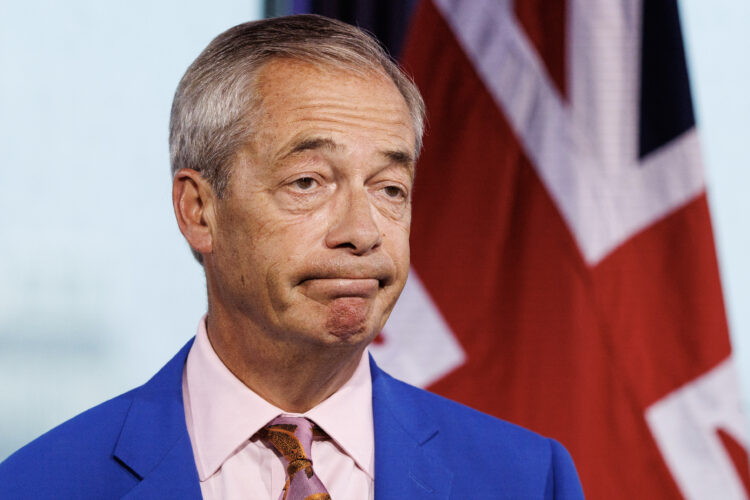
Reform UK continue to be in polling free fall after the party dropped to third.
YouGov’s latest polling recorded a three-point jump in support for the Conservatives in the wake of their party conference. Combined with a one-point drop for Reform, this means the Tories have overtaken Nigel Farage’s party into second place.
Labour remain top but only by one point ahead of the Conservatives after a one-point drop in support.
Sky News’s deputy political editor Sam Coates shared a note from YouGov about the latest polling, highlighting how the changes are within the three-point margin of error.
However, they pointed to a ‘conference bounce’ and increased coverage of the Tories over the last week as likely being a key factor in their jump in support.
They also said this was the first time YouGov have had Reform in third place since 2024.
The importance of a ‘conference bounce’ was also noted by More in Common’s Luke Tryl, who said the polling should be “a further warning of risks of a snap election.”
According to polling aggregator PollCheck, If YouGov’s data was replicated in an election it would see Labour win 244 seats, 62 short of a majority.
The Conservatives would be the second biggest party on 167 seats, whilst Reform would be in third with 85 seats.
Reform Free Fall Continues as Party Drops to Third Place in Latest Polling
Nigel Farage’s Reform UK has suffered another major political setback after a new opinion poll placed the party in third position, marking a fresh blow to its ambitions of becoming Britain’s dominant political force.
The latest figures suggest that Reform’s electoral momentum is continuing to weaken, with Labour strengthening its position and the Conservatives benefiting from a changing political landscape.
For a party that previously appeared capable of challenging Labour for control of Westminster, the latest results represent an uncomfortable development.
Farage has spent months presenting Reform as the only political movement capable of delivering the change demanded by millions of frustrated British voters. However, the latest polling raises serious questions about whether that message is still resonating with the electorate.
The decline also comes amid growing criticism of Reform’s immigration proposals, internal controversies and the increasing competition facing the party from both the Conservatives and Rupert Lowe’s Restore Britain.
Although one opinion poll cannot determine the outcome of the next general election, the latest findings suggest that Reform’s political position may be considerably more fragile than Farage would like voters to believe.
Reform Falls Behind Labour and the Conservatives
The latest opinion poll has delivered an uncomfortable result for Reform UK, placing the party in third position behind Labour and the Conservatives.
The figures indicate that Labour has strengthened its support, while the Conservatives have managed to move ahead of Farage’s party.
This is particularly significant because Reform had previously enjoyed a period of strong polling performance.
At various points, the party appeared capable of overtaking both traditional political parties and establishing itself as the leading alternative to Labour.
However, that momentum now appears to be facing considerable resistance.
The latest development will inevitably create questions about Reform’s ability to maintain the support it attracted during its earlier polling surge.
For Farage, the challenge is no longer simply persuading voters that Reform represents an alternative to the established political parties.
He must also convince supporters that the party has the organisation, policies and leadership required to become a credible government.
Labour’s Recovery Creates Fresh Problems for Farage
The biggest political beneficiary of Reform’s declining position appears to be Labour.
After experiencing a difficult period following its 2024 general election victory, Labour has recently shown signs of rebuilding public confidence.
The party has faced criticism over economic pressures, public services and living standards.
These difficulties initially created an opportunity for Reform to attract disillusioned voters.
However, Labour’s recent recovery suggests that some voters may be reconsidering their political preferences.
The party has increasingly focused its message on economic stability, improving the NHS, strengthening public services and addressing the cost of living.
Andy Burnham’s political interventions have also attracted attention, particularly his arguments about economic fairness and Britain’s future relationship with Europe.
For Labour, the latest polling development provides an opportunity to argue that Reform’s rise was not necessarily permanent.
The party will hope that its improving position represents the beginning of a more sustained recovery.
Nevertheless, Labour must still demonstrate that it can translate stronger polling figures into improvements that people can experience in their everyday lives.
The Conservatives Are Also Benefiting From Reform’s Problems
Another significant aspect of the latest poll is the Conservatives’ apparent improvement.
Kemi Badenoch’s party has spent considerable time attempting to recover from its devastating 2024 general election defeat.
For months, Reform appeared to be taking support away from the Conservatives, particularly among voters concerned about immigration, national sovereignty and dissatisfaction with the political establishment.
However, the latest figures suggest that the Conservative Party may be recovering some of that support.
This creates a difficult situation for Farage.
Reform’s political strategy depends heavily on convincing Conservative voters that the traditional party is no longer capable of representing their interests.
If Badenoch succeeds in rebuilding confidence, Reform could find itself struggling to maintain its position.
The Conservatives also possess an established parliamentary organisation and a substantial record of governing experience.
These factors could become increasingly important as voters begin examining which parties are genuinely prepared to form the next government.
Nigel Farage Faces Growing Questions Over Reform’s Direction
Farage remains the central figure in Reform UK.
His political influence and ability to attract media attention have played an important role in the party’s rise.
However, the latest polling setback raises questions about whether his leadership can maintain the momentum that previously made Reform such a powerful force.
The party has faced criticism over several controversies, including its candidates, internal organisation and policy announcements.
Its immigration proposals have also attracted considerable attention.
Reform recently announced plans to suspend the asylum system for five years, cancel outstanding applications and introduce a much larger deportation programme.
The proposals have generated strong criticism from Labour, refugee organisations and human rights campaigners.
While these policies may appeal to voters demanding tougher immigration controls, they also create questions about legal feasibility, international obligations and the practical costs of implementation.
Farage must therefore demonstrate that Reform can offer more than controversial political announcements.
Voters will want to know how the party intends to manage the economy, improve public services and address the wider challenges facing Britain.
Restore Britain Adds Another Headache for Reform
Reform’s difficulties have also coincided with the emergence of Restore Britain, led by Rupert Lowe.
The new political movement has created another source of competition among voters who favour a tougher approach to immigration and national sovereignty.
This is potentially damaging for Farage because Reform has relied heavily on attracting voters who feel politically homeless.
If Restore Britain manages to attract even a relatively small proportion of those supporters, it could affect Reform’s performance in closely contested constituencies.
Britain’s first-past-the-post electoral system makes this particularly important.
A party does not simply need to attract a large number of votes nationally. It needs to win individual constituencies.
If several parties compete for similar voters, the political consequences could be substantial.
The emergence of Restore Britain therefore creates another challenge for Reform as it attempts to turn national support into parliamentary victories.
Immigration Remains a Major Political Battleground
Despite the apparent decline in support, immigration remains one of Reform’s strongest political issues.
Farage has repeatedly argued that Britain needs a much tougher approach to border enforcement and irregular migration.
The party’s proposals include withdrawing from several international agreements and introducing sweeping changes to the asylum system.
However, Labour has attempted to challenge Reform by arguing that immigration can be controlled without abandoning Britain’s legal and humanitarian responsibilities.
The government has also pointed to reductions in small-boat arrivals during certain periods.
This has created an increasingly competitive political environment.
Reform wants voters to believe that only its approach can deliver meaningful change.
Labour wants to demonstrate that it can address immigration while maintaining an effective and lawful system.
The Conservatives, meanwhile, are attempting to reclaim their reputation on border security.
The latest polling setback suggests that Reform’s dominance of the immigration debate should not be taken for granted.
One Poll Does Not Decide the Next General Election
Although the latest figures represent an important setback for Reform, it is essential to remember that opinion polls are snapshots of public opinion.
They do not guarantee future election results.
Polling figures can change considerably depending on political developments, economic conditions, party leadership and the issues dominating public debate.
There is also an important distinction between national voting intention and constituency-level performance.
Even if Reform improves its national polling position, it could still struggle to win parliamentary seats if its support is distributed inefficiently.
Equally, a temporary decline does not mean that the party has lost its ability to attract voters.
Farage has demonstrated considerable political resilience throughout his career.
He will undoubtedly attempt to use the coming months to rebuild support and convince voters that Reform remains the strongest alternative to Labour.
Conclusion: Reform’s Political Momentum Faces Its Biggest Test Yet
The latest polling setback represents another difficult moment for Nigel Farage and Reform UK.
After previously enjoying a period of remarkable political momentum, the party is now facing the prospect of falling behind both Labour and the Conservatives.
Labour’s recovery, the Conservatives’ attempts to rebuild and the emergence of Restore Britain have created a much more complicated political landscape.
Reform also faces questions about its internal organisation, immigration proposals and ability to present itself as a credible government.
For Farage, the priority will be restoring public confidence and demonstrating that his party can deliver practical solutions rather than simply criticising its opponents.
However, the latest figures provide a warning that political momentum can disappear as quickly as it arrives.
The next general election remains some distance away, and there is still plenty of time for the parties to change their fortunes.
But if Reform’s decline continues, Farage could find himself facing a much tougher electoral battle than he anticipated.
For Labour and the Conservatives, meanwhile, the latest development offers a valuable opportunity to challenge Reform’s claim that its rise is unstoppable.