
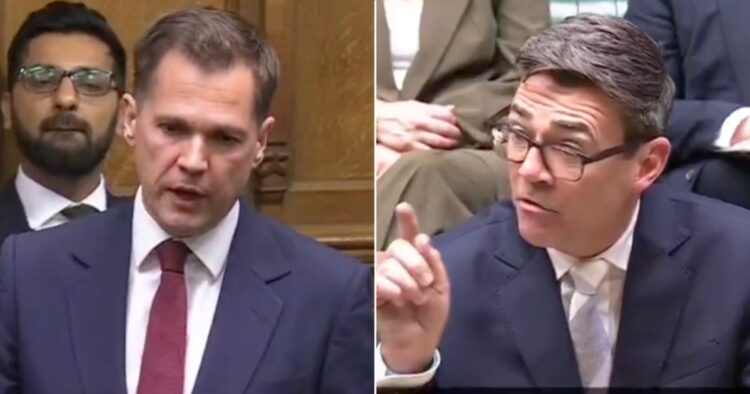
Andy Burnham ripped into Robert Jenrick over Reform UK’s unserious plans on immigration and the asylum system.
On Monday, Burnham was taking questions from MPs in the House of Commons after delivering a statement on the UK’s relationship with the European Union.
The prime minister called for “deeper cooperation” with the EU to help drive economic growth in the UK, and said it was an “immediate priority” for him to secure a successful outcome at the EU-UK summit next month.
At one point in the session, Tory-turned-Reform MP Robert Jenrick stood up to ask a question to the PM.
On the same day as the prime minister’s statement, Reform had announced they would shut down the asylum system for a full parliamentary term if they came into power, whilst Zia Yusuf had suggested a Reform government would allow the Royal Navy to use “lethal force” in the Channel.
So, Jenrick decided to ask the prime minister why he was not also backing these desperate and extreme policies.
Mentioning alleged security threats from Iran, the Newark MP asked: “Will he declare a national security emergency, because we have a gaping hole in our borders right now?
“Send the Royal Navy into the Channel and shut down the entire asylum farce once and for all to truly fulfil his duty as prime minister which is to keep the British people safe.”
In response, Burnham decided to remind Jenrick about his time as a Conservative minister, when he would have gawped at such suggestions.
“I could remember a time when the right honourable gentleman stood up in this House and made serious proposals, sadly not today,” Burnham said.
The Labour leader pointed out that small boat crossings are coming down under this government and how the opposite happened when Jenrick was immigration minister.
“Those are the facts, he should engage with them,” the PM added.
Burnham Tears Into Robert Jenrick Over Reform’s Immigration Plans
Andy Burnham has delivered a pointed response to Reform UK’s Robert Jenrick after the former Conservative minister demanded that the government adopt the party’s increasingly hardline immigration proposals.
The exchange took place in the House of Commons, where Jenrick challenged the government over illegal immigration and called for the Royal Navy to be deployed in the English Channel.
However, Burnham was quick to remind him of his previous record as immigration minister under the Conservatives, questioning why he had abandoned what Burnham described as serious political proposals.
The confrontation came on the same day Reform UK announced plans to suspend Britain’s asylum system for an entire parliamentary term if the party entered government.
The proposals have attracted widespread criticism, particularly over the suggestion that asylum applications should be cancelled and the Royal Navy could use force against migrant boats.
For Reform, immigration remains one of its central political issues. But Burnham’s response has raised questions about whether the party’s proposals are practical, legally sustainable and consistent with the responsibilities of government.
Jenrick Demands Tougher Action on Small Boats
The confrontation began when Robert Jenrick, now a Reform UK MP for Newark, stood up to question the government following a statement about Britain’s relationship with the European Union.
Jenrick accused the government of failing to protect Britain’s borders and referred to alleged national security threats involving Iran.
He demanded that the government declare a national security emergency and take more aggressive action against small-boat crossings.
Addressing the Prime Minister, he asked:
“Will he declare a national security emergency, because we have a gaping hole in our borders right now?”
He then called for the Royal Navy to be sent into the Channel and for the asylum system to be shut down.
His intervention reflected Reform’s wider immigration strategy, which proposes a fundamental restructuring of Britain’s asylum arrangements.
Jenrick argued that the government needed to take more decisive action to prevent irregular migration.
However, Burnham was not impressed by the proposals.
Burnham Reminds Jenrick of His Record as Immigration Minister
Rather than simply responding to Jenrick’s demands, Burnham turned the question back on the Reform MP.
He reminded Jenrick that he had previously served as immigration minister under the Conservative government.
Burnham said:
“I can remember a time when the right honourable gentleman stood up in this House and made serious proposals, sadly not today.”
The remark was a direct criticism of Jenrick’s political transformation since leaving the Conservatives and joining Reform UK.
Burnham suggested that Jenrick had previously approached immigration policy differently when he was responsible for the government’s immigration strategy.
He also challenged him to examine the available figures on small-boat crossings.
The Prime Minister pointed out that crossings had fallen under the current government, contrasting this with the increase recorded during Jenrick’s time as immigration minister.
He concluded:
“Those are the facts, he should engage with them.”
The exchange highlighted the political difficulty facing Jenrick as he attempts to defend Reform’s immigration proposals while being challenged over his previous record in government.
Small-Boat Crossings Have Fallen, According to Government Figures
One of the central arguments in Burnham’s response concerned the number of people arriving in Britain through small-boat crossings.
Figures reported at the time showed that 20,935 people had crossed the Channel so far in 2026.
That represented a 42 per cent reduction compared with the equivalent period in 2025, when 36,244 arrivals had been recorded.
The figure was also 19 per cent lower than the equivalent period in 2023, when 25,931 people had arrived.
These statistics provided the basis for Burnham’s argument that the government was making progress on the issue.
However, a reduction in crossings does not mean the problem has been resolved.
The number of arrivals remains substantial, and the government continues to face pressure to improve border enforcement, accelerate asylum decisions and increase the removal of people who have no legal right to remain.
Reform argues that existing policies do not go far enough and that a much more radical approach is required.
Reform Wants to Shut Down the Asylum System for Five Years
The parliamentary confrontation came after Reform announced one of its most controversial immigration proposals.
The party wants to suspend Britain’s asylum system for a full parliamentary term if it wins the next general election.
Under the proposed arrangements, new asylum applications would be rejected and existing applications would be cancelled.
Reform also wants to end several existing legal routes and introduce a much larger deportation programme.
The party argues that the current asylum system has become overwhelmed and that Britain needs to regain control of its borders.
However, opponents argue that a blanket suspension would create serious legal and humanitarian problems.
People escaping war, persecution and torture could find themselves without an effective opportunity to have their claims examined.
The proposal would also raise questions about Britain’s obligations under international refugee and human rights agreements.
Labour has criticised the plans, arguing that immigration enforcement must operate within the law.
The debate is therefore not simply about whether Britain should control its borders, but about how that control should be exercised.
Reform’s Royal Navy Proposal Creates Further Controversy
Another particularly contentious part of the debate concerns Reform’s suggestion that the Royal Navy could be deployed to stop migrant boats.
Zia Yusuf, Reform’s home affairs spokesman, suggested that Royal Marines could be sent into the Channel and permitted to use lethal force if necessary.
He argued that migrants could instead be intercepted and returned to France.
However, the suggestion that armed forces might use lethal force against people travelling in small boats has generated strong criticism.
Bridget Phillipson described the proposal as “disgusting and illegal”.
She argued that Britain’s armed forces should not be placed in a position where they might be expected to open fire on unarmed civilians.
Burnham also dismissed the idea of using the Royal Navy in this way as an unserious approach to the problem.
The government maintains that border enforcement must be effective while respecting legal obligations and protecting human life.
The practical difficulties of intercepting crowded boats in dangerous waters also raise significant safety concerns.
Jenrick Accuses Burnham of Ignoring the Border Crisis
Jenrick did not accept Burnham’s criticism.
Following the exchange, he posted on social media:
“Andy Burnham has his head in the sand.”
The Reform MP argued that the government was failing to recognise the seriousness of the situation.
His position reflects the party’s broader argument that existing immigration policies have not sufficiently discouraged dangerous Channel crossings.
Jenrick has increasingly become one of Reform’s most prominent political representatives since leaving the Conservatives.
His move has also attracted attention because of his previous experience in government.
As immigration minister, he was responsible for overseeing policies intended to reduce irregular migration and improve the removal of people without permission to remain in Britain.
Burnham’s criticism therefore focused on the contrast between Jenrick’s previous ministerial responsibilities and his current demands.
The Political Battle Over Immigration Is Intensifying
The confrontation illustrates how immigration continues to dominate the political debate between Labour and Reform.
Farage’s party has built much of its support around promises to reduce immigration and introduce tougher border controls.
Labour, meanwhile, is attempting to demonstrate that it can reduce irregular migration without abandoning international legal obligations.
The Conservatives also remain involved in the debate, with Kemi Badenoch seeking to rebuild her party’s credibility on immigration.
Jenrick’s defection to Reform has made the political competition even more complicated.
He brings experience of government, but his previous record also provides Labour with opportunities to challenge his proposals.
The argument is likely to continue as the parties develop their policies ahead of the next general election.
Conclusion: Burnham Challenges Jenrick Over His Political U-Turn
Andy Burnham’s exchange with Robert Jenrick has brought renewed attention to Reform UK’s controversial immigration proposals.
Jenrick demanded that the government declare a national security emergency, deploy the Royal Navy in the Channel and shut down the asylum system.
Burnham responded by reminding him of his previous ministerial responsibilities and questioning why he was no longer putting forward what he described as serious proposals.
He also pointed to figures showing a reduction in small-boat arrivals compared with previous years.
For Reform, the exchange demonstrates its determination to make immigration a central political issue.
For Labour, it provides an opportunity to challenge the credibility and practical implications of Farage’s proposals.
The wider debate remains unresolved.
Britain continues to face significant challenges involving irregular migration, asylum processing and border security.
The key question is whether political parties can offer policies that address those problems effectively while remaining consistent with Britain’s legal and humanitarian responsibilities.