

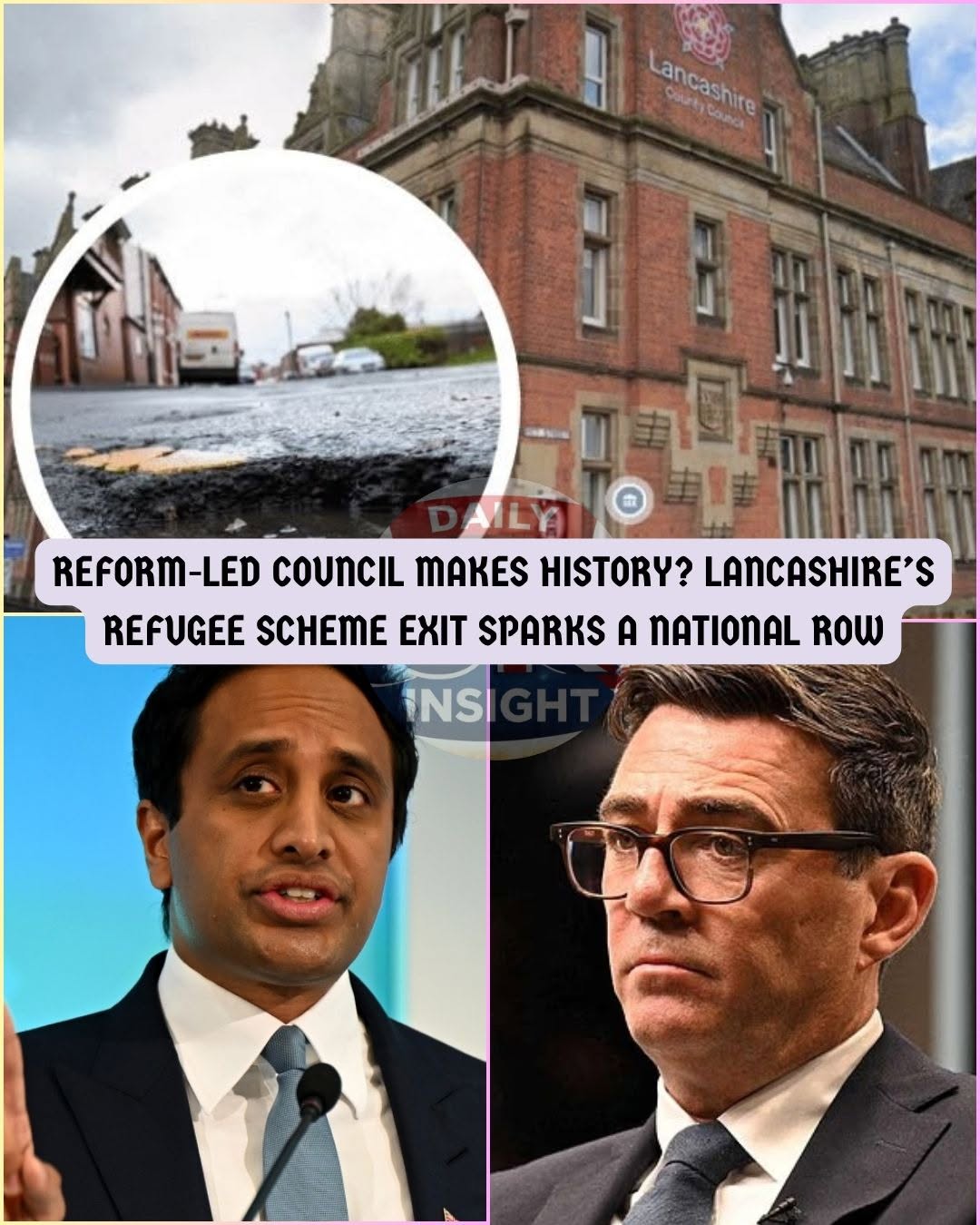
Lancashire Council Withdraws from Refugee Resettlement Role, Reigniting Debate Over Housing and Local Resources
Lancashire County Council has voted to step away from its role coordinating government refugee resettlement programmes across the county, reopening a politically charged debate over immigration, housing and pressure on public services. But the decision does not mean refugees already living in Lancashire will suddenly lose support, nor does it allow the council to terminate national resettlement programmes. Instead, responsibility will be transferred through a managed process involving the Home Office and other organisations.
A long-running political dispute over refugee resettlement in Lancashire has finally resulted in a formal change of policy.
On September 3, Lancashire County Council’s cabinet agreed that the authority would withdraw from its role as the coordinating body for refugee resettlement schemes operating across the county.
The Reform UK-led council will now notify the Home Office and begin transferring its administrative responsibilities, with the process scheduled to be completed no later than March 31, 2027.
The decision has immediately become part of Britain’s wider argument about immigration and the pressure facing local communities.
Supporters see it as an attempt to put local residents and stretched public services first.
Critics warn that withdrawing from refugee coordination could weaken support for vulnerable people fleeing war and persecution.
The reality, however, is more complicated than either interpretation suggests.
What Has Lancashire Actually Withdrawn From?
The most important distinction concerns what the county council currently does.
Lancashire County Council acts as a coordinating authority for refugee resettlement programmes.
Its Refugee Integration Team works with district councils and other organisations to help people arriving through a range of humanitarian routes integrate into communities.
The council’s own information says that the team has worked across more than 10 resettlement routes and has been funded by central government.
The September decision means Lancashire County Council intends to stop performing that coordinating and administrative role.
It does not mean Lancashire has legally abolished refugee resettlement within the county.
The council explicitly states that the Government’s programmes will continue and that alternative administrative arrangements will need to be established.
That distinction is crucial.
Why Did the Council Make the Decision?
The policy has been developing for months.
In May, Councillor Joshua Roberts, Lancashire’s cabinet member for rural affairs, environment and communities, announced plans for the Reform-led authority to withdraw.
Roberts argued that local residents should not be disadvantaged and called for government resources associated with refugee resettlement to be redirected towards vulnerable Lancashire residents and veterans.
Reform also argued that resettlement added pressure to local housing and council resources.
Those arguments fit into a wider debate occurring across Britain.
Housing availability remains politically sensitive, particularly in communities where residents already face long waits for affordable homes.
Councils must also deal with demand for education, social care and other services.
But there is an important qualification in Lancashire’s case.
The council’s refugee integration operation says it is fully funded by central government, meaning it would be misleading to suggest that the entire programme has simply been financed from Lancashire’s ordinary local-services budget.
Whether central-government funding adequately captures every indirect effect on housing and services is a separate policy question.
Housing Responsibilities Are Also Complicated
Another reason the story requires context is Britain’s local-government structure.
Lancashire County Council does not directly control every service affected by migration.
Under the existing two-tier system, the county council provides services including education, social care, roads and libraries, while district and borough councils are responsible for areas including housing and planning.
That means arguments about refugees competing directly for “Lancashire County Council housing” can oversimplify how responsibilities are divided.
Lancashire’s own information shows that numerous district councils have participated in the UK Resettlement Scheme, including Burnley, Chorley, Hyndburn, Lancaster, Pendle, Preston, South Ribble, West Lancashire and Wyre, alongside Blackpool.
The county council has effectively helped coordinate activity involving multiple authorities.
Its withdrawal therefore creates an administrative question: who takes over that coordination?
Existing Refugees Will Not Simply Lose Support
This is another important part of the September decision.
Lancashire says the change concerns administration and coordination rather than removing assistance from refugees already living in the county.
Roberts said the council would work with the Home Office and partners to ensure a managed transition that protects people currently receiving support.
That transition period will extend for several months.
Administrative responsibilities are expected to end no later than March 31, 2027, giving the Home Office and local organisations time to establish alternative arrangements.
The council also says there is no statutory requirement compelling Lancashire County Council itself to serve as coordinating authority.
So the dispute is not simply about whether refugees receive assistance.
It is also about which institution should organise that assistance.
Resettlement Is Not the Same as the Asylum System
The terminology surrounding immigration can easily create further confusion.
Refugee resettlement programmes are not identical to the asylum-dispersal system.
Lancashire’s council information says asylum dispersal and contingency accommodation are managed through Home Office arrangements involving contractors, while the county council does not play a direct role in asylum dispersal.
It instead works with other councils to coordinate services such as education, health and integration support.
That means the September decision should not be interpreted as Lancashire somehow closing its borders to asylum seekers.
Local authorities do not possess national border-control powers.
Immigration and asylum policy ultimately remains the responsibility of central government.
Critics Raise a Different Question
Refugee organisations have challenged the political case for withdrawal.
When Lancashire’s proposal first emerged, Refugee Council representative Imran Hussain argued that resettlement provided a safe route for vulnerable people escaping countries affected by war and persecution.
He said effective integration support — including English lessons and assistance finding employment — could help refugees eventually contribute to their communities.
That produces a fundamentally different interpretation of the same expenditure.
Supporters of withdrawal focus on immediate resource pressures and prioritising existing residents.
Supporters of resettlement argue that investment in integration can reduce longer-term dependence while fulfilling Britain’s humanitarian commitments.
Determining the actual local impact requires evidence about housing availability, public-service demand, employment and the amount of government funding attached to individual schemes.
Lancashire Is Already Undergoing Major Change
The timing also matters.
The county is simultaneously dealing with a major proposed restructuring of local government.
Lancashire currently has a county council, 12 district councils and two existing unitary authorities. Plans have been considered to replace the structure with new unitary councils, although the Government announced a review and pause of Lancashire’s reorganisation process in September.
Lancashire’s official announcement specifically cited wider local-government reorganisation as part of the context surrounding its refugee coordination decision.
That administrative uncertainty makes transferring responsibilities more complicated than a simple political declaration might suggest.
What Happens Next?
Lancashire County Council will now work with the Home Office and relevant partners to determine where its existing responsibilities go.
That process will be important.
If another organisation successfully takes over the coordinating role, refugee resettlement could continue with relatively limited disruption.
If the transition creates gaps in integration, housing coordination or support, critics are likely to argue that the withdrawal created avoidable problems.
Meanwhile, Reform UK is likely to present the decision as evidence that councils can challenge the way national migration policies are implemented locally.
Other councils will undoubtedly watch what happens.
A Local Decision With National Implications
Lancashire’s decision therefore matters — but not quite in the way the most dramatic headlines suggest.
The council has not independently ended Britain’s refugee programme.
It has not ordered existing refugees to leave Lancashire.
And it has not taken control of national immigration policy.
What it has done is refuse to continue serving as the local coordinating authority for government refugee resettlement schemes, forcing the Home Office and its partners to develop alternative arrangements.
That still represents a significant political move.
It places housing pressures, public-service capacity, humanitarian obligations and the division of responsibility between central and local government at the centre of the argument.
And the consequences will now be measurable.
The real test will come after Lancashire steps back: whether refugee support continues smoothly under new arrangements — and whether the council can demonstrate that withdrawing genuinely improves resources and services for the residents it says it wants to prioritise.
POLITICAL BOMBSHELL: LANCASHIRE COUNCIL SPARKS A MAJOR REFUGEE RESETTLEMENT ROW!
A major political controversy has erupted in Lancashire after the county council approved plans to withdraw from its role coordinating several refugee resettlement schemes, placing immigration policy, local government responsibilities and public spending under renewed scrutiny.
The decision, taken by the Reform UK-led Lancashire County Council on 3 September 2026, has sparked disagreement between political groups over fairness, financial priorities and the future of support for refugees already living in the county. The council plans to complete the transfer of its administrative responsibilities by 31 March 2027. <Cite refs={[“turn698151search0″,”turn698151search3”]}/>
The move has become a flashpoint in the wider national debate over immigration, with supporters arguing that councils must prioritise local responsibilities and critics questioning whether withdrawing from the coordinating role will solve the problems the policy is intended to address.
At the heart of the controversy lies an important distinction: Lancashire County Council is withdrawing from administering particular resettlement programmes, but that does not automatically end those programmes or mean refugees will no longer be entitled to support.
Why Lancashire Made the Decision
Lancashire County Council has been responsible for coordinating several government refugee resettlement schemes involving local authorities across the county.
Following a review, the council’s cabinet concluded that it should cease administering the programmes and allow alternative arrangements to be established.
The authority cited value for money, the effective delivery of services and fairness between residents as reasons for its decision. It also argued that responsibility for administering the arrangements should sit with local authorities that have statutory responsibilities for housing, particularly as Lancashire prepares for wider local government reorganisation. <Cite refs={[“turn698151search0″,”turn698151search1”]}/>
The decision reflects a broader political argument about the relationship between central government and local councils.
Local authorities are expected to deliver essential services, including social care, education-related services and other forms of community support. When budgets are under pressure, councillors must decide how available resources should be allocated and which responsibilities their organisations are best equipped to manage.
Supporters of Lancashire’s decision argue that councils should be able to review voluntary administrative arrangements and determine whether those arrangements remain appropriate.
They also maintain that residents should receive clear explanations of how public money is being spent and whether existing systems offer value for money.
However, critics question whether withdrawing from the coordinating role is the most effective response, particularly when the government-funded programmes may continue under different local arrangements.
The Political Opposition Pushes Back
The council’s decision has faced criticism from opposition councillors, who raised concerns about the process, the financial implications and the consequences for vulnerable people receiving assistance.
Nineteen councillors requested a formal review of the cabinet decision. A scrutiny committee considered their objections at a special meeting on 11 September 2026.
The committee ultimately decided not to require the cabinet to reconsider its decision, allowing the withdrawal plan to proceed. <Cite refs={[“turn698151search3″,”turn698151search4”]}/>
The scrutiny process examined whether the council had followed appropriate decision-making procedures. It was not a referendum on national immigration policy.
During the proceedings, questions were raised about whether the decision-making process had adequately considered the available options, the relevant equality assessment and potential financial or legal risks.
Cabinet member Joshua Roberts acknowledged having a prior view on the issue but maintained that he had considered the available options before reaching his decision.
The disagreement highlights a familiar tension in local government: elected representatives are entitled to hold policy preferences, but important decisions must still follow the appropriate procedures and take account of relevant evidence.
For critics, the controversy raises questions about whether the council sufficiently weighed the consequences of withdrawing. Supporters maintain that disagreement with the final decision does not, by itself, demonstrate that the process was improper.
What Happens to Refugees Already Living in Lancashire?
One of the most important questions concerns the people who currently receive assistance through the affected programmes.
Reporting published in September indicated that approximately 745 refugees across Lancashire were receiving government-funded support under the schemes affected by the decision. <Cite refs={[“turn698151search4″,”turn698151search5”]}/>
The programmes include arrangements for Afghans who assisted British military operations in their home country, alongside schemes supporting other vulnerable people who fled conflict and persecution.
These individuals arrived through legal routes and have been granted permission to remain in the United Kingdom.
Their circumstances are therefore different from those of people whose immigration status is unresolved or who have entered the country through other routes.
The council’s decision concerns who coordinates the relevant support services, rather than an automatic cancellation of refugees’ existing rights or the termination of the national resettlement programmes.
The transition will require alternative arrangements to be agreed with the Home Office and other local authorities.
The practical challenge will be ensuring that responsibilities transfer without unnecessary disruption to services such as housing-related assistance, employment support and help with integration.
If the transition is poorly managed, vulnerable households could face uncertainty. If the arrangements are transferred effectively, the administrative change could take place without an interruption in the support they are entitled to receive.
Preston City Council Enters the Debate
The controversy developed further when Preston City Council expressed an interest in taking over responsibility for coordinating refugee support.
In late September, Preston’s Labour-led council backed an approach to the government about assuming the role. The proposal attracted support from several political groups represented at the town hall. <Cite refs={[“turn698151search5″,”turn698151search7”]}/>
The development exposed a difference in approach between the two authorities.
Lancashire County Council argues that administration should be handled by local authorities with the appropriate statutory responsibilities, particularly in relation to housing.
Preston’s supporters of taking over the role argue that the funding attached to the programmes can also support services used by the wider community.
Lancashire County Council has reported receiving approximately £18 million from the government since 2020 in connection with its refugee support work. The future allocation of funding will depend on the arrangements established with the authorities that assume responsibility. <Cite refs={[“turn698151search5″,”turn698151search7”]}/>
This raises an important financial question: will withdrawing from the coordinating role reduce administrative burdens, or could it also mean losing funding that has helped support wider local services?
The answer depends on the final transfer arrangements, the costs incurred by each authority and the way government funding is distributed.
Immigration, Housing and Pressure on Public Services
The dispute takes place against a wider background of concern about housing affordability, public service capacity and the pace of immigration.
Across the United Kingdom, local authorities face difficult decisions about housing provision, social care, infrastructure and the allocation of limited resources.
Some residents argue that governments must ensure sufficient housing and service capacity before expanding or maintaining resettlement commitments.
Others emphasise that refugee resettlement is a humanitarian responsibility and that people admitted through legal routes should receive the support necessary to establish stable lives.
Both the national policy framework and local implementation matter.
Refugee resettlement programmes can involve support with accommodation, language learning, employment and access to relevant services. Their administration requires coordination between central government, councils and other organisations.
The fact that a local authority is experiencing pressure on housing does not, by itself, establish that refugee resettlement is the principal cause. Housing supply, planning decisions, construction rates, population growth and investment also influence availability and affordability.
A careful assessment should therefore examine the evidence for each claimed effect rather than assume that one policy explains every local difficulty.
What the Row Means for Reform UK
The decision also has political significance because it demonstrates how Reform UK-led local authorities are approaching immigration-related responsibilities.
The party has placed immigration and national sovereignty among its prominent political themes. Its representatives in Lancashire have argued that local priorities, financial accountability and fairness should guide decisions about public services.
Opposition parties have questioned the consequences of the policy and argued that withdrawing from the coordinating role may not reduce refugee arrivals or eliminate the need for support.
That distinction is crucial.
A county council can decide whether it wishes to administer particular programmes, subject to the applicable legal framework. It cannot independently abolish national immigration routes or determine every aspect of refugee placement across the country.
The ultimate impact of the Lancashire decision will therefore depend on what happens at national level and which local authorities assume the administrative responsibilities.
The controversy may also influence wider discussions about how councils should balance local priorities with national government programmes.
A Difficult Transition Lies Ahead
The next phase will be less about political announcements and more about practical implementation.
Lancashire County Council must work with the Home Office and relevant partners to establish a managed transfer of responsibilities. The administrative change is scheduled to be completed no later than 31 March 2027. <Cite refs={[“turn698151search0″,”turn698151search6”]}/>
The authorities involved will need to clarify who is responsible for existing cases, how records and funding will be transferred and how support will continue during the transition.
Residents will also want reassurance that local services remain accessible and that changes to administrative arrangements do not create unnecessary costs or confusion.
For refugees already living in Lancashire, continuity is particularly important. Their ability to access support should not depend on political uncertainty between different levels of government.
For taxpayers, transparency about the costs and benefits of the new arrangements will be essential.
And for elected representatives, the challenge will be to demonstrate that their decisions deliver practical improvements rather than simply generate political attention.
The Bigger Question for Britain
The Lancashire dispute illustrates the difficulty of managing immigration policy through a system in which responsibilities are divided between central government and local authorities.
National government determines the wider framework for resettlement, while local institutions play an important role in delivering services and helping communities respond to changing needs.
When those responsibilities become politically contentious, disagreements can emerge over funding, fairness and the proper role of individual councils.
Lancashire’s decision has not ended refugee resettlement in the county. Instead, it has initiated a process through which administrative responsibility must be transferred to other arrangements.
Whether that process proves effective will depend on the quality of the transition, the availability of funding and the ability of the relevant authorities to maintain essential support.
The controversy also raises a wider question about public confidence. Residents need clear explanations of how decisions are made, what services cost and how competing needs are balanced.
Refugees require clarity about the support available to them, while taxpayers deserve transparent information about how public money is used.
Ultimately, the success of the policy will be judged not by the strength of political rhetoric but by what happens on the ground.
As the March 2027 deadline approaches, Lancashire’s experience could become an important example of the challenges involved in transferring local responsibilities for national refugee programmes.
The central test will be whether the new arrangements deliver effective administration, protect people who are already receiving support and provide clear accountability for the public money involved.