

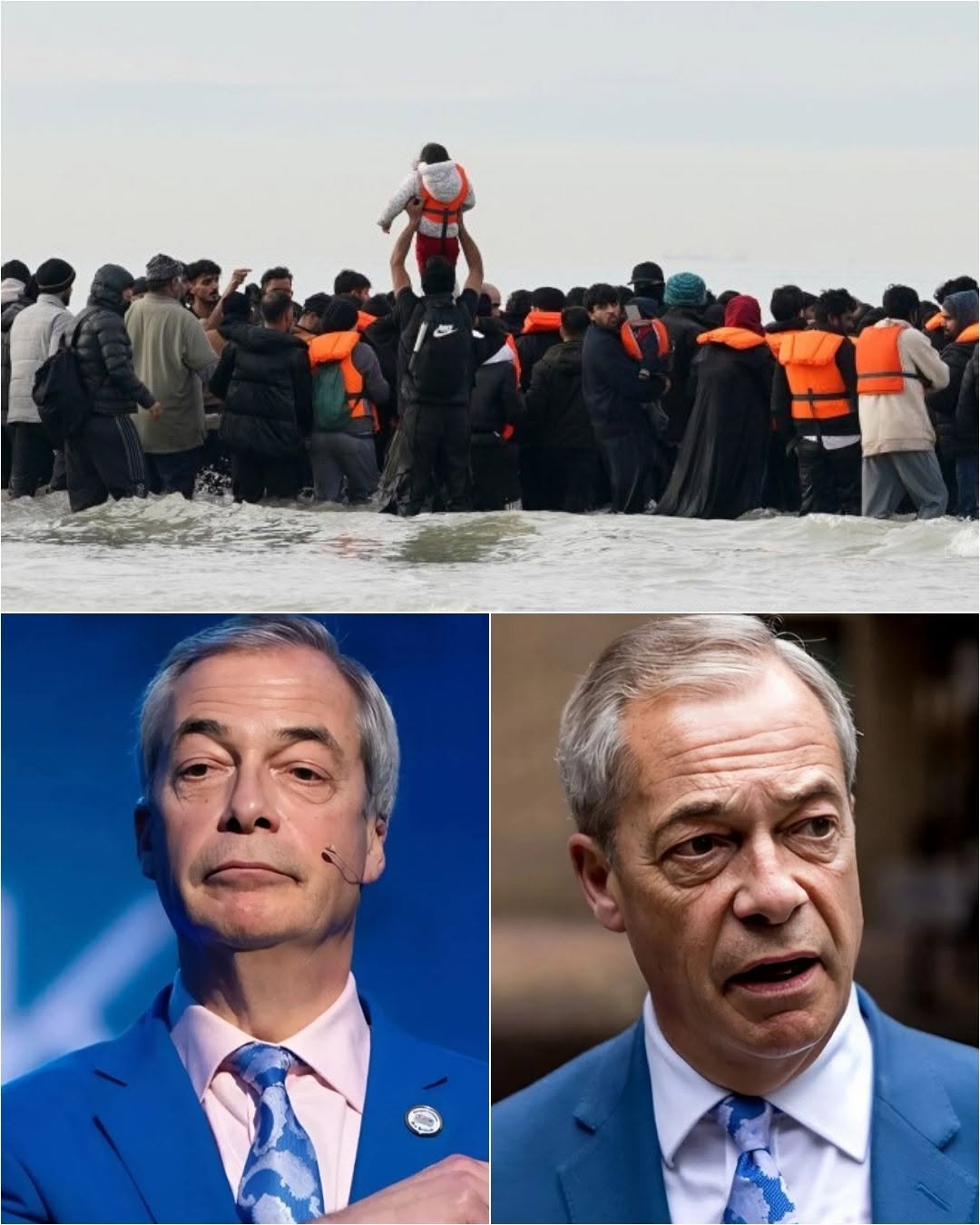
Farage’s 400,000 Asylum Review Plan: What Reform UK Is Proposing and Why It Could Face Major Legal Challenges
Nigel Farage’s Reform UK has proposed one of the most far-reaching changes to Britain’s asylum system in decades: reopening successful asylum decisions made during the previous five years and potentially removing large numbers of people whose refugee status has already been recognised. Reform estimates that as many as 400,000 people could fall within the scope of the review, although that figure should not be confused with 400,000 automatic deportations. The proposal has opened a major argument about border control, refugee law, cost and whether protection already granted by the British state can be reversed on such a scale.
Reform UK unveiled the proposal on April 20 as part of a broader programme intended to dramatically increase removals from Britain.
Farage said a Reform government would go back five years and review asylum cases already approved by the Home Office. His party says people who entered the UK through an irregular route, or who originally arrived on a visa and subsequently overstayed before claiming asylum, could have their status revoked and face removal.
Reform also says cases could be reconsidered where conditions in a refugee’s country of origin have changed sufficiently for that country to be considered safe.
The scale is what makes the proposal exceptional.
Reform estimates that up to 400,000 people could fall within the scope of the exercise and says it expects a majority ultimately to be removed.
400,000 Reviews — Not 400,000 Automatic Deportations
This distinction is crucial.
Some headlines have described the proposal as Farage announcing the deportation of 400,000 asylum seekers.
That simplifies what Reform itself has proposed.
The approximately 400,000 figure represents the party’s estimate of people potentially in scope for reassessment. Whether every individual could legally be stripped of protection and removed would depend on their circumstances, the legislation enacted by a future government and the outcome of any legal challenges.
Farage himself described the number as “up to 400,000 potentially within the scope” of the proposal.
Those people would also not necessarily be current “asylum seekers”.
An asylum seeker is generally someone awaiting a decision on a protection claim. Many people targeted by Reform’s proposal would already have received successful decisions and therefore have recognised protection status.
Calling all 400,000 “illegal migrants” would consequently blur several different legal categories.
Why Does Reform Want to Reopen Successful Cases?
Farage argues that the existing system has granted protection too readily and that entering Britain irregularly should prevent a person from being allowed to remain.
Reform home affairs spokesman Zia Yusuf has similarly said the party wants to revoke status from people who entered illegally or overstayed visas before claiming asylum.
The party’s argument is essentially that the asylum system should not reward people for bypassing normal immigration routes.
Critics challenge that premise because asylum law and ordinary immigration law are not identical.
A person’s method of arrival and the question of whether that person genuinely requires protection are separate legal issues.
That distinction would almost certainly become central to any attempt to implement Reform’s policy.
Can Refugee Status Already Be Revoked?
Yes — but under specific circumstances.
The Home Office already has procedures allowing refugee or humanitarian protection status to be revoked or ceased in certain cases.
Official guidance includes circumstances in which protection was obtained through deception, where protection is no longer required because circumstances have fundamentally changed, or where serious criminality or national-security considerations apply.
That is different from automatically cancelling refugee status simply because a person originally entered the UK irregularly.
Reform’s proposal would therefore represent a much broader political approach to people whose asylum applications had previously succeeded.
Labour Is Also Making Refugee Protection More Temporary
The proposal comes as the Labour government has itself moved towards a more restrictive asylum system.
Since March 2, 2026, refugee protection for new adult asylum claimants has shifted towards temporary status reviewed every 30 months. Where a person’s country becomes safe and protection is no longer required, the Government says that individual will be expected to return.
But Labour has also created transitional protections.
In a parliamentary answer, the Government said people who submitted asylum claims before March 2 would remain subject to existing arrangements and that it would not seek to revoke or amend existing leave already granted simply as part of the new rules.
That creates a significant dividing line.
Labour is moving towards temporary protection for newer claims.
Reform wants to reach backwards and reconsider successful decisions from previous years.
The Scale of Britain’s Asylum System
The argument is taking place against a backdrop of unusually high asylum numbers in recent years.
Official Home Office figures show that 86,000 people claimed asylum in the year ending June 2026, down 21% from the previous year but still above levels typically recorded before 2021.
Just over half of those claimants had arrived through irregular routes such as small boats, while approximately 41% had previously held a visa or another form of leave.
That statistic illustrates why asylum and small-boat migration should not be treated as interchangeable terms.
Not every asylum seeker arrives by boat.
Likewise, not everybody entering Britain legally remains legally indefinitely.
The Home Office recorded 38,000 detected arrivals through irregular routes during the same year, including approximately 33,000 by small boat.
A Huge Deportation Infrastructure
The five-year review is only one component of Reform’s wider strategy.
The party has proposed a dramatically expanded removal operation involving substantially increased detention capacity and multiple deportation flights.
Yusuf has spoken about creating modular detention facilities capable of holding tens of thousands of people and processing removals on a scale Britain has not previously attempted.
Reform has also proposed leaving the European Convention on Human Rights as part of its strategy for reducing legal barriers to removals.
That would itself represent a profound constitutional and foreign-policy decision extending far beyond asylum.
Would It Save Money?
Reform argues that it would.
At its April announcement, the party estimated the asylum-review policy would save approximately £14.3 billion in real terms over the 2029–34 Parliament, with much larger claimed savings over the longer term.
Those estimates have been disputed.
Critics argue that reopening hundreds of thousands of individual cases would itself require a substantial administrative system involving caseworkers, detention capacity, transport, legal proceedings and agreements with countries prepared to accept returnees.
The Refugee Council challenged the feasibility of reassessing such a large number of cases, while economist Jonathan Portes questioned Reform’s financial assumptions.
Ultimately, the net cost could not be established simply from the headline savings claimed by the party. It would depend on implementation, legal challenges, detention costs and how many removals could actually take place.
The Legal Battle Could Be as Important as the Political One
Perhaps the biggest uncertainty is what would happen in the courts.
A government with a parliamentary majority can change domestic immigration law.
But individual removal decisions can still involve questions about refugee protection, human rights, conditions in destination countries and Britain’s international obligations.
Even leaving the ECHR would not automatically resolve every legal question surrounding refugee protection.
Reform would therefore need more than political determination.
It would need legislation capable of surviving judicial scrutiny, administrative machinery capable of reconsidering hundreds of thousands of cases and countries willing to accept those Britain sought to remove.
What Happens to People Already Recognised as Refugees?
This may become the most contentious question of all.
A person who has successfully completed Britain’s asylum process has already persuaded the state that they meet the legal requirements for protection.
Reform’s proposal says some of those decisions should be reopened.
Supporters argue that governments must be able to correct what they regard as an asylum system that has been too permissive and return people who no longer require protection.
Opponents argue that retrospectively reopening huge numbers of completed cases would create prolonged uncertainty for refugees who had been told by the British state that they could remain.
Both arguments point towards the same practical problem: individual circumstances differ enormously.
A Radical Proposal — But Not Yet Government Policy
The proposal is politically significant, but its current status should be clear.
Reform UK is not currently implementing these deportations.
It is a policy the party says it would pursue if it wins power at the next general election.
Nor has any court ruled that 400,000 recognised refugees can legally be removed.
The figure is Reform’s estimate of the population potentially falling within its proposed review.
That leaves Britain with a sharp political divide.
Labour has already tightened the asylum system, introduced temporary protection for newer adult claimants and said refugees should return when protection is no longer necessary.
Farage wants to go considerably further by reopening decisions already made.
The real significance of Reform’s proposal is therefore not that Britain has suddenly ordered 400,000 people to leave. It is that a major political party has proposed reconsidering hundreds of thousands of asylum decisions that the British state had previously regarded as settled.
Whether such a system could be implemented at anything approaching the scale Reform envisages — legally, financially and logistically — would be one of the biggest questions facing any future government attempting to put the policy into practice.
MASS DEPORTATION BOMBSHELL: Nigel Farage Unveils Explosive Plan To Expel Up To 400,000 Asylum Seekers From Britain!
Nigel Farage has intensified Britain’s immigration debate with a proposal that could fundamentally change the country’s asylum system. Reform UK has called for a sweeping review of asylum decisions, arguing that people who entered Britain illegally or obtained protection under circumstances the party considers invalid should face the possibility of having their status revoked and being removed from the country.
The figure of up to 400,000 people has become a central part of the controversy. It refers to the estimated number of people who could fall within the scope of Reform UK’s proposed review of asylum grants made over the previous five years. It does not mean that 400,000 people have already been ordered deported or that every individual would automatically be removed.
The proposal reflects Farage’s broader argument that Britain needs a much tougher approach to immigration enforcement. It has also triggered questions about legal rights, administrative capacity, public spending and the practical consequences of attempting removals on such a large scale.
FARAGE’S PLAN TO REASSESS ASYLUM DECISIONS
Reform UK’s proposal is built around the idea that asylum decisions should not necessarily remain permanent if circumstances or the information supporting a decision change.
The party has argued that successful claims should be reviewed where there are grounds to believe that an applicant entered the country illegally, overstayed a visa before claiming asylum, or came from a country subsequently considered safe for return.
Under the proposal, individuals whose protection status was revoked following the review could face deportation.
Farage has presented the policy as a response to what he describes as failures by successive Conservative and Labour governments to control immigration. He argues that the public has lost confidence in a system that can allow people to remain in Britain for years while their cases are processed or challenged.
However, the policy would require individual cases to be examined carefully. A person’s arrival route alone does not establish that an asylum claim is fraudulent or that the individual can safely be returned to their country of origin.
The legal basis for withdrawing protection, the evidence available in each case and the circumstances facing the person concerned would all be important.
These details will determine how far the proposal could be implemented in practice.
WHY THE FIGURE OF 400,000 MATTERS
The number has attracted attention because it suggests a review on a scale far beyond routine immigration enforcement.
Reform has argued that reassessing successful asylum claims over a five-year period could identify a substantial number of people whose permission to remain should be reconsidered.
Supporters of the proposal say the government should be willing to investigate previous decisions rather than assume that every case must remain unchanged indefinitely. They argue that asylum protections should be based on genuine need and that people who no longer qualify should not automatically remain in Britain permanently.
Critics, however, warn that a mass review could place enormous pressure on the Home Office, immigration tribunals, detention facilities and the courts.
A review of hundreds of thousands of cases would require trained officials, reliable records, interpreters, legal procedures and a mechanism for assessing appeals. Even if the government prioritised the process, it would take considerable resources to determine which cases genuinely justified a change in status.
It is also important to distinguish the number of people potentially covered by a review from the number who could lawfully be deported. Those figures are not necessarily the same.
A credible assessment of the proposal would need to establish how many cases meet the proposed criteria, how many people could be returned safely and how much the process would cost.