

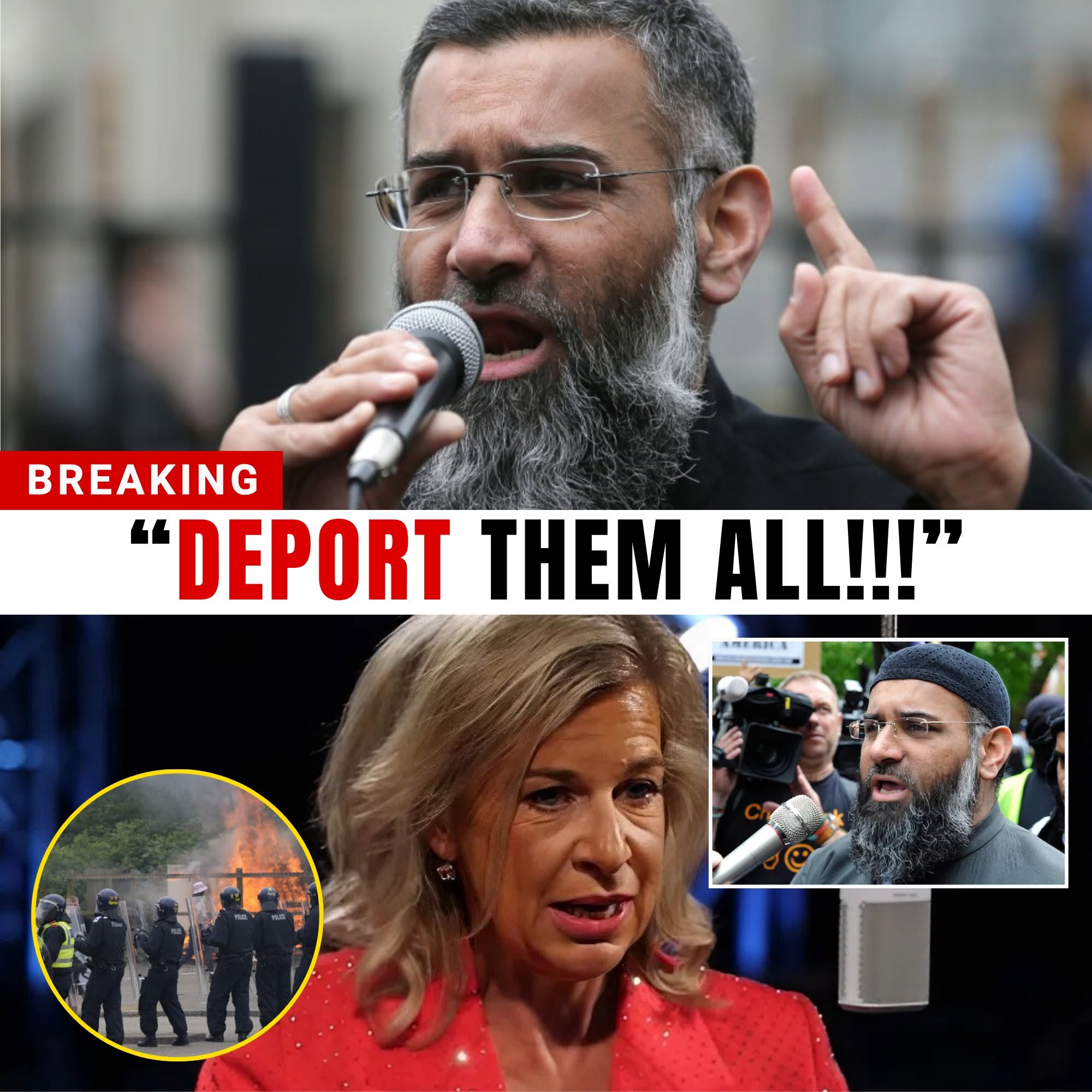
Viral ‘Deport All Muslims’ Parliament Clash Involving Katie Hopkins Has No Verified Basis
LONDON — A dramatic story claiming that commentator Katie Hopkins triggered chaos in the British Parliament after calling for the deportation of Muslims has spread online, reigniting arguments over immigration, Islam, integration and free speech. But there is a fundamental problem with the story: the supposed Westminster confrontation has not been substantiated by reliable evidence.
Posts circulating online describe an explosive parliamentary exchange in which Hopkins supposedly confronted a Muslim MP while lawmakers shouted across the chamber. Some versions claim that she demanded the deportation of “all Muslims,” while others attribute to her a narrower demand targeting Muslims who allegedly refuse to integrate or follow British law.
Those are significantly different claims.
More importantly, there is no reliable evidence that the parliamentary confrontation described in these posts actually occurred.
Hopkins is not a Member of Parliament, and Full Fact investigated an earlier viral claim depicting her confronting Muslim MPs in the House of Commons. It found no record of the alleged speech in Hansard, Parliament’s official record of proceedings. Images accompanying that story were identified as AI-generated.
That does not mean the political issues raised by the viral story are imaginary.
Britain is engaged in an intense debate over immigration, integration and national identity. Hopkins also has a long and well-documented history of provocative commentary concerning Islam and migration.
But those facts do not transform an unverified parliamentary confrontation into a real event.
What is being claimed?
The latest version of the story presents Hopkins as the central figure in a dramatic Westminster clash.
According to the viral narrative, she made sweeping remarks about deporting Muslims, was confronted by a Muslim MP and caused Parliament to descend into disorder.
Supporters supposedly praised her for expressing public frustration with immigration and perceived weaknesses in Britain’s laws, while critics accused her of inflammatory rhetoric.
There is no reliable parliamentary record supporting that sequence of events.
The absence of a Hansard record is particularly significant because speeches and exchanges in the House of Commons are formally documented.
There is an even more basic problem: Hopkins does not hold a Commons seat.
Full Fact noted this when investigating another viral post earlier this year that purported to show Hopkins speaking from the Commons despatch box and attacking Muslim MPs. The fact-checking organisation found the supposed scene had not occurred and that images used to support the claim contained evidence of AI generation.
The wording itself keeps changing
Another warning sign is that different versions of the claim attribute substantially different statements to Hopkins.
Some say she called for the deportation of all Muslims.
Others say she called for the removal of Muslims who “refuse to integrate” or refuse to abide by British law and values.
Those statements are not interchangeable.
The first proposes action against an entire religious group regardless of citizenship, immigration status or individual conduct.
The second, although still highly controversial depending on its exact wording, introduces conditions involving integration or compliance with the law.
A viral article published in August acknowledged that it could not find strong mainstream reporting confirming the exact alleged quotation or the supposed parliamentary setting.
Without a full recording, verified transcript or reliable first-hand report, the most extreme version of the quotation should not be attributed to Hopkins as established fact.
Hopkins does have a controversial record on Islam
None of this means Hopkins has avoided inflammatory statements about Muslims in the past.
She has repeatedly attracted criticism over comments concerning Islam, immigration and multiculturalism.
Following the Manchester Arena bombing in 2017, Hopkins published a tweet calling for what she described as a “final solution.” The wording prompted widespread condemnation because of the phrase’s historical association with Nazi Germany’s murder of European Jews.
The controversy was followed by her departure from LBC. Contemporary reporting also documented complaints to police concerning her comments.
Her previous statements therefore provide context for why some audiences may find a new extreme quotation attributed to her believable.
But a public figure’s history of controversial rhetoric cannot serve as proof that a new quotation is authentic.
Each claim still requires independent verification.
Previous false claims have already circulated
The current story also resembles another demonstrably false narrative involving Hopkins and Parliament.
In March 2026, Full Fact investigated posts claiming she had “unleashed hell in the Commons” and accused Muslim MPs of interfering politically with policing decisions.
Images supposedly showed Hopkins standing at the despatch box, with identifiable MPs sitting behind her.
Full Fact found no corresponding statement in Hansard.
Its investigation also found that the images had been created or modified using Google AI technology, with SynthID information indicating AI involvement.
There was another straightforward inconsistency: the social-media post claimed the confrontation had happened in Parliament that day, even though the Commons was in recess during the relevant period.
The episode illustrates how convincing political misinformation can be constructed by combining real politicians, genuine political disagreements and fabricated visual evidence.
Is Hopkins part of Reform UK?
The viral claim also describes Hopkins as “Reform UK’s Katie Hopkins.”
That description requires caution.
Hopkins has publicly promoted Reform candidates and policies. During the 2026 Welsh election campaign, for example, she posted material encouraging people to support Reform UK and praised one of its candidates.
Political support, however, is not the same as being a Reform MP or official parliamentary representative.
This distinction matters because describing Hopkins as a Reform UK politician participating in a Commons confrontation gives the viral story institutional credibility it has not earned.
The central image presented by the claim — a Reform parliamentarian confronting a Muslim MP inside Westminster — is therefore misleading on multiple levels.
The underlying immigration debate is real
The fabrication or exaggeration of a particular parliamentary confrontation should not be confused with the legitimacy of discussing immigration policy.
Britain is experiencing genuine political disagreements over irregular Channel crossings, asylum accommodation, deportations, legal migration, integration and national security.
Politicians across several parties are proposing different responses.
Those arguments can be examined using actual government statistics, parliamentary records, legislation and independently verified reporting.
Similarly, concerns about extremism can be discussed without treating Muslims collectively as responsible for the conduct of extremists.
Britain’s Muslim population includes British-born citizens as well as immigrants, and immigration status is legally separate from religious identity.
A British Muslim citizen cannot simply be treated as deportable because of religion.
Conversely, immigration enforcement can apply to people of any religion when the legal requirements for removal are satisfied.
Collapsing religion and immigration status into a single category therefore obscures rather than clarifies the policy debate.
Why stories like this spread so effectively
The viral Hopkins narrative contains many features that make political misinformation attractive online.
It has a famous and polarising protagonist. It involves Parliament. It presents a dramatic confrontation between opposing political identities. It offers an explosive quotation and promises an “unfiltered” video revealing what supposedly happened.
Most importantly, it builds upon a real political conflict.
People already know Hopkins has made controversial statements. They know immigration is politically contentious. They know MPs frequently engage in heated Commons exchanges.
A fabricated confrontation combining those real elements can therefore appear plausible even when the specific event never occurred.
Artificial intelligence makes that problem more difficult.
A realistic image of a commentator standing in the House of Commons may look persuasive to someone scrolling rapidly through social media. Unless viewers check parliamentary records or trace the image’s origin, visual familiarity can substitute for evidence.
What can actually be established?
The available evidence produces a much less dramatic conclusion than the viral headline.
There is no verified evidence that Katie Hopkins recently stood in Parliament, demanded the deportation of all Muslims and became involved in a confrontation with a Muslim MP that sent Westminster into chaos.
A previous highly similar story involving Hopkins confronting Muslim MPs in the Commons has already been independently investigated and rated false.
Hopkins genuinely has a record of controversial commentary about Islam and immigration. She has also publicly supported Reform UK politically. Those facts can be documented.
But they are not evidence that this particular confrontation happened.
The distinction is especially important because the alleged quotation concerns an entire religious community.
Immigration policy, integration, extremist activity and deportation law are legitimate subjects for vigorous political debate. Claims about what a public figure said inside Parliament should nevertheless meet a simpler standard:
Did the event actually happen?
In this case, the evidence currently available points away from the sensational account circulating online.
The political argument is real.
The dramatic Westminster showdown, based on the evidence available, is not.
The claim that Katie Hopkins sparked a parliamentary row over deporting Muslims needs an important qualification: a viral story is not the same as a verified event. In March 2026, the fact-checking organisation Full Fact reported that a widely shared claim about Hopkins confronting Muslim MPs in the House of Commons was false. There was no corresponding record in Hansard, and images purporting to show the confrontation had been generated using artificial intelligence. Hopkins is not a Member of Parliament.
Full Fact
The broader debate over immigration, integration, religious freedom and national identity is real, however, and it continues to generate strong reactions across British politics.
The controversy surrounding the phrase “deport all Muslims” illustrates how quickly an inflammatory political claim can spread online, especially when it appears to involve a confrontation inside Parliament. Such a headline can attract enormous attention because it combines immigration, religion, political conflict and questions about the limits of free speech.
But the distinction between a genuine parliamentary exchange and a fabricated account is essential. The House of Commons has an official record of its proceedings, known as Hansard. Claims that a public figure made a particular statement inside the chamber can be checked against that record. When a dramatic story lacks a verifiable parliamentary transcript, readers should be cautious about accepting its details as fact.
That does not mean Britain is avoiding difficult questions about immigration. Parliament has debated proposals for offshore detention and the deportation of people who enter the country illegally. In July 2026, MPs were scheduled to discuss a petition that had received more than 720,000 signatures and called for offshore facilities to process people arriving without authorisation and arrange their removal where legally possible. The government had argued that offshore detention would be costly and impractical, while pointing to wider asylum reforms.
UK Parliament+1
Those discussions demonstrate that immigration enforcement remains a major political issue. They are also different from a proposal to deport an entire religious population.
Muslims in Britain are not a single political or social group. They include British-born citizens, people who have lived in the country for generations, permanent residents, students, workers, refugees and people with many different nationalities and political beliefs. Their religious identity alone does not determine their citizenship or immigration status.
A blanket demand to remove people because they are Muslim would therefore raise fundamental questions about equality, religious freedom and the rule of law. Immigration decisions depend on an individual’s legal circumstances, not simply membership of a faith. British citizens cannot be treated as removable migrants merely because they practise Islam.
The distinction is important in a political environment where arguments about integration can become mixed with assumptions about religion. Governments can debate language education, employment, social cohesion, criminal justice and the enforcement of immigration rules without treating an entire faith community as collectively responsible for individual wrongdoing.
The same principle applies to security. Where individuals commit crimes, support violence or participate in extremist activity, authorities can investigate their conduct and take appropriate legal action. The relevant evidence concerns what those individuals have done, not whether they share a religion with millions of other people.
Katie Hopkins has long been a controversial commentator whose statements about immigration and multiculturalism have attracted extensive public criticism. Her reputation helps explain why claims attributed to her can spread rapidly. However, an established reputation for provocative commentary does not prove that she made a particular statement on a particular occasion.
This is where responsible reporting becomes especially important. A viral post may contain a dramatic quotation, an image of a parliamentary chamber and a description of MPs supposedly reacting in anger. Those details can create the impression of an authentic news event. Yet images can be manipulated or generated, quotations can be invented, and stories can combine genuine political disagreements with events that never occurred.
The appropriate response is to check the original record and distinguish confirmed facts from allegations. In this case, the specific claim that Hopkins confronted Muslim MPs in Parliament was debunked by Full Fact. It should not be repeated as an established incident simply because similar controversies have occurred elsewhere.
Full Fact
Meanwhile, Britain’s debate over deportation policy involves practical questions that deserve serious attention. The government must consider how quickly asylum claims can be processed, how failed applications are handled, how people with no legal right to remain can be removed and how the country meets its legal obligations to those seeking protection.
The legal position can be complicated. People who claim asylum generally cannot be returned to a country where they face persecution or serious harm while their claims remain unresolved. Decisions may involve appeals, individual assessments and international obligations. These procedures can take time, creating pressure on accommodation systems and public budgets.
House of Commons Library
Critics of the current system argue that lengthy delays undermine public confidence and leave communities uncertain about how migration rules are being enforced. Supporters of refugee protections counter that due process is essential because returning someone to serious danger can have irreversible consequences.
Both the administrative challenges and the humanitarian responsibilities need to be considered. Faster processing, clearer decisions and effective removal procedures where legally justified can be debated without abandoning individual rights or assigning collective blame to religious communities.
Integration presents another set of questions. Politicians and residents may reasonably discuss the importance of learning English, respecting the law, participating in civic life and ensuring that everyone receives equal protection. But integration is not a simple test of religious identity. People from the same faith may hold sharply different views about politics, social customs and the relationship between religion and public institutions.
A productive debate would focus on measurable outcomes: access to language education, employment opportunities, school participation, community safety and the consistent enforcement of criminal law. It would also examine discrimination and barriers that can prevent people from participating fully in society.
Free speech is another central issue. In a democracy, public figures must be able to criticise immigration policies, challenge religious ideas and argue for significant changes to the law. Equally, the right to express an opinion does not make every claim accurate, nor does it prevent public scrutiny of language that targets an entire group.
The challenge is to protect open debate while resisting misinformation and threats. Criticism of a religion or a government policy is not automatically the same as hostility towards every person associated with that religion. Conversely, presenting an entire faith community as a threat can obscure individual differences and intensify social divisions.
For politicians, journalists and commentators, the responsibility is to be precise. If a claim concerns illegal immigration, it should not be presented as a claim about all migrants. If it concerns extremist conduct, it should identify the conduct and the available evidence. If an alleged parliamentary confrontation never happened, it should not be used as proof of a national political crisis.
For readers, the lesson is equally straightforward: dramatic headlines deserve verification, particularly when they attribute inflammatory words to a named individual. Checking parliamentary records and reliable fact-checking reports can prevent fabricated incidents from being mistaken for genuine political developments.
Ultimately, Britain’s immigration debate is too consequential to be driven by invented quotations or misleading images. The country faces genuine questions about border enforcement, asylum backlogs, integration, public safety and the protection of individual rights. Those questions require evidence, clear legal standards and honest disagreement.
The alleged parliamentary row involving Katie Hopkins should therefore be treated with caution, because the specific confrontation has been debunked. The broader discussion about immigration and social cohesion remains real, but it should proceed on the basis of verified events and policies rather than a fabricated scene.
A democratic society can demand effective border controls, expect everyone to obey the law and scrutinise government decisions while also protecting citizens from discrimination based on religion. These principles are not mutually exclusive. The real test is whether public debate can address difficult problems without allowing misinformation or collective blame to replace facts.