
Nigel Farage has been accused of “playing the victim” with his Prime Minister’s Questions strike after it was revealed that the Reform UK leader has not applied for a question in months.
The Clacton MP opted not to take his seat in the House of Commons during the weekly despatch box bout, with Mr Farage instead sitting alongside long-time ally Arron Banks in the public gallery.
He wrote on X: “Every week at PMQs I am attacked by the PM and Labour MPs, but have no right of reply. I am just a mere spectator. So I have decided to spectate from the public gallery today instead.”
As leader of a minor party, Mr Farage is allowed to ask questions on a rota system, alongside other party leaders with few MPs in the Commons, such as the Greens and Plaid Cymru.
If the Reform UK leader wanted to ask additional questions, as an MP, he could enter the “shuffle”, a lottery where members of the Commons submit bids to ask questions.
Mr Farage last entered this ahead of the PMQs session on July 9, nearly four months ago, according to parliamentary records.
Despite the summer recess, a break when the House of Commons and the House of Lords do not meet, there have been five sessions of PMQs since then.
Around 15 MPs are selected from the “shuffle” each week.
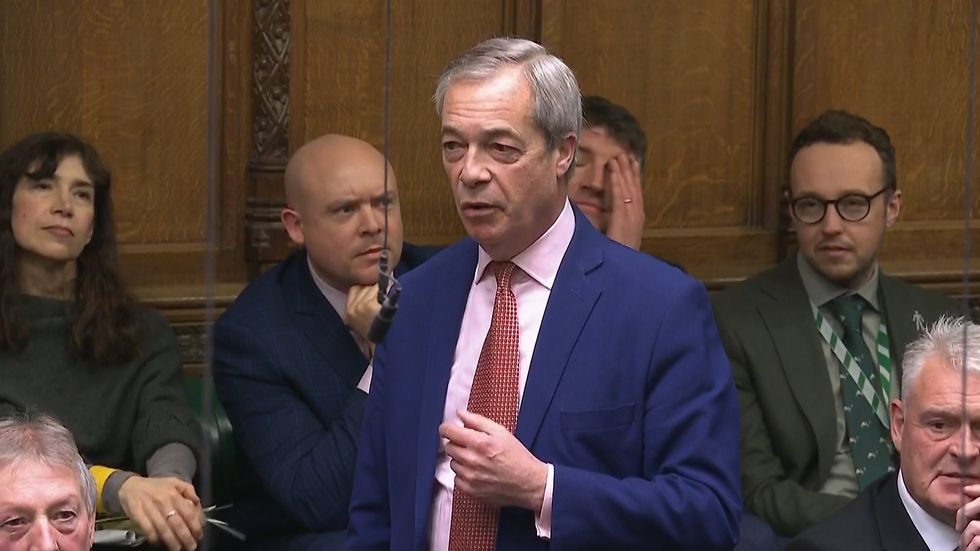
Nigel Farage has been accused of ‘playing the victim’ with his Prime Minister’s Questions strike
Liberal Democrat chief whip Wendy Chamberlain said: “This is classic Farage, all grievance and no graft. He’d rather play the victim instead of doing his job.
“He apparently doesn’t have any questions for the Prime Minister, but I suspect the people of Clacton have some questions for him.”
The records do not show how many times Mr Farage applied for the shuffle before his entry in July.
Under standard parliamentary procedure, Leader of the Opposition Kemi Badenoch gets to ask Sir Keir Starmer six questions a week.
Meanwhile, Liberal Democrat leader Sir Ed Davey gets to ask two questions as the leader of the third largest party.
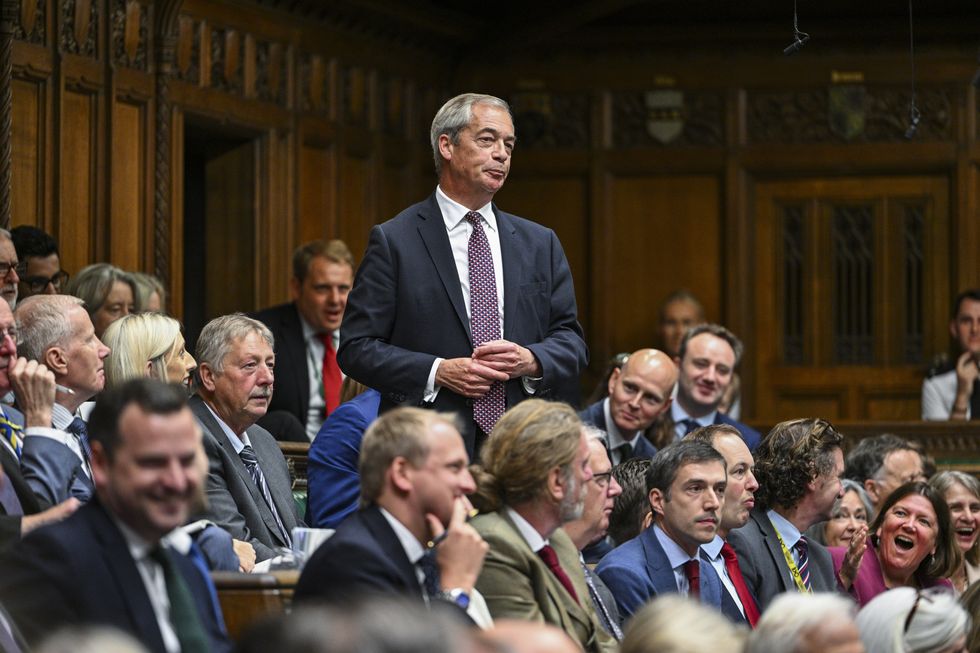
Commons Speaker Sir Lindsay Hoyle has been forced to interject during Nigel Farage’s speeches on three occasions due to heckling
House of Commons Handout photo issued by the House of Commons of Reform UK leader Nigel Farage speaking during Prime Minister’s Questions
The Reform UK leader is not due a “minor party” question until November, sparking complaints from his own party.
He has only been granted six questions since the 2024 General Election.
Commons Speaker Sir Lindsay Hoyle has been forced to interject during Mr Farage’s speeches on three occasions due to heckling.
The Speaker intervened twice on February 5 when Mr Farage slapped down an attack on Reform UK’s NHS policy.
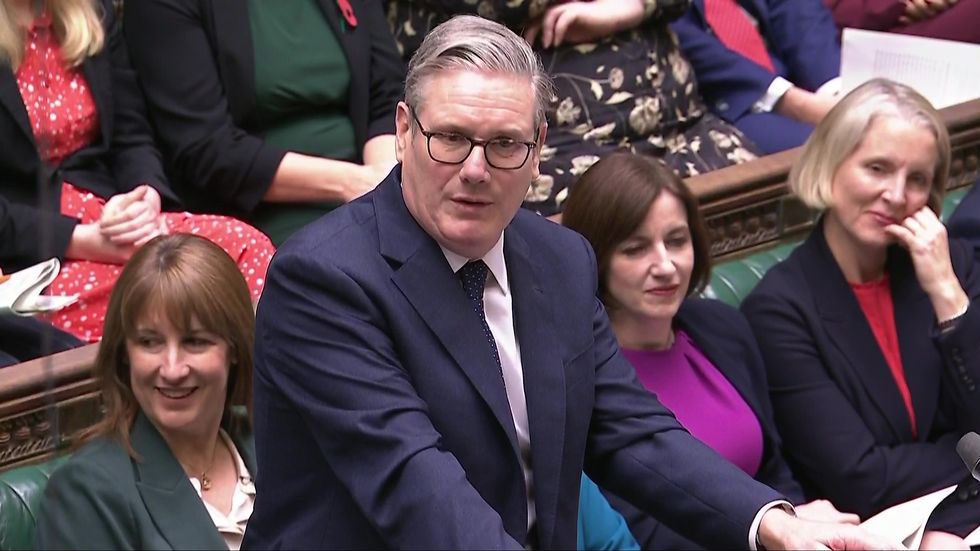
Between January 8 and October 22, the Prime Minister has landed blows against Mr Farage at 18 PMQs
PA
Between January 8 and October 22, the Prime Minister has landed blows against Mr Farage at 18 PMQs.
Ex-Deputy Prime Minister Angela Rayner also attacked Mr Farage during her stand-in appearance on June 18, which the Reform UK leader argues he cannot reply to.
Former Conservative MP Alex Stafford, who served as the MP for Rother Valley from 2019 to 2024, told GB News: “The more MPs they get, more likelihood they’re going to get called.
He added: “The speaker is quite fair, if you go to the speaker and say, ‘I want to raise a particular issue’, for instance, Nigel could say ‘I’ve been maligned in Parliament’ and the Speaker generally then will try and call that MP to raise the question.”
GB News contacted Reform UK for a comment.
Nigel Farage Accused of ‘Playing Victim’ With PMQs Strike as Reform UK Leader Hasn’t Applied for Question in Months
Reform UK leader Nigel Farage has faced fresh criticism after announcing a protest against Prime Minister’s Questions (PMQs), with political opponents accusing him of deliberately portraying himself as a victim despite apparently failing to apply for an opportunity to question Prime Minister Keir Starmer. The controversy has sparked another heated debate about parliamentary accountability, political publicity and Farage’s approach to his responsibilities as an elected Member of Parliament.
First of all, Prime Minister’s Questions is one of the most important weekly events in British politics. Every Wednesday, MPs gather in the House of Commons to question the Prime Minister about government decisions, national issues and matters affecting their constituencies. It provides opposition politicians with an opportunity to challenge the government directly and demand explanations about controversial policies.
However, Farage has complained that he is frequently criticised by Starmer and Labour MPs without receiving sufficient opportunities to respond. Frustrated by what he considers unfair treatment, the Reform UK leader decided to make a public protest by moving from the parliamentary chamber to the public gallery during PMQs in October 2025.
Farage explained his decision by claiming that he had become little more than a spectator during the parliamentary proceedings. He argued that the Prime Minister and government MPs regularly attacked him while he was unable to defend himself properly.
His protest attracted considerable media attention, but it also prompted questions about whether he had exhausted the available parliamentary procedures for securing an opportunity to speak.
According to parliamentary records reported by The Mirror and Left Foot Forward, Farage had not entered the weekly ballot for an additional PMQs question since July 2025. The ballot, commonly known as the ‘shuffle’, allows MPs to enter their names for a chance to ask one of 15 selected questions. <Cite refs={[“turn123333search0″,”turn123333search1”]}/>
This revelation became particularly damaging because it suggested that Farage had opportunities to seek additional speaking slots but had not used the available process for several months.
The Liberal Democrats were among the critics of his behaviour. Party chief whip Wendy Chamberlain accused Farage of playing the victim instead of concentrating on his parliamentary responsibilities. She argued that the people of Clacton, the constituency he represents, had legitimate questions that deserved answers.
Liberal Democrat leader Ed Davey also criticised the Reform UK leader, suggesting that his protest was an attempt to manufacture political grievances rather than address the concerns of ordinary voters.
These comments intensified the controversy, with critics questioning whether Farage was more interested in generating headlines than participating fully in parliamentary proceedings.
Nevertheless, Reform UK defended its leader. A party spokesperson argued that the allocation of questions at PMQs was unfair to smaller political parties and claimed that Reform representatives received significantly fewer opportunities than Conservative MPs.
The party also pointed out that the Speaker operates a system intended to provide smaller parties with opportunities to question the Prime Minister. Under this arrangement, Reform’s leader receives an allocated question periodically, while individual MPs can also enter the weekly ballot.
A spokesperson for Speaker Sir Lindsay Hoyle explained that all MPs, including Reform representatives, could enter the ballot. The Speaker also has discretion to call additional members to ensure a reasonable balance between political parties. <Cite refs={[“turn123333search1″,”turn123333search3”]}/>
The disagreement therefore raises an important question about parliamentary fairness. Smaller parties may reasonably argue that their representatives should have sufficient opportunities to challenge the government, particularly when their electoral support is growing.
However, critics believe that political leaders must also make full use of the opportunities already available to them. Complaining about a lack of speaking opportunities while not entering the relevant ballot creates an uncomfortable contradiction.
The controversy is also significant because Farage has increasingly positioned Reform UK as a major alternative to Labour and the Conservatives. His party has attracted voters concerned about immigration, taxation, public services and Britain’s economic future.
As Reform’s political influence grows, expectations surrounding its leadership are also increasing. Voters will want to see whether the party can demonstrate serious parliamentary experience and provide detailed answers about how it would govern the country.
Farage’s supporters argue that he is being treated unfairly by the political establishment and that his protest highlights problems with the parliamentary system. They believe that the leader of a party with substantial public support should have more opportunities to challenge the Prime Minister.
On the other hand, opponents argue that parliamentary procedures apply to all MPs and that political popularity does not automatically guarantee additional speaking time. They insist that Farage should demonstrate his commitment to parliamentary accountability by using the available mechanisms.
Another important issue concerns the relationship between political theatre and effective representation. Dramatic protests can attract attention, influence public opinion and help political parties communicate their messages. However, voters ultimately expect elected representatives to spend their time addressing practical problems.
The people of Clacton, like voters elsewhere in Britain, face concerns about housing, immigration, employment opportunities, healthcare and the cost of living. Their elected representative has a responsibility to raise these issues and explain how his political proposals would address them.
Furthermore, PMQs is only one part of parliamentary work. MPs can challenge ministers through written questions, debates, select committees and other parliamentary procedures. Therefore, the ability to scrutinise the government does not depend entirely on being selected to speak during Wednesday’s session.
In conclusion, Nigel Farage’s PMQs protest has created another political controversy after reports revealed that he had not applied for an additional question through the parliamentary ballot since July 2025. His critics have accused him of manufacturing a sense of victimhood, while Reform UK insists that smaller parties deserve fairer treatment in the House of Commons. The disagreement highlights wider questions about parliamentary fairness, political responsibility and the growing influence of Reform UK. Ultimately, voters will judge Farage not simply by his protests or television appearances, but by his willingness to use his position as an MP to challenge the government and represent the people who elected him.