
Columns of masked Muslim men were seen chanting “Allahu Akbar” in London in a march against a Ukip demonstration in the capital.
The party, now led by Nick Tenconi, had been due to stage a protest in Whitechapel – which was called off over a “realistic prospect of serious disorder” due to its large Muslim population.
His protest was moved nine miles from the borough of Tower Hamlets following a ban imposed by Scotland Yard.
A mass counter-march went ahead there, which is led by convicted fraudster mayor Lutfur Rahman.
The decision to ban Ukip from marching in Whitechapel, where at least 42.1 per cent of residents identify as Muslim, was welcomed in the local area.
On the street, a protester shouted through a megaphone: “They [Ukip] came specifically targeting Islam. They said: ‘We are coming on a crusade,’ they said: ‘We need to take back our streets.’
Hundreds, if not thousands, of masked protesters marched through Whitechapel
GETTY
“We stand firm to let them know if you come, we will stand firm and will be ready to defend our elders, to defend our women, to defend our community.
“We have never once said we were going on crusades or going into your areas to cause you problems.
“You are coming into our homes and you want to cause us problems. What is wrong with us standing up?”
Rahman said: “We will still hold our peaceful march in Whitechapel on Saturday to celebrate our diversity and unity. From the Battle of Cable Street to today, the far-right has never succeeded in dividing our community, and they never will.”
Huge crowds of masked men could be seen marching through the area chanting “Allahu Akbar”, or “God is great”, in Arabic.
In one clip, a protester holding a “Stand Up To Racism” sponsored placard could be heard saying: “There’s no need for that – we’re on the same side bruv.”
A voice from the marching crowd then shouted back: “No we’re not!”
Palestinian and Bangladeshi flags were seen as demonstrators prayed in the street on Saturday
Ukip’s protesters instead gathered in Kensington, west London.
Four counter-demonstrators in the capital’s west were then arrested, the Metropolitan Police has said.
Around 75 Ukip supporters assembled in front of the London Oratory, with images from the scene showing protesters holding a banner which said: “Islamist invaders not welcome in Britain.”
The Metropolitan Police has since confirmed that four counter-protesters who appeared along the route in breach of conditions had been arrested after refusing to leave.
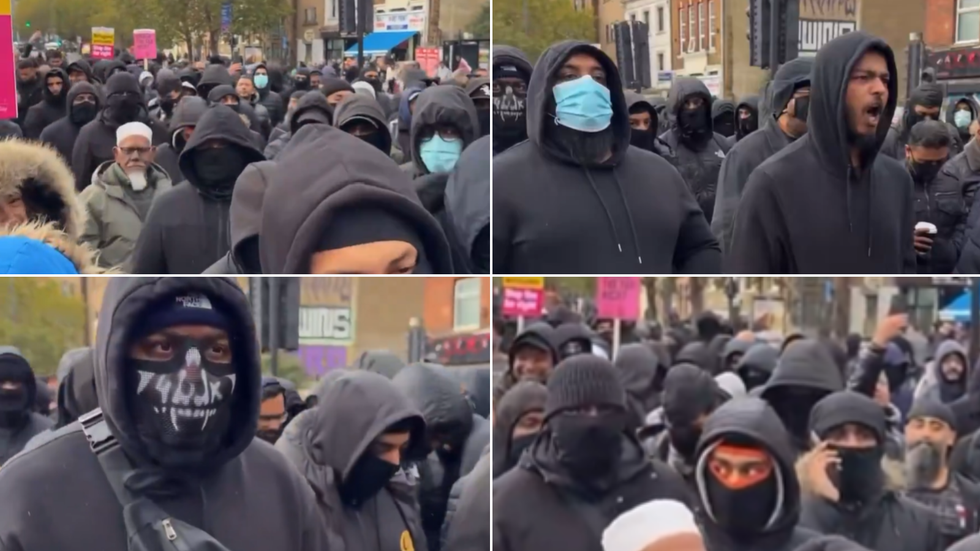
PICTURED: Columns of masked Muslim men chant ‘Allahu Akbar’ in London
X
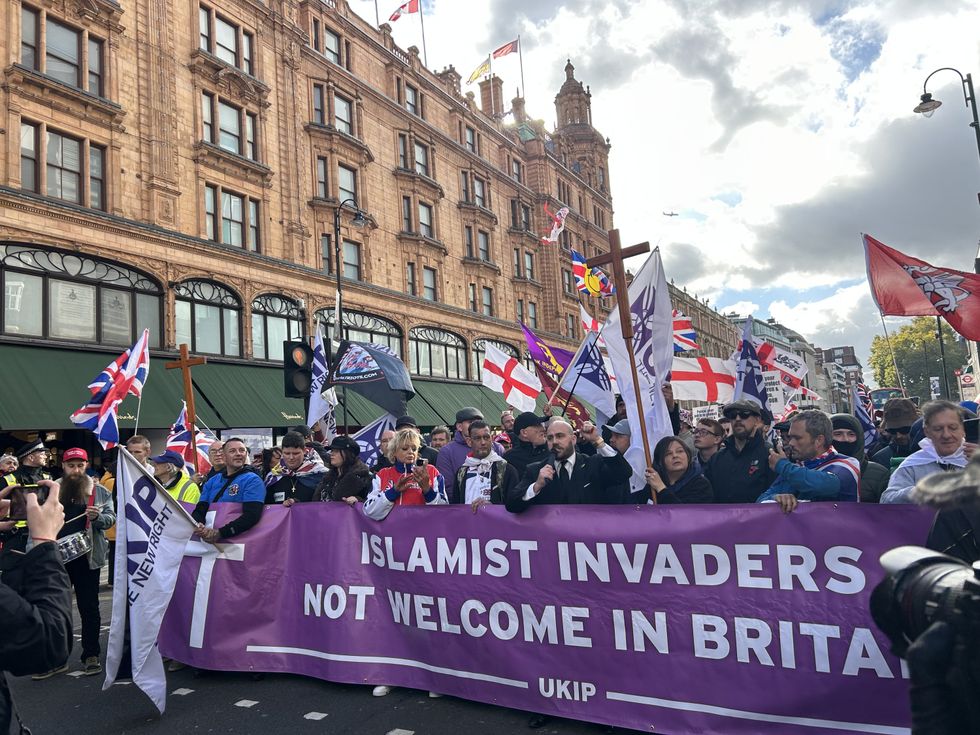
Around 75 Ukip supporters assembled in front of the London Oratory
PA
A Scotland Yard spokesman said: “Four counter protesters who appeared along the route in breach of the conditions in place and refused to leave have been arrested.”
However, the force said that no arrests had been made at the main location of the counter-demonstration in Whitechapel.
Protesters taking part in the Stand Up To Racism counter-protest were restricted from gathering in an area of central London, including where the Ukip protest was due to take place.
Ukip’s demonstration is part of a series of events taking place across the UK, which were promoted as a “mass deportations tour”, with organisers calling on attendees to “reclaim Whitechapel from the Islamists”
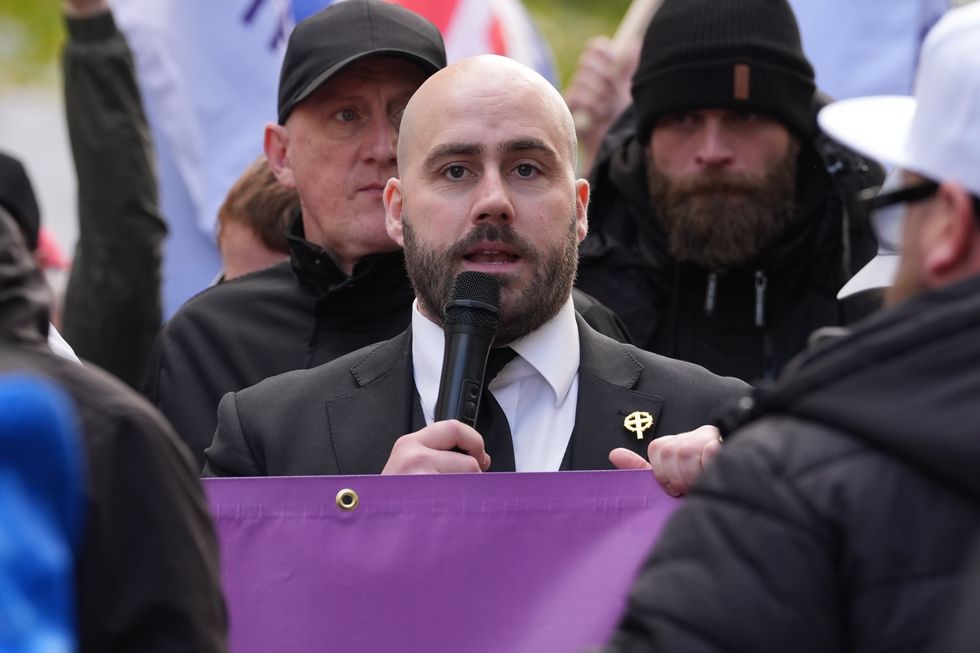
Ahead of today’s protest, hard-right Ukip leader Nick Tenconi said: ‘We will confront the communists at Hyde Park Corner’
PA
Ahead of today’s protest, hard-right Ukip leader Nick Tenconi said: “We will confront the communists at Hyde Park Corner.
“We will march to Marble Arch and I will give my historic address with the communists and Islamists flaying in the background outraged that we have once and for all finally stood up to them.
“They will be met with Christian courage and it will be glorious. Patriots, this is just the beginning. Saturday, October 25. The Crusade begins.”
Commander Nick John, who is in charge of public order policing in London this weekend, said: “Our role in relation to the policing of protest is to ensure that they take place peacefully, that offences are dealt with, that they do not cause excessive disruption to the ordinary lives of local residents, visitors and businesses and to ensure that where there is a prospect of disorder we take action to prevent it.
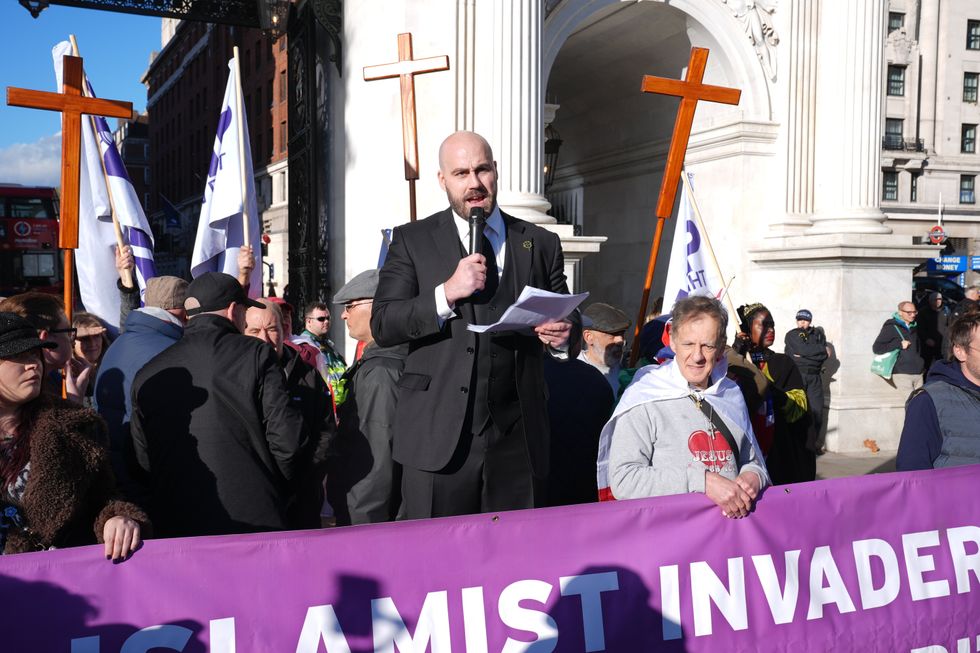
PICTURED: Ukip party leader Nick Tenconi addresses a rally at Marble Arch
PA
“The risk of such disorder can be elevated if groups with clearly opposing views are allowed to gather in close proximity to each other, particularly if they do so in the heart of a residential area at a time when tensions and fears in relation to hate crime and similar offences are heightened.
“We intervened earlier this week to use our powers under the Public Order Act to prevent a protest taking place in Whitechapel due to the prospect of serious disorder.
“This was not a ‘ban’ as it has been described in some coverage and commentary, but a requirement for the protest to move if it was to go ahead.
“We have used the same power on many occasions over the past two years when policing demonstrations by various groups.”
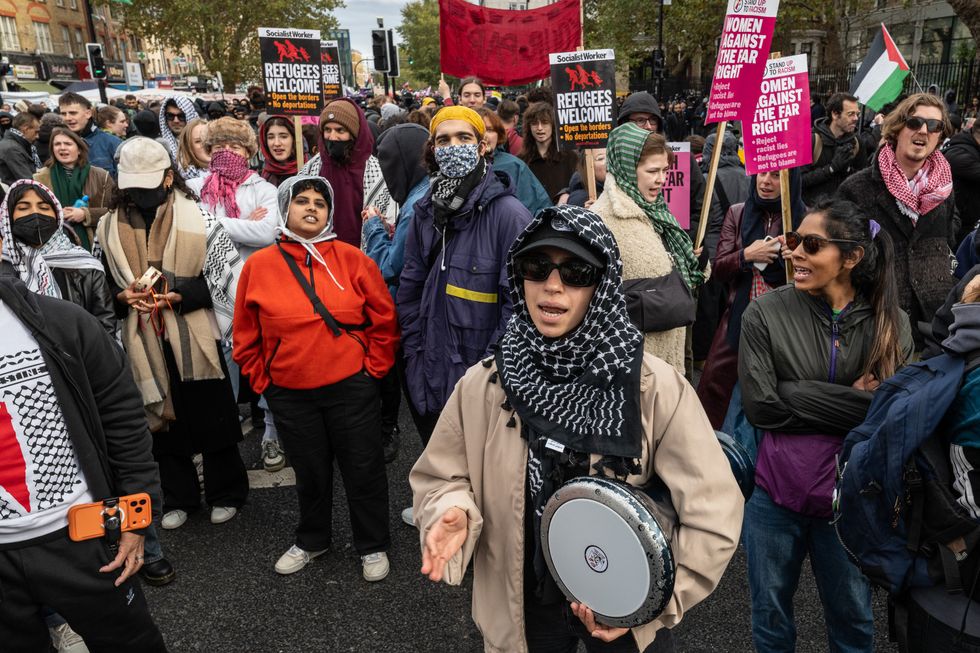
Pro-Palestine activists also marched through London
GETTY
Scotland Yard’s conditions, as per the Public Order Act, also ban members of the Ukip march from protesting before 1pm or after 4.30pm.
Earlier, counter-protesters compared the planned Ukip demonstration to the 1936 Battle of Cable Street.
The Battle of Cable Street, which is also located in Whitechapel, witnessed members of the British Union of Fascists descending on the area, which was then known for having a large Jewish population.
Toxic Political Discourse: The Urgent Need to End Political Abuse and Protect Democratic Values
In recent years, political discourse has become increasingly hostile and divisive in many democratic societies. Political disagreements, which should be an essential part of a healthy democracy, are increasingly expressed through insults, intimidation, discrimination and even acts of vandalism. A recent incident involving vandals writing the offensive message “F**k off home” on a Reform UK office has once again highlighted the growing problem of political hostility. Occurring just hours before a Speaker called for urgent action to tackle political abuse, the incident raises important questions about freedom of expression, respect for different political opinions and the responsibility of individuals to maintain a civil society. Political abuse is not simply an issue affecting politicians; it threatens democratic values, social unity and public confidence in political institutions.
First and foremost, political abuse undermines the fundamental principles of democracy. Democracy is based on the idea that people have the right to express their opinions, support different political parties and participate in public debate without fear of intimidation. In a democratic country, political parties should be able to present their policies, challenge their opponents and communicate with voters freely. However, when political disagreement turns into personal attacks, threats or vandalism, the democratic process is weakened. The incident involving the Reform UK office demonstrates how hostility can move beyond online arguments and become a physical act of intimidation. Regardless of whether people agree or disagree with the party’s political positions, damaging its property or displaying threatening messages is unacceptable. Political differences should be resolved through discussion, elections and peaceful protest rather than aggression.
Secondly, the rise of toxic political discourse can be partly attributed to the growing influence of social media. Digital platforms have transformed the way politicians, journalists and ordinary citizens communicate with one another. Although social media provides opportunities for people to share information and participate in political discussions, it can also encourage aggressive behaviour. Insulting comments, misleading information and inflammatory language can spread rapidly, reaching thousands or even millions of people within a short period. In many cases, individuals feel more comfortable expressing extreme opinions online because they believe they can avoid the consequences of their behaviour. Furthermore, social media algorithms may promote controversial content because it attracts attention and generates engagement. As a result, political discussions can become increasingly emotional, with people focusing more on attacking their opponents than examining important issues. This environment can normalise hostility and encourage similar behaviour in real life.
Another significant concern is the impact of political abuse on politicians and public representatives. People who enter public life should expect to face criticism and scrutiny because their decisions can affect millions of citizens. Nevertheless, there is an important distinction between legitimate criticism and personal abuse. Politicians should be challenged about their policies, political records and public statements, but they should not have to endure threats, harassment or intimidation. When political figures become targets of constant abuse, they may experience considerable psychological pressure, anxiety and fear for their personal safety. Some may even decide to withdraw from public life. This is particularly concerning because democracy depends on the participation of people from different backgrounds and perspectives. If political abuse discourages capable individuals from becoming involved in politics, society risks losing valuable voices and perspectives.
Furthermore, toxic political language can deepen divisions within communities. Political parties often represent different beliefs, priorities and visions for the future. Such differences are natural and can contribute positively to democratic development. However, when political leaders or supporters use hostile language to portray opponents as enemies, the distinction between political disagreement and personal hatred becomes increasingly blurred. This can create an atmosphere in which people judge others based on their political affiliations rather than their individual character. The offensive message written on the Reform UK office is particularly troubling because the phrase “F**k off home” can also carry xenophobic implications, depending on the context in which it is used. Language suggesting that certain individuals do not belong in a country can reinforce prejudice and undermine the principle of equal treatment. No individual should be subjected to intimidation or discrimination because of their perceived nationality, background or political beliefs.
Nevertheless, addressing political abuse does not mean restricting freedom of speech. Freedom of expression is one of the most important rights in a democratic society. Citizens must be able to question political leaders, criticise government policies, challenge controversial ideas and participate in peaceful demonstrations. Strong criticism is not necessarily toxic, and political debate should not be limited to polite or comfortable opinions. In fact, disagreement is essential for identifying weaknesses in public policy and holding those in power accountable. However, freedom of speech should not be used as an excuse for threats, harassment, discrimination or deliberate intimidation. The challenge for democratic societies is therefore to strike a reasonable balance between protecting free expression and preventing harmful behaviour. People should be free to disagree passionately without resorting to violence or personal attacks.
To tackle this problem effectively, political leaders must take greater responsibility for the language they use. Politicians have considerable influence over public attitudes and behaviour. Their speeches, interviews and social media posts can either encourage constructive debate or intensify social tensions. Therefore, political representatives should avoid inflammatory rhetoric, misleading accusations and language that dehumanises their opponents. Instead, they should demonstrate respect, acknowledge legitimate disagreements and focus on discussing solutions to national challenges. Leadership should involve setting positive examples, particularly during periods of political uncertainty or intense public debate. If political leaders consistently promote hostility, it becomes difficult to expect ordinary citizens to communicate respectfully.
Education also has a crucial role to play in reducing toxic political discourse. Schools, universities and community organisations should encourage critical thinking, media literacy and respectful communication. Young people need to understand how to evaluate information, recognise misinformation and distinguish between facts and opinions. They should also learn that individuals can hold different political beliefs without becoming enemies. Educational programmes that promote empathy, tolerance and democratic participation can help create a generation of citizens who are more willing to engage in meaningful discussions. In addition, social media companies should strengthen their efforts to address online harassment, threats and discriminatory content while ensuring that legitimate political expression remains protected.
Law enforcement and political institutions must also respond appropriately to acts of intimidation and vandalism. Attacks against political offices should be investigated fairly, and individuals responsible for criminal damage should be held accountable under the law. Such responses should not depend on which political party is targeted. Equal protection is essential because democratic principles cannot be applied selectively. At the same time, institutions should provide appropriate support and security measures for public representatives who face credible threats. Tackling political abuse requires cooperation between government authorities, political parties, civil society organisations, educational institutions and technology companies.
Ultimately, building a healthier political culture requires a collective commitment from everyone in society. Ordinary citizens should think carefully before sharing inflammatory content, avoid spreading unverified information and challenge abusive behaviour when they encounter it. Political supporters should recognise that loyalty to a particular party does not justify attacking those who hold different opinions. The media also has a responsibility to report political conflicts accurately and avoid unnecessarily sensationalising disagreements. Constructive journalism should inform the public, encourage critical discussion and hold powerful individuals accountable without contributing to unnecessary hostility.
In conclusion, the vandalism of the Reform UK office and the subsequent call for urgent action against political abuse highlight a serious challenge facing modern democracy. Political disagreement is unavoidable and, indeed, necessary for a functioning democratic system. However, when disagreement develops into intimidation, discrimination and violence, it threatens the freedoms and values that democracy is designed to protect. Addressing this problem requires responsible political leadership, effective law enforcement, better education, responsible social media practices and greater public awareness. Most importantly, society must recognise that respecting another person’s right to hold a different opinion does not mean agreeing with that opinion. It means defending the principles of freedom, equality and mutual respect. A strong democracy is not one in which everyone thinks alike, but one in which people can disagree openly, peacefully and respectfully without fear of abuse.