
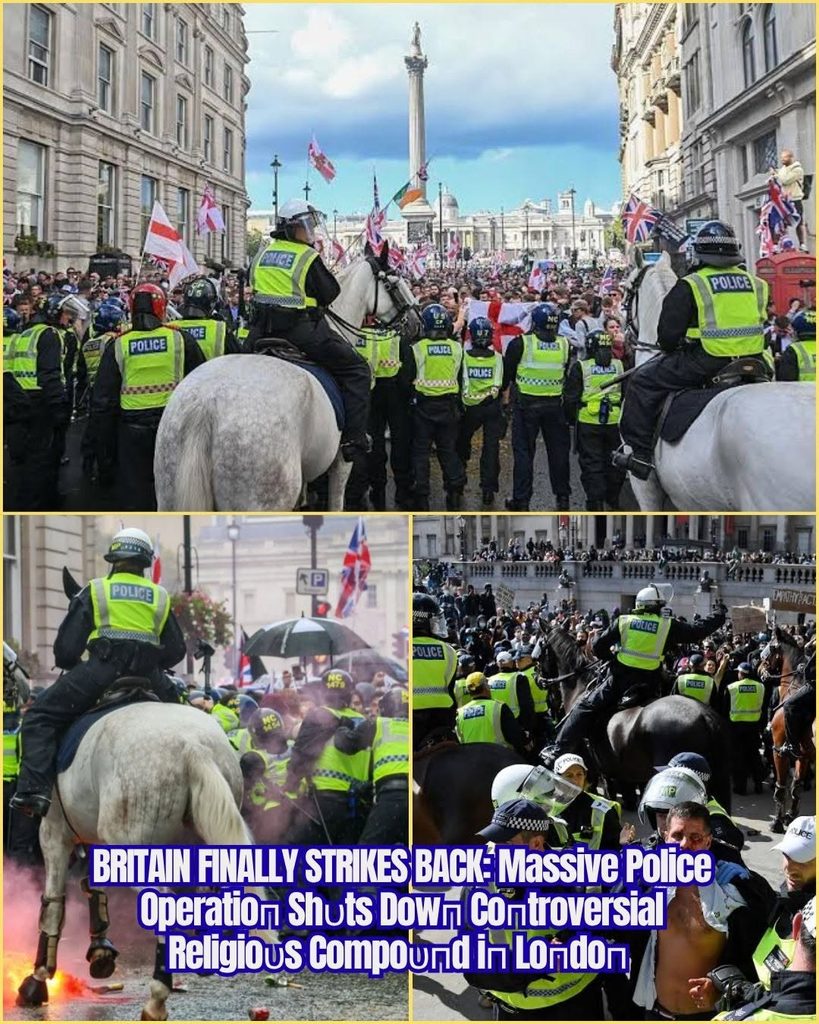

Britain woke up this morning to scenes many people described as “unbelievable” after dramatic footage emerged showing hundreds of police officers storming a heavily guarded compound linked to a controversial religious organization in London.
The operation, which reportedly began before sunrise, has instantly become one of the most talked-about stories in the country.
Videos showing armed officers, flashing emergency lights, barricaded entrances, and crowds gathering outside the compound spread across social media within minutes, triggering intense national debate.
For some, the raid represented long-overdue action.
For others, it raised troubling questions about extremism, security, freedom of belief, and how authorities allowed tensions surrounding the group to escalate for so many years.
But regardless of political opinion, one thing became clear very quickly:
The entire country was watching.
According to early reports circulating online, the compound had been the subject of growing concern for years.
Critics claimed the organization operated in near secrecy, with allegations involving intimidation, isolation practices, and connections to extremist rhetoric repeatedly discussed across forums, local communities, and activist circles.
Authorities had reportedly monitored the location for an extended period before finally launching the coordinated operation involving multiple law enforcement divisions.
Witnesses described the atmosphere as chaotic and surreal.
Residents living near the area said they were awakened by loud sirens and helicopters hovering overhead before seeing streets rapidly blocked off by police vehicles.
“I looked outside and saw officers everywhere,” one local resident reportedly said. “It felt like something out of a movie.”
Another witness described seeing dozens of officers entering the property while crowds began gathering behind police barriers filming the scene on their phones.
Within hours, clips from the raid flooded TikTok, X, Facebook, and Instagram.
Some videos appeared to show heavily equipped officers moving through gates while smoke and shouting could be heard in the background.
Hashtags connected to London, extremism, and the compound quickly surged to the top of trending lists across the UK.
The public response was immediate — and deeply divided.
Thousands praised the authorities for finally taking decisive action after years of controversy surrounding the group.
“This should have happened years ago,” one viral comment read.
Another person wrote:
“Britain cannot keep ignoring extremism hiding in plain sight.”
Supporters of the operation argued that the government had spent too long hesitating out of fear of political backlash or accusations of discrimination.
Many insisted the raid represented a turning point in how Britain responds to organizations accused of spreading dangerous ideologies.
Others, however, expressed concern over the scale and tone of the operation itself.
Civil rights advocates and some political commentators questioned whether authorities had released enough verified information to justify the dramatic response.
Several warned against allowing public fear and social media outrage to replace due process or careful investigation.
“This is exactly the kind of situation where facts matter more than emotion,” one legal analyst said during a televised discussion.
Still, public attention intensified even further after unconfirmed reports claimed investigators had discovered disturbing materials inside sections of the compound.
Although authorities had not publicly verified many of the online claims at the time, speculation exploded across the internet.
That speculation fueled even greater anger.
People across Britain began debating not only the specific operation, but the wider issue of rising extremism and public trust in institutions.
Some accused leaders of ignoring warnings for years.
Others blamed political divisions, online radicalization, and fear of public backlash for preventing earlier intervention.
One thing many people seemed to agree on was that the raid symbolized something larger than a single police operation.
To supporters, it represented frustration boiling over after years of perceived inaction.
“This isn’t just about one compound,” one commentator explained online.
“It’s about whether Britain still believes in enforcing its laws equally and protecting public safety.”
The emotional intensity surrounding the story only grew as more footage emerged throughout the day.
Images showing officers carrying evidence boxes, securing entrances, and escorting individuals away from the area continued spreading rapidly online.
Meanwhile, crowds gathered outside the police perimeter holding signs, filming livestreams, and arguing openly about what the raid meant for the country moving forward.
Political leaders were also quickly pulled into the controversy.
Several MPs reportedly demanded full transparency from law enforcement regarding the investigation, while others publicly defended the operation as necessary and overdue.
News channels dedicated hours of nonstop coverage to analyzing every new detail and viral video clip.
International media soon picked up the story as well, turning what began as a local operation into a global headline.
But beyond the political debate, many ordinary citizens described feeling something deeper:
Exhaustion.
Fear.
Frustration.
And uncertainty about what Britain is becoming.
“This country feels more divided than ever,” one London resident said during an interview outside the scene.
“People are angry, suspicious, and constantly fighting online.
This raid just brought all of that tension into the open.”
As investigations continue, authorities are expected to release additional information regarding arrests, evidence, and the reasons behind the operation.
Officials have urged the public not to spread misinformation while facts are still being verified.
Even so, the images from London have already left a lasting impression on millions of people watching around the world.
The sight of hundreds of officers storming a controversial compound in the heart of Britain’s capital has become more than just a news story.
It has become a symbol of a country wrestling with questions about security, identity, extremism, and how far governments should go when public pressure reaches a breaking point.
And whether people support the operation or fear its implications, one reality is impossible to ignore:
Britain is talking about little else tonight.
Britain Finally Strikes Back? Major Police Operation at Controversial Religious Compound in London Raises Serious Questions
A reported police operation involving a controversial religious compound in London has brought renewed attention to the difficult balance between public safety, religious freedom and the enforcement of British law. The dramatic claim that authorities have finally “struck back” raises questions about what prompted the operation, whether arrests were made and what investigators may have discovered.
However, the details of the incident are essential. Without a verified location, an official police statement or reliable reporting identifying the compound, it would be irresponsible to claim that a particular religious group has been shut down or that criminal activity has been established.
What can be examined is the broader significance of police action involving a religious organisation, the standards that authorities must follow and why such operations can become the focus of intense public debate.
What Could Prompt a Major Police Operation?
Police operations involving religious premises can take place for a range of reasons. These may include investigations into alleged criminal offences, safeguarding concerns, suspected financial misconduct, public-order issues or the execution of a court-authorised search warrant.
The presence of officers at a religious building does not, by itself, establish that its leaders or members have committed a crime. Investigators must establish the relevant facts, collect evidence lawfully and determine whether there are grounds for further action.
Depending on the circumstances, officers may interview witnesses, secure evidence, search specified premises or make arrests. Each action has its own legal requirements, and the details of an operation matter when assessing whether the authorities acted appropriately.
If a religious compound has genuinely been closed or its activities suspended, the legal basis would be particularly important. A temporary restriction during an investigation is not necessarily the same as a permanent closure, and a search does not automatically mean that an organisation has been found guilty of wrongdoing.
The public therefore needs clear information about what happened, which authority was involved and whether any formal decision has been made.
Religious Freedom and the Rule of Law
Britain’s legal system protects freedom of religion and belief. People are generally entitled to practise their faith, gather for worship and organise religious communities, provided their activities comply with the law.
These protections apply to religious groups even when their beliefs are unfamiliar, unpopular or controversial. At the same time, religious status does not exempt individuals or organisations from ordinary legal obligations.
If credible evidence indicates that a crime has occurred, police can investigate regardless of whether the location is a private residence, commercial building, religious centre or other institution.
The challenge is ensuring that enforcement is based on evidence rather than hostility towards a particular belief system. Authorities must distinguish between lawful religious practices and conduct that may breach criminal or civil law.
This distinction is important for public confidence. People should be able to trust that police will respond to genuine threats while respecting the rights of individuals who have done nothing unlawful.
A successful investigation should therefore be judged by the quality of the evidence, the legality of the procedures and the protection afforded to anyone affected by the operation.
Why Controversial Religious Compounds Attract Attention
Religious communities sometimes operate from buildings that combine worship, accommodation, education and community activities. Depending on the organisation, such premises may have restricted access or internal rules that are unfamiliar to outsiders.
When questions arise about what happens inside these buildings, concerns can develop over transparency, safeguarding and the welfare of residents or visitors.
Those concerns deserve appropriate investigation when supported by credible information. However, secrecy or unusual religious practices alone do not prove criminal conduct.
Responsible reporting should identify the specific allegations, explain who has made them and establish whether they are supported by independent evidence. It should also give the organisation concerned a fair opportunity to respond where appropriate.
Without that context, sensational descriptions can create the impression of a confirmed scandal before investigators have established what happened.
Public Safety Must Remain the Priority
Where an operation is prompted by a credible threat to public safety, authorities must be able to act within the law. Their responsibilities may include protecting vulnerable individuals, preventing further offences, securing evidence and ensuring that anyone at immediate risk receives assistance.
If children or vulnerable adults are involved, safeguarding arrangements may be particularly important. Relevant agencies may need to coordinate their work, depending on the circumstances and the nature of the concerns.
Yet public safety is best served by accurate information rather than speculation. Unsupported claims can damage innocent people, heighten tensions between communities and make it harder for the public to understand the real issues.
Police statements should therefore be read carefully. An announcement that officers are investigating allegations is different from confirmation that offences have occurred. An arrest is not a conviction, and a person under investigation should not automatically be treated as guilty.
These distinctions are fundamental to the principle that everyone is entitled to a fair process.
The Role of London’s Police
London’s policing environment presents complex challenges. Officers must respond to crime, public disorder, safeguarding concerns and security threats across a city containing many different communities and religious traditions.
When police conduct a high-profile operation, the public may expect immediate answers. In practice, investigators may be unable to release every detail while searches, interviews or other investigative work continue.
There may also be legal restrictions on what can be disclosed, particularly where doing so could compromise evidence or affect proceedings.
Nevertheless, authorities should provide accurate updates when they can. Clear communication can reduce rumours, explain the purpose of police action and reassure residents that concerns are being handled appropriately.
If a closure has occurred, officials should clarify whether it is temporary or permanent and identify the relevant legal authority where possible. If no closure has been ordered, reporting should avoid suggesting otherwise.
The Danger of Turning an Investigation Into a Cultural Conflict
Operations involving religious institutions can quickly become entangled in wider debates about immigration, integration, extremism and national identity. Political commentators may interpret a particular incident as evidence for much broader claims about British society.
Such arguments need to be examined carefully. Evidence relating to one organisation cannot automatically establish that an entire religion or community presents a threat.
Collective blame is neither a reliable method of investigating crime nor a sound basis for public policy. Criminal responsibility belongs to individuals and organisations where the evidence establishes the relevant conduct.
Equally, concerns about a specific institution should not be dismissed simply because they involve a religious setting. Credible allegations deserve investigation, and victims or witnesses should be able to seek help without fear of being ignored.
The appropriate response is to focus on the facts of the individual case, ensure that the law is applied consistently and avoid generalisations that unfairly target people who have no connection to any alleged wrongdoing.
What Happens Next?
The next steps depend on the verified circumstances of the reported operation. Police may release further information, seek assistance from witnesses, conduct additional searches or refer evidence to prosecutors.
If arrests have occurred, investigators will need to follow the applicable procedures. If premises have been restricted or closed, the legal basis and duration of that restriction will matter. If the operation has concluded without charges, that outcome should also be reported accurately.
The public should look for confirmation from the relevant police force, court records or established news organisations before accepting claims about arrests, criminal discoveries or permanent closures.
The name of the organisation, the exact location and the date of the operation would help establish which incident is being discussed. Without those details, specific claims about what officers found or why they acted cannot be reliably confirmed.
Conclusion: Evidence Must Come Before Dramatic Claims
The headline describing Britain as finally striking back suggests a decisive confrontation between the authorities and a controversial religious compound. But the facts must determine whether that description accurately reflects what occurred.
A police operation may represent an important step in an investigation, but it does not automatically establish guilt or prove that an entire organisation has been shut down. Those conclusions require reliable evidence and, where relevant, formal legal decisions.
The wider principles are clear. Public safety must be protected, credible allegations must be investigated and religious freedom must be respected. Authorities should act lawfully, communicate clearly and provide appropriate safeguards for everyone affected.
Ultimately, the significance of the London operation will depend on what investigators establish and what can be verified independently. The public deserves a factual account of the incident—not assumptions based on a dramatic headline.