
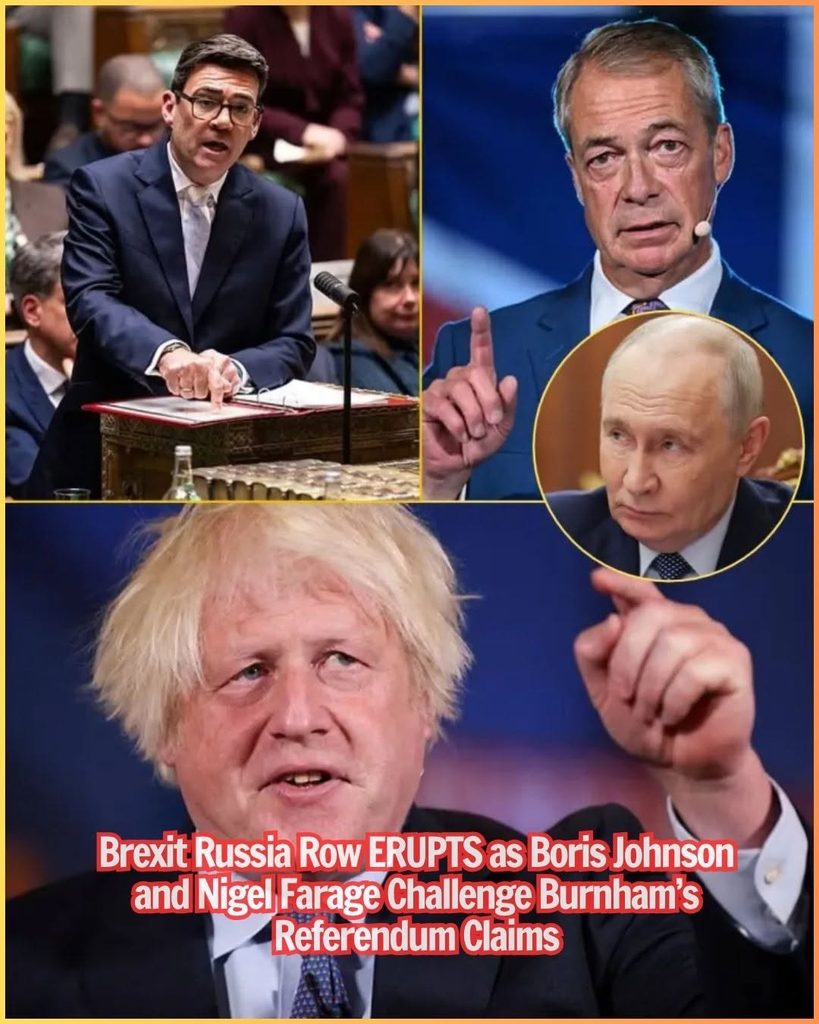
Prime Minister Andy Burnham is facing fierce criticism from Boris Johnson and Nigel Farage after claiming Russia interfered in the 2016 Brexit referendum, prompting a fresh political dispute over evidence, foreign influence and the legitimacy of Britain’s historic vote.
A bitter row over Brexit has erupted in Westminster after Andy Burnham said he had received confirmation that Russia interfered in the referendum that led Britain to leave the European Union.
Speaking on The Rest Is Politics podcast, the Prime Minister explained that he had asked about Moscow’s involvement after entering Downing Street in July.

Burnham said he was informed that interference had occurred, arguing that European democracies needed to understand the risks posed by foreign attempts to disrupt political processes.
His remarks immediately provoked a strong reaction from prominent Brexit supporters.
Reform UK leader Nigel Farage accused the Prime Minister of lying, insisting that earlier assessments had found no evidence of Russian interference capable of changing the referendum outcome.
Former Prime Minister Boris Johnson also challenged Burnham’s account.
Johnson said he had asked the security services about the issue after becoming foreign secretary in 2016 and had been told there was no evidence of successful interference by Russia or another foreign power.
However, the dispute centres partly on an important distinction: whether Russia attempted to interfere and whether any such activity actually influenced the result.
Downing Street subsequently clarified that Burnham was not suggesting the referendum had been illegitimate.
Foreign Office minister Stephen Doughty also said that Russian attempts to interfere had not succeeded.
The government maintained that Britain’s decision to leave the European Union remained valid.
The controversy revived questions first raised in a 2020 report by Parliament’s Intelligence and Security Committee.
That investigation criticised the government’s failure to properly assess potential Russian influence surrounding the referendum, including activity involving state-backed media and online accounts.
It did not establish that Russian activity changed the outcome.
The renewed argument comes at a politically sensitive moment, with Burnham seeking closer cooperation between Britain and the European Union.
His government has indicated that improved relations with Brussels could help address challenges involving trade, economic growth and migration.
Critics have questioned whether reopening discussions about Russian interference risks undermining confidence in the referendum.
Burnham, meanwhile, has maintained that acknowledging potential foreign interference does not invalidate the decision made by British voters.
The Prime Minister has also linked the issue to wider concerns about Russian disinformation campaigns targeting European democracies.
For Johnson and Farage, the central issue remains the evidence behind Burnham’s original statement.
For the government, the emphasis is on distinguishing attempted interference from a successful effort to alter an election result.
With Brexit still one of Britain’s most divisive political questions, the disagreement has rapidly become another confrontation over the country’s past decision and its future relationship with Europe.
What remains unresolved publicly is the precise intelligence underpinning Burnham’s assessment — and whether further information will be released to clarify the extent of any Russian activity.
Brexit Russia Row Erupts as Boris Johnson and Nigel Farage Challenge Burnham’s Referendum Claims
Britain’s Brexit debate has returned to the political spotlight as claims about Russia’s role in the referendum collide with renewed criticism from Boris Johnson and Nigel Farage over Andy Burnham’s position on the country’s departure from the European Union. The dispute has reopened difficult questions about foreign interference, democratic accountability and whether Britain’s relationship with Europe should be reconsidered.
Brexit remains one of the most consequential political decisions in modern British history. Although the 2016 referendum settled the immediate question of EU membership, arguments about its consequences have continued to shape debates over trade, immigration, sovereignty and the country’s economic future.
The latest row illustrates how deeply the issue remains embedded in British politics. For some politicians, questions about Russia and the referendum concern the integrity of democratic decision-making. For others, revisiting the referendum risks undermining the decision made by voters. Meanwhile, Burnham’s views on Britain’s future relationship with Europe have become part of a wider argument about Labour’s direction and the political choices facing the country.
However, the precise claims made by each politician matter. Allegations about foreign interference, assertions about the referendum result and arguments about a future referendum are separate issues that should not be confused.
Why Russia Has Returned to the Brexit Debate
Russia’s possible influence on Western political debates has attracted scrutiny for years. Governments and security agencies in several countries have investigated attempts to influence public discussion through online activity, misleading information and the amplification of divisive political messages.
The Brexit referendum took place in June 2016, when voters chose whether the United Kingdom should remain in or leave the European Union. The Leave campaign won approximately 52 per cent of the vote, compared with about 48 per cent for Remain.
The result was clear, but the campaign environment subsequently became the subject of extensive political and public debate. Questions emerged about online advertising, the use of personal data, campaign financing and the influence of foreign actors in democratic processes.
It is important, however, to distinguish evidence that foreign-linked accounts discussed or amplified particular political messages from evidence that a foreign government determined the outcome of the referendum. Those are very different claims and require different standards of proof.
A careful examination of the Russia question therefore needs to establish which activities have been documented, what investigations concluded and what remains uncertain. The existence of geopolitical interest in Brexit does not, by itself, prove that Russia controlled the campaign or changed the result.
The issue remains politically sensitive because it touches on a fundamental democratic principle: voters should be able to make decisions based on open debate rather than covert manipulation.
Boris Johnson’s Position and the Defence of Brexit
Boris Johnson was one of the most prominent figures in the campaign to leave the EU. His support for Brexit became a defining part of his political identity and helped establish him as a leading voice within the Conservative Party.
Johnson and other Brexit supporters have consistently defended the referendum result as a legitimate expression of public opinion. From this perspective, leaving the EU was a decision about national sovereignty, democratic control and the ability of the United Kingdom to determine its own laws and policies.
Supporters of Brexit argue that the referendum should not be retrospectively dismissed because political opponents disagree with its outcome. They maintain that governments have a responsibility to respect the decision and focus on making the post-Brexit settlement work.
At the same time, defending the referendum result does not mean every aspect of the campaign must be beyond scrutiny. Questions about campaign conduct, financial transparency and foreign interference can be investigated without automatically invalidating the result.
That distinction is central to the current political dispute. Investigating possible interference is not necessarily the same as demanding another referendum, just as defending the referendum result does not require dismissing every concern about the campaign.
For Johnson, any suggestion that the referendum lacked legitimacy is likely to touch on one of the most important political achievements associated with his career. But the precise substance of his response to Burnham’s latest claims would need to be established from a verified statement rather than inferred from his historical position.
Nigel Farage and the Battle Over Brexit’s Legacy
Nigel Farage has also played a central role in the movement for British withdrawal from the European Union. Through UKIP, the Brexit Party and later Reform UK, he has made national sovereignty and immigration major themes of his political campaigns.
Farage has generally argued that Brexit represented a democratic decision that should be respected. He has also criticised attempts to move Britain closer to the EU’s political structures, particularly where he believes they would weaken the country’s ability to control its own affairs.
For his supporters, the referendum was not simply a dispute about trade arrangements. It was a demand for political change and a rejection of decisions being made at a distance from British voters.
Critics of Farage’s approach argue that Brexit has produced economic and administrative challenges that deserve serious examination. They point to trade barriers, difficulties affecting some businesses and the continuing need for cooperation with European countries on security, research and other shared interests.
These disagreements illustrate the difference between assessing Brexit’s practical consequences and debating whether the original decision was democratically legitimate. Both questions matter, but they cannot be answered by the same evidence.
If Farage is challenging Burnham’s claims about the referendum, the key issue is the specific argument being disputed. Without the original wording and supporting evidence, it would be inappropriate to attribute a detailed position to either politician beyond their established public records.
Andy Burnham and Labour’s European Dilemma
Andy Burnham has remained an influential Labour figure through his role as Greater Manchester mayor. His national profile means that statements about Brexit, relations with Europe and Britain’s political future can attract attention well beyond the region he represents.
Labour has faced a difficult balancing act over Brexit. The party includes voters who supported Remain, voters who supported Leave and people whose priorities now focus more heavily on public services, living standards and economic growth.
A political figure considering closer relations with the EU must therefore address several questions. How can Britain improve trade and cooperation without reopening every argument from the referendum? Which parts of the current relationship create the greatest economic or administrative difficulties? What changes would require parliamentary approval, negotiations with European institutions or another public vote?
These are substantive policy questions, not merely disputes about political personalities.
Closer cooperation with the EU can take many forms, including agreements on trade, research, security and professional standards. It does not automatically mean rejoining the bloc. Likewise, discussing the possibility of a future referendum does not establish that one has been formally proposed or scheduled.
Any claims about Burnham’s intentions should therefore be assessed against his actual statements and any published policy proposals. A headline suggesting a confrontation does not, on its own, establish the precise disagreement.
Could Britain Hold Another Referendum?
The possibility of another referendum remains a recurring topic in British political discussion. Those who favour a new vote argue that the public should be able to reassess the relationship with the EU in light of subsequent developments. Opponents argue that reopening the question would undermine political stability and disregard the decision made in 2016.
A future referendum would involve substantial political and practical questions. What precise question would voters be asked? Would the choice concern rejoining the EU, negotiating a closer partnership or accepting a particular agreement? What would the proposed terms of membership be, and how would the government explain the economic and legal implications?
These distinctions are crucial because “rejoining Europe” is often used loosely in public debate. The United Kingdom remains geographically European and maintains diplomatic, commercial and security relationships with European countries. The specific issue is the institutional relationship with the European Union.
Rejoining the EU would require negotiations and agreement on the terms of membership. A closer partnership outside the bloc would involve a different set of arrangements. A referendum on either option would need a clear question and a defined policy objective.
There is also a question of timing. Governments generally have to balance long-term constitutional decisions against immediate priorities such as economic performance, public services and international security.
For these reasons, discussion about another referendum should not be confused with a confirmed plan to hold one.
What the Russia Row Means for British Democracy
The dispute raises an important issue beyond Brexit itself: how democracies should respond to allegations of foreign interference while preserving confidence in legitimate political debate.
Foreign governments may seek to influence public opinion because divisions within another country can create strategic opportunities. Digital platforms make it easier to spread information quickly, sometimes through accounts whose affiliations or intentions are difficult to establish.
However, not every controversial post, political argument or online campaign is evidence of foreign direction. Investigations must distinguish between coordinated activity, ordinary political expression and claims that cannot be substantiated.
Transparency around political advertising, campaign finance and online influence can help the public understand how political messages are distributed. Independent scrutiny is also important because allegations of foreign interference can themselves become tools in domestic political disputes.
A credible response requires evidence, proportionate conclusions and an explanation of the limits of what investigators can establish.
Conclusion: Brexit Remains an Unresolved Political Fault Line
The renewed dispute involving Russia, Boris Johnson, Nigel Farage and Andy Burnham demonstrates that Brexit remains a significant dividing line in British politics. The referendum settled the question of EU membership in 2016, but it did not end disagreements about the campaign, the consequences of withdrawal or the country’s future relationship with Europe.
Johnson and Farage have long defended the decision to leave, while debates about closer cooperation and a possible future referendum continue among politicians and voters with differing priorities.
The Russia question requires particular care. Evidence of attempted foreign influence should be examined seriously, but it should not be used to make claims about the referendum’s outcome that the evidence cannot support.
Similarly, any claims about Burnham’s position should be judged against his actual words and documented proposals rather than assumptions about his political ambitions.
Ultimately, Britain’s next steps on Europe will depend on political decisions, negotiations, economic evidence and public opinion. The most constructive debate will focus on verifiable facts: what happened during the referendum campaign, what Brexit has changed, which problems remain and what realistic options are available for the future.