
The brief interaction, which took place amid heightened global tensions, has sparked significant backlash from political opponents and commentators in the UK, who argue the exchange represents a diplomatic misstep for the Labour Party.
Advertisement
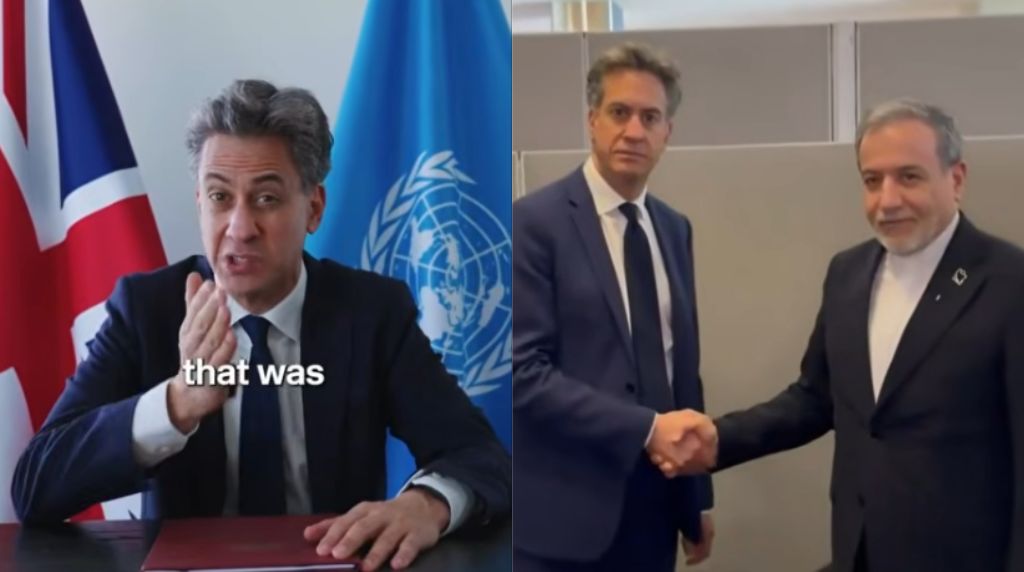
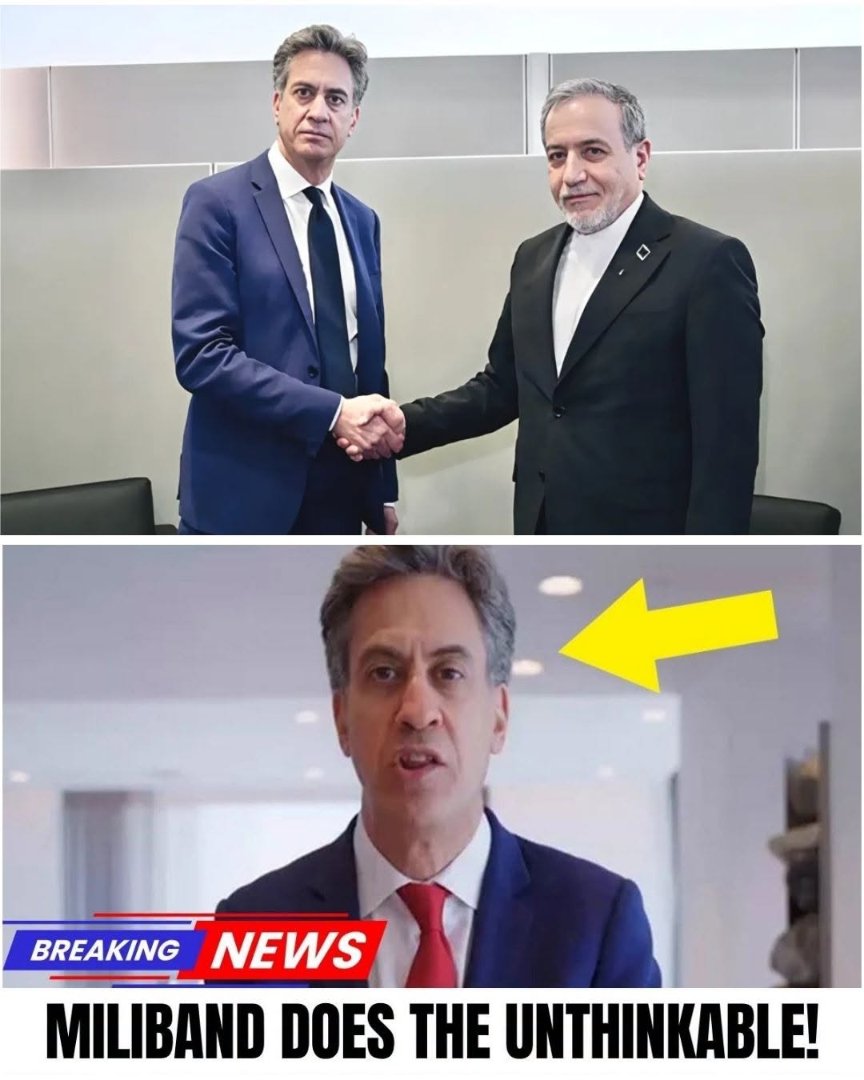
The footage shows Miliband engaged in a cordial exchange with the Iranian official, smiling and shaking hands .
Critics have swiftly condemned the optics of the meeting.
Commentators highlighted the stark contrast between Miliband’s friendly demeanor in the video and the Iranian regime’s track record, pointing to Iran’s execution of political dissidents, its backing of proxy groups in the Middle East, and recent allegations of state-sponsored cyberattacks and attempted assassinations on British soil .
A Conservative MP demanded an apology, calling the handshake a “propaganda win for Tehran.”
The MP expressed outrage that Miliband would casually meet with the representative of a regime holding British citizens hostage as political leverage and orchestrating attacks against Jewish communities globally.
“This is not an ally who’s misbehaving so you make a stern face while shaking the hand… this is a regime behind repeated attacks,” the MP’s statement read .
Advertisement
The backlash over the Iran meeting comes simultaneously with a separate video released by Miliband on his social media channels addressing the Israel-Palestine conflict.
In that video, Miliband announced that the UK government is taking action to ban the import of goods from illegal Israeli settlements and cutting off supply lines of finance and construction for settlement expansion .
Miliband characterized these measures as a “clear message to the government of Israel… that we will not acquiesce in the destruction of the two-state solution” .
He further announced increased humanitarian support for Palestinians in Gaza and the West Bank .
Political opponents have accused Miliband and the Labour government of hypocrisy, contrasting the party’s strong punitive stance on Israel with Miliband’s willingness to cordially engage with Iranian leadership .
Critics allege these moves are less about consistent foreign policy and more about pandering to specific domestic voter blocs in the UK .
Miliband’s office has not yet issued a formal response explaining the context of the interaction with the Iranian foreign minister.
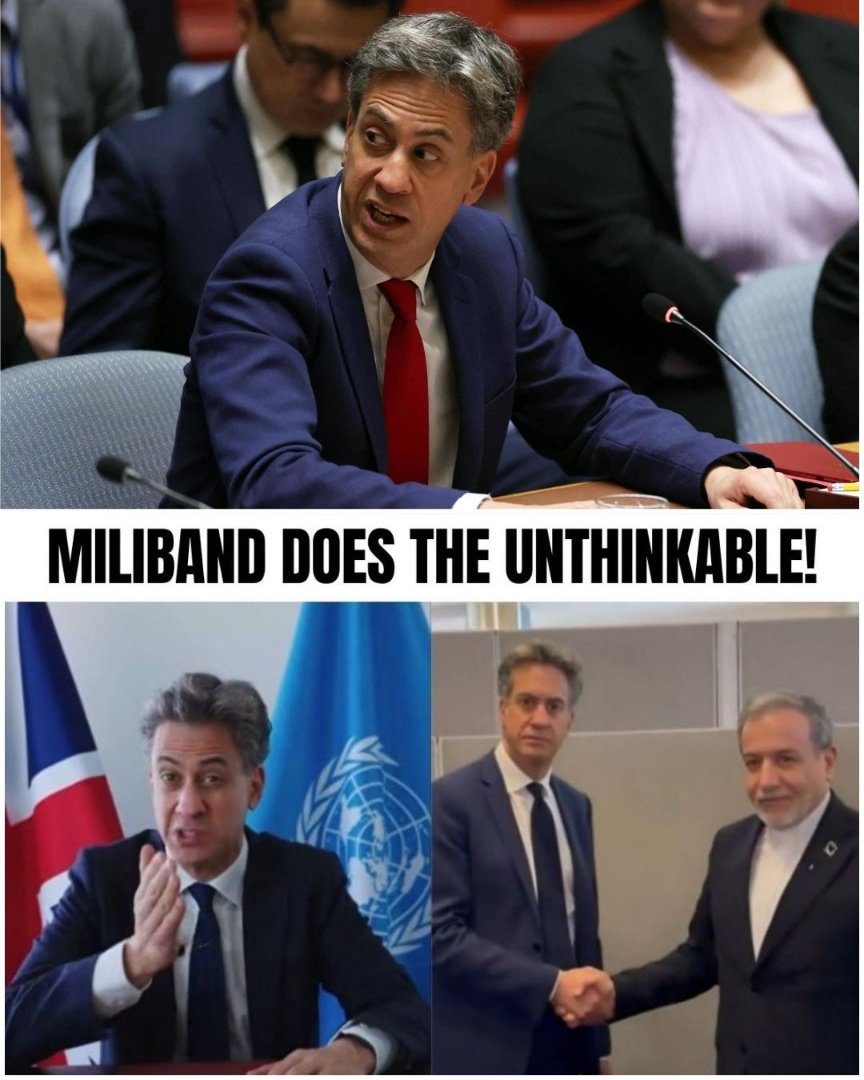
In separate political news mentioned during the UN trip, Greater Manchester Mayor Andy Burnham, who is also in New York, dismissed recent rumors of an early UK general election in November or spring, stating definitively that the government’s focus is on “doing the job” .
BREAKING: ED MILIBAND’S SECRET HANDSHAKE WITH IRAN’S FOREIGN MINISTER SPARKS FURY! LABOUR FACES QUESTIONS OVER DIPLOMATIC CONTROVERSY!
British politics has been thrown into a fresh storm after Foreign Secretary Ed Miliband came under intense criticism for shaking hands with Iran’s Foreign Minister, Abbas Araghchi, during a diplomatic meeting in New York. The encounter, which took place on the sidelines of the United Nations General Assembly on 24 September 2026, has triggered fierce reactions from opposition politicians, commentators, and members of Britain’s Jewish community.
Photographs showing the two men shaking hands quickly became the focus of political debate. Critics questioned why Britain’s top diplomat would publicly share such a moment with a representative of the Iranian government, particularly amid serious concerns about Tehran’s activities and alleged links to threats against British interests.
The controversy has created an uncomfortable situation for the Labour government. Ministers are already facing questions about national security, Britain’s relationship with Iran, and the government’s approach to protecting communities against foreign interference.
However, the Foreign Office insists that the meeting was an opportunity to deliver a direct warning to Tehran rather than an attempt to improve relations without conditions.
THE HANDSHAKE THAT IGNITED A POLITICAL FIRESTORM
The meeting between Miliband and Araghchi took place during the 81st United Nations General Assembly in New York.
Although diplomatic meetings between foreign ministers are not unusual, the circumstances surrounding this particular encounter made it especially sensitive.
Iran has faced repeated criticism from Western governments over its regional activities, treatment of political opponents, support for armed groups, and alleged involvement in hostile operations abroad.
Against that background, photographs of Britain’s Foreign Secretary shaking hands with Araghchi immediately attracted attention.
For critics, the image raised questions about whether the British government was giving Tehran an opportunity to present itself as a legitimate and respected diplomatic partner.
Some opposition politicians argued that the handshake could be used by Iranian state media as propaganda, portraying the encounter as evidence of international acceptance.
But the government defended the meeting, arguing that diplomatic engagement is sometimes necessary precisely because relations between countries are difficult.
TOM TUGENDHAT AND ALICIA KEARNS LEAD THE CRITICISM
Conservative politicians were among the most outspoken critics of Miliband’s decision.
Shadow Foreign Secretary Tom Tugendhat questioned whether the meeting gave Iran an unnecessary diplomatic advantage.
He argued that the Iranian government had provided insufficient justification for a senior British minister to engage in such a public encounter.
Tugendhat also questioned whether the British government fully understood the security challenges associated with Iran and its regional activities.
Alicia Kearns, another senior Conservative foreign affairs figure, delivered particularly strong criticism.
She described the encounter as a propaganda victory for Tehran and argued that Miliband owed Parliament, British Jewish communities, and the family of two British citizens detained in Iran an explanation.
Her criticism focused on the wider security concerns surrounding Iran, including allegations of hostile activities against British interests.
The comments intensified the political pressure on the Foreign Secretary, turning a diplomatic meeting into a major domestic political controversy.
WHAT DID MILIBAND ACTUALLY DISCUSS WITH IRAN?
The Foreign Office has provided an explanation of the discussions, insisting that Miliband used the meeting to raise serious concerns directly with Araghchi.
According to the official account, the Foreign Secretary warned that Britain would not tolerate intimidation, threats, or hostile activities on British soil by groups linked to Iran.
He specifically raised concerns about attacks targeting the British Jewish community.
Miliband also discussed the ongoing conflict in the Middle East and called on Iran to pursue de-escalation and diplomacy.
Another important issue was the Strait of Hormuz, a strategically important international shipping route.
The Foreign Secretary stressed the importance of restoring freedom of navigation and reopening the waterway, which plays a crucial role in international energy supplies.
The meeting also addressed the detention of Craig and Lindsay Foreman, two British nationals who were arrested in Iran while travelling through the country on a motorcycle journey.
The couple were subsequently sentenced to ten years in prison on espionage charges, which they deny.
Miliband reportedly reiterated Britain’s demand for their immediate release and emphasized that their welfare remained a government priority.
THE BRITISH COUPLE AT THE CENTRE OF THE DIPLOMATIC DISPUTE
The case of Craig and Lindsay Foreman has become one of the most sensitive issues in Britain’s relationship with Iran.
The couple were arrested in January 2025 while travelling through the country.
Their imprisonment has generated considerable concern among their family, supporters, and British politicians.
The fact that Miliband raised their detention directly with Araghchi was therefore an important part of the diplomatic meeting.
Critics nevertheless questioned whether the public handshake risked overshadowing the serious message that Britain was attempting to deliver.
They argued that Tehran could use photographs of the encounter for domestic political purposes while the couple remained imprisoned.
The government, however, maintains that diplomatic communication provides an important opportunity to raise individual cases and press for practical outcomes.
For the Foreman family, the most important issue is not the political argument surrounding a photograph. It is securing the couple’s freedom and ensuring their safety.
WHY IRAN’S RELATIONSHIP WITH BRITAIN IS SO TENSE
The controversy cannot be understood without considering the wider relationship between London and Tehran.
Britain has repeatedly expressed concerns about Iranian activities, including alleged threats against individuals living in the UK, cyber operations, and connections to groups involved in regional conflicts.
British security agencies have also warned about attempts to obtain sensitive information through cyber campaigns.
In September 2026, the UK’s National Cyber Security Centre issued warnings concerning Iranian state-linked cyber actors and spyware known as CHOSEN BRICK.
The reported operations involved attempts to obtain emails, messages, and other sensitive information through targeted online campaigns.
These developments have reinforced concerns about the potential reach of foreign intelligence operations.
The British government has also taken measures against organisations and networks it considers connected to hostile activities.
Consequently, Miliband’s decision to meet Araghchi has been judged against a background of serious security concerns rather than ordinary diplomatic disagreements.
THE QUESTION OF IRANIAN PROPAGANDA
One of the biggest arguments surrounding the handshake concerns the way diplomatic photographs can be used.
In international politics, images often carry messages that extend beyond the actual discussions taking place.
A photograph of two foreign ministers shaking hands can be presented as a symbol of dialogue, recognition, or improved relations.
However, the same photograph may communicate something very different to audiences who oppose the government being represented.
This is particularly sensitive when dealing with countries that have difficult relationships with Western governments.
Critics argue that Iran could use the image to suggest that Britain is willing to engage normally with Tehran despite continuing disagreements.
Supporters of diplomatic engagement respond that refusing to meet representatives of hostile governments can make it harder to resolve conflicts, secure the release of detained citizens, or deliver warnings directly.
The central question is whether the benefits of maintaining diplomatic communication outweigh the potential political costs.
WHY THE MEETING HAS CREATED ANOTHER PROBLEM FOR LABOUR
For Labour, the controversy arrives at a politically sensitive time.
The government must demonstrate that it can protect Britain’s national interests while managing complicated international relationships.
Miliband is expected to defend British security, support international diplomacy, and maintain pressure on governments accused of threatening British citizens.
These responsibilities can sometimes pull in different directions.
A refusal to engage diplomatically might satisfy critics who demand a tougher public stance, but it could also reduce opportunities to communicate directly with Tehran.
Conversely, visible diplomatic engagement can create serious political difficulties if the public believes the government is offering legitimacy without obtaining meaningful concessions.
Labour therefore faces a communications challenge.
It must explain why the meeting took place, what was achieved, and whether Iran was given any assurances in return.
The government will also need to demonstrate that its warnings are backed by practical security measures.
DIPLOMACY OR WEAKNESS? BRITAIN FACES A DIFFICULT CHOICE
The disagreement surrounding Miliband’s handshake reflects a much wider debate about Britain’s foreign policy.
Some politicians believe that diplomatic engagement should remain possible even when relations between countries are extremely hostile.
They argue that governments must communicate with one another to prevent escalation, resolve disputes, and protect their citizens.
Others believe that highly public diplomatic gestures can weaken Britain’s position when dealing with governments accused of serious hostile activities.
They argue that diplomacy should be accompanied by clear consequences and visible demonstrations of national strength.
Both positions raise important questions.
Diplomatic engagement does not necessarily mean political approval, but governments must consider how their actions will be interpreted internationally.
Equally, refusing to communicate with difficult governments does not automatically make a country safer.
Britain must find a way to combine diplomatic communication with credible deterrence, intelligence cooperation, and protection of vulnerable communities.
WHAT HAPPENS NEXT?
The pressure on Miliband is unlikely to disappear immediately.
Opposition politicians will continue demanding explanations about the purpose of the meeting and the government’s broader assessment of Iran.
The detention of Craig and Lindsay Foreman will remain an important issue in diplomatic discussions.
British security agencies will also continue monitoring potential threats linked to hostile foreign actors.
Meanwhile, the government must demonstrate that its warnings to Tehran are more than carefully worded diplomatic statements.
The effectiveness of Britain’s response will ultimately be judged by whether it can protect its citizens, defend its national interests, and secure practical results through international engagement.
CONCLUSION: ONE HANDSHAKE, A MUCH BIGGER POLITICAL BATTLE
Ed Miliband’s meeting with Iranian Foreign Minister Abbas Araghchi has developed into a significant political controversy.
For critics, the handshake represents a serious diplomatic misjudgment that could provide Tehran with valuable propaganda.
For the government, the meeting was an opportunity to deliver direct warnings, discuss international security, demand the release of British detainees, and push for de-escalation in the Middle East.
The disagreement reveals the difficult choices facing British foreign policy.
Should Britain maintain diplomatic channels with governments accused of threatening its interests, or should public engagement be restricted until meaningful changes take place?
There are no easy answers.
However, one thing is clear: the British public expects its government to protect national security, defend vulnerable communities, and ensure that diplomatic meetings produce meaningful results.
For Ed Miliband, the challenge now is to demonstrate that the handshake was part of a serious diplomatic strategy rather than an unnecessary political gesture.
And as opposition politicians continue demanding answers, this controversy could become another major test of Labour’s credibility on foreign policy and national security.