
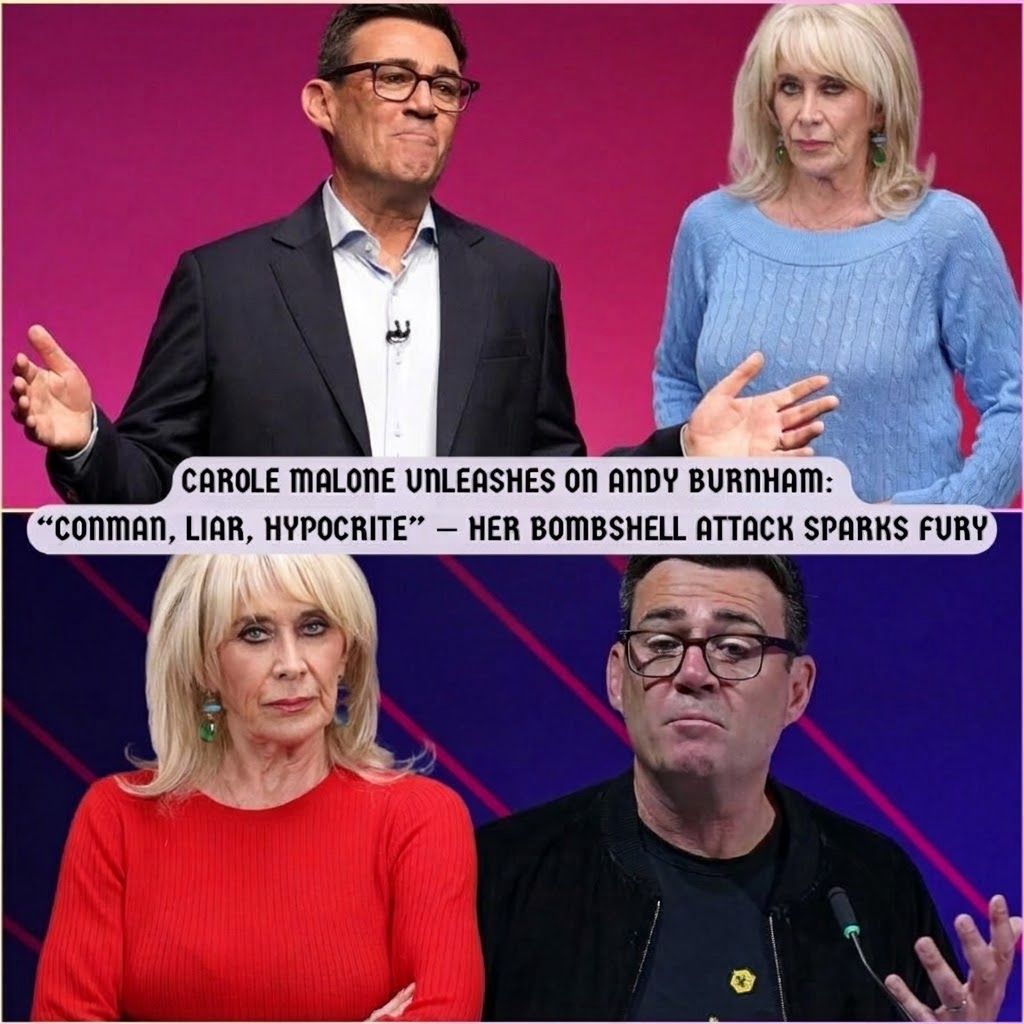
A fresh political row has erupted around Andy Burnham after columnist and broadcaster Carole Malone launched a highly critical attack on the Greater Manchester mayor and his political record.
Malone’s intervention focused on several areas of Burnham’s public statements and political positioning, including Britain’s relationship with the European Union, pension policy, government spending and his relationship with Prime Minister Keir Starmer. Her comments have added another layer to an already lively debate about Burnham’s political ambitions and the direction he could take in the future.
It is important, however, to distinguish between Malone’s commentary and established facts. Terms such as “conman”, “liar” and “hypocrite” are Malone’s characterisations rather than independently established findings.
Questions over Burnham’s EU position
One of the central issues highlighted by Malone is Burnham’s position on Britain’s relationship with the European Union.
The subject has become increasingly prominent in British politics since Brexit, particularly as debates continue over the UK’s economic relationship with the bloc and whether closer integration should be considered.
According to the argument presented by Malone, Burnham previously reassured voters during campaigning in Makerfield that he was not proposing that Britain should consider rejoining the EU. Malone then pointed to more recent comments attributed to Burnham in which he reportedly acknowledged that Britain could eventually “go all the way” and rejoin.
The apparent contrast has become a point of political discussion.
However, there is an important distinction between supporting closer relations with the European Union and advocating immediate British membership. Political positions can evolve, and statements made in different political circumstances can refer to different stages of Britain’s relationship with Europe.
Burnham’s comments therefore need to be considered in their full context, including the date, audience and precise wording.
The pension debate
Another issue raised by Malone concerns the future of the state pension and the so-called triple lock.
The triple lock is a mechanism under which the UK state pension generally rises each year by whichever is highest among average earnings growth, inflation or 2.5 per cent, subject to the way the policy is applied by the government of the day.
The policy has become one of the most politically sensitive areas of public spending. Supporters argue that it protects pensioners from inflation and ensures that the value of pensions does not fall behind wages. Critics have questioned its long-term cost and whether the same mechanism can remain sustainable as demographic pressures increase.
Malone’s criticism centres on what she presents as a contradiction between Burnham’s earlier political ambitions and his more recent comments about pension policy.
Any claim that Burnham has proposed ending or changing the triple lock should therefore be examined against his actual policy statements rather than relying solely on commentary.
Spending and borrowing
Malone also questioned what she sees as a lack of detailed answers on Britain’s wider financial challenges.
Among the issues mentioned are the cost of welfare benefits, military expenditure and national borrowing.
These are substantial areas of public policy involving billions of pounds of government spending. Decisions about them involve difficult trade-offs between taxation, public services, defence, welfare provision and debt management.
The figure of £330 billion cited in the criticism requires particular care because the total cost of benefits depends heavily on which benefits and accounting period are being included. A headline figure without a precise definition can therefore give an incomplete picture of government expenditure.
Similarly, discussions about defence spending cannot be separated from Britain’s wider security commitments, NATO obligations and the Government’s assessment of threats.
Burnham and Starmer
Malone’s criticism also touches on Burnham’s relationship with Keir Starmer.
Burnham and Starmer have occupied different positions within Labour politics, and their relationship has periodically attracted political attention. Burnham previously served as a Labour cabinet minister and later became Mayor of Greater Manchester, while Starmer became Labour leader and subsequently Prime Minister.
Malone argues that Burnham had spent a significant period criticising or challenging Starmer before later expressing appreciation for him during a party conference address.
Such developments are common subjects of political commentary, particularly within major parties where figures can disagree over policy while remaining members of the same political movement.
Whether that represents political inconsistency is ultimately an interpretation rather than a factual finding.
Personal grief and political speeches
Another controversial aspect of Malone’s criticism concerned Burnham’s decision to refer to personal family grief during a major political speech following the death of his father.
Political speeches frequently combine personal experiences with policy arguments. Politicians sometimes use family stories to explain their motivations, values or political outlook.
Whether such references are appropriate is largely a matter of political commentary and audience reaction.
Malone clearly regarded Burnham’s use of the subject as inappropriate, while others may interpret personal references differently.
The distinction is important because the underlying fact — that Burnham discussed personal bereavement — is separate from the question of whether doing so was politically appropriate.
Burnham’s broader political ambitions
At the heart of the controversy is a broader question about Burnham’s political future.
The former cabinet minister has built a significant political profile through his long period as Mayor of Greater Manchester. His political career has included service in Parliament, senior government positions and leadership contests within the Labour Party.
That history means his comments on national issues are regularly scrutinised, particularly when they concern major questions such as Brexit, public spending and the future direction of Labour.
The debate over Europe is especially significant because Britain’s relationship with the EU remains politically sensitive. Different Labour figures have adopted different positions over Brexit, while the party leadership has generally focused on improving the UK’s relationship with Europe without pursuing immediate re-entry into the EU.
Burnham’s remarks therefore attract attention not simply because of their content, but because of what they might indicate about his broader political outlook.
A debate over consistency
The latest controversy ultimately comes down to the question of political consistency.
Malone’s argument is that Burnham’s positions have changed significantly and that voters should scrutinise those changes closely. Her critics could respond that political circumstances evolve and that changing one’s position does not automatically demonstrate bad faith.
Both perspectives can be considered separately from the personal language used in the criticism.
The most useful way to assess the controversy is therefore to examine Burnham’s statements over time, compare them with his documented policies and identify where his positions have changed, remained consistent or been misunderstood.
What happens next?
The controversy surrounding Burnham is unlikely to disappear quickly. Questions about Britain’s relationship with Europe, pension policy, public spending and the country’s finances remain central to political debate.
For Burnham, the challenge is likely to be explaining how his current positions relate to statements he made previously.
For commentators such as Malone, the issue provides another opportunity to scrutinise his political record and ambitions.
Ultimately, the debate illustrates how quickly individual remarks can become part of a much larger political argument. Claims about changing positions need to be examined in their original context, while strongly worded commentary should be distinguished from independently verified facts.
As Britain continues to debate its relationship with Europe, the future of pensions and the balance between public spending and fiscal responsibility, figures such as Burnham will remain under close scrutiny.
The key question is not simply what Burnham has said recently, but how his current position compares with what he said before — and what policy proposals he would actually put forward if given greater national responsibility.
Andy Burnham Under Fire as Carole Malone Questions His EU Policy, Pension Promises and Political Consistency
Andy Burnham has come under renewed political scrutiny as questions surrounding his position on the European Union, the future of pensions and his wider political consistency fuel debate about his ambitions and policy priorities. The controversy highlights the challenges facing any Labour figure seeking to present himself as a credible national leader while balancing the expectations of different groups of voters.
Commentator Carole Malone has raised questions about Burnham’s political positions, bringing attention to issues that remain particularly sensitive for British voters. From the legacy of Brexit to the financial security of pensioners, the debate touches on subjects that could shape how the public evaluates Labour’s direction and its approach to Britain’s economic future.
At the heart of the dispute is a familiar political question: how can a politician demonstrate that his principles remain consistent while responding to changing economic circumstances and public expectations?
For Burnham, the challenge is to explain his positions clearly, distinguish established policies from speculation and demonstrate how his proposals would affect ordinary households.
EU Policy Returns to the Political Spotlight
Britain’s relationship with the European Union remains a complicated issue several years after Brexit. Although the UK has left the bloc, questions about trade, migration, economic cooperation and regulatory arrangements continue to influence political debate.
Any suggestion that a prominent Labour figure wants a closer relationship with Brussels can provoke strong reactions. Some voters believe that improved cooperation with the EU could help British businesses, reduce administrative barriers and support economic growth. Others remain concerned that closer alignment could weaken the independence they believe Brexit was intended to secure.
For a politician such as Burnham, the distinction between practical cooperation and reversing Brexit is especially important.
There are several possible approaches to the UK’s relationship with Europe. The government could seek technical agreements, closer cooperation in specific industries, changes to trading arrangements or broader regulatory alignment without necessarily pursuing EU membership. A decision to rejoin the bloc, by contrast, would involve a much more extensive political and legal process.
These options should not be treated as interchangeable.
Questions about Burnham’s EU policy therefore require clarity about what he has actually proposed. Supporting closer cooperation in a particular area would not automatically establish that he favours reversing Brexit. Equally, a politician advocating a substantial change in Britain’s relationship with Europe would need to explain the expected economic benefits, the potential costs and the implications for national decision-making.
Malone’s criticism, as framed by the headline, places pressure on Burnham to make his position understandable to voters who may hold sharply different views about Europe.
The Brexit Legacy Still Divides Voters
Brexit remains politically significant because its consequences extend beyond the original referendum campaign. Businesses have had to navigate changes to trading arrangements, while political parties continue to debate how the UK should balance sovereignty, economic cooperation and access to international markets.
Supporters of closer EU ties argue that reducing barriers to trade could benefit exporters, improve cooperation and help address economic challenges. They may also believe that a more constructive relationship with European partners would strengthen Britain’s international position.
Those who favour maintaining distance from EU institutions argue that the country should preserve its ability to set its own rules and pursue independent policies. They may question whether closer alignment would deliver sufficient benefits to justify any additional obligations.
Neither position can be assessed solely through political slogans. The effects would depend on the specific arrangements being proposed, the sectors involved and the conditions negotiated.
If Burnham is to establish a clear position on the issue, he would need to explain which changes he supports and why. Voters would also want to know how any proposed arrangements might affect jobs, prices, investment and public services.
The broader lesson is that the EU debate is not simply a question of whether a politician is for or against Europe. It concerns the practical relationship Britain should have with its largest nearby economic partners and the trade-offs that relationship may involve.
Pensions: A Crucial Test of Political Credibility
Pensions are another area in which political consistency can become a source of controversy. For millions of people approaching or already in retirement, the state pension is a central part of household finances.
Rising living costs, energy bills, food prices and housing expenses can make even relatively small changes in pension income significant. Older people who rely heavily on the state pension may have limited opportunities to increase their earnings when costs rise.
This makes pension policy particularly sensitive whenever politicians discuss tax changes, public spending or reforms to the welfare system.
The state pension triple lock is a central part of the debate. Under the established policy, the basic and new state pensions rise each year by the highest of earnings growth, inflation or 2.5%, subject to the rules and measures applying to the relevant year.
Supporters argue that the mechanism helps protect pensioners from losing purchasing power and ensures that retirement incomes do not fall too far behind the earnings of working people. Critics raise concerns about the long-term cost to public finances and the pressure that pension spending can place on other government priorities.
A politician discussing pension reform must therefore address two competing objectives: protecting older people from financial hardship and ensuring that the system remains affordable over time.
Questions about Burnham’s position would be best answered by examining his stated commitments, including whether he supports the existing triple lock, what additional assistance he proposes and how any changes would be funded. Without specific policy details, it would be premature to conclude that he has made contradictory promises.
For pensioners, the most important issue is not simply the strength of a political statement. It is whether proposed measures would deliver a reliable income and how they would interact with taxation, benefits and household costs.
The Financial Pressures Facing Older People
Pension policy cannot be separated from the wider economic circumstances facing retirees.
Some older households own their homes outright and have private pension savings, while others rent privately, rely on limited incomes or face significant care costs. The same policy change can therefore have very different consequences for different groups.
Energy costs are particularly important for pensioners who spend more time at home or have health and mobility needs that make it difficult to reduce heating. Food prices and council tax can also consume a substantial share of a fixed income.
These pressures have helped make winter support, pension increases and eligibility rules recurring political issues.
A government seeking to protect pensioners must decide how assistance should be distributed. Broad universal payments are relatively straightforward to understand, but they can be expensive because they also reach households with substantial resources. Means-tested support can concentrate public money on people with lower incomes, but it may leave some eligible pensioners unaware of assistance or unable to navigate the application process.
Any proposal associated with Burnham should therefore be judged on its details: who would qualify, how much support would be available, whether payments would keep pace with costs and how the measures would be financed.
Political consistency matters, but so does the ability to adapt policies when circumstances change. The public deserves a clear explanation of why a position has changed and what evidence supports the revised approach.
Carole Malone’s Questions and the Demand for Answers
Political commentators frequently challenge public figures over apparent inconsistencies between their earlier statements and their current positions. Such scrutiny can be valuable when it directs attention to specific commitments, unexplained reversals or gaps between political promises and practical outcomes.
However, criticism is most useful when it is tied to verifiable statements and clear policy comparisons.
If Burnham has expressed different views on EU relations or pensions at different times, the relevant questions are what he said, when he said it and whether the circumstances or proposals changed. A change in position may reflect political calculation, new evidence, altered economic conditions or a genuine reassessment of policy. The available evidence is needed to distinguish between those possibilities.
It would be equally misleading to assume that every difference in emphasis represents hypocrisy. Politicians sometimes support a general objective while disagreeing about the best method of achieving it.
At the same time, public figures cannot expect their earlier commitments to be ignored when they seek greater political responsibility. Voters are entitled to ask whether their proposals remain coherent and whether their explanations withstand scrutiny.
The key issue is whether the questions raised about Burnham can be answered through specific examples rather than general accusations.