
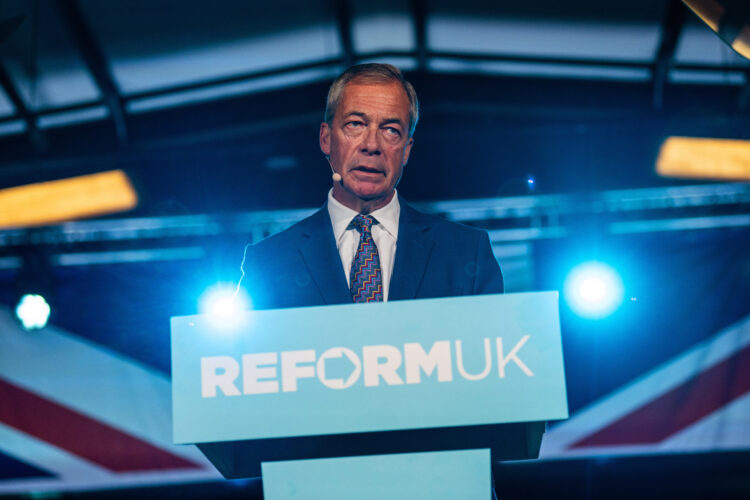
A close adviser of Nigel Farage had an “influential” role at a national polling company that he did not publicly disclose.
An investigation from the Guardian has found that Chris Bruni-Lowe, who worked as Farage’s private pollster for many years, had a significant role at polling company Redfield & Wilton Strategies.
Owned by Bruno Rodrigues, a lawyer, Redfield & Wilton Strategies was founded in 2020 and started getting increased coverage in the UK during lockdown in the Covid pandemic.
Having produced private polling for Farage since at least 2014, Bruni-Lowe went on to run Farage’s 2015 election campaign, helped test messaging for the creation of the Brexit party and advised on the 2019 local elections campaign.
The Guardian reports that Bruni-Lowe requested UK and US opinion polls, directed research on issues such as council spending, and was said to be “obsessed” with producing a dossier which he suggested could be sold to political parties.
Sources told the publication that Bruni-Lowe used his role to develop potential campaign strategies and was so central to the firm that he sometimes went by the name “Chris Redfield,” a name he was quoted by in the Washington Post.
Bruni-Lowe was never publicly associated with the firm.
Rodrigues told the Guardian that Bruni-Lowe worked with the pollster from mid-2020 to late 2022 as a “consultant”, before returning “voluntarily” to the pollster in the summer of 2025 to train interns.
The Guardian’s report comes after an undercover investigation revealed a senior adviser of Farage, Dan Jukes, had arranged for an American donor to pay £30,000 for three polls which returned results supporting Reform policy lines.
The revelation around Bruni-Lowe will only increase scrutiny over transparency and political affiliations in the polling industry.
British Polling Council regulations do not require pollsters to state any political affiliations, but there are strict guidelines on declaring who has commissioned and paid for any polling.
Israel at Risk of Civil War and ‘Total Collapse’, CIA Report Warns
Israel is facing growing political, economic and social divisions that could threaten the country’s long-term stability, according to a reported classified assessment by the United States Central Intelligence Agency (CIA). The document, reportedly prepared in August 2026 by the agency’s Red Cell intelligence unit and titled “Fracture From Within”, warns that Israel could face serious internal conflict or even state collapse if its existing crises continue to intensify. The assessment has attracted international attention because it suggests that the greatest threat to Israel’s future may not come exclusively from external enemies, but also from deep divisions within Israeli society itself.
According to investigative outlet Drop Site News, which published details of the assessment on 5 October 2026, two American sources familiar with the document described a combination of political polarisation, economic difficulties, military exhaustion and growing social tensions. The CIA has not publicly confirmed the document, and its authenticity has not been independently verified. Nevertheless, the reported findings raise important questions about the country’s internal resilience after years of military conflict and political instability.
One of the most significant factors identified in the assessment is the prolonged conflict involving Israel, particularly the wars in Gaza, Lebanon and Iran. These military campaigns have placed considerable pressure on the country’s armed forces, public finances and civilian population. Thousands of Israeli soldiers have experienced extended periods of military service, while reservists have repeatedly been called away from their families and workplaces. The continued demands on the military have created economic and personal difficulties for many households.
The return of soldiers from prolonged combat has also raised concerns about psychological trauma and the challenges of reintegration into civilian life. According to the reported CIA assessment, some returning veterans are heavily armed and experiencing serious psychological difficulties. Analysts reportedly warned that the combination of political fragmentation and a population affected by prolonged military conflict could create conditions for internal instability.
Another major source of tension concerns compulsory military service. Israel’s military system requires most Jewish citizens to serve, although certain exemptions have historically applied to ultra-Orthodox Jewish men, known as Haredim. This arrangement has become increasingly controversial as the country faces continued military demands and repeated reserve mobilisations.
Many secular and religious Israelis believe that the burden of defending the country is distributed unfairly. Reservists who have spent months or years serving in the military increasingly question why large sections of the ultra-Orthodox community remain exempt. The dispute has developed into a major political and constitutional issue, particularly because religious parties are important members of Prime Minister Benjamin Netanyahu’s governing coalition.
For ultra-Orthodox communities, however, the issue is not simply about avoiding military responsibilities. Religious leaders argue that full-time religious study is an essential obligation and that military service can threaten their traditional way of life. Consequently, the disagreement reflects a much deeper conflict over national identity, religion, equality and the responsibilities of citizenship.
The situation presents a difficult challenge for the Israeli government. Any attempt to impose military service more broadly could provoke resistance from religious communities and threaten the governing coalition. However, maintaining extensive exemptions could deepen resentment among secular Israelis and military reservists. This unresolved disagreement represents one of the most serious internal divisions facing the country.
Political polarisation is another central concern. Benjamin Netanyahu has remained a dominant figure in Israeli politics, but his leadership has faced sustained opposition. Critics have questioned his handling of the security failures surrounding the Hamas-led attack on 7 October 2023, the subsequent military campaign in Gaza and the country’s wider regional conflicts.
The controversy surrounding Netanyahu’s political future has also contributed to constitutional tensions. Israel experienced major protests in 2023 over the government’s proposed judicial reforms, which opponents argued would weaken judicial independence and undermine democratic checks and balances. Although the immediate political circumstances have changed since then, disagreements over the relationship between the government, Parliament and the judiciary remain significant.
The reported CIA assessment identifies Netanyahu’s efforts to remain in power as an additional source of instability. The approaching Israeli parliamentary election on 27 October 2026 has intensified political competition, with opposing political groups struggling to establish a clear governing majority. A disputed election result, prolonged coalition negotiations or further constitutional confrontation could increase tensions between different sections of Israeli society.
Economic pressure is another important element of the crisis. Years of military operations have increased defence expenditure and placed additional pressure on public finances. Government resources must be directed towards military operations, security requirements, reconstruction and support for affected communities. At the same time, households are facing higher living costs and uncertainty about future economic conditions.
The reported assessment highlights rising food prices as one indication of the difficulties experienced by ordinary citizens. According to figures cited in the investigation, food prices, including fresh fruit and vegetables, increased by approximately 9.5 per cent over two years. Such increases can have a considerable impact on families already dealing with the financial consequences of prolonged conflict.
Israel’s technology sector, which has traditionally played an important role in economic growth, could also face difficulties if political instability discourages international investors. Foreign companies may reconsider investment decisions if they believe the country’s political environment is becoming unpredictable. A significant reduction in foreign investment could further weaken economic confidence and increase pressure on employment and public finances.
The assessment also reportedly identifies growing violence by Israeli settlers in the occupied West Bank as another source of internal and regional tension. Violence, confrontations and disputes over land have contributed to wider political divisions. The issue has implications not only for Palestinians living in the occupied territory but also for Israel’s international relationships and domestic political debate.
International isolation represents another potential challenge. Israel has traditionally enjoyed strong diplomatic, military and economic support from the United States. However, American public opinion has become increasingly divided over Israeli government policies, particularly following the devastating war in Gaza. This shift could create long-term difficulties for the relationship between Washington and Jerusalem.
The United States remains a crucial strategic partner for Israel, providing military assistance, diplomatic support and extensive security cooperation. Any significant deterioration in this relationship could affect Israel’s international position. The reported CIA assessment suggests that declining American support and growing diplomatic isolation may contribute to internal instability by increasing economic and political uncertainty.
Nevertheless, it is important to distinguish between a warning about potential risks and a prediction that civil war or state collapse is inevitable. The CIA’s Red Cell specialises in alternative analysis, examining scenarios that challenge conventional assumptions. Its purpose is to identify possible vulnerabilities and consider developments that policymakers might otherwise overlook. Therefore, the reported assessment should be understood as a warning about interacting risks rather than confirmation that Israel is about to collapse.
There are also limitations to the information available about the document. The original assessment has not been independently published or authenticated, and the reporting relies on two American sources familiar with its contents. Furthermore, the assessment reportedly concentrates on Jewish citizens in Israel without fully addressing the experiences of Arab and Palestinian citizens, who constitute approximately one-fifth of the country’s population. This limitation is important when evaluating the broader social and political situation.
Despite these uncertainties, the issues identified in the report deserve attention. Israel’s internal stability depends on more than military strength. A country also requires political legitimacy, functioning institutions, economic confidence and a degree of social solidarity. When these elements become weakened simultaneously, the ability of governments to manage national crises can become increasingly difficult.
The coming months will therefore be important for Israel’s political future. The October 2026 election could influence the direction of government policy, the future of Netanyahu’s leadership and the relationship between religious and secular political groups. Decisions concerning military conscription, judicial independence, defence expenditure and the country’s regional relationships will also shape the national debate.
Ultimately, the reported CIA assessment presents a serious warning about the consequences of prolonged conflict and unresolved domestic divisions. Israel remains a state with substantial military capabilities, established institutions and important international partnerships. However, these strengths do not make it immune to political fragmentation, economic pressure or social unrest.
The central question is whether Israel’s political leadership can address the divisions that have become increasingly difficult to manage. Without meaningful efforts to rebuild public trust, resolve disputes over military service, strengthen democratic institutions and reduce the economic burden on ordinary households, existing tensions could become more difficult to contain.
The warning of civil war and total collapse should not be treated as an established future outcome. Rather, it highlights the importance of recognising internal vulnerabilities before they develop into more serious crises. Israel’s long-term security will depend not only on its ability to confront external threats but also on its capacity to maintain stability, political accountability and social cohesion at home.