



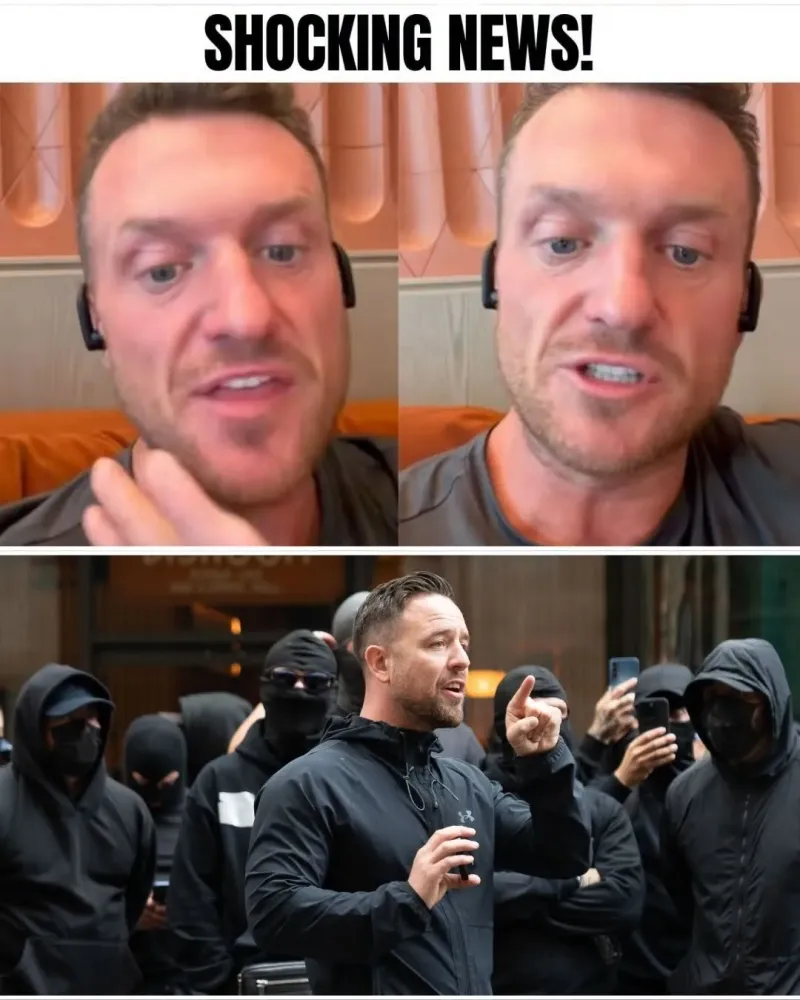
Danny Tommo’s Detention Versus RAF Fairford Bail Decisions Fuels ‘Two-Tier Britain’ Debate
LONDON — The continued detention of anti-migration activist Daniel Thomas, better known as Danny Tommo, has become the focus of a rapidly escalating political argument after five men arrested on suspicion of terrorism-related offences near RAF Fairford were released on police bail.
The contrast has been seized upon by Reform UK leader Nigel Farage, who publicly questioned why Thomas remained behind bars while the five RAF Fairford suspects were allowed out under conditions.
“How is it that Danny Tommo sits in a cell while five suspected terrorists are out on bail?” Farage asked in a social-media post reported by British media, before raising the possibility of what he called “two-tier Britain.”
The comparison is politically powerful.
Legally, however, the two situations are considerably more complicated than the headline suggests.
Thomas has been charged, appeared before courts and been refused bail. The five RAF Fairford suspects were released on police bail while an active counter-terrorism investigation continued, with authorities stressing that they remained suspects and faced stringent restrictions.
The different outcomes therefore raise legitimate questions about how Britain’s bail system operates, but they do not by themselves establish that political views determined who remained in custody.
Why Danny Tommo is in custody
Thomas, 37, is the founder of Patriot Platform and has become a prominent organiser of anti-migration demonstrations.
His current criminal case arose from an incident in the English Channel on September 22.
Prosecutors allege that Thomas damaged an inflatable boat with a knife while an emergency responder remained aboard. He was subsequently charged with criminal damage and with failing to disclose the PIN to his phone under Section 53 of the Regulation of Investigatory Powers Act 2000.
Thomas has pleaded not guilty to the charges reported at his Crown Court hearing.
He appeared by video link from prison at Portsmouth Crown Court on September 29, wearing a grey T-shirt and holding a Bible.
Judge James Newton-Price KC refused his application for bail.
A provisional trial date of March 1, 2027 was established, while Thomas is expected to appear again on November 12.
This has sometimes been described online as Thomas being “locked up until 2027.”
That description requires qualification.
Thomas has been remanded in custody pending further proceedings; he has not received a prison sentence for the alleged Channel incident. He remains an unconvicted defendant and is legally presumed innocent.
What happened at RAF Fairford?
The comparison attracting Farage’s attention involves five British men in their 20s arrested near RAF Fairford in Gloucestershire.
They were initially detained on suspicion of offences under explosives legislation and were subsequently arrested on suspicion of preparing an act of terrorism.
The circumstances were serious enough to trigger a substantial counter-terrorism investigation.
But investigators later announced that no explosives had been found in the three vehicles examined near the airbase. Police recovered petrol and continued investigating what the men were doing in the area.
After extensive interviews, all five were released on police bail.
Assistant Commissioner Laurence Taylor, head of Counter Terrorism Policing, stressed that the decision did not mean the investigation had ended.
The suspects remained under investigation and were subjected to “stringent conditions” governing their movement and contact with other people.
Authorities are continuing to examine whether the incident involved people knowingly or unknowingly acting on behalf of a foreign state.
The investigation has since acquired even greater national-security significance, with the British government saying there are indications of possible Iranian involvement, while Iran denies any role.
No suspect has been convicted, and the investigation remains ongoing.
Why the bail comparison is not straightforward
At first glance, the contrast appears remarkable.
Five people arrested during a counter-terrorism investigation are outside custody, while a man facing a criminal-damage allegation remains in prison.
But severity of the headline allegation is not the only factor governing bail.
British law begins with a general right to bail for most unconvicted defendants, subject to statutory exceptions. Courts can consider factors including the likelihood of a defendant failing to surrender, committing further offences or interfering with witnesses, alongside the seriousness and circumstances of the alleged offending.
There is another crucial difference.
The Fairford suspects were released on police bail during an investigation.
Thomas has been charged and remanded by the courts, and his lawyers subsequently made another bail application at Crown Court.
These are different procedural situations.
Counter Terrorism Policing also said the Fairford suspects remained subject to investigation and significant restrictions. Their release did not constitute a determination that the original suspicions were unfounded.
Equally, Thomas’s detention does not establish his guilt.
Farage turns the contrast into a political question
Farage’s intervention has nevertheless ensured that the two cases will be discussed together.
His question reflects a broader argument that has circulated in British politics under the label “two-tier policing” or “two-tier justice.”
The claim generally holds that authorities treat some political movements or demographic groups more severely than others.
Supporters of Thomas point to defendants in apparently more serious cases who have received bail and argue that his treatment is disproportionate.
Critics respond that selecting individual cases with different legal circumstances cannot demonstrate systematic discrimination.
Both points can be tested against evidence.
What cannot currently be established merely from these two cases is that Thomas was denied bail because he is an anti-migration activist.
Demonstrating that would require evidence connecting the judicial decision to his political views or broader statistical evidence showing comparable defendants receiving systematically different treatment because of ideology.
No such finding has been made in Thomas’s case.
Tommy Robinson enters the controversy
Tommy Robinson, whose real name is Stephen Yaxley-Lennon, has been one of Thomas’s most visible supporters.
Robinson attended Thomas’s earlier appearance at Basingstoke Magistrates’ Court and has used his online platforms to promote Thomas’s case.
The relationship between the men predates the current prosecution.
Thomas has been associated with Robinson for years and has become increasingly prominent through Patriot Platform and recent protests against irregular migration.
Robinson has argued publicly that Thomas’s prosecution is politically motivated.
That is Robinson’s allegation, not an established finding by a court.
Thomas’s own barrister has also criticised aspects of the prosecution. But at an earlier hearing, his defence made an important distinction: Thomas is not formally charged with the offence of engaging in political activism. The criminal proceedings concern specific alleged conduct.
That distinction will matter at trial.
What about the alleged £160,000 “secret”?
Another dramatic claim circulating alongside the case says Robinson has exposed a £160,000 financial problem connected with Thomas’s trial that could devastate his family.
At present, that claim requires substantial caution.
No reliable mainstream court report located for this article confirms that Thomas has been ordered to pay £160,000, that his trial has officially been estimated to cost his family that amount, or that the judge has imposed such a financial requirement.
Thomas’s family circumstances have been reported.
The Guardian described him as a roofer and father of four whose partner is pregnant.
That makes the financial consequences of prolonged detention potentially significant for his household.
But it does not verify a £160,000 figure.
Unless documentary evidence, a court order or a credible report establishes where that amount comes from, it should be treated as an unverified claim rather than a fact about the prosecution.
Thomas is not serving a sentence
One misconception is particularly important to correct.
Thomas has not been sentenced to remain in prison until March 2027.
March 1 is currently his provisional trial date.
He is being held on remand.
That means his detention is occurring before a determination of guilt.
Pre-trial detention can be deeply consequential. It separates defendants from families and employment and can continue for substantial periods when courts face scheduling pressures.
For that reason, bail decisions are legitimate subjects for public scrutiny.
But describing remand as punishment imposed after conviction confuses two fundamentally different stages of the criminal process.
The wider argument will continue
The Thomas and Fairford cases have collided at an especially sensitive moment.
Britain is debating irregular Channel migration, increasingly confrontational anti-migration demonstrations and national-security threats simultaneously.
Thomas’s supporters see his detention as symbolic of a government and justice system responding aggressively to those protesting against border policy.
His critics argue that political beliefs cannot excuse potentially criminal conduct.
The Fairford releases have now added another dimension.
Five men were arrested amid suspicions serious enough to involve counter-terrorism police, yet investigators concluded that continued detention was not necessary while inquiries proceeded. They remain subject to strict bail conditions and have not been convicted of anything.
Thomas, meanwhile, has been charged, denied the allegations and had bail refused by two courts.
That contrast explains why Farage’s question has attracted attention.
It does not answer it.
Whether Britain operates a politically “two-tier” justice system is a much larger empirical claim than any single pair of bail decisions can establish.
The evidence presently supports a narrower conclusion.
Daniel Thomas remains on remand awaiting trial. Five RAF Fairford suspects remain under investigation while on strict police bail. Nigel Farage has publicly questioned the disparity, and Tommy Robinson continues to campaign on Thomas’s behalf.
Everything beyond that — including claims that Thomas is being deliberately silenced because of his politics or that an unexplained £160,000 burden has been imposed on his family — requires evidence that has not yet been publicly established.
With Thomas’s next scheduled appearance on November 12 and his trial provisionally set for March, the courts rather than social-media comparisons will ultimately determine the criminal allegations against him.
Until then, both Thomas and the five Fairford suspects remain exactly that:
suspects or defendants whose cases have not resulted in convictions.
EXPOSED: The Shocking Truth Behind Danny Tommo’s Locked Cell!
The story surrounding Danny Tommo and the mystery of his locked cell has sparked curiosity, speculation and intense debate. What exactly lies behind the closed door? Why has the situation attracted so much attention, and what can the circumstances reveal about life behind bars, the realities of confinement and the questions that arise when information is limited?
In a world where dramatic headlines spread rapidly across social media, a locked cell can become a powerful symbol of secrecy. For those following Danny Tommo’s story, the unanswered questions have become a major part of the fascination. Yet separating confirmed information from speculation is essential, particularly when a story concerns an identifiable person and potentially sensitive circumstances.
The phrase “the shocking truth” promises a revelation. But the most important questions are not necessarily the most sensational ones. They concern the circumstances surrounding the cell, the rules governing access, the reasons for any restrictions and the evidence available to explain what happened.
The Mystery Behind the Locked Door
A locked cell can mean different things depending on the circumstances. In a prison or detention facility, locked doors are a routine part of maintaining security, controlling movement and protecting people inside the institution. A cell may remain locked during designated periods even when there is no extraordinary incident.
However, when a particular individual becomes the focus of public attention, ordinary procedures can appear mysterious. A lack of detailed information may encourage people to develop their own explanations, especially when short videos, dramatic captions or second-hand accounts circulate online.
Danny Tommo’s name has attracted interest, but the existence of a locked cell alone cannot establish that something unusual or improper occurred. To understand the story accurately, readers need reliable information about where the incident took place, when it happened and what officials or people directly involved have said.
Without those details, claims about secret punishments, extraordinary restrictions or hidden discoveries should be treated cautiously. A compelling narrative is not the same as verified evidence.
Life Behind Bars: A Reality Often Hidden From Public View
The wider subject nevertheless raises important questions about confinement and institutional control. For people held in prisons or other secure facilities, daily life is governed by schedules, security procedures and restrictions that can be difficult for outsiders to understand.
Doors may be locked to prevent unauthorised movement, protect vulnerable individuals or maintain order during particular periods. In some circumstances, additional restrictions may be imposed because of a specific safety concern. Such measures should have an appropriate basis and should be subject to the rules and oversight that apply to the institution.
The impact of confinement can be significant. Limited movement, reduced privacy and separation from family and friends can place considerable psychological pressure on people in custody. Access to healthcare, communication and legal assistance can therefore be especially important.
These realities deserve serious discussion, but they should not be used to fill gaps in the evidence about an individual case. General facts about prison life cannot establish what happened to Danny Tommo or explain why a particular door was locked.
Why the Story Has Captured Attention
Mystery is a powerful driver of public interest. When a headline suggests that an important fact has been hidden, readers naturally want to discover the missing information. The words “exposed” and “shocking truth” intensify that curiosity by suggesting that a revelation is imminent.
Social media can amplify this effect. A short clip may show only a fragment of an event, while a caption supplies an interpretation that viewers have little opportunity to verify. As the material spreads, speculation can become detached from the original context.
This does not mean every dramatic story is false. It means that the available evidence must be examined before conclusions are drawn.
For Danny Tommo’s story, the most useful questions are practical. Is there a complete recording of the relevant event? Has a reliable source explained the circumstances? Are there statements from people with direct knowledge? Do independent accounts support the same explanation?
Answers to those questions would provide a stronger foundation than anonymous claims or dramatic online commentary.
Security, Rights and Accountability
The locked-cell controversy also provides an opportunity to consider the balance between institutional security and individual rights.
Secure facilities must be able to control access and movement. Without effective procedures, staff and detainees could face unnecessary risks. At the same time, security measures should not become an excuse for arbitrary treatment, unnecessary isolation or a lack of accountability.
Where a person is subject to unusual restrictions, the relevant institution should be able to explain the legal or operational basis when disclosure is appropriate. Complaints should be handled through established procedures, and serious allegations should be assessed using reliable evidence.
Transparency matters because it helps distinguish legitimate security practices from conduct that requires further examination. It also protects staff and institutions against misleading allegations by creating a clear record of what occurred.
If Danny Tommo’s situation involved an unusual decision about his confinement, the circumstances surrounding that decision would be central to understanding the story. Without verified information, however, it would be premature to describe the locked cell as evidence of punishment, mistreatment or a secret operation.
The Danger of Rumours Becoming Facts
One of the greatest risks in high-profile stories is that speculation can quickly acquire the appearance of certainty. A claim repeated across multiple accounts may seem independently confirmed even when every version originates from the same unverified source.
This can have consequences for the person at the centre of the story, for those associated with them and for public understanding of the institutions involved.
Responsible reporting requires clear distinctions between what has been documented, what someone has alleged and what remains unknown. If an explanation has not been independently confirmed, it should be described accordingly.
Readers also have a role to play. Checking the original source, looking for a date and context, and avoiding the automatic sharing of sensational claims can help prevent misinformation from spreading.
The demand for answers is entirely reasonable. But a genuine answer must be supported by evidence, not simply by the promise of a dramatic revelation.
What Happens Next?
The questions surrounding Danny Tommo’s locked cell can only be resolved through reliable information about the specific incident. A detailed account, a verified recording or a credible statement from someone with direct knowledge could help establish the circumstances and clarify which claims are accurate.
Until such information is available, several explanations may be possible, and none should be presented as fact without supporting evidence.
That uncertainty does not make the story unimportant. On the contrary, it highlights why accurate reporting and transparent procedures matter whenever an individual’s treatment in a secure environment becomes a subject of public debate.
The central issue is not simply whether a cell was locked. It is what the available evidence shows about the circumstances, whether the relevant procedures were followed and whether any legitimate concerns require further investigation.
Conclusion: The Facts Matter More Than the Headlines
The story of Danny Tommo’s locked cell has all the ingredients of an attention-grabbing mystery: an identifiable figure, a closed door and questions that invite speculation. But the promise of a shocking revelation should not be mistaken for proof that a hidden scandal exists.
The responsible approach is to establish the facts before drawing conclusions. That means identifying the incident, checking reliable accounts and distinguishing confirmed information from rumour.
If the evidence reveals serious questions about the circumstances, those questions deserve proper scrutiny. If the explanation turns out to involve routine security procedures, that should be reported just as clearly.
Ultimately, the truth behind Danny Tommo’s locked cell can only be established by evidence specific to his situation. Until the circumstances are verified, the most important unanswered question remains simple: what actually happened, and what reliable information supports the explanation?