

Manchester, once a symbol of multicultural Britain, has just become ground zero for the nation’s furious awakening. On a rain-soaked Saturday in late February 2026, thousands of angry patriots poured into the city streets for the “March for Remigration,” organized by Britain First, waving Union Jacks like battle flags and roaring demands for mass deportations. What started as a determined show of strength against open borders quickly spiraled into one of the most intense public confrontations England has witnessed in years—clashes, chaos, and a clear message: Britain is fighting back.
The march began outside Piccadilly Station, where hundreds—then thousands—gathered under grey skies. Protesters, many in dark jackets and carrying placards reading “Send Them Back” and “Britain for the British,” chanted slogans calling for an immediate end to illegal immigration and the “remigration” of millions they claim are draining the nation’s resources. Union Jack flags dominated the skyline as the crowd swelled, their voices echoing through the city center: “No more replacement! Take our country back!”
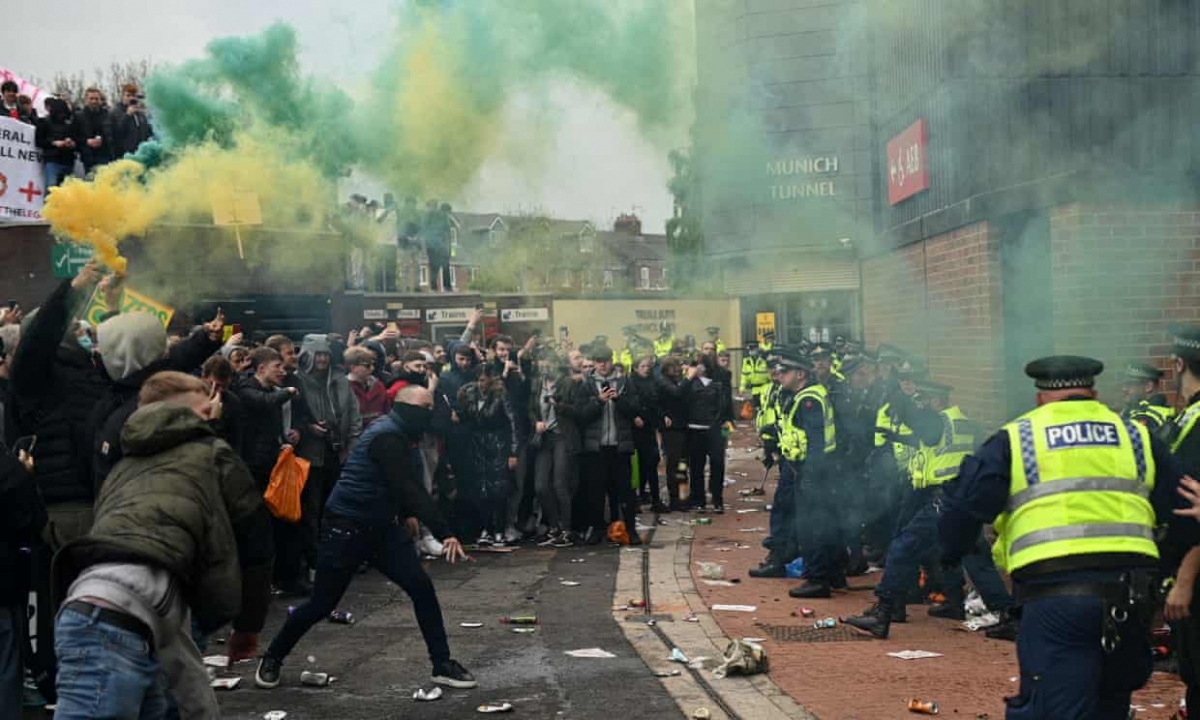
But the patriots were not alone. Immigrant communities and left-wing counter-protesters mobilized in force, outnumbering the marchers in some areas with banners proclaiming “Refugees Welcome” and accusations of fascism. Tensions boiled over almost immediately. Videos circulating online show aggressive confrontations: one migrant activist reportedly lunged at a group of marchers, only to be swiftly surrounded and restrained by the crowd until police could intervene. Scuffles erupted on side streets, with bottles thrown, shields clashing, and red smoke flares filling the air as rival groups pushed against police lines.
Eyewitness accounts describe raw fury on both sides. “They thought they could intimidate us into silence,” one marcher told reporters. “But we’re done being replaced in our own homeland. This is our country—time to reclaim it.” Counter-protesters, meanwhile, accused the far-right demonstrators of spreading hate and division, with some chanting back that “racism has no place here.”
Police faced mounting criticism for apparent bias. Officers were filmed forming protective lines around agitators while aggressively pushing back patriots, fueling accusations that law enforcement is shielding troublemakers at the expense of ordinary Brits. Greater Manchester Police imposed a 10-hour dispersal order and made at least 11 arrests—mostly for public order offenses like assault and affray—but many on the ground claim the real numbers of detentions were higher, with patriots feeling targeted.
The disorder spilled across the city: fires lit in bins, riot shields battered, and mounted police charging to separate the groups. It was the most significant street unrest since the major anti-immigration waves of recent years, a boiling point after decades of unchecked borders, strained public services, and what many call a deliberate policy of demographic replacement.
Britain First leaders, including Paul Golding and Ashlea Simon, addressed the crowd with fiery speeches. “The British people are waking up,” Golding declared. “We’ve had enough of being told to accept our own erasure. Remigration isn’t hate—it’s survival.” The march, though met with fierce opposition from coalitions like Stand Up To Racism and Resist Britain First—including figures like former Labour leader Jeremy Corbyn—sent shockwaves nationwide.
This wasn’t just a protest; it was a declaration. As videos of the clashes spread like wildfire online, patriots hailed Manchester as the spark that could ignite a broader movement. While mainstream media rushed to label it “far-right violence,” thousands more across the country watched and nodded in agreement: the era of passive acceptance is over.
Britain is no longer willing to stand by as its identity is eroded. The streets of Manchester proved it—when patriots rise in their thousands, demanding sovereignty and security, no amount of counter-protests or biased policing can silence them. The remigration march wasn’t the end; it was the beginning of Britain’s long-overdue fightback.
Massive “Remigration” March Turns Manchester Into a Centre of Political Tension
Manchester has found itself at the centre of Britain’s increasingly heated immigration debate following claims of a major “remigration” march that brought protesters, political activists and opponents of the movement into the same public conversation. The controversy highlights the growing divisions over immigration, national identity, border security and the future direction of British politics.
The word “remigration” has become increasingly prominent in European political debates, particularly among movements advocating stricter immigration controls. Supporters often use the term to describe policies intended to encourage or require people without a legal right to remain in a country to leave. However, some political groups use it more broadly to advocate the departure of migrants who have legal status, as well as people from immigrant backgrounds. That distinction is crucial because the legal and social consequences of these proposals can differ substantially.
If a large demonstration takes place under this banner, it is likely to attract attention well beyond the streets where protesters gather. Supporters may describe their participation as a demand for stronger border controls and greater government accountability, while opponents may view the movement as a threat to social cohesion and the rights of minority communities.
Although dramatic descriptions of Manchester becoming a political “warzone” can capture public attention, such language should not be confused with verified evidence of widespread violence. The scale of any demonstration, the number of participants, the presence of counter-protesters and the actions of police all need to be established through reliable reporting.
Nevertheless, the controversy reflects a significant political challenge for Britain: how to debate immigration policy openly while protecting public safety, individual rights and the ability of communities with different backgrounds to live together peacefully.
Why “Remigration” Has Become Such a Controversial Word
Immigration has been one of the defining political issues in Britain for years. Discussions about asylum applications, small-boat crossings, housing pressures, public services and the enforcement of immigration rules have generated strong reactions across the political spectrum.
The term “remigration” adds another layer to this debate because it does not have one universally accepted political meaning.
In a narrow administrative sense, the departure of people who have no legal right to remain can be discussed through established immigration procedures, including voluntary return and enforced removal where legally authorised. Governments have the authority to enforce immigration law, subject to domestic legislation and applicable international obligations.
However, some movements use “remigration” to describe much broader programmes aimed at reversing immigration over several decades. Depending on the group, such proposals may include restrictions on family migration, incentives for people to leave, changes to citizenship policy or the removal of certain categories of foreign residents.
The most controversial versions have raised concerns about discrimination, collective punishment and whether people who have acquired citizenship or established lawful residence would be treated differently because of their ancestry or background.
These distinctions matter when evaluating a demonstration. A march demanding the enforcement of existing immigration law is not automatically advocating the same policies as a movement seeking to remove lawful residents or citizens.
Understanding what organisers actually demand is therefore more useful than relying exclusively on a slogan.
Manchester and the National Immigration Debate
Manchester is an important centre of British commerce, education, culture and political discussion. Its population includes people with a wide range of national, ethnic and religious backgrounds, making debates about immigration particularly significant for local communities.
Like other major British cities, Manchester must address practical questions concerning housing availability, public services, employment opportunities and the integration of new arrivals. Residents can hold differing opinions about how these challenges should be managed without necessarily sharing the same political beliefs.
For some people, concerns about immigration are connected to the speed of population change, pressure on local infrastructure or the perception that national politicians have failed to enforce rules consistently. Others emphasise the economic contributions of migrants, the importance of protecting people fleeing persecution and the long history of migration in shaping British cities.
These perspectives can produce intense disagreements, especially when national political campaigns bring wider controversies into local communities.
A demonstration organised around remigration can therefore become a focal point for disputes that extend well beyond the event itself. Political slogans, speeches and social media footage may influence how people understand the march, even when they have not witnessed it directly.
However, Manchester’s political life cannot be reduced to a single demonstration. The views expressed by demonstrators should not automatically be attributed to the city’s wider population.
The Role of Immigration in British Politics
The continuing argument over immigration has placed pressure on successive governments to demonstrate that they can control the country’s borders while maintaining an effective asylum system.
Small-boat crossings across the English Channel have become a particularly visible symbol of this challenge. Governments have introduced enforcement measures and agreements intended to discourage dangerous journeys, disrupt people-smuggling networks and manage asylum applications.
Yet immigration is a much broader issue than Channel crossings alone. It also includes work visas, international students, family reunification, settlement, citizenship and people arriving through humanitarian programmes.
Each category operates under different rules, and changes to one part of the system do not necessarily produce the same results in another.
Political movements advocating remigration may present their proposals as a comprehensive answer to these challenges. Critics, however, question whether broad promises can be translated into workable policies that comply with the law and avoid damaging businesses, families and local communities.
The debate is further complicated by the distinction between reducing future immigration and requiring people who already live in Britain to leave. These are fundamentally different policy choices, with different economic, legal and humanitarian implications.
Any serious assessment of a remigration platform must therefore examine its specific proposals rather than treating the term as a complete policy in itself.
Why Protesters May Feel Frustrated With the Government
People who participate in anti-immigration demonstrations can have different motivations. Some are primarily concerned about border enforcement, while others focus on public spending, housing, wages or the availability of services in their communities.
Some may believe that political leaders have made promises about immigration that have not been fulfilled. Others may see demonstrations as a way to influence parties that they believe have neglected their concerns.
These frustrations deserve to be examined through evidence and public debate. Governments should explain how immigration rules operate, publish meaningful data and acknowledge the practical challenges facing local authorities.
At the same time, claims about migrants and their effects on society should be evaluated carefully. Broad assertions that entire communities are responsible for economic or social problems can obscure the many factors that influence housing, employment, healthcare and public expenditure.
A useful debate distinguishes between measurable policy outcomes and generalisations about people based on nationality, ethnicity or religion.
Political leaders also have a responsibility to explain what their proposals would achieve, how they would be implemented and what the likely consequences would be for businesses, public services and families.
Without that detail, emotionally charged slogans can dominate a debate that requires practical answers.
Counter-Protests and the Risk of Confrontation
Large political demonstrations can attract people who strongly disagree with the organisers. When rival groups gather in the same area, tensions may develop over slogans, flags, speeches and competing interpretations of national identity.
The presence of counter-protesters does not necessarily mean that violence will occur. Many demonstrations remain peaceful, with participants expressing opposing views while police manage the movement of crowds and protect public spaces.
Nevertheless, confrontations can become more likely when participants believe that their opponents are threatening their safety or fundamental rights.
Police forces must balance several responsibilities: facilitating lawful protest, protecting people from violence and intimidation, maintaining access to public areas and intervening when offences occur.
The appropriate response depends on the circumstances. Officers may establish separation between groups, impose lawful conditions on demonstrations where the relevant legal requirements are met, and investigate specific allegations of criminal conduct.
It is important to distinguish between peaceful participation in a controversial march and conduct involving threats, assault or other unlawful activity. The political views of a demonstrator do not, by themselves, establish that a crime has occurred.
Equally, a claim that a march was peaceful should be assessed against the available evidence rather than accepted automatically.
Where reports describe Manchester as a “political warzone”, details about injuries, arrests, property damage and the police response are essential to understanding what actually happened.
The Impact on Minority Communities
The language surrounding remigration can have consequences beyond the immediate political dispute.
People who belong to immigrant communities may worry that proposals presented as immigration enforcement could extend to individuals who have lived in Britain for decades or who hold British citizenship. Such concerns can become particularly acute when political slogans fail to distinguish between immigration status and ethnic or national background.
A person who has entered Britain unlawfully, a foreign national whose visa has expired, a settled migrant and a British citizen with immigrant ancestry occupy different legal positions. Treating these groups as interchangeable would ignore important distinctions in British law.
Public debate about immigration should recognise those differences.
Supporters of stricter controls may argue that a country must retain the ability to enforce its laws and determine who can enter or remain within its borders. Opponents of expansive remigration policies may respond that removing lawful residents on the basis of ancestry or background would violate fundamental principles of equal treatment.
The specific proposals matter because they determine whether a movement is advocating conventional immigration enforcement or something considerably broader.
Community relations can also be affected by the way political messages are communicated. Strong disagreement over government policy need not become hostility towards neighbours, colleagues or fellow citizens.
Maintaining that distinction is essential if Britain is to debate immigration without encouraging collective suspicion.
Economic Questions Behind the Debate
Immigration policy also has significant economic implications.
Businesses in sectors such as healthcare, hospitality, construction, agriculture and social care may depend on workers recruited from overseas. Changes to visa rules or large-scale departures could affect staffing, wages, costs and the availability of particular services.
Supporters of reducing immigration may argue that a smaller inflow could ease pressure on housing and infrastructure, encourage investment in domestic training or reduce competition for certain jobs.
Critics may question whether those benefits would materialise without additional investment in skills, construction, productivity and public services.
The outcome would depend on the details of the policy, the industries affected and the extent to which employers and workers could adjust.
A policy requiring people without a legal right to remain to leave is also different from one seeking to encourage lawful residents to depart. The latter could raise much broader questions about employment, taxation, family life and the treatment of long-term residents.
For these reasons, proposals described as remigration should be accompanied by transparent assessments of their expected economic effects.
The political debate cannot be settled simply by asserting that more immigration is always beneficial or that less immigration automatically improves living standards. The consequences vary across sectors, regions and groups of workers.
Can Britain Find a Way Forward?
The controversy surrounding remigration highlights the difficulty of reconciling public concerns about border control with the legal protections and economic realities of a diverse society.
A credible immigration system requires clear rules, timely decisions, effective enforcement and procedures that people can understand. It also requires governments to explain how different categories of migration contribute to the country’s needs and how unlawful activity will be addressed.
At the same time, policies must comply with the law and respect the rights of individuals. Broad political demands need to be translated into specific proposals that can be scrutinised for legality, cost and effectiveness.
Manchester’s political debate illustrates why these questions cannot be answered through slogans alone.
Those who support stricter immigration policies should be able to explain which rules they want changed and how their proposals would work in practice. Those who oppose remigration programmes should be equally clear about how they would address public concerns about enforcement, housing and services.
Open debate is most useful when it allows competing claims to be tested against evidence rather than treating disagreement as proof of bad intentions.
Conclusion: A Political Dispute With National Consequences
The claim that a massive remigration march has turned Manchester into a political warzone captures the intensity of Britain’s immigration debate, but the description must be distinguished from verified details about any particular event.
The size of a demonstration, the actions of participants, the response of police and the presence of violence should be established through reliable evidence. Without those facts, dramatic language risks creating a misleading picture of events.
What is clear is that immigration remains a major issue in British public life. Questions about border security, asylum, economic growth, citizenship and social cohesion continue to challenge political leaders and divide public opinion.
The term “remigration” has become a particularly contentious part of that discussion because it can refer to policies ranging from lawful returns to proposals with much wider implications for settled residents and citizens.
Understanding those differences is essential to evaluating the movement and its political influence.
Ultimately, Britain’s challenge is not simply to manage demonstrations or respond to controversial slogans. It is to develop immigration policies that are lawful, effective and transparent while protecting public safety and the rights of people who live in the country.
Manchester may provide a focal point for these arguments, but the questions raised extend across the United Kingdom. How politicians answer them will shape not only immigration policy, but also public confidence in government and the ability of communities with different experiences and beliefs to coexist peacefully.