
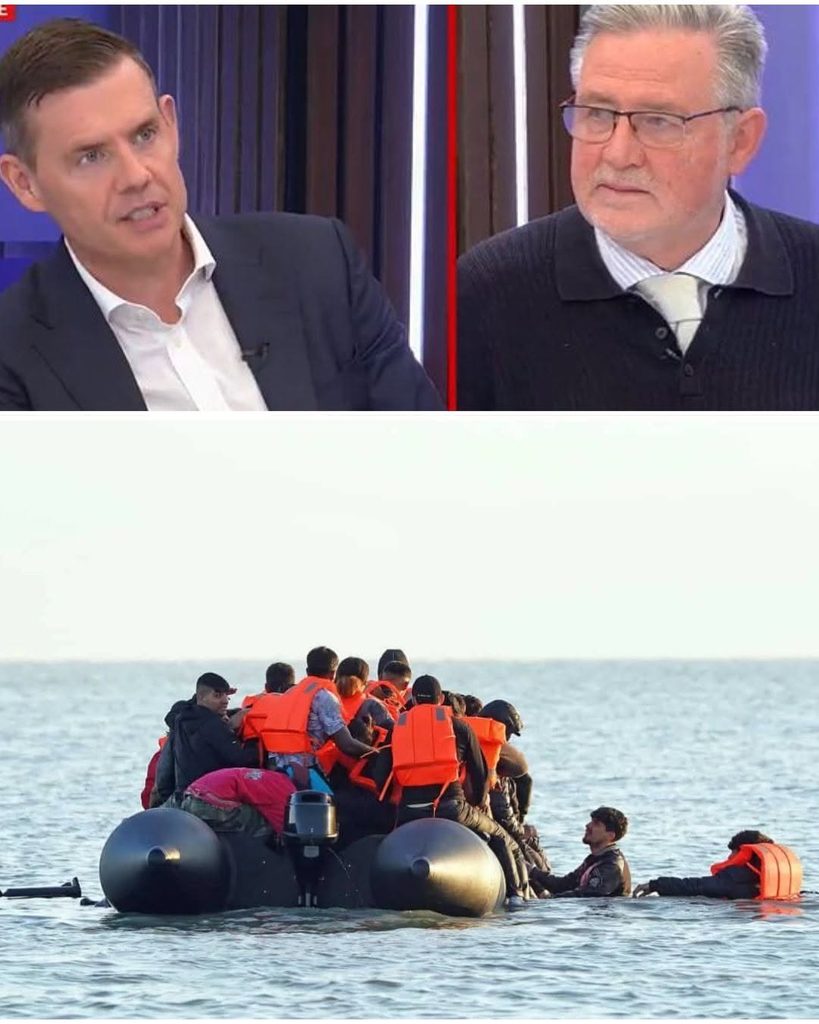
Labour MP Barry Gardiner and commentator Matt Goodwin traded accusations of misleading the public during a heated on-air argument about Channel crossings, legal routes and the European Convention on Human Rights. The exchange has fuelled wider debate about how migration figures and policy options are presented.

A tense confrontation on GB News has drawn attention after academic and commentator Matt Goodwin accused Labour MP Barry Gardiner of “gaslighting” viewers over the scale and handling of small-boat arrivals. The exchange, which took place on Michelle Dewberry’s programme, quickly escalated into mutual claims that each side was distorting the reality of Britain’s immigration challenges.
The discussion centred on recent Channel crossings, the government’s approach to returns, and whether expanding safe and legal routes while remaining bound by the European Convention on Human Rights (ECHR) can deliver meaningful control. Goodwin argued that official narratives underplayed the numbers and the practical barriers to removal.
Gardiner countered that simplistic calls to leave the ECHR ignored the need for cooperation with other countries and the residual effects of leaving the European Union’s previous return arrangements.
What was said
Goodwin pressed the point that small-boat statistics remained high and that Labour’s simultaneous expansion of certain safe and legal routes from countries such as Afghanistan and Syria risked adding to inflows rather than reducing pressure. He told Gardiner: “You’re gaslighting people watching this show.” He maintained that deportation, combined with departure from the ECHR, was the only route to restoring control.
Gardiner rejected the characterisation. He argued that leaving the ECHR would not automatically unlock returns because destination countries still had to agree to take people back. He claimed the bigger practical obstacle stemmed from the loss of EU mechanisms after Brexit and accused Goodwin of offering an overly simple solution that itself misled the public.
Both men accused the other of failing to confront the full picture.
Presenter Michelle Dewberry was seen reacting with visible frustration as the argument intensified. Clips of the exchange circulated rapidly, with supporters of each side claiming the other had been exposed.
The wider context

The row reflects a deeper and persistent disagreement about how to describe and address irregular migration. One side emphasises the cumulative total of arrivals, the low rate of removals, and the strain on housing, services and public trust. The other stresses the legal, diplomatic and logistical constraints on returns, the distinction between asylum claims and economic migration, and the risks of unilateral action that could damage international cooperation.
Small-boat crossings have fluctuated but remain a high-profile issue. Successive governments have struggled to increase the rate of returns significantly.
Labour has pointed to reductions in some net migration categories and changes to legal routes, while critics argue that the overall system continues to grant settlement and citizenship pathways to large numbers of people who arrived in earlier high-inflow years.
The ECHR debate is equally polarised. Advocates of leaving or reforming the Convention argue that it has been used to block removals of foreign national offenders and failed asylum seekers. Defenders insist that the real barriers are operational and diplomatic, and that withdrawal would not solve the problem of countries refusing to accept returnees.
Political fallout
Exchanges of this kind have become common on British television and social media. They rarely resolve the underlying policy questions, but they do illustrate the depth of mutual distrust. Reform UK and Conservative voices often frame Labour positions as denial of the scale of the problem.
Labour MPs and ministers tend to portray right-wing critiques as unrealistic or as scapegoating.
For viewers, the practical questions remain the same: how many people are arriving irregularly, how many are removed, what legal tools actually work, and whether the current mix of deterrence, processing and international agreements is delivering results that the public finds acceptable. The GB News clash did not settle those questions, but it crystallised the rhetorical battleground on which they are fought.
As long as Channel crossings continue and returns remain limited, such confrontations are likely to recur. The public, meanwhile, is left to weigh competing claims about numbers, causes and solutions amid a highly charged political atmosphere.
“YOU ARE GASLIGHTING THE PUBLIC!” — GB News Clash Erupts Over Small Boats
A heated debate over illegal migration and small-boat crossings has reignited Britain’s increasingly divisive immigration debate after a furious exchange on GB News. The confrontation, described by viewers as an explosive clash over whether the public is being given an honest account of the Channel crisis, has brought familiar questions back to the centre of national discussion: is the government doing enough to control Britain’s borders, and are politicians being transparent about the scale of the problem?
The accusation that someone is “gaslighting the public” is particularly powerful in a political environment where trust in institutions is already a major concern. It suggests that people are not simply disagreeing over policy, but are being given an account of events that critics believe fails to reflect reality. When immigration is involved, such accusations can quickly turn a discussion about statistics and government decisions into a wider argument about credibility, accountability and public confidence.
Although the precise details of the GB News exchange would need to be verified before attributing particular statements to individual participants, the controversy reflects the intensity of Britain’s ongoing debate over small boats crossing the English Channel.
Why the Small Boats Issue Continues to Divide Britain
Small-boat crossings have become one of the most recognisable symbols of Britain’s immigration challenges. Images of inflatable vessels carrying people across one of the world’s busiest shipping lanes have repeatedly focused public attention on the government’s ability to manage its borders.
For critics of current policies, the continued arrival of boats raises questions about deterrence, cooperation with France and the effectiveness of the asylum system. They argue that repeated promises to tackle irregular migration have created expectations that politicians must now demonstrate measurable progress.
Others stress that the issue cannot be understood solely through the number of people arriving. Some people crossing the Channel are seeking international protection from persecution or conflict, while others may have different immigration circumstances. Each asylum claim must be assessed according to the relevant legal framework rather than assumptions based on nationality or method of arrival.
The difficulty for policymakers is that border enforcement and the protection of refugees are both important responsibilities. A government must prevent dangerous journeys, disrupt criminal smuggling operations and enforce immigration rules while ensuring that people with valid protection claims can access a fair process.
These competing responsibilities help explain why the subject generates such intense disagreement on television and across social media.
The Meaning Behind the “Gaslighting” Accusation
The language used during political confrontations can be as significant as the policy arguments themselves. Accusing someone of gaslighting suggests that they are deliberately distorting information or attempting to make people doubt what they believe they have witnessed.
In the context of immigration, the accusation can arise when participants disagree about official statistics, the interpretation of government announcements or the difference between promises and actual results.
For frustrated viewers, the central issue may be whether politicians acknowledge the scale of irregular migration and explain why particular policies have succeeded or failed. They may feel that repeated announcements are insufficient if the outcomes remain unclear.
However, the accusation itself does not establish that anyone has misled the public. That conclusion requires evidence, including the statements made, the figures available at the time and whether important information was omitted or misrepresented.
A productive debate should therefore separate factual questions from political rhetoric. How many people have crossed the Channel during a specified period? How many asylum claims have been decided? How many people have been removed following unsuccessful claims? What has happened to the backlog, and how much has accommodation cost?
These are questions that can be examined through official data. Personal accusations may attract attention, but reliable evidence is necessary to determine whether the claims behind them are justified.
Government Promises and the Question of Accountability
Immigration has become a test of political credibility because successive governments have faced pressure to demonstrate control over irregular arrivals.
Voters often judge a policy by comparing its stated objectives with its results. If ministers announce a new strategy to reduce crossings, members of the public reasonably expect clear information about the targets, implementation and measurable outcomes.
When those results are difficult to identify, frustration can grow. Critics may argue that political leaders are prioritising announcements over practical solutions, while government supporters may point to operational difficulties, international cooperation and legal constraints.
The distinction between a policy’s announcement and its implementation is essential. A new agreement with another country does not automatically mean that crossings will stop. Additional enforcement measures may take time to produce results, and their effectiveness can depend on factors outside the government’s direct control.
Nevertheless, explanations of those obstacles should be accompanied by evidence. Ministers should provide regular updates, acknowledge setbacks and explain what changes are being made when a policy fails to meet its objectives.
Without transparent reporting, the debate risks becoming a contest between competing political narratives rather than a serious examination of the country’s immigration system.
The Role of France and the English Channel
The Channel crisis cannot be addressed through British policy alone. France is an essential partner because many dangerous crossings begin along its northern coastline.
Cooperation between the two countries can involve policing suspected smuggling networks, sharing intelligence, improving surveillance and coordinating measures intended to prevent people from making hazardous journeys.
Smuggling organisations create particular difficulties because they can adapt their methods when enforcement changes. They may move departure points, alter routes or exploit vulnerable people who believe that travelling in a small boat offers their only realistic chance of reaching Britain.
This is why tackling the criminal networks behind the crossings is an important element of any strategy. Preventing people from boarding dangerous vessels can save lives, while effective investigations can target those who profit from arranging the journeys.
At the same time, international agreements must operate within applicable legal obligations. Returning people to another country requires appropriate legal arrangements and safeguards. Diplomatic cooperation can be complicated, and an agreement’s existence does not necessarily guarantee that every person arriving irregularly can be returned.
Any politician claiming to have a complete solution should explain how the proposed arrangements would work in practice, including the legal framework, operational resources and cooperation required from international partners.
The Pressure on Local Communities
The political debate does not end when a boat reaches the British coast. People entering the asylum system may require accommodation while their claims are considered, creating responsibilities for national government and, in some cases, consequences for local communities.
Residents may raise concerns about accommodation costs, pressure on housing availability, the provision of public services and the level of consultation surrounding decisions. Such questions deserve clear answers, particularly where public money is involved.
Local authorities can find themselves dealing with the practical consequences of national policies despite having limited control over immigration rules and border enforcement.
Transparency is therefore essential. The government should explain how accommodation is funded, what arrangements are in place and how the needs of local communities are being considered. It should also distinguish between verified evidence and speculation about the effects of migration.
Equally, discussions about asylum seekers should avoid treating all individuals as a single group. People have different circumstances, and allegations about criminality or public spending must be supported by reliable information rather than generalisations.
A balanced approach allows legitimate concerns to be discussed without turning vulnerable people into targets of hostility.
Why Television Debates Become So Heated
Programmes such as GB News provide a platform for competing interpretations of political events. Live discussions can bring together people with sharply different views on immigration, creating opportunities to challenge government policy and question established assumptions.
However, the format can also reward dramatic confrontations. A forceful accusation may dominate headlines even when the underlying facts remain unresolved.
For viewers, the challenge is to distinguish between a memorable exchange and a convincing argument. The loudest participant is not necessarily the one with the strongest evidence, and a confident statement should not be mistaken for a verified fact.
A useful way to evaluate such a confrontation is to identify the specific claim being disputed. If one participant cites an official figure, viewers can examine the original statistics and determine what period they cover. If someone alleges that a policy has failed, the relevant objectives and available outcome data should be considered.
The same standard should apply to politicians, commentators and broadcasters regardless of their position on immigration.
The public deserves vigorous scrutiny of government decisions, but that scrutiny is most valuable when it helps people understand the facts rather than simply deepening existing divisions.
What Would a More Effective Approach Look Like?
A credible response to irregular Channel crossings would need to combine enforcement, administrative efficiency and international cooperation.
First, asylum claims should be processed as efficiently as possible while preserving fair procedures. Long delays can leave applicants in uncertainty, increase accommodation costs and make it harder for authorities to resolve cases.
Second, the government should strengthen efforts to identify and disrupt smuggling networks. Investigations should focus on those organising dangerous journeys and profiting from vulnerable people.
Third, decisions involving people who have no legal right to remain should be implemented consistently, subject to applicable legal protections and return arrangements.
Fourth, ministers should publish clear performance information. Regular figures on arrivals, asylum decisions, backlogs, removals and expenditure would enable the public to assess progress more accurately.
Finally, cooperation with France and other relevant partners should be measured by practical outcomes rather than announcements alone.
No single measure is likely to resolve every aspect of the problem. Effective policy requires sustained implementation, realistic objectives and a willingness to revise measures that fail to produce the intended results.
Conclusion: The Public Wants Answers, Not Just Arguments
The reported GB News confrontation over small boats reflects a broader struggle over trust, transparency and the future of Britain’s immigration policy. The accusation that the public is being gaslighted captures the anger that can emerge when people believe political explanations do not match the reality they see.
Yet strong language is not a substitute for evidence. Establishing whether the public has been misled requires examining the precise statements made, the relevant statistics and the record of the policies being discussed.
The central questions remain significant: are irregular crossings being reduced, are asylum claims being processed efficiently, are smuggling networks being disrupted and are public funds being used effectively?
Politicians should answer those questions directly, acknowledging both measurable progress and continuing difficulties. Broad promises and dramatic television exchanges may capture attention, but lasting public confidence depends on clear information and demonstrable results.
Ultimately, the small-boats debate is about more than political confrontation. It concerns the government’s responsibilities, the safety of people crossing the Channel, the protection of Britain’s borders and the public’s right to understand how decisions are made. A more constructive national conversation will require less reliance on unverified accusations and greater emphasis on facts, accountability and workable solutions.