
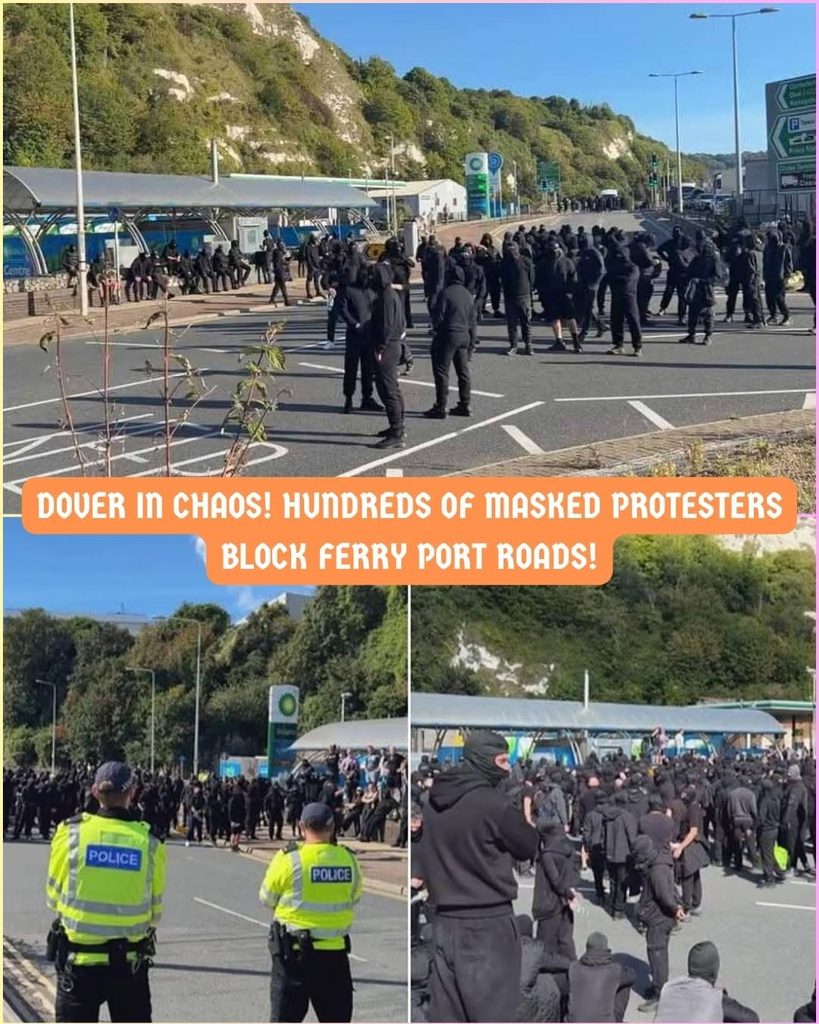
Hundreds of masked anti-migrant protesters brought Dover to a standstill after blocking roads around Britain’s busiest ferry port during a “stop the boats” demonstration.
The activists, many dressed entirely in black and wearing balaclavas, descended on the Kent town on Saturday morning and caused hours of disruption.

+4
View gallery
A group of masked anti-migrant activists have been condemned by politicians after they blockaded Britain’s busiest ferry port in a ‘stop the boats’ protest

+4
View gallery
On Saturday, hundreds of protesters – dressed in black and wearing balaclavas – descended on Dover in Kent, brought the port to a standstill after catching police off guard

+4
View gallery
Roads in Dover were gridlocked for hours in the morning because of the protests, with four-mile tailbacks forming

+4
View gallery
Robert Jenrick called the disruption ‘completely disgraceful’
Four-mile traffic queues formed as access routes to the port became gridlocked.
Hundreds of holidaymakers reportedly missed their scheduled ferry crossings as traffic ground to a halt.
Protesters were seen marching through Dover chanting “Stop the boats” and “Whose streets? Our streets” while police officers followed the crowds.
Footage from the demonstration showed groups linking arms across the A20 and preventing vehicles from continuing towards the port.
Despite the disruption, there were no reports of violence and police made no arrests.
The protesters are believed to have links to Patriot Platform, an anti-migrant group founded by Danny Thomas, who is associated with activist Tommy Robinson.
Robinson promoted the protest online and encouraged supporters to travel to Dover.
Initial claims suggested the blockade could continue for several days.
However, protesters began dispersing around midday, with police officers escorting some participants towards a railway station.
By later in the day, the Port of Dover said routes into and out of the town had reopened and operations had returned to normal.
The disruption nevertheless triggered widespread political criticism.
Reform UK leader Nigel Farage said he opposed protesters wearing balaclavas.
Robert Jenrick, Reform’s Treasury spokesman, described the disruption as “completely disgraceful”.
Labour MP for Dover and Deal Mike Tapp also condemned the demonstration, saying he was frustrated by people travelling to the town specifically to create disruption.
Local Conservative councillor Chris Vinson said the coordinated action had effectively paralysed Dover.
He said people were left trapped in cars or unable to get to work and described the sight of masked men blocking vehicles as intimidating.
Vinson also criticised the fact that police appeared to have been caught by surprise.
He said authorities had not been able to warn residents and travellers in advance because officers had apparently not known the scale of the protest beforehand.
Witnesses described chaotic scenes around the port.
Tour guide Rafael Pittman said he had been left waiting for around three hours while trying to collect a group.
A ferry passenger arriving from the Netherlands said motorists were unable to leave the terminal after disembarking because roads outside had been blocked.
P&O Ferries reassured customers that anyone who missed a sailing because of the disruption would be placed on the next available crossing.
DFDS issued similar guidance.
Although the blockade ended peacefully, there were concerns that further surprise demonstrations could take place and potentially prove harder for police to manage.
The incident highlighted the growing intensity of public anger around the issue of small-boat crossings.
However, the scale of the disruption also drew criticism from those who argued that blocking roads and preventing ordinary travellers from reaching the port undermined the protesters’ message.
For several hours on Saturday morning, one of Britain’s most important transport gateways was effectively paralysed.
And although the crowds eventually dispersed without serious disorder, the images of masked protesters blocking Dover’s roads are likely to intensify debate over both immigration and the policing of disruptive demonstrations.
Masked ‘STOP THE BOATS’ Protesters Bring Dover to a Standstill as Four-Mile Queues Leave Hundreds Missing Ferries
Dover has once again become the focus of Britain’s heated immigration debate after reports of a protest by masked “Stop the Boats” demonstrators allegedly caused serious disruption around the port, leaving motorists facing lengthy queues and ferry passengers at risk of missing their departures.
The reported four-mile traffic backlog has raised concerns about the impact of demonstrations on local residents, international travellers and the freight operators that depend on Dover’s transport links. The incident also highlights the growing tension surrounding small-boat crossings across the English Channel, an issue that continues to divide public opinion and place pressure on political leaders.
However, the precise circumstances of the reported protest, including the number of demonstrators, the duration of the disruption and the number of passengers who missed ferries, require confirmation. The wider issues surrounding border policy, peaceful protest and transport disruption remain important regardless.
Dover at the Centre of the Immigration Debate
Dover occupies a strategically important position in Britain’s transport network. Its port connects the United Kingdom with continental Europe, carrying large numbers of passengers, cars, coaches and freight vehicles throughout the year.
Any significant disruption can have consequences far beyond the immediate area. Drivers may face missed departures, businesses can experience delays to deliveries, and local roads can become congested as traffic builds up around access routes.
That makes demonstrations near the port particularly sensitive. A protest that blocks or slows a major road can affect people who have no connection to the issue being demonstrated, including families travelling for holidays, workers trying to reach their destinations and hauliers operating to strict schedules.
If the reported four-mile queues occurred as described, the disruption would underline the importance of balancing the right to demonstrate with the need to keep essential transport routes operating safely.
The full circumstances matter, however. Establishing whether roads were deliberately blocked, traffic was diverted or congestion developed for other reasons would be necessary to understand the protest’s precise impact.
Why ‘Stop the Boats’ Protests Continue
The phrase “Stop the Boats” has become a prominent slogan in Britain’s political debate over irregular migration across the English Channel.
Supporters of tougher border enforcement argue that dangerous small-boat journeys demonstrate the need for more effective action against people-smuggling networks. They want faster decisions on asylum applications, effective enforcement of removal decisions where legally justified and greater cooperation with other countries to prevent dangerous crossings.
For many people who support these demands, the issue is closely connected to public confidence in the immigration system. They believe that governments must demonstrate that the rules are enforceable and that organised criminal groups cannot continue to profit from vulnerable people making perilous journeys.
Others argue that the issue cannot be resolved through enforcement alone. They point to the complexity of asylum claims, the international nature of people-smuggling and the need for cooperation with European partners. They also emphasise that people seeking protection must have their claims considered in accordance with the law.
These differences have made immigration a recurring source of political tension. Demonstrations can provide an outlet for public frustration, but their effectiveness and legitimacy depend partly on how they are conducted and whether they respect the rights of other people.
The Controversy Over Masked Demonstrators
Reports that some protesters wore masks are likely to prompt questions about identification, public safety and the atmosphere surrounding the demonstration.
There can be different reasons why people cover their faces at a protest, and the presence of a mask alone does not establish that someone has committed an offence. The legal position depends on the circumstances, the conduct involved and any applicable restrictions.
Nevertheless, confrontational demonstrations can create anxiety among residents and travellers, especially when large crowds gather close to busy roads or transport infrastructure.
Police must assess the situation and determine whether any restrictions or interventions are necessary to protect public safety and prevent serious disruption. Their response should be proportionate and consistent with the law.
It is also important to distinguish between peaceful demonstrators and individuals who may engage in threatening or unlawful behaviour. A slogan or political viewpoint does not establish that every person present has acted in the same way.
The key question is what actually happened at the scene, rather than assumptions based solely on how demonstrators looked or what message they were expressing.
Passengers and Businesses Face the Consequences
For ferry passengers, delays near Dover can have immediate practical consequences. People who arrive after their scheduled departure may have to seek alternative sailings, change onward travel arrangements or wait for another available crossing.
Families travelling with children may face additional difficulties, while people attending appointments or connecting with other transport services could experience further disruption. The precise consequences depend on the operator’s arrangements, the availability of alternative sailings and the circumstances of each booking.
Freight operators can also be affected. Dover is a major gateway for goods moving between Britain and mainland Europe, and delays can disrupt delivery schedules and increase operating costs.
For businesses working with time-sensitive goods, even relatively short interruptions may require additional planning. Repeated disruption can make journey times less predictable and create pressure on drivers, logistics companies and customers.
Local residents may face another set of problems, including congestion, noise and delays on roads they use for everyday activities. These impacts help explain why demonstrations near major transport links can generate concern even among people who have no strong view on the underlying political issue.
If hundreds of passengers genuinely missed ferries during the reported incident, the operators and relevant authorities would need to establish the scale of the problem and explain what arrangements were made to assist those affected.
The Police and the Right to Protest
The reported disruption raises questions about how police should manage demonstrations in strategically important locations.
In Britain, the right to peaceful protest is protected, but it is not unlimited. Police have powers under relevant legislation to manage certain forms of protest and respond to unlawful conduct. The circumstances, location and level of disruption all matter when deciding what action is lawful and proportionate.
Authorities face a difficult balancing exercise. They must protect the ability of people to express political opinions while also safeguarding public safety and allowing other people to use roads and transport services.
A demonstration does not automatically become unlawful because it causes inconvenience. Equally, the right to protest does not provide unlimited permission to obstruct roads or endanger others.
The appropriate response depends on the facts, including the nature of any obstruction, the risks created and whether lawful directions were followed.
Clear communication can help reduce tensions. Organisers can work with authorities to identify suitable locations, minimise disruption and make sure emergency access remains available. Police, meanwhile, must explain their actions where significant restrictions or enforcement measures are used.
What Does the Incident Mean for Immigration Policy?
A protest near Dover cannot, by itself, resolve the wider questions surrounding small-boat crossings. Border policy involves several connected challenges, including preventing dangerous journeys, investigating smuggling networks, processing asylum claims and carrying out lawful removal decisions.
The government must also consider international cooperation and the practical capacity of the agencies responsible for managing these processes.
People who want stricter enforcement are likely to judge ministers on whether they can demonstrate measurable progress. Those who emphasise refugee protection will look for evidence that asylum claims are handled fairly and that legal safeguards are maintained.
A sustainable policy needs to address both effective administration and legal obligations. Simplistic promises may attract attention, but implementation depends on resources, legislation, international arrangements and the circumstances of individual cases.
Political leaders also have a responsibility to discuss immigration without treating entire groups of people as responsible for the actions of smugglers or for problems within the asylum system.
A Wider Test for Dover
The reported demonstration illustrates how a national political argument can have immediate consequences for a local community and a major transport hub.
If the four-mile queues and missed ferry departures are confirmed, the incident would raise legitimate questions about traffic management, the conduct of the protest and the arrangements available to protect passengers from unnecessary disruption.
At the same time, the public’s concerns about border control should be addressed through clear information, lawful enforcement and policies that can be evaluated against evidence.
Dover’s importance means that disruption there can affect travellers, businesses and supply chains well beyond the town itself. Authorities therefore have a strong interest in ensuring that future demonstrations are managed safely and that any unlawful obstruction is dealt with appropriately.