
Viral Video After London Rally Fuels Fresh Row Over Policing, Protest and Claims of a Media Double Standard
A short piece of footage circulating after a major London demonstration has become the centre of a much wider political argument — one that now stretches far beyond the people actually visible in the recording.
The clip is being shared online with claims that it captures individuals described as counter-protesters making inflammatory remarks about controversial activist Tommy Robinson shortly after a large demonstration in central London. Supporters of Robinson have seized on the footage as evidence that aggressive behaviour by his opponents receives less scrutiny than incidents involving people attending rallies associated with him.
But there is an important distinction between what a viral video appears to show and what can be established independently.
At the time of writing, the identities of the people in the circulating clip, their precise political affiliations, the full circumstances surrounding the recording and everything said before and after the widely shared segment have not been conclusively established by reliable independent evidence. Even the article that helped circulate the claim acknowledges that the full context of the footage has not been verified. Uk News Forum
That uncertainty does not make the footage irrelevant. It means it has to be handled carefully.
The argument now unfolding is therefore about much more than one video. It touches on policing, political violence, free speech, media selection, social-media algorithms and one of the most persistent claims in contemporary British politics: that people on different sides of ideological disputes are being judged according to different standards.
A Video Becomes a Political Symbol
Viral political footage rarely remains just footage.
Within hours, a recording can acquire a narrative.
One account posts it as evidence of police failure. Another describes it as proof of extremism. A third argues that journalists deliberately ignored what happened. Soon, the original incident becomes inseparable from arguments that existed long before anyone pressed the record button.
That appears to be what has happened here.
The video has circulated among users who argue that confrontational language allegedly coming from opponents of Robinson has received less attention than arrests, offensive rhetoric and clashes involving people attending demonstrations associated with his movement.
The underlying allegation is straightforward: if politically inflammatory behaviour is newsworthy when it comes from one side, why should similar behaviour not receive equal attention when it comes from the other?
As a principle, that question is legitimate.
As a factual claim about systematic bias, however, it is much harder to prove.
One recording cannot demonstrate the existence of a nationwide policy of selective policing. Nor can a handful of newspaper headlines establish that an entire media industry consciously protects one political faction.
The evidence required for conclusions of that magnitude would have to be much broader: charging decisions, arrest records, police statements, prosecutorial outcomes, comparable incidents and a sufficiently large sample of media coverage.
That is precisely where this debate becomes more complicated than the viral posts surrounding it suggest.
The Political Background
Demonstrations associated with Tommy Robinson have become some of the most politically charged public-order events in Britain.
Robinson, whose real name is Stephen Yaxley-Lennon, has built a large following around issues including immigration, Islam, national identity and freedom of expression. Admirers see him as someone willing to discuss subjects that established political institutions have been reluctant to address.
His opponents describe him as a far-right activist whose campaigns have contributed to hostility toward Muslims and migrants.
Those dramatically different interpretations mean that rallies involving Robinson often become symbolic battles over what Britain is becoming — and over who has the right to define British identity.
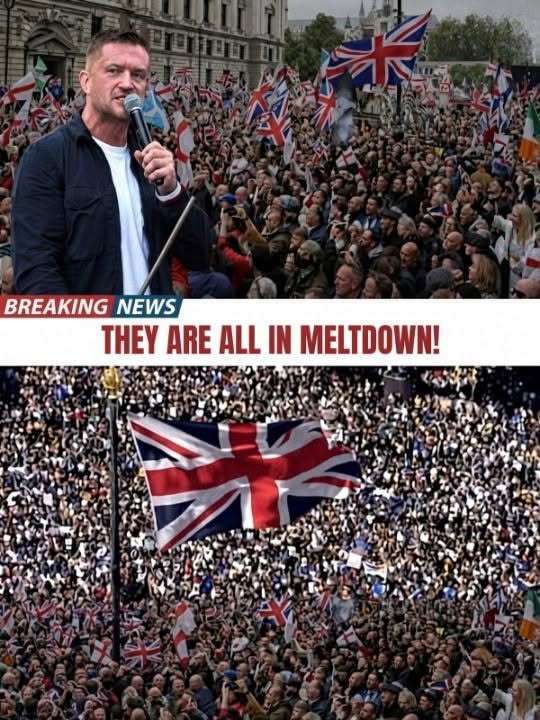
A large Unite the Kingdom demonstration held in London on 16 May 2026 attracted tens of thousands of people. Police estimates put attendance at roughly 60,000, while approximately 4,000 officers were deployed across central London as authorities managed the rally, a separate pro-Palestinian demonstration and other major events taking place in the capital. euronews
Footage published by Reuters showed large crowds carrying Union Jacks and St George’s flags and demonstrators expressing concerns about immigration, demographic change and Britain’s relationship with European institutions. Reuters Connect
The rally took place in an environment where police were attempting to prevent hostile groups from coming into direct confrontation.
That distinction matters.
A demonstration involving tens of thousands of people cannot reasonably be understood through the behaviour of a few individuals — whether those individuals are protesters, counter-protesters or people who happen to be standing nearby.
What the Arrest Figures Actually Show
Arrest data provides useful context because it is less vulnerable to selective editing than social-media clips.
During the May demonstrations, 43 arrests were reported across the wider policing operation. According to contemporary reporting, 20 were linked to the Unite the Kingdom rally and 12 to the pro-Palestinian demonstration, while additional arrests were unrelated to either protest. The Guardian
Police subsequently continued reviewing footage.
On 18 May, the Metropolitan Police announced another arrest involving a participant in the Nakba protest. A 28-year-old man was detained on suspicion of stirring up racial hatred after police said he had been photographed holding a sign calling for people to be hanged alongside other offensive language. Mynewsdesk
That case is particularly relevant to accusations that authorities ignore inflammatory conduct by people opposed to Robinson-linked rallies.
Whatever one thinks about the broader political debate, the arrest demonstrates that police were prepared to investigate suspected offences associated with participants on the other side of the demonstration as well.
The same Metropolitan Police update also recorded charges relating to people from both demonstrations. Mynewsdesk
That does not prove that every policing decision was correct.
It does not establish that enforcement was perfectly symmetrical.
And it certainly does not answer every allegation of political inconsistency.
But it does make sweeping claims that authorities simply refused to investigate one side difficult to sustain without stronger evidence.
The Earlier Rally Shows Why the Argument Is So Emotional
Part of the anger surrounding the latest footage comes from memories of the much larger Unite the Kingdom demonstration held on 13 September 2025.
That event produced serious disorder.
The Metropolitan Police later disclosed that 23 people were arrested in connection with the demonstration at the time covered by its published figures: 22 associated with the Unite the Kingdom march and one associated with the counter-protest. Alleged offences included violent disorder, assaults on emergency workers, affray, aggravated trespass and public-order offences. Cảnh sát London
Police figures also show that 37 officers were injured during the operation, while another 11 were assaulted without suffering recorded injuries. Of those injured, 33 were recorded as having been hurt through assaults. Cảnh sát London
Those numbers explain why confrontations involving Robinson-linked demonstrations have attracted intense media attention.
Violence against police officers is plainly newsworthy.
So are arrests for violent disorder.
Yet those facts do not mean that questionable behaviour by political opponents should escape scrutiny.
Two propositions can be true simultaneously: serious disorder involving one demonstration deserves extensive coverage, and threatening or unlawful behaviour by counter-protesters should also be investigated.
Treating those ideas as mutually exclusive is one of the reasons the political debate becomes so distorted.
What Does the New Footage Actually Prove?
Very little by itself.
That is not an argument for ignoring it.
It is an argument for separating evidence from interpretation.
Before drawing major conclusions from any circulating recording, several questions have to be answered.
Who recorded it?
When exactly was it recorded?
Where were the people standing?
Were they participating in an organized counter-demonstration?
What happened immediately before filming began?
Was anything removed from the beginning or end?
Were the remarks literal, sarcastic, rhetorical or responsive?
Was anyone being threatened?
Was police action already taking place outside the camera frame?
Have investigators identified the individuals involved?
Without answers to those questions, declaring that a short clip reveals “the truth” about an entire demonstration is premature.
The website publishing the circulating account itself states that the precise wording, identities and context of the individuals in the video have not been independently established. Uk News Forum
That qualification is crucial.
Why Short Videos Are Particularly Dangerous Evidence
The camera creates an impression of certainty.
People instinctively trust what they can see.
But video is not the same thing as context.
Imagine a recording lasting 25 seconds.
The camera may accurately document everything that happens during those 25 seconds.
Yet the audience still does not know what happened during the previous five minutes.
A person appears aggressive.
Perhaps they initiated the confrontation.
Perhaps they are responding to something that has just happened outside the frame.
Someone shouts a threatening phrase.
Perhaps it was directed literally toward another person.
Perhaps it was a chant.
Perhaps it was part of an argument.
Perhaps it was edited from a longer exchange.
None of those possibilities should be assumed without evidence.
This problem affects political movements across the spectrum.
A clip showing a nationalist protester shouting abuse may be circulated without showing what preceded it.
A clip showing an anti-racist demonstrator making a violent-sounding statement may be edited the same way.
The political incentive is identical.
Show the most damaging moment.
Remove unnecessary complexity.
Post it with an emotionally certain caption.
Allow users to supply the conclusion.
The Difference Between Offensive Speech and Criminal Speech
Another complication is Britain’s legal framework.
Much political expression is offensive but lawful.
People are generally entitled to condemn political leaders, ridicule movements and express views that others regard as disturbing or insulting.
Criminal law enters the picture under narrower circumstances.
Threats, harassment, racially or religiously aggravated public-order offences, incitement and offences involving the stirring up of hatred can potentially cross legal boundaries depending on the language used, the intent, the audience and the surrounding circumstances.
That means a statement sounding deeply unpleasant on social media is not automatically a criminal offence.
Likewise, claiming that something is “just free speech” does not automatically protect conduct that crosses a statutory threshold.
Police have to distinguish between the two.
And they frequently make those judgments while surrounded by thousands of people, rival groups, noise, flags, cameras and rapidly changing crowd dynamics.
It is unsurprising that those decisions are later contested.
The “Two-Tier Policing” Argument
Claims of politically selective policing have become an increasingly powerful theme in British public debate.
Critics sometimes use the phrase “two-tier policing” to argue that nationalist, anti-immigration or socially conservative demonstrators receive harsher treatment than protesters associated with progressive causes.
Other activists make the opposite argument.
They contend that minorities, anti-racist protesters, environmental activists and pro-Palestinian demonstrators are disproportionately monitored or criminalised.
Both perceptions have considerable political power.
But perceptions are not the same thing as comparative evidence.
To establish genuine discriminatory enforcement, analysts would need to examine similar behaviour committed under similar circumstances.
For example, if two demonstrators from opposing movements both assault police officers, were both arrested?
If two participants display signs potentially constituting the same public-order offence, were they treated similarly?
If one case generated prosecution and another did not, was the evidence equivalent?
Comparisons become misleading when completely different offences are placed side by side.
Twenty arrests at one march and twelve at another do not automatically prove that the first side behaved worse, that the second was favoured or that police enforcement was biased.
Crowd sizes differ.
Offences differ.
Evidence differs.
Individual circumstances differ.
The correct question is not whether both sides experienced identical arrest numbers.
It is whether equivalent conduct was treated according to equivalent legal standards.
Why Police Face an Almost Impossible Public-Relations Problem
Large political demonstrations place police in a peculiar position.
Every possible decision can be interpreted politically.
Intervene rapidly and officers may be accused of suppressing dissent.
Wait too long and another audience asks why threatening conduct was tolerated.
Separate rival groups and protesters complain that authorities restricted freedom of assembly.
Allow groups closer together and police are blamed when confrontations erupt.
Arrest a nationalist protester and accusations of political policing appear online.
Arrest an anti-racist protester and accusations of authoritarianism move in the opposite direction.
For operational commanders, however, the first responsibility is less ideological.
It is preventing injuries and maintaining public order.
At demonstrations involving tens of thousands of participants, a relatively small confrontation can trigger crowd movement extending hundreds of metres beyond the original incident.
That is why police routinely use barriers, separate routes and dispersal powers.
These measures may look excessive when viewed through the lens of a single peaceful participant.
From a crowd-management perspective, their purpose is to prevent exactly the kind of rapid escalation that large hostile demonstrations can produce.
What the May Operation Tells Us
The May 2026 operation illustrates the scale of those challenges.
Around 4,000 police officers were deployed while tens of thousands attended rival demonstrations in central London. euronews
Authorities had to manage not only politically hostile protesters but also the wider movement of people across a city simultaneously hosting other major events.
Contemporary reports described a large police presence involving officers positioned between groups to reduce the possibility of confrontation. euronews
Despite the extensive deployment and dozens of arrests, the event did not descend into the level of sustained violence seen at some previous demonstrations.
That outcome can be interpreted differently.
Critics may regard the scale of policing as excessive.
Supporters of the operation may argue that the relatively contained disorder demonstrates why the deployment was necessary.
Both interpretations involve judgment.
The arrest and injury statistics provide firmer ground.
The Media-Bias Question
The most emotionally powerful claim surrounding the latest video concerns the media.
Supporters sharing the footage ask why confrontational behaviour allegedly involving counter-protesters did not dominate national headlines.
The answer could involve bias.
But it could also involve ordinary editorial selection.
News organizations make hundreds of decisions every day about what deserves prominence.
If police officers are assaulted at a demonstration, that will usually attract coverage.
If someone prominent makes an inflammatory speech from a stage, journalists can easily verify who said it and where.
If 40 people are arrested, police provide confirmed numbers.
A recording involving several unidentified people on a street is more difficult.
Editors must determine whether the footage is authentic, whether the people actually belong to the group they are claimed to represent, whether the complete recording exists and whether the remarks can be verified.
That process can make such incidents slower to report.
None of this means media bias never exists.
Journalists have political assumptions like everyone else.
Newsrooms can exhibit institutional blind spots.
Editorial cultures differ.
But proving systemic suppression requires more than noticing that one particular clip was not widely reported.
Political Movements Experience Different Kinds of Coverage
Another reason accusations of bias are difficult to analyse is that different demonstrations produce different kinds of news.
A rally featuring a prominent political activist naturally generates coverage of that activist’s speech.
A protest producing serious violence generates coverage of the disorder.
A demonstration centred on foreign policy may receive coverage focused on its political demands.
Audiences then compare individual headlines as though journalists were covering identical events.
Often they were not.
This is also why headline counting is an unreliable way to measure political fairness.
A movement may receive more articles but more negative coverage.
Another may receive fewer articles but greater sympathy within those articles.
A third may be discussed mainly on television rather than in print.
Meaningful analysis requires examining tone, placement, framing, sourcing and frequency across large numbers of reports.
Social Media Has Its Own Much More Powerful Selection Bias
Criticism of traditional media often overlooks a second gatekeeper: algorithms.
Social platforms do not provide users with a neutral sample of reality.
They provide content predicted to hold attention.
If someone regularly watches videos about immigration, platforms are likely to recommend more immigration content.
If they repeatedly engage with footage showing aggressive counter-protesters, they may see more of it.
Another user who frequently interacts with anti-racist content may receive recordings of racist abuse or confrontational nationalist demonstrators.
After several months, both users may genuinely believe they have seen overwhelming evidence supporting completely opposite descriptions of Britain.
Neither necessarily watched fabricated videos.
The selection itself created the distortion.
One person repeatedly saw examples of disorder associated with the political left.
Another repeatedly saw examples associated with the political right.
Each becomes increasingly convinced that mainstream institutions are hiding the examples appearing constantly in their own feed.
This creates a strange paradox.
Personalised media feels more authentic because users discover clips directly.
Yet the collection of clips they receive may be far less representative than they realize.
The Camera Is No Longer Neutral
Political activists understand this environment extremely well.
At modern demonstrations, cameras are everywhere.
Protesters record counter-protesters.
Counter-protesters record protesters.
Independent livestreamers record police.
Police record crowds.
Journalists film confrontations.
Participants sometimes appear to deliberately provoke reactions because a dramatic response can later become content.
The objective is no longer simply to win an argument at the demonstration.
It is to produce the most shareable image of the opposition.
A ten-second confrontation can generate millions of impressions.
An uneventful six-hour demonstration cannot.
This creates incentives that would barely have existed two decades ago.
Political street activism increasingly operates simultaneously in two spaces: the physical street and the digital information battlefield surrounding it.
What happens online afterward may have more political impact than what happened during the march itself.
Counter-Protesters Are Not a Single Organization
Another fundamental error occurs when individual behaviour is attributed to an entire political category.
“Counter-protester” is not an ideology.
People opposing Robinson-linked demonstrations can include socialists, trade unionists, anti-racist groups, religious organisations, pro-Palestinian activists, local residents and people with no organizational affiliation.
Their politics may differ dramatically.
The behaviour of one person cannot automatically be attributed to all of them.
Exactly the same rule should apply to people attending Unite the Kingdom rallies.
Tens of thousands of participants cannot reasonably be treated as a single ideological personality.
Some may be primarily concerned about immigration.
Others may attend because of free-speech concerns.
Some may hold nationalist political beliefs.
Others may simply object to the current government.
A small number may express extremist views.
Judging everyone by the most inflammatory individual visible on camera is analytically weak regardless of which side is being discussed.
Guilt by Association Is Politically Convenient
Yet collective attribution is extraordinarily useful in political campaigning.
If one person at a march carries an offensive sign, opponents can circulate the photograph and imply that it represents the entire demonstration.
If one counter-protester makes a violent remark, the same technique works in reverse.
The audience rarely sees the tens of thousands of people who did nothing dramatic.
Normal behaviour is not viral.
Outrage is.
That creates a distorted picture of mass protest.
Someone watching social media afterward may conclude that an event consisted almost entirely of confrontation, when most participants may have spent hours walking, listening to speeches and eventually going home.
The Politics of Tommy Robinson Makes Neutral Analysis Particularly Difficult
Few British political activists generate stronger reactions than Robinson.
His supporters frequently argue that mainstream institutions unfairly characterize his movement while refusing to discuss legitimate concerns about immigration, integration and Islamist extremism.
His critics contend that he frames complicated social problems in ways that intensify hostility toward Muslims and immigrants.
Those competing interpretations shape how information is processed.
If a Robinson supporter is arrested, some followers may immediately suspect political targeting.
Opponents may regard the arrest as confirmation of extremism.
If an opponent of Robinson is arrested, those interpretations reverse.
Evidence then becomes secondary to identity.
People ask not “What happened?”
They ask “Which side was the person on?”
That is a dangerous standard for both journalism and criminal justice.
One Legal Standard Is the Only Sustainable Standard
The most defensible principle is also the simplest.
If a person supporting Robinson makes a credible unlawful threat, investigate it.
If someone opposing Robinson makes the same threat, investigate that person as well.
If someone assaults a police officer, their political views should not matter.
If someone expresses an unpleasant but lawful opinion, the protection afforded to expression should not depend on ideological affiliation.
That standard sounds obvious.
Applying it consistently across thousands of individual encounters is much harder.
But abandoning it would undermine public confidence more quickly than almost anything else.
Why Perceived Inconsistency Matters Even When It Is Not Proven
Institutions should not dismiss accusations of double standards merely because some viral claims are exaggerated.
Perceived unfairness has consequences.
If large numbers of people become convinced that police enforce laws politically, cooperation with law enforcement declines.
If audiences conclude that journalists systematically conceal information, they abandon mainstream outlets for alternative sources.
If people believe courts apply different standards according to ideology, trust in the legal system deteriorates.
Some of those beliefs may be based on misinformation.
Others may arise from genuine institutional errors.
The appropriate response is transparency.
Police publication of arrest numbers, alleged offences and subsequent charging outcomes helps.
So does correcting initial information when investigations develop.
Journalists can similarly explain what has and has not been independently verified rather than presenting viral material with more certainty than the available evidence allows.
Why Verification Usually Loses the Race
Unfortunately, careful verification is structurally disadvantaged online.
“The context remains unclear” is not exciting.
“They caught them!” is.
“Police are reviewing footage” spreads slowly.
“Authorities are covering this up” spreads quickly.
Nuance requires several paragraphs.
Outrage fits inside a caption.
By the time reporters verify an event, millions of people may already have seen an unverified interpretation of it.
Corrections rarely receive comparable attention.
This dynamic benefits political activists on every side.
It does not require deliberate fabrication.
Selective truth is often more effective than falsehood.
A genuine video placed inside a misleading narrative can be more persuasive than an invented video because the underlying images are authentic.
A Useful Test for Viral Political Footage
Before treating politically explosive footage as proof of a larger claim, viewers can ask several questions.
Is the complete recording available?
Can the date and location be confirmed?
Are the people correctly identified?
Does the video prove their political affiliation?
Does an official statement exist?
Has anyone been arrested or charged?
Are captions describing observable facts or interpretations?
Does the footage show what happened immediately before the confrontation?
Has another camera captured the same event?
These questions do not make disturbing behaviour acceptable.
They make conclusions more reliable.
The Arrest Figures Should Not Become Political Scorecards
There is another danger in this debate.
Political activists sometimes treat arrest statistics like football results.
Twenty arrests versus twelve.
Twenty-two versus one.
Higher numbers are then offered as proof that one movement is more violent or that another receives preferential treatment.
That is not how criminal statistics work.
An arrest is not a conviction.
A person may later be released without charge.
Evidence may develop.
Charges may change.
Trials may produce acquittals.
One incident can involve several offences.
Another arrest may concern conduct unrelated to the political purpose of the demonstration.
Numbers provide important context.
They do not eliminate the need to examine individual cases.
What Can Reasonably Be Said About the Current Controversy?
Several conclusions can be made with reasonable confidence.
Large demonstrations associated with Robinson have attracted tens of thousands of people and required substantial policing operations. euronews
Police have arrested people associated with Robinson-linked rallies for alleged public-order and violent offences. Cảnh sát London
Police have also taken enforcement action against people associated with opposing demonstrations, including an arrest after the May event on suspicion of stirring up racial hatred. Mynewsdesk
Footage now circulating online is being used to argue that inflammatory behaviour by counter-protesters receives insufficient attention, but the identities, affiliations and full circumstances of the people shown have not been independently established from the available material. Uk News Forum
Everything beyond those propositions requires greater caution.
What Cannot Yet Be Established
The available evidence does not establish that the video proves systematic media censorship.
It does not prove systematic political policing.
It does not demonstrate that an entire counter-protest supported whatever may have been said in the recording.
Nor would wrongdoing by individuals on one side erase documented wrongdoing by individuals on the other.
That last point is especially important.
Political debates increasingly operate through competing exonerations.
One side points to misconduct by opponents as though it cancels misconduct among its own supporters.
It does not.
If two people behave unlawfully, both cases matter.
Justice is not a balance sheet where wrongdoing on one side cancels wrongdoing on the other.
What the Controversy Really Reveals
Perhaps the most revealing aspect of this episode is not the content of the video.
It is the speed with which millions of people are prepared to interpret it through a pre-existing political framework.
Supporters see evidence of hypocrisy.
Opponents see another attempt to distract from extremism.
Media critics see censorship.
Police critics see selective enforcement.
Almost everyone believes the camera has confirmed what they already suspected.
That is becoming one of the defining characteristics of contemporary politics.
Evidence does not merely inform political identities.
Political identities increasingly determine how evidence is interpreted.
Britain Is Entering a New Era of Street Politics
Large demonstrations involving immigration, national identity, religion and foreign policy are unlikely to disappear.
The political incentives driving them remain strong.
Immigration continues to generate intense debate.
Questions about integration and multiculturalism remain unresolved.
Public confidence in political institutions is fragile.
International conflicts increasingly spill into domestic demonstrations.
And social media provides enormous rewards for confrontational political content.
This means Britain may face more occasions where rival groups occupy central London while thousands of police officers attempt to keep them separated.
Every arrest will be recorded.
Every confrontation will be filmed.
Every controversial remark may appear online within seconds.
Institutions will have to adapt to a political culture in which operational decisions are instantly transformed into national arguments.
Transparency Will Matter More Than Ever
The best defence against misinformation and accusations of political favouritism is not simply telling the public to trust institutions.
It is giving people evidence.
Publish arrest breakdowns.
Explain alleged offences.
Correct inaccurate numbers.
Provide charging outcomes.
Clarify why intervention occurred in one case but not another where possible.
Journalists face a similar responsibility.
Clearly distinguishing verified facts from viral allegations may seem less dramatic than sensational headlines, but it becomes increasingly important when edited footage can shape political opinion before professional verification begins.
The Wider Lesson
The latest controversy should therefore not be understood simply as another argument between supporters and opponents of one activist.
It represents a broader democratic problem.
How does an open society protect robust political protest while preventing violence?
How should police enforce public-order laws without appearing ideological?
How can journalists select the most important events from thousands of hours of footage without inevitably being accused of choosing politically?
How should citizens evaluate videos when algorithms reward certainty rather than context?
There are no easy answers.
But one principle remains essential.
The evidential standard cannot change according to who is speaking.
The Camera Captured Something — But Not Everything
The phrase surrounding the viral footage suggests that something was caught on camera that powerful institutions did not expect the public to see.
Perhaps the recording will ultimately reveal serious misconduct.
If investigators verify threatening or unlawful behaviour, those responsible should be treated according to the same laws that apply to everyone else.
But a camera angle is not omniscience.
It records one place, from one position, during one slice of time.
The truth about a large political demonstration is inevitably larger.
Thousands of people can participate peacefully while a handful behave appallingly.
Police can make legitimate arrests while still making mistakes elsewhere.
News organizations can report real violence without capturing every relevant incident.
Counter-protesters can oppose extremist ideas while individuals among them may themselves cross legal or ethical lines.
All of those things can be true simultaneously.
That complexity may be frustrating in an online environment built around instant certainty.
It is nevertheless where responsible reporting has to begin.
The central question raised by the circulating footage is therefore not simply whether one political side behaved badly.
It is whether Britain can maintain the same legal, journalistic and evidential standards when the people being judged belong to movements that deeply dislike one another.
The arrest records from recent demonstrations show that police have taken action involving people from different political camps. The viral video now being debated may justify further scrutiny, but its broader meaning cannot responsibly be established until its context, participants and circumstances are verified.
Until then, claims that it proves a nationwide conspiracy, systematic media suppression or universal misconduct among counter-protesters should be treated as claims rather than established facts.
In a political environment increasingly shaped by edited clips, competing narratives and algorithms that reward outrage, that distinction may be more important than the video itself.
The footage may have captured a moment. The harder task is establishing what that moment actually means.