
£662M BORDER CONTROVERSY: What the Figures Really Show About Channel Crossings — and What French Police Are Now Being Asked to Do
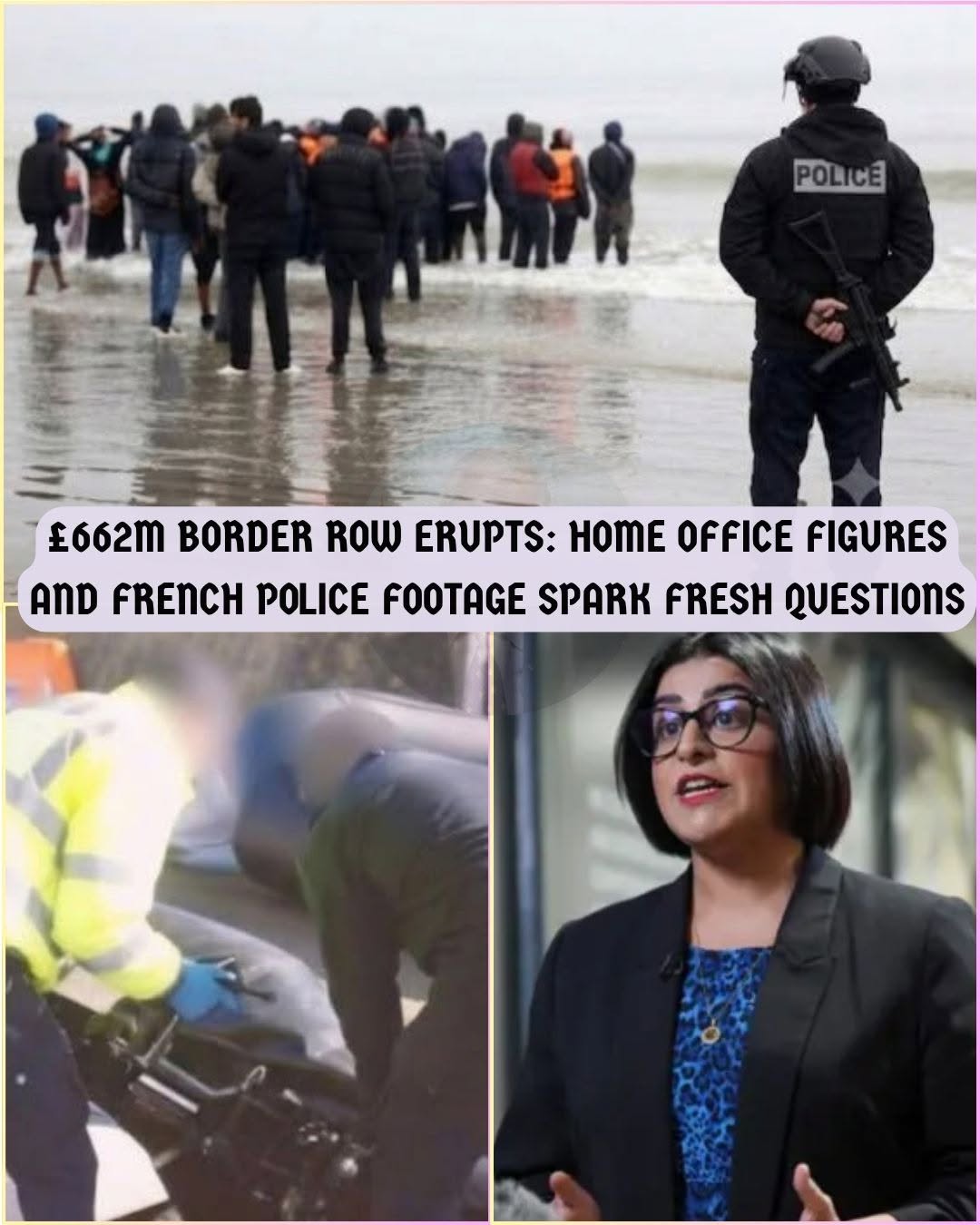
A new UK-France border agreement has intensified a long-running argument over small-boat crossings, public spending and the effectiveness of French enforcement. But several numbers circulating online refer to different periods, and recent changes to French maritime tactics mean that footage of officers apparently standing back does not necessarily describe the policy now in force.
The English Channel has once again become the focus of an intense political argument over migration, border enforcement and public money. At the centre of the latest controversy is a striking figure: £662 million.
That is not simply a social-media claim. In April 2026, Britain and France agreed a new three-year funding arrangement worth £662 million, or approximately €767 million, covering the period from 2026/27 to 2028/29. According to the House of Commons Library, £501 million is intended to strengthen existing border controls in northern France, while another £161 million is available for new tactics and operational measures. (House of Commons Library)
The scale of that commitment has inevitably raised a straightforward question among British taxpayers: what exactly is the United Kingdom getting for the money?
That question has become especially contentious when videos emerge apparently showing groups attempting to reach boats while French officers are nearby. Some clips have been presented online as proof that French police are simply allowing crossings to happen despite British funding.
But the full picture is considerably more complicated.
There is evidence that some crossings continue despite French police presence. There is also official evidence that French authorities are preventing thousands of attempted crossings, seizing boats and engines, arresting suspected smugglers and, under a newer policy, intercepting certain boats on the water.
Understanding the controversy therefore requires separating three things that are often mixed together: the amount Britain has committed to France, the number of people actually reaching Britain, and the number of attempted crossings prevented before they succeed.
The £662 million figure is real — but it covers three years
The first important clarification concerns the money itself.
The £662 million is not a single payment made to French police for one year of beach patrols. It is a multi-year UK funding commitment covering three financial years.
The House of Commons Library says the agreement consists of £501 million for strengthening existing controls in northern France and £161 million for new tactics. The British government has said the arrangement will increase personnel, expand surveillance, strengthen intelligence operations, provide new detention capacity and develop maritime interception capabilities. (House of Commons Library)
Government statements say the programme is expected eventually to bring the number of law-enforcement, intelligence and other frontline personnel involved in northern France to nearly 1,100.
Five specialist police units were also included in the plans, together with drone surveillance, two additional helicopters, camera systems and expanded maritime capabilities. (Câu hỏi và Tuyên bố Quốc hội)
There is another significant difference from earlier agreements.
Part of the new funding is supposed to be linked to results.
In an April parliamentary answer, the Home Office said the flexible component of the funding would be reviewed annually and that financing for unsuccessful new tactics could be stopped after the first year and redirected elsewhere. (Câu hỏi và Tuyên bố Quốc hội)
That is important because criticism of previous UK-France arrangements has often focused on accountability: Britain could identify how much money had been committed, but it was harder for the public to determine precisely how much difference each individual measure had made.
The Commons Library notes that Britain and France conduct strategic reviews of their cooperation but do not publish the results of those reviews. (House of Commons Library)
That leaves room for a legitimate public debate about transparency even when headline operational statistics are available.
What about the “46,000 crossings” figure?
This is where the current debate can become misleading.
Approximately 46,000 people did arrive in Britain by small boat in 2022, according to the House of Commons Library. That remains the annual peak in the historical series.
But it is not the current 2026 total.
The Commons Library reported this month that arrivals reached about 46,000 in 2022, subsequently fell, and then rose again to approximately 41,000 in 2025. In the 12 months ending June 2026, around 33,000 people were detected arriving by small boat. (House of Commons Library)
The latest available reporting gives an even clearer picture of the current calendar year.
As of September 21, 17,480 people had crossed the Channel by small boat during 2026, according to figures reported by The Times. That was around 46% lower than at the equivalent point of the previous year. (The Times)
So a claim that “46,000 migrants have crossed this year” would not match the current official and reported data.
The figure of roughly 46,000 is historically significant because it represents the 2022 peak, but it should not be confused with the number recorded so far in 2026.
There is another figure in roughly the same range that can cause confusion.
The British government said in August that joint UK-French activity had prevented more than 48,000 crossing attempts since the 2024 UK election. That is a figure for attempts reportedly prevented, rather than successful arrivals. (Home Office Media)
Those are fundamentally different statistics.
A person prevented from boarding a boat in France belongs in a prevention figure. Someone detected after reaching or being intercepted en route to Britain belongs in an arrival figure. Combining those categories can produce a highly distorted picture.
The longer trend remains politically significant
None of these clarifications means small-boat migration has disappeared.
It plainly has not.
The Home Office recorded approximately 33,000 small-boat arrivals during the year ending June 2026, representing about 88% of detected unauthorised arrivals during that period. (GOV.UK)
The Commons Library estimates that approximately 205,000 people were detected arriving by small boat between 2018 and June 2026. (House of Commons Library)
The composition of boats has changed substantially as well.
The average number of people aboard each detected small boat increased from only seven in 2018 to around 65 in the year ending June 2026. (House of Commons Library)
That development matters operationally.
Authorities may succeed in reducing the number of boats without achieving an equivalent reduction in the number of people arriving if smuggling organisations respond by placing substantially more passengers aboard each vessel.
Recent cases demonstrate how extreme overcrowding can become. Earlier this year, one dinghy was reported carrying 165 people, including 31 children. (The Times)
This is one reason why statistics measuring “boats stopped” and statistics measuring “people prevented from crossing” should not be treated as interchangeable.
What were French police previously allowed to do?
Perhaps the most misunderstood part of the Channel debate concerns what happens when migrants reach the water.
For years, British politicians and commentators complained about footage apparently showing French officers watching people enter dinghies without physically stopping them.
Sometimes those images were interpreted as evidence that officers simply did not want to intervene.
The legal and operational situation was more complicated.
French authorities traditionally concentrated heavily on preventing departures before vessels entered the water. Once a crowded inflatable boat was at sea, intervention could create a danger of capsizing, injury or drowning.
That distinction created an obvious tactical opportunity for smuggling networks.
If a boat could reach the water, the chances of physically preventing its journey could change considerably.
Smugglers adapted.
One particularly important development has been the so-called “taxi boat” tactic. Instead of assembling a large group around an inflatable vessel directly on a heavily patrolled beach, smugglers can launch the boat elsewhere and move along the coast or through waterways before approaching groups waiting to board.
The Border Security Command says organised criminal groups increasingly adopted tactics including simultaneous launches intended to overwhelm police resources and taxi boats that collect passengers in shallow offshore waters. (GOV.UK)
That forced France and Britain to reconsider the operational model.
France has changed its policy
This is critical when assessing current claims about what French officers have been “instructed” to do.
The Commons Library reported in May that French police had begun implementing a policy allowing them to intercept and immobilise taxi boats in certain circumstances. (House of Commons Library)
The British government has similarly said France expanded its maritime approach so that certain taxi boats can be intercepted at sea.
Under the April agreement, the UK is supporting expanded maritime capability, including an additional vessel and more than 20 additional maritime officers. (Câu hỏi và Tuyên bố Quốc hội)
This does not mean French authorities have been instructed to chase every migrant boat across the Channel.
Nor does it mean officers can automatically board or disable every vessel once passengers are aboard.
Safety assessments remain important.
Evidence given to a French parliamentary inquiry illustrates that limitation. Officials described decisions about interception as depending on operational assessments, including whether children or other vulnerable people were aboard.
Reporting by Le Monde also described a confidential November 2025 policy document under which interceptions initially targeted taxi boats before migrants boarded them. The policy was introduced gradually because of concerns about drowning and the risks associated with maritime interception. (Le Monde.fr)
That distinction helps explain why two apparently contradictory videos can both be genuine: officers may aggressively disable an empty or accessible inflatable vessel in one situation while avoiding a physical confrontation with a dangerously overloaded boat in another.
The circumstances matter.
French officers are now physically stopping some launches
There is recent evidence of significantly more direct intervention.
Footage released by Britain’s Border Security Command in August showed French officers confronting a group attempting to launch an inflatable boat.
Individuals in life jackets appeared to throw objects at officers. Police responded with incapacitant spray, reached the inflatable vessel and cut the boat to prevent it from being used. (ITVX)
Whatever political interpretation is placed on that footage, it directly contradicts any broad claim that French police are universally under instructions to stand aside.
The current policy is clearly more interventionist than that.
But it would be equally misleading to suggest that every attempted departure is stopped.
Many are not.
What has the £662 million agreement achieved so far?
Because the latest funding arrangement only began in April, a definitive assessment would be premature.
There are, however, early figures.
According to information supplied by French authorities and published by the UK Home Office, French units prevented 185 small-boat crossing events between April 27 and August 2.
The government says those operations prevented more than 4,300 attempted crossings. (GOV.UK)
During that three-month period, the reported prevention rate was approximately 61% of small-boat events, almost five percentage points higher than during the corresponding period in 2025.
French authorities also reported four weeks during which every identified potential crossing event was intercepted. (GOV.UK)
Operations included stopping departures from beaches, discovering boats hidden in vegetation, confiscating engines and fuel, arresting suspected smugglers, intercepting vehicles carrying maritime equipment and using drones to locate groups transporting boats toward the coast.
French units have also started using the newer maritime tactics.
The Home Office reported in August that, since the first deployment of those tactics on March 3, French authorities had intercepted 12 taxi boats on the water. (GOV.UK)
Those figures represent measurable enforcement activity.
But they do not settle the argument about value for money.
Why critics remain unconvinced
For critics, the central test is not simply how many boats France stops.
It is how many people ultimately reach Britain.
That distinction matters.
A government can report thousands of disrupted journeys, seized engines and arrests while the public may continue seeing crowded boats reaching British waters.
Critics therefore argue that successful arrivals should remain a central measure of effectiveness.
There is also a methodological problem.
If authorities stop one group repeatedly—perhaps preventing its departure on Monday before the same people attempt another journey on Wednesday—statistics measuring “attempts prevented” do not necessarily represent an equivalent number of unique individuals permanently prevented from reaching Britain.
Official language generally refers carefully to crossing attempts, which is not necessarily the same as unique people.
Transparency therefore matters when interpreting the headline numbers.
At the same time, measuring policy only by successful arrivals has limitations too.
Weather conditions affect crossings. So do smuggling tactics, enforcement elsewhere in Europe, the availability of boats and engines, political developments in migrants’ countries of origin, asylum policy and conditions along alternative routes.
The Border Security Command itself acknowledges the difficulty.
Its annual report concluded there was moderate evidence that the border-security system had helped make France a less viable departure point, while also noting that evidence was weaker when attempting to establish how some interventions affected the behaviour of migrants and organised criminal groups. (GOV.UK)
That is a much more cautious conclusion than either “the policy has completely failed” or “the problem has been solved.”
Neither extreme is supported by the available evidence.
Smuggling networks adapt when enforcement changes
Border enforcement is rarely static.
Every new police tactic creates incentives for smugglers to find another vulnerability.
British authorities say stronger enforcement in northern France has contributed to organised groups changing their methods.
Taxi boats are one example.
Simultaneous launches are another.
Longer routes may become another challenge. Recent reporting has described boats departing from parts of Normandy considerably farther from the traditional Calais-Dover corridor. (The Sun)
The Commons Library has also identified a significant increase in taxi-boat launches from Belgium.
Between January and April 2026, there were reportedly 32 attempted launches from Belgian beaches, compared with just two during the whole of 2025. Some observers have linked the change to intensified policing in northern France, although establishing direct causation is difficult. (House of Commons Library)
This illustrates what border-security specialists sometimes describe as displacement.
Stopping one route does not necessarily eliminate demand.
It can move the activity somewhere else.
For policymakers, therefore, the challenge is not simply to secure a particular beach. It is to disrupt the wider system that supplies boats, engines, transport, financial services and organisers.
That explains why a substantial part of UK strategy has moved toward intelligence and criminal investigations rather than relying exclusively on uniformed officers standing along the French coastline.
The battle against smugglers
The UK government says joint activity with France resulted in 480 suspected smugglers being arrested during 2025. (GOV.UK)
The Border Security Command’s annual report says there were almost 2,000 organised immigration-crime arrests in Britain and overseas during the 2025/26 financial year, representing a 74% increase. (GOV.UK)
The government also reported in August that around 1,100 small boats or engines had been seized since the election. (Home Office Media)
Again, these are enforcement outputs rather than proof by themselves that the broader strategy will produce a lasting reduction in crossings.
A criminal network can replace an arrested operative.
Boats can be replaced.
Routes can shift.
The more important long-term question is whether authorities can raise the financial and operational cost of smuggling sufficiently to reduce the number of journeys that can be organised.
That takes longer to measure.
The humanitarian dimension cannot be separated from enforcement
There is another reason maritime intervention is controversial.
The Channel is not simply a border. It is one of the busiest shipping routes in the world, and people attempting crossings often travel aboard inflatable craft never designed for such journeys.
Once a boat is overloaded and moving through open water, a law-enforcement operation can rapidly become a rescue operation.
That creates an unavoidable tension.
Governments want to prevent unauthorised journeys and undermine criminal smuggling businesses. At the same time, French and British authorities have obligations relating to safety at sea and cannot treat a dangerously overloaded inflatable boat like an ordinary vehicle attempting to evade a checkpoint.
This explains some of the caution surrounding intervention once boats are underway.
It also explains why newer French tactics have focused particularly on taxi boats before passengers board, when disabling or intercepting a vessel can present substantially less risk.
Humanitarian organisations have nevertheless criticised some increasingly aggressive policing techniques.
Following footage of the August beach confrontation, charities raised concerns that tactics involving incapacitant sprays or physical confrontation near the water could themselves endanger people. (The Guardian)
Supporters of stronger enforcement counter that allowing overloaded boats to depart exposes passengers to an inherently dangerous maritime journey.
Those competing concerns are likely to remain part of the debate regardless of which government is in office.
The separate UK-France returns arrangement
The £662 million enforcement package should also not be confused with another UK-France policy: the reciprocal migration agreement that began operating in August 2025.
Under that arrangement, eligible people who reach Britain by small boat can be returned to France, while an equivalent number of people can enter Britain from France through a controlled legal route after identity, security and eligibility checks. (GOV.UK)
Official statistics show that between August 6, 2025 and June 30, 2026, 1,087 people had been returned from Britain to France, while 1,117 had been transferred legally from France to Britain under the reciprocal system. (GOV.UK)
Those numbers are relatively small compared with overall Channel arrivals.
The policy’s stated purpose, however, is partly deterrence: someone contemplating paying a smuggler should know that reaching British territory does not automatically guarantee remaining there.
Whether that deterrent effect becomes substantial is something that can only be assessed with more evidence over time.
Are crossings actually falling?
At the moment, the answer is yes compared with the corresponding period last year, although that observation requires context.
The latest September reporting placed the 2026 calendar-year total at 17,480 by September 21, around 46% below the equivalent point in 2025. (The Times)
The longer official series similarly shows approximately 33,000 arrivals in the year ending June 2026, down from the levels recorded during the preceding year. (House of Commons Library)
That is evidence of a decline.
What the figures cannot establish on their own is precisely how much of that decline should be attributed to the £662 million agreement.
The agreement was signed only in April.
Some enforcement policies preceded it.
Weather varies between years.
Smuggling networks change tactics.
Measures in Belgium, Germany and elsewhere can influence the supply chain.
Changes to British asylum and returns policy may affect incentives.
A statistically responsible assessment therefore needs to distinguish correlation from causation.
The Border Security Command’s own cautious assessment—that there are signs of impact but further evidence is required—is useful in this respect. (GOV.UK)
What should taxpayers watch next?
The real test of the £662 million programme will unfold over the remaining years of the agreement.
Several indicators will matter simultaneously: successful arrivals, attempted crossings, interception rates, repeat attempts, smuggling arrests, equipment seizures, deaths and rescues at sea, the development of alternative departure routes and the number of people successfully returned after arriving.
No single statistic can provide the whole answer.
A rising interception percentage could be positive while total arrivals remain high.
A declining number of boats could conceal increasing overcrowding.
A falling number of arrivals from France could coincide with departures shifting toward Belgium or Normandy.
And a large number of arrests would matter less if smuggling networks could replace organisers immediately.
The financial structure also deserves scrutiny.
Because £161 million of the package is intended for newer tactics and part of the arrangement is explicitly linked to performance, future government reporting should make it easier to judge whether those interventions are producing measurable results. (House of Commons Library)
That is where the argument over taxpayer value is likely to become more evidence-based.
So what do the figures really show?
They show a situation more complicated than the most dramatic claims circulating online.
The £662 million commitment is genuine, but it is a three-year package rather than a one-off annual payment.
The often-cited figure of approximately 46,000 successful crossings belongs to the 2022 peak, not the current 2026 calendar year. Around 41,000 people arrived by small boat in 2025, while approximately 33,000 were recorded in the 12 months ending June 2026. (House of Commons Library)
As of September 21, the reported 2026 calendar-year total stood at 17,480, substantially below the equivalent stage of 2025. (The Times)
Meanwhile, the government says more than 48,000 crossing attempts have been prevented since the 2024 election. That is a different statistic and should not be presented as the number of people who successfully crossed. (Home Office Media)
And the claim that French officers are simply instructed to watch boats leave is no longer an accurate description of the overall policy.
French authorities are now authorised to carry out more direct interventions in certain circumstances, including disabling boats before departure and intercepting some taxi boats on the water. Recent footage has shown officers physically confronting groups and cutting an inflatable vessel to prevent its launch. (House of Commons Library)
At the same time, operational and safety restrictions remain. French officers do not necessarily attempt to seize every crowded boat once it is afloat, particularly when intervention could endanger passengers.
That distinction is essential.
A controversy that will not be settled by one video
Images from the Channel are powerful.
A video showing migrants boarding a dinghy while officers appear nearby can understandably produce anger among viewers who know Britain is spending hundreds of millions of pounds on cooperation with France.
A different video showing French officers chasing a group, using spray and puncturing a dinghy can produce the opposite impression.
Neither clip, viewed alone, can measure the effectiveness of an international border policy.
The more meaningful evidence lies in trends measured over months and years: how many journeys are attempted, how many are prevented, how many people arrive, how many smugglers are prosecuted, whether alternative routes emerge, whether deaths decline and whether the financial investment produces sustainable changes.
For now, there is evidence of both continued crossings and intensified enforcement.
French authorities are stopping thousands of attempts. The latest data also indicate that successful arrivals are currently lower than last year. But people are still crossing, criminal networks are adapting, and the British government has committed a very substantial amount of public money to the effort.
That means scrutiny of the agreement is unlikely to disappear.
The £662 million figure deserves attention. So do the thousands of prevented attempts, the changing maritime rules and the declining 2026 arrival figures.
The central question is therefore no longer simply whether France is “doing anything.”
The evidence shows that it is.
The harder question—and the one that will require considerably more data—is whether the expanded enforcement system can produce a sustained reduction in dangerous Channel crossings that is proportionate to its financial cost, while operating within maritime safety and legal constraints.
That answer will not come from a single viral clip or headline statistic.
It will emerge from what happens on the beaches, in the Channel, inside smuggling networks and in official data over the remaining years of the agreement.