
Under Fire Over the Channel: What Is Actually Behind the Pressure on Shabana Mahmood
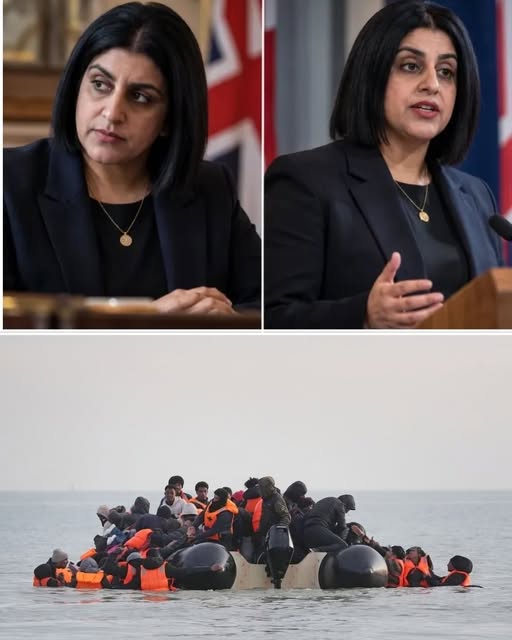
Reading time: ~30 minutes · Format: Neutral long-read and claim-by-claim check · Subject: The viral “BORDER ROW INTENSIFIES” headline about Home Secretary Shabana Mahmood, Channel crossings and demands for answers
Editorial note on sources and method
This article begins from a widely shared social-media headline:
“BORDER ROW INTENSIFIES: Shabana Mahmood Under FIRE as Critics Demand Answers Over Channel Crossings!”
Versions of the same message have circulated for several weeks. Earlier variants used the phrases “BORDER CRISIS” and “faces reported calls to resign.” The latest version softens the resignation claim into a demand for answers, while keeping the same suggestion: that the Home Secretary is in serious political trouble because small-boat crossings continue, and that pressure may force the government to change course.
That suggestion has been checked, claim by claim, against official Home Office statistics published on GOV.UK, parliamentary reporting, and named reporting by established news organisations and wire services. Material appearing only on social media, petition sites or unattributed aggregation pages is identified as such wherever it is used.
The distinction matters because the verifiable record points in two directions at once. Crossings in 2026 are substantially lower than a year earlier; they also remain, in absolute terms, very large — a single calm week in October brought more than 1,700 people. A flagship returns agreement with France has just ended after returning a small fraction of arrivals. Two boats reached the Kent coast undetected in September. And the Home Secretary herself has said, on the record, that Britain is “not in control of this border.” All of those things are true at the same time. The viral headline selects only the second set of facts. This article attempts to select neither, and instead to set out what is known, what is contested, and what the headline claims that the record does not establish.
The short version
For readers who want the conclusions first:
- Mahmood is the Home Secretary, and she remains in post. Appointed on 5 September 2025, previously Lord Chancellor, she was reappointed when Andy Burnham became Prime Minister in July 2026. No parliamentary motion or formal process to remove her is under way.
- Criticism of her is real and on the record — but mostly not a resignation demand. Shadow home secretary Chris Philp has said Labour has “lost control of our borders.” That is conventional, if sharp, opposition rhetoric. The explicit demands for Mahmood herself to resign come overwhelmingly from online petitions and social-media posts: an official parliamentary petition was rejected in December 2025, and a new Change.org petition appeared on 18 October 2026.
- The Channel numbers are genuinely mixed. Official statistics show 33,374 small-boat arrivals in the year ending June 2026, down 23 per cent. Arrivals in 2026 to early October — roughly 20,900 — were about 40 per cent lower than at the same point in 2025, and the summer was the quietest since 2020. Against that, the absolute number remains historically high, the week of 1–7 October alone brought 1,739 arrivals, and the cumulative total since Labour took office — just under 77,000 by July 2026 — remains the critics’ central figure.
- A real policy setback sits underneath the row. The “one in, one out” returns arrangement with France stopped taking new cases on 1 October 2026, having returned about 4 per cent of arrivals at an average cost, Mahmood told MPs, of about £56,000 per person. France declined to renew it. No replacement has been announced.
- “Tensions” are real but diffuse. Protests in Dover, Portsmouth and Gosport, disputes over asylum accommodation including a court battle over a hotel in Epping, and sharp parliamentary exchanges are all documented. Whether they add up to a “border crisis” that will force a change of approach is a political judgement, not a measured fact.
The rest of this article works through each of those points in detail.
1. What the headline actually claims
Viral headlines of this kind rarely make one claim. They make several, compressed into a single sentence. Unpacked, this one contains four: that Mahmood is personally “under fire”; that critics are demanding answers — in earlier versions, her resignation; that Channel crossings constitute an intensifying row, implicitly because they are continuing or worsening; and, posed as a question, that pressure may force the government to change its approach. Each has a different evidential status, and treating them as a single package is the headline’s central technique.
The first is broadly supportable, loosely understood: Mahmood answers in Parliament and on television for immigration, borders, policing and national security, and criticism of her department — from opposition parties, campaigners on both sides, and her own party — is documented and continuing. The second is where precision matters. “Critics demand answers” is true in the ordinary sense that Parliament questions every home secretary every month; “critics demand her resignation” is a stronger, different claim, and its evidence — examined in section 8 — is much thinner. The third depends entirely on the period chosen: over twelve months crossings are down nearly a quarter; over the first week of October they were high enough to generate coverage of one arrival “every six minutes.” Both statements are arithmetically correct; neither alone describes the situation. The fourth — that pressure will force a change — is at present unestablished. The observable facts are that the Prime Minister kept Mahmood in post three months ago, that her department has announced a returns taskforce rather than a new strategy, and that the gap left by the end of the French arrangement remains unfilled. Whether that gap, rather than the headlines, eventually forces a change — a question about Paris, enforcement logistics and winter weather as much as Westminster rhetoric — is the genuinely open question in this story.
2. The minister: how Mahmood came to own this brief
Shabana Mahmood is the MP for Birmingham Ladywood and one of the most senior figures in the Labour government. Her route to the Home Office explains both why she was given the job and why criticism of her comes from such different directions. From July 2024 she served as Lord Chancellor and Secretary of State for Justice, dealing with a prisons crisis, early-release measures and sentencing reform — a portfolio that established her reputation as a minister willing to take publicly unpopular decisions and defend them bluntly.
On 5 September 2025 she was moved to the Home Office as Home Secretary — an appointment widely read as a signal that the brief would be held by the tougher, enforcement-focused wing of Labour’s internal debate. The policies since bear that out: an enforcement-led approach to small boats; a returns arrangement with France built on the principle that arriving illegally should not guarantee remaining; and settlement reforms — discussed in section 9 — that would lengthen the route to indefinite leave to remain for many migrants. Those reforms draw criticism from refugee charities and Labour’s own left in terms almost as strong as the criticism she receives from the right for failing to stop the boats. A home secretary attacked simultaneously for being too harsh and too weak is not unusual; what is unusual in Mahmood’s case is the volume of both at once.
In June and July 2026 the government changed hands: Keir Starmer resigned, Andy Burnham won the Labour leadership and became Prime Minister on 20 July 2026. Burnham formed his own cabinet — and kept Mahmood at the Home Office. That is the strongest available evidence of her standing with the one person who decides whether she stays: a new prime minister, with a free hand and every incentive to signal a fresh start, chose continuity in precisely this job. Reporting since then has continued to suggest he wants to keep her in post.
3. The numbers, in full: what the official record shows
Any honest account has to start with the statistics, because both sides are quoting real ones. The figures below come from the Home Office’s immigration system statistics for the year ending June 2026 (GOV.UK), its provisional daily and weekly small-boat data, and summaries by the House of Commons Library and the Migration Observatory, which work from the same official data.
The twelve-month picture
In the year ending June 2026, 33,374 people arrived in the UK by small boat. That was 23 per cent lower than the 43,309 arrivals recorded in the year ending June 2025. It was, however, broadly in line with levels seen in the year ending June 2024 (31,493) and the year ending June 2022 (35,356). The highest twelve-month figure on record remains the year ending December 2022, at 45,774.
Small boats were not a marginal route: of 38,086 people detected arriving through illegal entry routes in that year, they accounted for 88 per cent. The five most common nationalities — Eritrean, Sudanese, Afghan, Somali and Iranian — made up about two-thirds of arrivals, who were roughly 72 per cent adult men, 13 per cent adult women and 15 per cent children.
The Home Office attaches a warning to these comparisons: numbers fluctuate with the weather, summer months normally produce more crossings, and comparisons between short periods should be treated with caution. That warning cuts against selective use by both sides — a government celebrating one quiet month, or critics treating one busy week as a trend.
The calendar-year story critics rely on: 2025
The government’s critics have a strong factual basis for focusing on 2025, and a neutral account should state it plainly. In the calendar year 2025, 41,472 people crossed the Channel in small boats — the second-highest annual figure ever recorded, and 13 per cent above 2024. Several monthly records were broken after Labour took office, including records for March, April, May, June and July 2025. By the end of 2025, close to 65,000 people had arrived by this route since Labour entered government.
That cumulative figure grew further in 2026. In a Westminster debate on 13 July 2026, Conservative MP Esther McVey cited Home Office data showing just under 77,000 arrivals since Labour came to power. The figure was not invented on social media; it was stated in Parliament, from official data, by a named MP, and it has since become the most repeated number in the viral criticism of Mahmood.
It is accurate as a cumulative total. What it does not show is direction of travel — a cumulative total can only rise. Nor does it allocate responsibility by tenure: for most of the record-breaking months of 2025 Mahmood was not Home Secretary; she took the job on 5 September 2025. The viral framing attributes the whole two-year total to the minister who has held the brief for the last thirteen months of it. That is a political choice, not an arithmetical one, and readers should notice it being made.
4. The numbers, continued: the turn in 2026
If 2025 is the critics’ strongest ground, 2026 is the government’s — the trend has moved, substantially and consistently, the other way. By 17 September, Home Office figures showed 17,480 arrivals since 1 January, around 44 per cent lower than the same period in 2025; by late September the figure was roughly 18,565, down 42 per cent; by early October approximately 20,900, roughly 40 per cent below the same point in 2025. Different counts on different dates produce slightly different percentages, because the comparison point moves each week; the underlying picture is consistent. 2026 is running at little over half the level of 2025, on course for the lowest annual total in several years.
The summer figures are the centrepiece of the government’s case. Between June and August 2026 — normally the peak season — 7,371 people crossed in 102 boats: the lowest summer total since 2020 and the fewest boats in a summer since 2019. Mahmood said the work was “beginning to bear fruit” and that the government would be “relentless in targeting the criminal gangs behind these crossings.” The Home Office also says joint action with France has prevented more than 48,000 crossing attempts since the 2024 election.
The Migration Observatory, which has no stake in either party’s argument, adds the necessary caution: by September it calculated the rolling annual total had fallen to around 27,900, its lowest since 2021 — but isolating the reason is difficult, because weather, smuggling activity, French enforcement and UK policy all move the numbers. The trend is real and verifiable; its causes are disputed. Both halves of that sentence need to survive into any fair summary.
One more figure complicates the story of fewer boats: the average number of people per boat has risen to approximately 65, from 56 the previous year and just seven in 2018, reaching 71 in some months. Fewer boats are arriving, but they are more crowded — consistent with smuggling networks adapting to enforcement by loading more passengers per vessel, and directly relevant to the danger of the crossing. A route used less often but more lethally is not an uncomplicated improvement.
One week in October
Against that background, the first week of October shows why this story keeps reigniting even as the annual trend falls. Official provisional data for 1–7 October recorded 1,739 arrivals in 23 boats: none on 1 October, then 91, 164, 418, 609, 338 and 119 on successive days. One tabloid summary — a person crossed “every six minutes” — is arithmetically defensible and was widely shared; it is also a framing choice, since weather windows bunch crossings, as they did under the previous government and will under the next. A single busy week proves the route remains fully operational; it is not, on its own, evidence the annual trend has reversed — and, on the latest figures, it has not.
That combination — a falling trend, a high absolute level, and bursts large enough to dominate a news cycle — is the statistical reality underneath the “intensifying row.” It lets the government say, truthfully, that its approach is working, and the opposition say, truthfully, that thousands still arrive illegally each month. The argument is not between a true set of numbers and a false one. It is between two true sets of numbers, weighted differently.
5. The undetected landings: the September incident that sharpened the row
If the statistics explain the row’s persistence, a specific incident in September explains its current temperature. Within 48 hours, two small boats reached the Kent coast without being intercepted — the first uncontrolled landings officially recorded since 6 September 2025, and, before that, the only others since the Home Office began keeping such data in 2023. On the Monday, at least five people were detected at The Warren, near Folkestone. On the Tuesday, at least 21 arrived at Samphire Hoe, near Dover; a government spokesperson said 21 individuals had been detained in a swift response involving Border Security Command and Kent Police, with an investigation ongoing, though officials could not immediately confirm everyone who reached the beaches had been detained.
Uncontrolled landings matter politically out of proportion to their numbers — five and twenty-one people, against thousands intercepted in the same month — because they strike at the premise of the enforcement system: that crossings are detected, escorted and processed, identities checked and claims registered. A boat that lands unobserved is a gap in that chain; nobody knows who was on it until afterwards, and in some cases not completely then.
Mahmood’s response was immediate and notably unsparing of her own department. The arrivals were “unacceptable”; “even one” uncontrolled landing was “one too many.” She ordered an urgent Border Security Command review into how they had happened and how to prevent a repeat. She also offered the government’s counter-interpretation: that smugglers’ new tactics — launches from much further west in France, on longer, more dangerous routes — showed enforcement around the Calais–Dover corridor was forcing the gangs to change their approach. “Our improved monitoring has led to uncontrolled crossings becoming incredibly rare,” she said. “But even one is one too many.”
The opposition’s response was equally immediate. Chris Philp, the shadow home secretary, said Labour had “lost control of our borders,” described the situation on social media as a “free for all” in a related exchange, and argued that the only way to stop crossings was to leave the European Convention on Human Rights so that anyone arriving illegally could be rapidly deported. Helen Whately, another Conservative frontbencher, accused the Burnham government of being “incredibly weak on illegal immigration” and said it had failed to stop the boats. The Liberal Democrats’ home affairs spokesman, Max Wilkinson, took a different line, arguing that smugglers would keep finding a way through until the government joined the EU’s migration and asylum pact.
A further strand of the September coverage concerned remarks by Lucy Powell — by then Deputy Prime Minister — who, pressed about the landings, was reported as saying the government could not “stop everything.” Powell subsequently said on Good Morning Britain that the remark was being taken out of context, insisting the government was “clamping down on small boat crossings every single day.” The episode illustrates the communications trap of this issue: any acknowledgement of the physical limits of enforcement — a 21-mile-wide shipping lane, crossed at night, in small boats — can be clipped and presented as surrender, while any absolute promise to “stop the boats” becomes a hostage the moment the next boat arrives.
6. The end of “one in, one out”: the policy setback at the centre of the story
The scheme — formally a pilot, known operationally as Operation Hillmore — was launched in August 2025. A person who arrived by small boat and was judged to have no right to remain could be detained and returned to France; in exchange, Britain would accept from France an equal number of asylum seekers who had applied legally and were likely to qualify for protection, prioritising vulnerable nationalities and people with UK family links. The theory was deterrence by symmetry: if crossing illegally produced return and applying legally produced transfer, the smugglers’ pitch — pay us, and you will get to Britain — would collapse.
In June 2026 the two governments agreed to extend the pilot until 1 October. France’s interior minister, Laurent Nuñez, had already signalled that it was “not intended to be renewed beyond October 1, 2026,” and French ministers had long argued that returns arrangements of this kind should be negotiated with the European Union as a whole rather than bilaterally with London. Reporting of the final phase indicates that Burnham personally pressed President Emmanuel Macron during September talks to keep the arrangement alive, and that Paris declined. On 30 September the Home Office confirmed that the pilot was “no longer processing new cases”; it formally ceased taking cases on 1 October, with returns flights continuing for several weeks for people already detained under it.
The numbers explain why the scheme’s defenders and critics talk past each other. On the Home Office figures reported by Euronews, between 4 August 2025 and 30 June 2026, 1,087 people were returned to France under the arrangement while 1,117 were transferred to the UK under it — during a period in which 27,920 people arrived by small boat. Later totals put the final number of returns at roughly 1,400 to 1,500. As a proportion of arrivals, the scheme returned about 4 per cent. And on 15 September, Mahmood told MPs that it had cost the UK taxpayer an average of about £56,000 per person returned.
Government sources have acknowledged the pilot “did not reach our desired scale” and that London would willingly have seen it continue; Mahmood told Parliament it had “not been without its challenges” and “the numbers are still relatively small.” Her department’s broader defence — that the pilot was experimental and demonstrated that illegal arrival does not guarantee remaining — is a defence of a proof of concept, not of a result. The Times summarised the volume involved as “never significant.”
For the purposes of the viral headline, the important point is the gap that now exists. The scheme, however modest its numbers, was the government’s principal returns mechanism for small-boat arrivals and the centrepiece of its claim that illegal crossing would not pay. It has ended, at France’s choice rather than Britain’s, with no replacement announced. Mahmood’s stated answer is a new Small Boats Returns Taskforce, charged with accelerating removals using existing powers and working with willing countries such as Albania. Whether it can remove people at a scale the pilot never approached — and where people can lawfully be removed to when their own countries will not take them and France no longer will — is untested. That unanswered question, more than any petition, is what gives the opposition’s “demand for answers” its force in this round of the row.
7. What “critics demand answers” actually looks like on the record
The Conservative attack, led by shadow home secretary Chris Philp, is built on the language of control: the government has “lost control” of the borders, security has “descended into chaos,” and Keir Starmer’s pledge to “smash the gangs” was “always a farce.” His proposed remedy is specific: leave the European Convention on Human Rights, deport anyone who arrives illegally to their home country or a safe third country, and end hotels and benefits for arrivals. Conservative colleagues echo the framing — Helen Whately called the government “incredibly weak on illegal immigration” — while Esther McVey’s July intervention, the 77,000 figure, argued government failure on irregular migration rather than moving against the Home Secretary personally.
Reform UK’s criticism operates in a similar register, with an additional theme: that the government polices public protest about migration more energetically than it polices the border itself. A report on a Reform-adjacent website in October attributed to Nigel Farage a conditional ultimatum — that if the Home Secretary disagreed with his assessment of a national emergency on the borders, “she must resign.” That report has not been corroborated in the same terms by a major wire service or national newspaper in the material checked for this article, and is recorded here as attributed and unverified, without the sourcing that Philp’s or McVey’s on-the-record remarks have.
The Liberal Democrats share the premise that the approach is not working but attack from the opposite direction on means, arguing the government should join the EU’s migration and asylum pact. Refugee and human-rights organisations argue that enforcement-first policy drives people into more dangerous routes — the rising passengers-per-boat figure being a foreseeable consequence — and that safe and legal routes, not returns deals, are what undercuts smugglers.
What is absent from that record is notable: no opposition-day motion demanding her resignation, no published and verified letter from Conservative or Reform MPs to the Prime Minister demanding her dismissal, no select committee report recommending she go. Parliamentary accountability — questions, urgent debates, statements in which she has herself reported uncomfortable figures such as the £56,000 cost per return — is functioning vigorously, and Mahmood has been answering throughout. “Critics demand answers” is therefore accurate as a description of ordinary, intense scrutiny. It becomes misleading only when the headline invites the reader to upgrade it into a minister on the brink — an upgrade earlier versions of this headline made explicit with the word “resign,” on evidence examined next.
8. The resignation claim, examined
First, online petitions exist — as they do for almost every senior minister in every year of modern British politics; the barrier to creating one is a web form. A Change.org petition titled “Call for Shabana Mahmood’s resignation as Home Secretary” was published on 18 October 2026, three days before this article was written, arguing in general terms that her tenure had failed marginalised communities. Its existence is a fact; its significance, without a large verified signature count or any parliamentary consequence — and none has been reported — is limited.
Second, the official route was tried and failed. A parliamentary petition calling for her removal was rejected by the petitions office in December 2025. Rejection does not measure public feeling either way, but it does mean the one formal, citizen-facing mechanism for registering such a demand was used nearly a year ago and did not proceed — a history that headlines presenting resignation demands as a new October development omit.
Third, social-media posts demand her resignation in large numbers, many attached to the 77,000 figure. Their volume is real but unmeasurable, and a poor proxy for institutional pressure: it does not move a prime minister, who is the only person who can remove a home secretary short of a collapse of the government itself.
Fourth — the part of the record pointing the other way — the Prime Minister reappointed her in July 2026 and subsequent reporting indicates he wants to keep her. No ministerial colleague has publicly broken ranks, and no verified report in a major outlet, in the material checked, records a named mainstream politician, editor or broadcaster calling in recent days for her resignation over Channel crossings — as distinct from criticising her policies in the strongest available terms, which several have done.
Fifth, there is one direction from which something closer to organised internal pressure genuinely exists, and it is not the direction the headline implies. More than 100 Labour MPs have urged Mahmood to abandon the retrospective application of her settlement reforms (section 9). That is a large, named, intra-party revolt — against a policy, by her own side. It is not a call for her to resign, and its participants are, for the most part, people who want the government to be less hardline, not more. But as a measure of the real strain on her position inside her own party, it outweighs every petition on the internet.
The verdict on the resignation claim is therefore: contested, and in its strong form unsubstantiated. Calls exist, in the literal sense that identifiable people have made them online. A coordinated, institutionally serious campaign to remove her — of the kind that has actually preceded home secretaries’ departures — is not visible in the verifiable record. The earlier headline’s phrase, “reported calls,” is a classic hedge of viral political writing: it asserts only that calls have been reported — unfalsifiable, since someone, somewhere, said it — while inviting the reader to feel the weight of a much larger claim. Responsible coverage names who is calling, how many there are, and whether anyone with the power to act is listening. On those tests, the current story scores low.
9. Pressure from the other direction: settlement, and the Labour left
At the centre of the dispute is settlement: the point at which a migrant living legally in Britain acquires indefinite leave to remain. Mahmood’s reforms would lengthen that route substantially — doubling the qualifying period to ten years for most migrants, fifteen years for lower-paid workers, and at least twenty years for refugees, on the reported outline. The most contentious element is retrospectivity: applying the longer periods to people already in the UK, who built their lives — mortgages, families, careers — on the basis of the five-year route they were promised.
More than 100 Labour MPs have urged her to scrap the retrospective application, arguing that changing the terms mid-journey for people who complied with every rule is a breach of faith that damages integration and punishes precisely the migrants who did everything the system asked. Mahmood’s counter-argument is that settlement must be earned, that a system perceived as automatic loses public consent, and that without consent for legal migration the politics of the whole question curdles toward forces she regards as dangerous — that a Labour government visibly restoring control is what keeps the centre holding.
The viral headline reduces that argument to a single minister “under fire.” The reality is a governing party arguing with itself, in public, about first principles — with Mahmood at the centre of both halves: too hardline for a hundred of her own MPs, too ineffective for the entire opposition.
10. Candour as a liability: the podcast interview
One recent episode shows how Mahmood’s own words have fed the row from several directions at once: an interview with The Rest Is Politics: Leading, the podcast hosted by Rory Stewart and Alastair Campbell, reported by the BBC and widely excerpted, handed material to almost every one of her critics simultaneously.
The most quoted was an admission: “We’re not in control of this border.” In context, it belonged to an argument — that the sifting of who reaches northern France and boards a dinghy is currently done, in effect, by criminal gangs, and that this is what policy must change. Detached from that context, it is a five-word concession, and it has circulated in exactly that detached form ever since. The remark is best understood as a deliberate rhetorical gamble, of a piece with her public style, rather than a slip; whether it pays off depends on whether voters reward the candour or remember only the concession.
She also said she could “almost guarantee that every woman that’s in the north of France has probably been raped along the journey,” adding that “some of the men too, they’ve certainly been abused and threatened,” and that traffickers deciding who reaches Britain “is not the model that should decide whether somebody gets to come to the UK.” The moral core of that claim — that the routes into northern France are saturated with sexual violence and exploitation, documented over years by charities and investigators — is not seriously disputed. Her specific quantification, however, cannot be checked: no Home Office assessment quantifying it was released alongside the interview, and official statistics record arrivals’ sex, age and nationality, not what happened to them before embarkation. The phenomenon is real and grave; the near-total figure is a ministerial assertion, not a measured statistic.
Politically, the remark served as the stated foundation for a policy turn: the reopening of safe and legal routes. The Home Office has confirmed that the UK Resettlement Scheme — closed to new applicants in December 2024 — will reopen, with officials expecting a substantial share of places to go to Afghan women and girls and Palestinians, alongside new community-sponsorship routes to launch next year; no annual cap has yet been set. At Labour’s conference Mahmood insisted resettlement must be “capped and controlled,” and she has also spoken of pursuing “return hubs” in third countries for failed asylum seekers. The two ideas belong to one strategy — replace the smugglers’ route with a capped, state-run one, while removing those who bypass it — and draw fire from both directions: from the right, that any reopened route is a pull factor; from refugee organisations, that a capped scheme of unspecified size is no answer to a route used by tens of thousands.
Finally, in the same interview, she turned on some of her own ostensible supporters — demonstrators who had praised her border policy — telling them to “sod off” and saying that some would want to drive her out of her own country because she is a Muslim. Mahmood’s position in this debate is not only ministerial but personal: one of the most senior Muslim politicians in Britain, implementing an enforcement policy applauded by some anti-migration protesters whose broader views she plainly regards as hostile to her own place in the country. That tension explains some of the unusual heat, from unusual directions, that this row generates.
11. On the ground: protests, accommodation and the south coast
The pattern repeats along the coast. When 149 people from a boat launched, unusually, from Normandy rather than the Pas-de-Calais were brought ashore at Gosport on a Sunday night in early October, it prompted an anti-immigration protest — around 350 people, with a dozen arrests — and a major police deployment; it was the third crossing from Normandy in a month. Dover, the traditional landing point, has seen repeated demonstrations and counter-demonstrations through the autumn, as have other south-coast towns.
Two things should be said carefully. First, most protests on all sides have been lawful; demonstrating about immigration policy is a protected activity, not a disorder problem in itself. Second, the policing question is legally distinct from the border question, however fused they have become politically: decisions about individual demonstrations are operational matters for police forces, not decisions taken by the Home Secretary, though she owns the framework and answers for the system. Viral posts accusing the government of policing protesters instead of stopping boats collapse two different systems into one accusation.
The other standing source of local tension is accommodation. Asylum seekers whom the state must support while claims are decided have to be housed somewhere, and where — a town-centre hotel, a former military site, dispersed flats — has become one of the most combustible questions in local politics. The prolonged legal battle over a hotel in Epping, Essex, became a national symbol of that friction through 2025 and into 2026, and disputes over large sites elsewhere have followed the same pattern: a community that feels a decision was imposed, a council weighing legal action, a government insisting the alternatives are worse or more expensive.
The government’s figures point to movement here too: asylum claims fell about a fifth, to roughly 86,000; the number in hotels fell to about 16,000 — though more than 70,000 people are in other accommodation, and much of the backlog has moved downstream into the appeals courts. Real movement, in the government’s direction, from a very high base.
12. The two cases, steelmanned
The government’s case is a trend-line case. Arrivals are down 23 per cent over twelve months and around 40 per cent year-to-date; the summer was the quietest since 2020; more than 48,000 crossing attempts have been prevented with France; disruptions of organised immigration crime groups rose 48 per cent, to 3,900; removals are, on government figures, at a ten-year high, with more than 80,000 removed since July 2024; asylum claims are down a fifth; hotel use has halved. No previous government stopped the boats either — the route’s record year was under the Conservatives. On this account, Mahmood inherited the worst year on record and the numbers have turned on her watch; judging a multi-year enforcement build by single weeks is a category error.
The critics’ case is a promise-and-scale case. Just under 77,000 people arrived in Labour’s first two years; 2025 was the second-worst year ever; around 20,900 have still arrived in 2026; boats carry 65 people on average and launch from new coasts; two landed undetected; the flagship returns deal expired having returned 4 per cent of arrivals at £56,000 a head, with no replacement; the Home Secretary has said “we’re not in control of this border”; and the promise to “smash the gangs” set a test by which the gangs are still operating. On this account, a decline from a record peak — driven partly by weather and French policing Britain does not control — is not control but a lull, and lulls in this story have always ended.
The assessment this article would defend is narrow: both cases are built from real numbers; they differ in baseline, time horizon, and what counts as success. The government measures itself against 2025; the critics measure it against its promises and against zero. The two hard facts neither framing dissolves are the expired French deal with no successor, and the Home Secretary’s own concession about control. The two hard facts on the other side are the size and consistency of the 2026 decline, and the reappointment in July. A reader weighing the headline should hold all four.
13. Could the pressure “force a change”? How change would actually happen
A Home Secretary leaves office by resignation, by dismissal or reshuffle by the Prime Minister, or with the fall of the government itself. None of the preconditions for the first two is visible in the current record. Mahmood has shown no sign of resigning — she is publicly staking her position on her reforms, including against her own party’s left. Burnham, who could replace her at will, retained her three months ago and has personally invested in the border diplomacy — the September approach to Macron — that underpins her strategy. Prime ministers do sometimes sacrifice home secretaries under sustained pressure, but the observable evidence points the other way for now.
Policy change is more plausible than personnel change. The realistic menu, as debated across the parties, is short: a renewed returns arrangement, most plausibly at EU level rather than with France alone — what Paris has been arguing for, and what the Liberal Democrats advocate in pact form; “return hubs” in third countries for failed asylum seekers, which Mahmood says she is pursuing, facing the legal, diplomatic and cost obstacles that consumed the previous government’s Rwanda scheme; intensified upstream enforcement against boats, engines and money flows; expanded safe and legal routes, now under way with the resettlement scheme’s reopening, at a scale yet to be announced; and legislative change to settlement and asylum rules, the actual centre of Mahmood’s domestic programme. The Conservative proposal — withdrawal from the European Convention on Human Rights to permit immediate deportation of all illegal arrivals — is the only option its proponents claim would change the situation categorically, and also the one with the largest external consequences, touching the Good Friday Agreement and Britain’s wider treaty position, which is why successive governments of both parties have not done it.
What would genuinely force the issue is not a petition or a headline but a number: a spring and summer in which arrivals climb back toward 2025 levels despite the enforcement build — demonstrating that the 2026 decline was weather and French politics rather than British policy — with the returns gap still unfilled. Equally, a second consecutive year of decline, with the returns taskforce producing removals at scale, would deflate the row faster than any rebuttal. The next chapter will be written by the weather over the Channel, the politics of Paris and the throughput of the Home Office, roughly in that order; Westminster rhetoric, including this autumn’s, will mostly be commentary on those three things.
14. Timeline: the row in sequence
- July 2024 — Labour wins the general election. Shabana Mahmood becomes Lord Chancellor and Justice Secretary. The new government’s border pledge centres on “smashing the gangs.”
- December 2024 — The UK Resettlement Scheme stops taking new applicants.
- August 2025 — The “one in, one out” pilot with France (Operation Hillmore) is launched.
- 5 September 2025 — Mahmood becomes Home Secretary in a reshuffle.
- Calendar 2025 — 41,472 people cross by small boat, the second-highest annual total on record.
- December 2025 — A parliamentary petition calling for Mahmood’s removal is rejected by the petitions office.
- Year ending June 2026 — Small-boat arrivals total 33,374, down 23 per cent; organised immigration crime disruptions rise 48 per cent; asylum claims fall about a fifth to roughly 86,000.
- June 2026 — UK and France extend the returns pilot to 1 October; France signals it will not renew. Keir Starmer resigns as Prime Minister.
- 13 July 2026 — Esther McVey MP cites just under 77,000 arrivals since Labour took office; the figure becomes the critics’ central reference point.
- 20 July 2026 — Andy Burnham becomes Prime Minister and reappoints Mahmood as Home Secretary.
- June–August 2026 — 7,371 people cross in 102 boats, the lowest summer total since 2020.
- 15 September 2026 — Mahmood tells MPs the French scheme cost about £56,000 per person returned.
- September 2026 — Two boats land undetected on the Kent coast within 48 hours, the first uncontrolled landings in a year; Mahmood orders an urgent Border Security Command review and calls the arrivals “unacceptable”; Chris Philp says Labour has “lost control.”
- 30 September – 1 October 2026 — The Home Office confirms the French pilot is no longer taking new cases; a Small Boats Returns Taskforce is announced. Final returns under the scheme total roughly 1,400–1,500 people.
- 1–7 October 2026 — 1,739 people arrive in 23 boats in a single weather window, about 40 per cent below the year-to-date level notwithstanding.
- Early October 2026 — A boat carrying 149 people launched from Normandy reaches Gosport, prompting protest and a major police deployment; reporting of Mahmood’s Rest Is Politics interview — “we’re not in control of this border” — circulates widely, alongside confirmation that the UK Resettlement Scheme will reopen.
- 18 October 2026 — A new Change.org petition calling for Mahmood’s resignation is published.
- Late October 2026 — The latest variant of the viral headline circulates. Mahmood remains Home Secretary. No replacement returns mechanism has been announced.
15. What is known, what is contested, what is not established
Established on official or named sourcing: Mahmood’s appointment (5 September 2025) and reappointment (July 2026); 33,374 small-boat arrivals in the year ending June 2026, down 23 per cent, 88 per cent of all detected illegal-entry arrivals (Home Office, GOV.UK); 41,472 crossings in calendar 2025 and just under 77,000 cumulatively since July 2024, cited in Parliament; a fall of roughly 40–44 per cent in 2026 year-to-date arrivals and the lowest summer total since 2020; 1,739 arrivals in the week 1–7 October 2026 (provisional); average occupancy of about 65 people per boat; the end of the France pilot on 1 October 2026 after roughly 1,400–1,500 returns — about 4 per cent of arrivals — at about £56,000 per return; two undetected landings in September 2026 and the urgent review ordered; the rejected parliamentary petition (December 2025), the Change.org petition (18 October 2026), and the urging of more than 100 Labour MPs on settlement; and Mahmood’s podcast statements, including “we’re not in control of this border.”
Contested — real evidence on more than one side: what caused the 2026 decline (UK enforcement, French enforcement, weather, smuggler adaptation, or a combination — the Migration Observatory cautions against simple attribution); whether the French pilot deterred crossings beyond the people it returned; whether removals and “prevented attempts” figures allow fair comparison with previous years; the extent of sexual violence on the routes into northern France (documented and serious, but Mahmood’s near-total quantification is unsupported by any published assessment); and whether “crisis” correctly characterises a route carrying historically high but sharply falling numbers.
Not established by the evidence checked: that a coordinated, institutionally serious campaign to force Mahmood’s resignation exists, or that any parliamentary mechanism to remove her is in motion; that the Prime Minister is considering replacing her (the most recent hard evidence, her July reappointment, points the other way); that crossings are rising on any trend measure longer than a single weather-driven week — on every official trend measure they are falling; that a replacement for the French arrangement exists or is imminent (this absence, not the petitions, is the government’s most exposed flank); or that any protest, petition or headline of October 2026 has changed a single government policy.
Conclusion: a row that is real, about a problem that is changing
The viral headline is not fabricated from nothing. Britain’s Home Secretary is under sustained, multi-directional political pressure over Channel crossings; the pressure has identifiable new fuel — an expired returns deal, two undetected landings, a busy October week, and the Home Secretary’s own televised candour; and the question of whether it forces a change of approach is a live one in Westminster. A reader who shared the headline was sharing something connected to real events.
But the headline, like most of its kind, works by selection and compression. It omits the reappointment, the 40 per cent decline, the lowest summer since 2020, the stillbirth of the one official petition, and the fact that the loudest organised pressure on Mahmood inside Parliament comes from her own party’s left, over settlement, in the opposite policy direction to the headline’s implication. It upgrades routine scrutiny into an implication of imminent downfall the record does not support, and treats a falling trend as a worsening crisis by the simple device of not mentioning the trend.
The accurate one-sentence version is less shareable and more interesting: a home secretary kept in post by a new prime minister, presiding over the sharpest fall in Channel crossings in years and the simultaneous collapse of her flagship returns policy, attacked by the opposition for losing control of the border, by a hundred of her own MPs for trying to control settlement too harshly, and by her own words, replayed daily, conceding that the border is not under control — with the verdict on all of it to be delivered, as it always is in this story, by next summer’s weather and next summer’s numbers.
That is the row. It is intensifying in the sense that the arguments are getting sharper as the policy gap widens. Whether it is intensifying toward a resignation, a policy reversal, or merely another season of the same argument is — on the evidence available today — not yet known.
Sources and verification basis: Home Office immigration system statistics, year ending June 2026, and provisional small-boat activity data (GOV.UK); House of Commons Library and Migration Observatory summaries of the same data; PA Media reporting carried by national and regional outlets (September–October 2026) on the undetected landings, the summer figures and the ministerial statements quoted; Euronews reporting of the Home Office confirmation ending the France pilot, including the return and cost figures Mahmood gave to MPs; parliamentary reporting of the 13 July 2026 debate; BBC-reported remarks from the Rest Is Politics: Leading interview; petition records (Parliament petitions office, December 2025; Change.org, 18 October 2026). Claims appearing only on social media or unattributed aggregation sites are identified in the text as attributed or unverified. Figures described as provisional are subject to revision by the Home Office.