

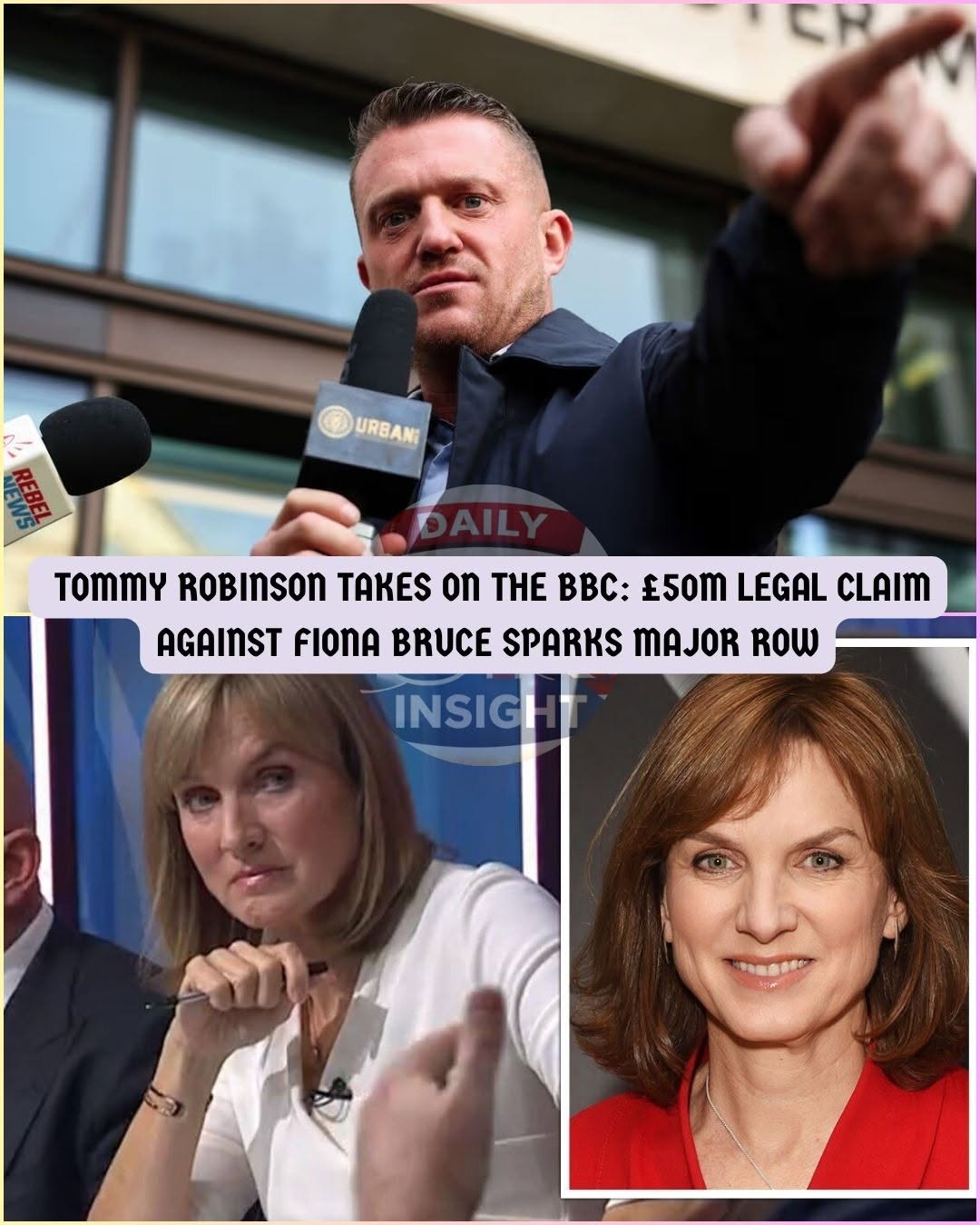
Tommy Robinson, the BBC and the Reported £50 Million Claim: What Do We Actually Know?
Reports circulating online that Tommy Robinson is pursuing a £50 million legal claim against the BBC and presenter Fiona Bruce have ignited a new argument over broadcasting, reputation and accountability. But despite the dramatic headlines, an important question remains unresolved: has a £50 million lawsuit actually been filed, or are the reports describing a threatened or proposed legal action?
A supposed £50 million confrontation between Tommy Robinson and the BBC has become the latest story to spread rapidly through Britain’s politically charged social-media landscape.
Robinson, whose real name is Stephen Yaxley-Lennon, has long had an adversarial relationship with sections of the British media. The latest claims suggest that he is seeking an extraordinary £50 million from the BBC and presenter Fiona Bruce following a contentious broadcast encounter.
If formally pursued, a claim of that scale would inevitably attract enormous attention.
But there is a fundamental distinction that should not be lost amid the headlines.
At present, reliable publicly accessible reporting and court material do not provide clear confirmation that a £50 million lawsuit by Robinson against both the BBC and Bruce has been formally filed and is proceeding before a court.
That does not establish that no legal correspondence exists. Lawyers can exchange letters before proceedings are issued, and potential claimants can publicly announce intended action.
It does mean that the phrase “£50 million lawsuit” should be treated cautiously until an actual claim, court filing or independently verified legal statement establishes its status.
Why the Difference Matters
Legal terminology can make a dramatic difference to a news story.
Someone can say they intend to sue.
Their lawyers can send a letter before action.
They can demand an apology, correction, retraction or damages.
They can even publicly state the amount they intend to seek.
None of those steps necessarily means that court proceedings have formally begun.
A filed claim creates a legal process in which defendants can respond, jurisdiction and legal arguments can be tested, evidence can be disclosed and ultimately a judge or jury — depending on the jurisdiction and type of case — can determine the issues.
A public threat does not establish liability.
Nor does the size of a damages demand indicate that the claimant will ultimately receive anything close to that amount.
Reputation Versus Broadcasting
The controversy nevertheless raises a legitimate question about the responsibilities of broadcasters when dealing with highly controversial public figures.
Major broadcasters are expected to distinguish between verified facts, allegations and opinion.
At the same time, public figures are routinely subjected to robust questioning about their statements, activities and records.
A difficult or confrontational interview is not, by itself, defamatory.
For a defamation action to succeed in England and Wales, the legal questions go substantially beyond whether the claimant disliked the interview or believed questioning was unfair.
Under the Defamation Act 2013, a statement is not defamatory unless its publication has caused or is likely to cause “serious harm” to the reputation of the claimant.
Defendants may also have legal arguments involving truth, honest opinion and publication on a matter of public interest, depending on the circumstances.
Exactly which principles would apply to any Robinson-BBC dispute would depend on the words complained of and the legal cause of action actually pleaded.
Without the relevant filing, those details cannot responsibly be assumed.
Robinson Is No Stranger to the Courts
Robinson has extensive experience with litigation, including proceedings directly involving statements he has made about other people.
One particularly important case involved Syrian schoolboy Jamal Hijazi.
After Robinson published allegations about Hijazi, a High Court judge found in 2021 that Robinson had libelled him and awarded £100,000 in damages.
Robinson was subsequently subject to an injunction preventing repetition of the defamatory allegations.
Later proceedings concerned breaches of that injunction, eventually resulting in contempt-of-court action. The High Court published a further judgment involving Robinson in May 2025.
That history does not determine the merits of any future case Robinson might bring against a broadcaster.
A claimant is entitled to pursue legitimate legal remedies regardless of previous litigation.
But it illustrates why claims involving reputation must be determined through evidence and law rather than social-media popularity.
The BBC Faces Other Major Litigation
The BBC itself is currently defending an extremely high-profile defamation action brought by US President Donald Trump over a Panorama documentary.
Trump’s case concerns the editing together of separate parts of his January 6, 2021 speech.
The BBC apologised for the edit, saying it created the mistaken impression that Trump had made a direct call for violent action, but disputes that the programme provides grounds for the enormous damages being sought.
That case is proceeding in the United States and a trial has been scheduled for February 2027 if it reaches that stage.
It provides a useful reminder of something frequently misunderstood in coverage of large lawsuits.
The amount demanded by a claimant is not the same as damages awarded by a court.
Trump may seek billions, but the BBC disputes liability and the litigation remains unresolved.
The same principle would apply to a hypothetical £50 million Robinson claim.
What About Fiona Bruce?
Including an individual presenter in a legal allegation requires additional caution.
Fiona Bruce is one of the BBC’s most recognisable broadcasters and presenter of Question Time.
A presenter asking challenging questions during a political programme does not personally become legally liable simply because an interviewee objects to the exchange.
Liability would depend on the specific statements complained about, who made or published them, their meaning, the relevant evidence and the legal defences available.
Until documentation identifying the alleged statements and causes of action becomes available, claims about Bruce’s personal legal exposure remain speculative.
That is particularly important because social-media posts often compress disputes involving a programme, production team and broadcaster into allegations against the most recognisable presenter.
A £50 Million Number Changes the Story
There is another reason the figure deserves scrutiny.
£50 million is an enormous amount in the context of an individual reputation dispute in Britain.
The number itself naturally generates headlines.
But readers should ask several questions whenever an extraordinary damages figure appears.
Who announced it?
Has a solicitor confirmed it?
Has a claim form been issued?
Which court is handling the proceedings?
What statements are alleged to be unlawful?
And is £50 million the amount actually claimed in court, or simply a number contained in a public demand?
Until those questions have answers, the number tells us more about the scale of the reported dispute than about its legal merits.
The Wider Battle Over Media Trust
The reason the story has travelled so rapidly is not purely legal.
Robinson has built a significant audience partly through criticism of mainstream media institutions.
The BBC, meanwhile, occupies a uniquely prominent position in British public life because of its public-service role and licence-fee funding.
A confrontation between the two therefore immediately becomes symbolic.
Supporters of Robinson may see litigation as a way of forcing a powerful broadcaster to justify its reporting.
Critics may see an enormous damages threat as part of a broader strategy of attacking journalists and institutions that scrutinise controversial political movements.
Neither interpretation proves the underlying legal case.
The evidence would still have to establish what was said, whether it was inaccurate or defamatory, what harm resulted and what legal defences apply.
What Would Happen If Proceedings Are Filed?
If Robinson formally brings a defamation action, the dispute could move from social-media claims into a process where the precise allegations matter enormously.
The court could examine the meaning of the statements, evidence supporting them and arguments from both sides.
The BBC and Bruce would have opportunities to respond.
Robinson would likewise have to establish the elements required by the relevant cause of action.
The result could range from settlement or withdrawal to dismissal or eventual judgment.
But until that process is confirmed, declaring either side the winner is premature.
The Key Question Remains Unanswered
The most responsible conclusion is therefore less dramatic than the viral headline.
There may be a serious dispute between Tommy Robinson and the BBC.
There may also have been discussion of legal action and a £50 million damages demand.
But those propositions are different from stating as established fact that Robinson currently has a £50 million lawsuit progressing through the courts against the BBC and Fiona Bruce.
For now, the central question is not whether Robinson will win £50 million. It is whether a £50 million court claim has actually been filed — and, if so, exactly what statements he alleges crossed the line from aggressive broadcasting into unlawful reputational harm.
Until documentary evidence answers those questions, the extraordinary figure should remain exactly what it currently appears to be: a reported claim, not a confirmed judgment and not proof that either side has won the legal argument.
TOMMY ROBINSON VS BBC — £50 MILLION LEGAL CLAIM SPARKS CONTROVERSY!
A dramatic legal battle involving controversial British activist Tommy Robinson and the BBC would attract enormous public attention. The prospect of a £50 million claim raises difficult questions about freedom of speech, media accountability and the limits of political broadcasting.
However, there is an important distinction between a viral allegation and a confirmed court case. Reports circulating online have claimed that Robinson is pursuing a £50 million legal challenge against the BBC and Question Time presenter Fiona Bruce. Yet the available evidence does not establish that such a lawsuit has formally been filed. One website promoting the story even describes its account as fictional.
The allegation has nevertheless highlighted a wider debate about the relationship between controversial public figures and Britain’s national broadcaster.
A £50 MILLION CLAIM THAT HAS ATTRACTED ATTENTION
The figure of £50 million is striking. In any legal dispute, a demand of that size would immediately raise questions about the alleged wrongdoing, the evidence supporting the claim and the extent of the damage said to have been caused.
Online versions of the story suggest that Robinson believes his reputation could have been damaged by a television confrontation or the way he was discussed in connection with BBC programming.
But these details should not be treated as established facts. No independently verified court filing has been identified in the material reviewed that confirms the alleged action against both the BBC and Fiona Bruce.
A genuine legal dispute would normally have identifiable details, including the parties involved, the legal basis of the claim and the statements or publications being challenged.
Without those details, it is impossible to determine whether a claim exists, what it alleges or whether it has any realistic prospect of success.
That distinction matters because a legal threat, a letter before action and a formally issued lawsuit are three different things.
THE BBC AND THE QUESTION OF MEDIA ACCOUNTABILITY
The controversy touches on a question that has long surrounded political broadcasting: how far can journalists go when questioning people whose views and public activities generate strong reactions?
The BBC has a responsibility to report accurately, distinguish fact from opinion and give audiences sufficient context to understand contentious issues. Its programmes also need to challenge guests and examine claims that may be disputed.
At the same time, controversial figures may argue that they have been represented unfairly or that a broadcast has presented allegations without adequate explanation.
Such complaints cannot be resolved simply by examining whether a guest was embarrassed, criticised or challenged on television.
A meaningful legal assessment would require the precise words used, the context in which they were broadcast and evidence of the harm allegedly caused. It would also need to consider any applicable legal defences.
The BBC’s public role does not place it beyond legal scrutiny. Equally, criticism of a broadcaster does not automatically establish that it has acted unlawfully.
WHAT WOULD A DEFAMATION CASE REQUIRE?
If Robinson were to bring a defamation claim in England and Wales, the legal questions would be specific.
Under the Defamation Act 2013, a statement must have caused, or be likely to cause, serious harm to a person’s reputation to meet the statutory threshold.
Other issues could include whether the challenged statement was substantially true, whether it represented an honestly held opinion, or whether publication on a matter of public interest could provide a defence.
The outcome would depend on the actual material being challenged and the available evidence.
A claimant cannot establish defamation merely by demonstrating that a programme was hostile, that a presenter asked difficult questions or that viewers reacted negatively.
Nor does a broadcaster automatically escape responsibility because a statement appeared during a live discussion.
The legal analysis would turn on the circumstances of the particular publication, the identities and responsibilities of the parties, and the evidence presented to the court.
Until the alleged claim is documented, however, these remain general legal considerations rather than conclusions about a case involving Robinson and the BBC.
WHY THE £50 MILLION FIGURE NEEDS CAREFUL EXAMINATION
A further source of confusion is the difference between the amount demanded by a claimant and the damages a court might ultimately award.
Even if Robinson had demanded £50 million, that would not mean the BBC had been found liable for that amount.
A demand is an assertion by one party. A judgment is a decision made by a court after considering the applicable law and evidence.
The two should never be confused.
A large damages figure can attract headlines and generate intense discussion online, but it does not establish the strength of a legal argument. The court would need to consider the nature of the alleged defamation, the harm demonstrated and the remedies available under the law.
It would also be necessary to establish whether the figure was a formal demand, an estimate circulated by supporters or simply a number attached to an online story.
Those details remain essential to understanding the allegation.
TOMMY ROBINSON’S HISTORY WITH THE COURTS
Robinson, whose legal name is Stephen Yaxley-Lennon, has previously been involved in significant legal proceedings concerning statements he published about other people.
In a case brought by Syrian schoolboy Jamal Hijazi, the High Court found that Robinson had made defamatory allegations. Hijazi was awarded £100,000 in damages, and an injunction prohibited Robinson from repeating specified claims.
Robinson subsequently admitted breaches of that injunction and was sentenced for contempt of court in October 2024. The case demonstrated that freedom of expression does not remove the obligation to comply with court orders.
That history does not decide whether Robinson could have a valid claim against a broadcaster in a separate dispute. Each case must be assessed on its own facts.
It does, however, underline the importance of evidence, accurate reporting and respect for the legal process when discussing claims involving reputation.
FREEDOM OF SPEECH VERSUS THE RIGHT TO PROTECT A REPUTATION
The broader debate is not confined to Robinson or the BBC.
In a democratic society, journalists must be able to investigate public figures, challenge political arguments and report matters of public interest. Without those freedoms, important questions could go unanswered.
But individuals also have a legitimate interest in protecting their reputations against statements that are false and seriously damaging.
The difficult question is where the boundary lies.
If a broadcaster publishes a false factual allegation that causes serious reputational harm, the law may provide a remedy. If a presenter expresses a clearly identifiable opinion or reports information that is protected by a valid defence, the legal position may be different.
This is why the precise wording of a broadcast matters more than dramatic descriptions of a confrontation.
A dispute should be examined through the evidence rather than through assumptions about the political views of the people involved.
HOW SOCIAL MEDIA CAN TURN AN ALLEGATION INTO APPARENT FACT
The alleged £50 million case also illustrates how quickly unverified stories can spread online.
A sensational headline can be shared thousands of times before readers examine the article beneath it. As the story moves between websites and social media accounts, qualifications may disappear and hypothetical scenarios can be presented as confirmed developments.
A claim that someone is considering legal action can become a report that a lawsuit has been filed. A supposed demand for damages can then be described as though a court has already ruled in the claimant’s favour.
This process can mislead readers regardless of their political position.
People who strongly distrust the BBC may see the story as evidence that the broadcaster is finally facing consequences. Others may dismiss the allegation because of their views about Robinson.
Neither reaction substitutes for independent verification.
The most useful evidence would be an identifiable court document, a statement from the parties or reliable reporting that clearly explains the status of the proceedings.
WHAT HAPPENS NEXT?
For now, the reported £50 million dispute should be treated cautiously.
The available material does not verify that Robinson has formally filed the claimed lawsuit against the BBC and Fiona Bruce. Until credible documentation emerges, it would be premature to describe the allegation as an established legal battle.
That does not mean the broader questions are unimportant. The responsibilities of public broadcasters, the rights of individuals to challenge allegedly defamatory statements and the importance of accurate political reporting all deserve serious consideration.
If a formal claim is eventually confirmed, attention will turn to the exact statements being challenged, the evidence of reputational harm and the legal arguments advanced by both sides.
Until then, the headline remains more dramatic than the verified facts.
The central lesson is straightforward: a reported legal claim is not the same as a confirmed lawsuit, and a lawsuit is not the same as a successful judgment. In a debate as politically charged as this one, maintaining that distinction is essential to understanding what has actually happened.