

Matthew Goodwin, the Reform candidate in Gorton And Denton (Image: Getty)
Matt Goodwin, Reform’s election campaign in the Gorton and Denton by-election, has denied acting inappropriately after it emerged he was accused of making inappropriate comments to a young woman. The GB News presenter was accused of making comments to a junior staff member at the TV channel which she regarded as sexually harassment, the Guardian has reported.
The woman is said to have complained to the network’s HR department in 2025 following comments including one about her appearance. The Guardian reports Mr Goodwin has denied acting inappropriately. A lawyer acting for him confirmed to the Guardian that a grievance had been raised relating to two alleged verbal remarks made months apart, and no disciplinary action was taken.
Get the latest politics news – straight from our team in Westminster and more

You agree you are 18 or over. We use your sign-up to provide content in ways you’ve consented to and to improve our understanding of you. This may include adverts from us and third parties based on our knowledge of you. You can unsubscribe at any time. More Info.
A Labour Party Spokesperson said: “These are extremely concerning allegations – Matthew Goodwin needs to come clean with the public as to what happened here.
“From saying young girls should be given a ‘biological reality check’ to his plan to tax women more if they don’t have children, Goodwin’s attitude towards women frankly stinks.”
Labour is fighting a fierce battle to hold the seat, which it won in 2024, with some polls suggesting it could come third behind Reform and the Greens.
Mr Goodwin is standing for the party in the by-election on February 26, which was triggered when former Labour MP Andrew Gwynne stood down citing health reasons.
He is already fighting a legal battle over claims he broke election rules.
On Friday, lawyers for the candidate and his election agent, Adam Rawlinson, told the High Court that some of Mr Goodwin’s election leaflets failed to include a “statutory imprint”, which constituted “inadvertent illegal practice”.
Under the Representation of the People Act 1983, election material must include the name and address of those the document promotes, the promoter, and the printer.
Failure to do this is classed as an “illegal practice”, which can be punishable by a fine of up to £5,000.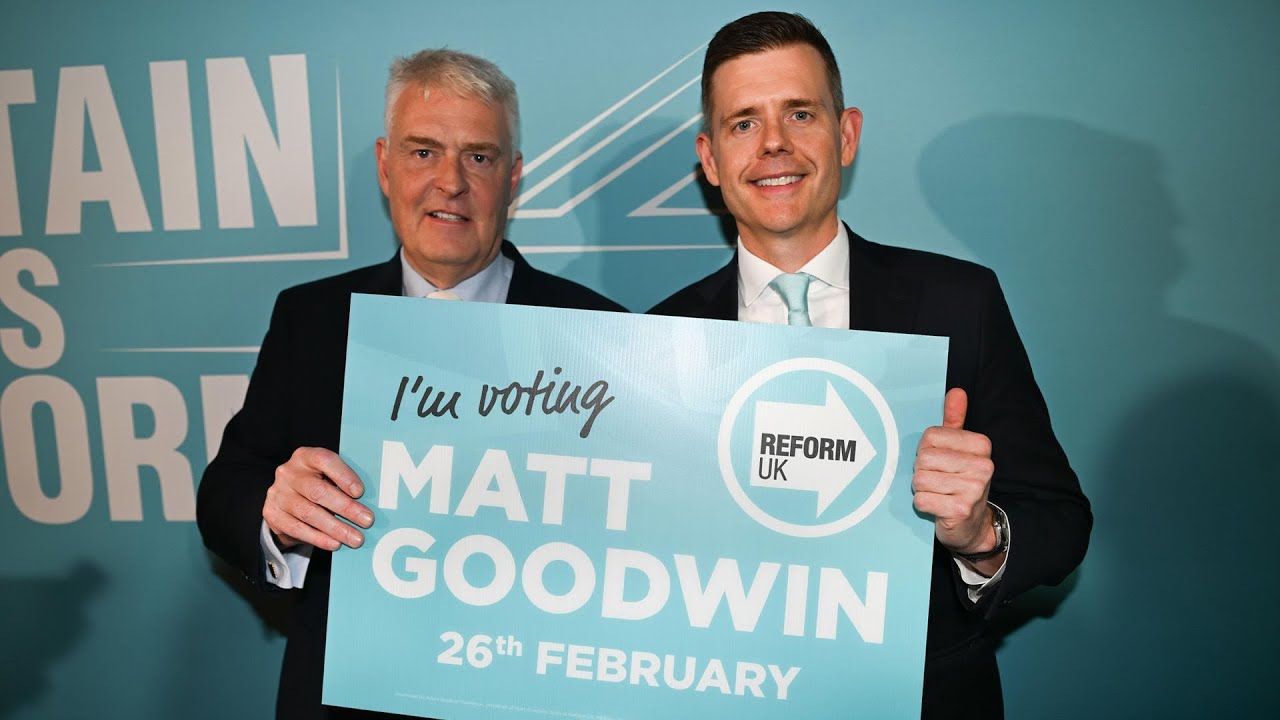
The imprint was missing from a leaflet containing an open letter by a pensioner who had switched her support from Labour to Reform.
Mr Goodwin and Mr Rawlinson are now asking the court to rule that they do not have to face a sanction over the issue, which their barrister described as an “honest administrative error”.
Adam Richardson, for the two, told the court in written submissions that the rule breach was “limited in scope, technical in nature, and had no material impact on the election”.
He continued that the Act allows a judge to order that a person should not face consequences for “illegal practice” if it arose from “inadvertence or from accidental miscalculation” and “did not arise from any want of good faith”.
He said: “Without relief, they face the risk of criminal prosecution, a fine, a three-year disqualification from elective office, and, if Mr Goodwin were elected, potential invalidation of the result.”
The court in London was told that the imprint was included in the signed-off version of the leaflet, which was sent to printing company Hardings Print Solutions.
Mr Richardson continued that an “internal error” at Hardings led to a “change of font” at the final stage of production, which caused the imprint to be “trimmed off or omitted”.
The barrister said the error was spotted on February 6, with no further leaflets being distributed and Hardings having “publicly admitted full responsibility for the production error”.
He said: “This error was neither requested nor authorised by the claimants or anyone on their behalf.”
He continued: “The omission was wholly inadvertent and arose from a third-party production error that was neither foreseen nor preventable.”
Mr Goodwin and Mr Rawlinson also informed the Crown Prosecution Service and the acting returning officer of the error, the barrister said.
Lawyers on behalf of the acting returning officer attended the hearing in London but made no representations, and no other party was represented.
At the end of the hearing, Mr Justice Soole said that a three-hour hearing to decide whether Mr Goodwin and Mr Rawlinson should be sanctioned will be held on Wednesday, and that the other candidates in the by-election should be given “formal notice” of the matter.
Nigel Farage Faces Election Nightmare as Labour Voters Set to Make Drastic Move
Nigel Farage and Reform UK are facing a new electoral challenge as polling suggests that a significant number of Labour voters could be prepared to change their vote strategically in constituencies where the main objective is to prevent Reform from winning.
The development highlights one of the most important features of Britain’s increasingly fragmented political landscape: national support for a party does not necessarily translate directly into parliamentary seats. Under the first-past-the-post system, constituency-level decisions can have a major effect, particularly when voters are willing to abandon their preferred party in order to defeat another.
Recent research by YouGov shows that tactical voting against Reform has become more prominent compared with earlier surveys. In a hypothetical constituency in which only Labour and Reform UK could realistically win, 41 per cent of voters said they would support Labour, compared with 26 per cent for Reform. YouGov said this represented a six-point increase for Labour and a five-point decline for Reform compared with February.
The figures do not mean that 41 per cent of voters will necessarily vote Labour at the next general election. They describe a hypothetical two-party contest designed to examine how voters might behave if the electoral choice became concentrated around two realistic contenders.
Labour voters consider a tactical switch
Perhaps more significant for Reform is the willingness among Labour supporters to consider voting for another party if that is what is required to prevent a Reform victory.
YouGov found that 35 per cent of people who voted Labour in 2024 would now be willing to support the Conservatives in a hypothetical Conservative-Reform contest. That figure was 29 per cent in February and only 20 per cent in the first survey of the series in February 2025.
This is an unusual political dynamic because Labour and the Conservatives are normally competing directly for voters. Yet the possibility of Reform winning can change the calculation for some voters.
A separate More in Common survey reported by The Independent found that 32 per cent of voters overall said they would consider voting tactically at the next general election. Among Labour supporters, 51 per cent said they were prepared to vote tactically, while 49 per cent said they would consider voting Conservative if doing so helped prevent Reform from winning.
Such figures should be interpreted carefully. Saying that someone is willing to vote tactically is not the same as saying that person will definitely do so when an election takes place.
Local circumstances would matter enormously.
Why constituency politics matters
The United Kingdom does not allocate parliamentary seats according to national vote share alone.
Instead, each constituency elects one MP, and the candidate receiving the most votes wins. This means a party can have considerable nationwide support but still fail to win a particular seat if its votes are divided among several parties.
For Reform UK, this creates both opportunities and risks.
The party has built significant support since the 2024 general election and has become one of the principal competitors in many constituencies. But if Labour, Conservative, Liberal Democrat and Green voters coordinate around whichever candidate is best positioned to defeat Reform locally, the distribution of seats could look very different from a straightforward national vote-share calculation.
A September MRP analysis by Electoral Calculus, based on more than 5,500 respondents surveyed between 4 and 11 September, illustrated this distinction. Its model put Reform on 22 per cent of the vote and projected 84 seats without claiming that this represented an actual election result. Its tactical-voting scenario reduced the modelled Reform total from 127 to 84 seats.
MRP projections are models, not election results. Their estimates depend on assumptions about turnout, constituency-level behaviour and the way voters translate preferences into actual votes.
A changing relationship between Labour and its voters
The tactical-voting figures also come at a time when Labour’s electoral coalition is changing.
Research published by The Guardian, based on polling of more than 8,000 voters conducted by Survation and 38 Degrees, identified several distinct groups among voters broadly described as progressive. The research found that some voters who previously supported Labour had moved towards the Greens, Reform or political disengagement.
At the same time, some left-leaning voters appear to be reconsidering Labour under Prime Minister Andy Burnham, with the desire to prevent a Reform government identified as one factor in that movement.
The groups are not politically identical. Some are primarily concerned about living costs and public services, while others place greater importance on immigration, environmental policy or political reform.
That makes Labour’s task more complicated than simply recovering all of its former voters. The party has to appeal to voters with different priorities while competing with several parties for their support.
Reform remains a major electoral force
The tactical-voting evidence should not be interpreted as showing that Reform UK has ceased to be competitive.
YouGov’s broader research has documented the scale of Reform’s rise since the 2024 general election. Its June voter study found that immigration was the most frequently cited reason for Reform support, with 54 per cent of Reform voters identifying trust in the party to manage immigration as one of the reasons for their support.
The party therefore retains a substantial coalition of voters whose political priorities are closely connected to immigration and other issues on which Reform has positioned itself prominently.
The challenge is that the same issues that motivate Reform supporters may also encourage some opponents to coordinate against the party.
This creates a potentially unusual electoral environment in which Reform’s ability to attract committed supporters could coexist with strong tactical resistance from voters supporting other parties.
Labour and Conservative voters could cross traditional boundaries
The most striking element of the latest research is that tactical voting does not necessarily follow conventional left-right divisions.
YouGov found that 35 per cent of 2024 Labour voters would choose the Conservatives in a hypothetical contest where the Conservatives and Reform were the only viable contenders. At the same time, voters from the Liberal Democrats and Greens showed substantial willingness to support Labour if Labour were the main challenger to Reform.
The More in Common findings point in a similar direction. More than half of Labour, Liberal Democrat and Green supporters said they were prepared to vote tactically in at least some circumstances.
This suggests that a future campaign could involve voters making decisions based not only on their preferred party, but also on the perceived competitiveness of candidates in their individual constituency.
A Labour voter in one constituency could therefore behave differently from a Labour voter elsewhere.
The Farage factor
Nigel Farage remains central to Reform’s political identity. The party’s support is closely associated with his leadership and his long-standing emphasis on immigration, Brexit and political change.
That personal association can work in different ways electorally.
For supporters, Farage’s profile provides a clear political identity and distinguishes Reform from the established parties. For opponents, his prominence can make Reform the focal point of tactical voting campaigns.
Recent YouGov polling found that 73 per cent of Britons described Farage as at least fairly “sleazy”, while 71 per cent used the same description for Reform UK. These figures represent perceptions recorded by the pollster rather than objective findings about Farage or the party.
The same research also showed that perceptions of other political parties and leaders varied considerably, underlining the fact that negative views are not unique to Reform.
A tactical voting campaign would face obstacles
Although the latest numbers show considerable willingness to vote tactically, converting that willingness into coordinated voting would be difficult.
First, voters need accurate information about which candidate is actually capable of winning locally.
Second, voters have to trust tactical-voting recommendations.
Third, some people may refuse to abandon their preferred party even when an election is close.
Fourth, the political landscape can change substantially before polling day.
A voter who currently says they would support one party in a hypothetical contest may make a different decision after a general election campaign, particularly if party leaders, policies or local candidates change.
There is also no guarantee that anti-Reform tactical voting would benefit Labour. Depending on the constituency, the main challenger to Reform could be Conservative, Labour, Liberal Democrat, Green or another party.
What the latest evidence tells us
The latest polling therefore points to an important development rather than a predetermined electoral outcome.
Reform UK has established itself as a significant force in British politics, but its parliamentary prospects depend on how efficiently that support is distributed across constituencies. At the same time, Labour appears to have an opportunity to regain some voters who have moved elsewhere, particularly where those voters see stopping Reform as an important objective.
The most notable finding is that traditional party loyalties may become less decisive in closely fought constituencies.
Labour supporters are not simply being asked whether they prefer Labour or Reform. Some are being presented with a different question: which candidate has the strongest chance of preventing Reform from winning?
For Farage, that distinction matters because a strong national vote share and strong constituency performance are not necessarily the same thing.
For Labour, the figures demonstrate both an opportunity and a challenge. Tactical support could help it in some contests, but relying on voters to abandon their preferred party is not the same as rebuilding durable support.
And for voters themselves, the eventual significance of tactical voting will depend on the candidates, local polling, national issues and campaign circumstances at the time of the next election.
The current evidence therefore describes a fluid political contest rather than a settled result. What it does show is that if tactical voting becomes more widespread, the relationship between national opinion polls and parliamentary seats could become even more complicated.
For Nigel Farage and Reform UK, the central issue is consequently not simply how many people support the party. It is whether those supporters are concentrated strongly enough in individual constituencies to withstand the possibility of voters from other parties temporarily crossing traditional political boundaries to oppose Reform candidates.
That question will remain unresolved until voters actually cast their ballots.