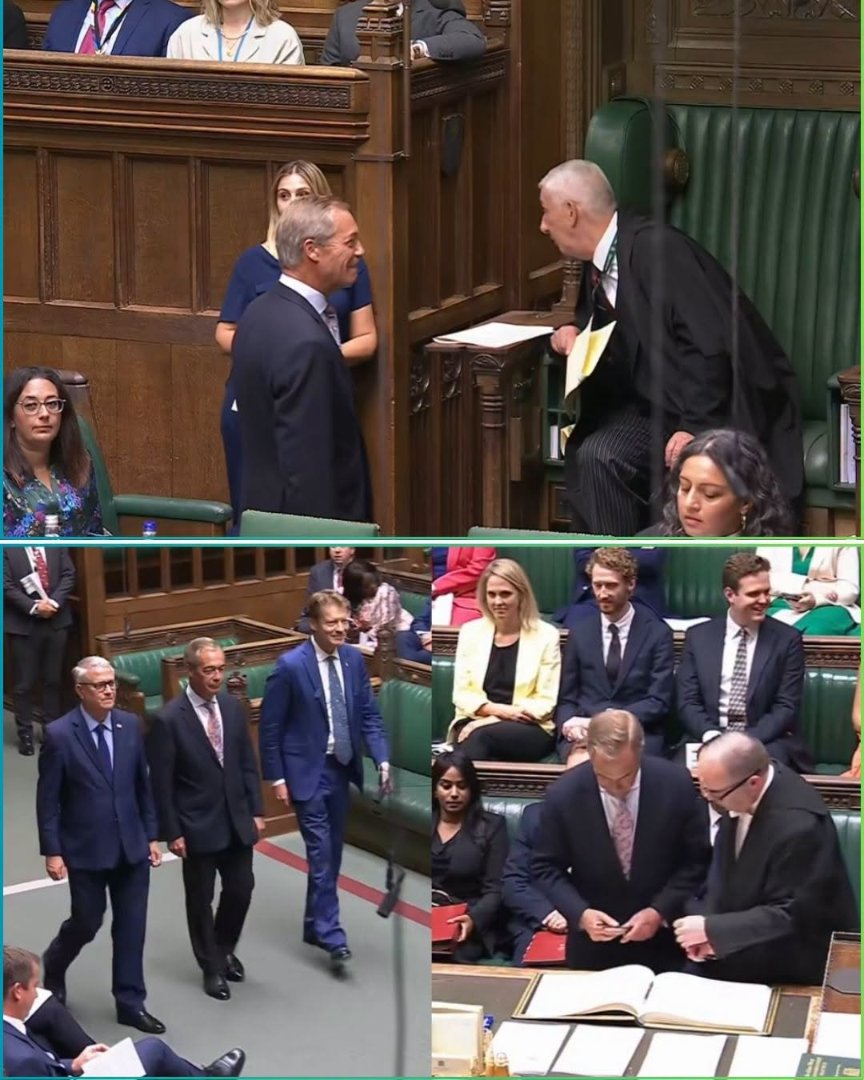
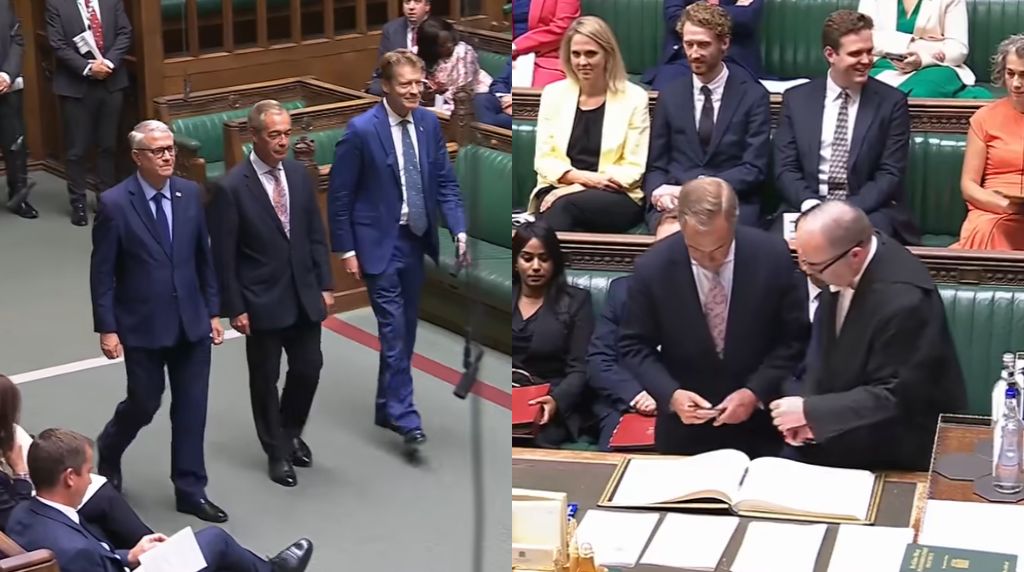
The proceedings were straightforward and adhered to the traditional protocols of the House.
Called to the table by the Speaker of the House, Farage, accompanied by his supporters, proceeded down the center aisle of the chamber.
In a brief and solemn moment, Farage took the oath of allegiance.
Holding a religious text, he recited the required pledge: “I swear by Almighty God that I will be faithful and bear true allegiance to His Majesty King Charles, his heirs and successors, according to law.
So help me God.”
Advertisement
Following the oath, Farage signed the official parliamentary register, a formal act solidifying his status as a Member of Parliament.
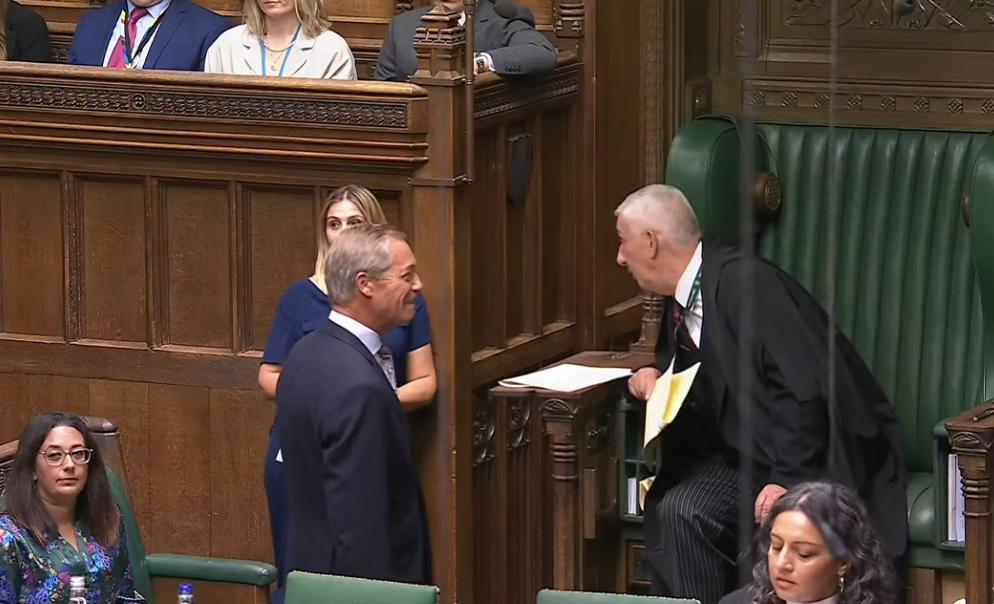
He then briefly approached the Speaker’s chair, exchanging a few words before returning to the floor.
The ceremony was brief, and the atmosphere in the chamber was composed as Farage completed the necessary procedural steps to assume his office.
Nigel Farage Takes His Seat in Parliament — But One Moment Quickly Caught Attention!
British politics witnessed another significant moment as Nigel Farage took his seat in Parliament, bringing renewed attention to one of the country’s most controversial and recognizable political figures. His arrival was more than an ordinary parliamentary occasion. It represented another chapter in a political journey that has challenged established parties, attracted passionate supporters, and generated intense criticism across the United Kingdom.
However, while the parliamentary appearance itself attracted considerable attention, one particular moment quickly became a talking point. Observers began discussing Farage’s presence, his interactions with fellow politicians, and what his arrival could mean for the future of British politics.
For a politician who has spent decades criticizing Westminster from the outside, entering Parliament represents a significant change in his political position. Farage has repeatedly presented himself as a challenger to the traditional political establishment. Now, he must demonstrate how that outsider image translates into practical parliamentary responsibility.
A Political Figure Who Has Changed Britain’s Political Conversation
Nigel Farage has been a major figure in British politics for many years.
He first became widely recognized through his leadership of the UK Independence Party (UKIP), where he campaigned for Britain’s withdrawal from the European Union.
His political message attracted voters who felt that decisions about Britain’s future were increasingly being made by institutions they believed were distant from ordinary citizens.
The Brexit referendum in June 2016 became the defining moment of that political campaign.
Following the referendum, Farage continued to play an important role in British political debate through the Brexit Party, which later became Reform UK.
His political career has been marked by repeated confrontations with established parties, particularly over immigration, national sovereignty, economic policy, and the relationship between Britain and Europe.
Supporters view him as a politician willing to challenge issues they believe traditional leaders have neglected.
Critics, however, question his political proposals and argue that his rhetoric can deepen divisions within British society.
Regardless of these contrasting opinions, his parliamentary presence has ensured that his political movement remains an important part of national debate.
The Moment That Attracted Attention
When Farage entered the parliamentary spotlight, attention naturally focused on his interaction with the established political environment.
For years, he has criticized Westminster politicians, accusing successive governments of failing to deliver meaningful change.
Now, he finds himself operating within the very institution he has frequently challenged.
This creates an interesting political situation.
As an elected representative, Farage is expected to participate in parliamentary debates, examine legislation, question government ministers, and represent the interests of his constituents.
His supporters will expect him to maintain the direct and confrontational approach that helped establish his political reputation.
His critics will be watching to see whether his parliamentary conduct matches the standards of responsibility expected from an elected politician.
The most important question is not simply how he behaves when cameras are watching. It is whether he can translate political promises into effective parliamentary action.
What Does Farage’s Parliamentary Presence Mean for Reform UK?
Farage’s position has significant implications for Reform UK.
The party has attempted to present itself as an alternative to Britain’s traditional political establishment.
Its political platform has focused heavily on immigration, taxation, public spending, national identity, and reform of government institutions.
Farage’s parliamentary involvement gives the party an additional opportunity to communicate its policies directly within the national legislature.
It also places greater responsibility on Reform UK.
Criticizing government decisions from outside Parliament is very different from having to examine legislation, defend alternative proposals, and explain how policies would operate in practice.
Voters may increasingly demand detailed answers rather than political slogans.
For example, proposals concerning immigration require explanations about border administration, employment, public services, and international agreements.
Economic promises require credible financial calculations and an understanding of how government revenue and public spending interact.
These are difficult issues, and parliamentary participation provides an opportunity to examine them more closely.
The Challenge of Facing Labour
Farage’s relationship with Labour is another important part of the political story.
Labour politicians have frequently challenged Reform UK’s positions, particularly regarding immigration, economic policy, and the future of public services.
The disagreements reflect fundamentally different political approaches.
Labour generally emphasizes public investment, workers’ rights, economic stability, and government-led reform.
Reform UK has emphasized reducing immigration, lowering certain taxes, changing government priorities, and challenging what it describes as the political establishment.
These differences are likely to generate intense parliamentary discussions.
Farage’s communication style is often direct and combative. He frequently attempts to place opponents under pressure by asking questions about government performance and political promises.
However, parliamentary debates require more than effective television performances.
Politicians must support their arguments with evidence, understand legislation, and respond to detailed questions.
This will be an important test of how Reform UK develops as a parliamentary political force.
Westminster Faces a Different Kind of Opposition
The arrival of Farage also highlights a broader change in British political competition.
For many years, the Conservative and Labour parties dominated the country’s national political conversation.
However, growing dissatisfaction with established political institutions has created opportunities for alternative parties.
Reform UK’s development reflects this changing political environment.
Some voters believe the traditional parties have failed to address immigration, economic pressures, and concerns about national identity.
Others remain deeply concerned about Reform UK’s proposals and the possible consequences of its policies.
This disagreement is part of the democratic process.
A functioning Parliament must allow competing political movements to challenge government decisions, present alternative policies, and face scrutiny from other representatives.
Farage’s presence adds another voice to that debate, but it also means Reform UK must accept the same level of accountability expected of every parliamentary party.
Can Farage Deliver What His Supporters Expect?
One of the biggest challenges facing Farage is the gap between campaigning and governing.
Political campaigning allows candidates to focus on the issues that matter most to their supporters.
Parliamentary work is more complicated.
An elected politician must deal with legislation, budgets, committee work, constituency problems, and competing national priorities.
There are also practical limitations on what an individual MP can achieve.
Even a prominent political figure cannot independently change national policy without parliamentary support and the necessary political processes.
Farage’s supporters will therefore be looking for tangible results.
They may want to see him challenge government ministers, raise immigration concerns, question spending decisions, and push for changes to existing policies.
Meanwhile, opponents will expect him to provide detailed explanations of his proposals and demonstrate that his political promises are realistic.
The public will ultimately judge his parliamentary contribution through his actions rather than his reputation alone.
Why This Moment Matters Beyond One Politician
Farage’s parliamentary arrival is significant because it reflects wider questions about the future of British democracy.
Public trust in political institutions has become an important issue.
Many voters want greater transparency, stronger accountability, and politicians who understand the practical difficulties facing ordinary households.
Concerns about housing, healthcare, immigration, taxation, employment, and the cost of living continue to influence political discussions.
These issues cannot be resolved through dramatic speeches alone.
They require detailed policy proposals, effective administration, and cooperation across different political institutions.
The challenge for Farage is to show that his political movement can contribute to those solutions.
The challenge for Labour and the Conservatives is to demonstrate that their established experience still provides meaningful answers to the problems facing the country.
Ultimately, voters should have the opportunity to evaluate all political parties through the same standards of evidence, accountability, and performance.
Conclusion: A New Chapter in British Parliamentary Politics
Nigel Farage taking his place in Parliament represents an important development in his political career.
After years of campaigning against the political establishment, he now has a direct opportunity to participate in the institution he has frequently criticized.
The attention surrounding his parliamentary appearance demonstrates the continued public interest in his political activities.
However, the real significance of this moment will depend on what happens next.
Will he concentrate on challenging government policies? Will Reform UK develop detailed alternatives to existing legislation? Can Farage maintain his political identity while accepting the responsibilities of parliamentary office?
These questions will shape how his contribution is understood in the months and years ahead.
One parliamentary appearance cannot determine the future of British politics. Nor can a dramatic television moment establish whether a politician will succeed in delivering meaningful change.
What matters is the work that follows.
For Farage, the challenge is now clear: turning political attention into parliamentary results.
For his opponents, the responsibility is equally clear: challenging his arguments with evidence and presenting convincing alternatives.
And for the British public, the most important thing is to watch closely, ask difficult questions, and judge every politician by what they actually deliver.
The cameras may capture the moment Nigel Farage takes his seat, but the real political story will be written through the decisions, debates, and consequences that follow.
This event officially begins Farage’s tenure in the current Parliament, where he will represent his constituency and lead his party’s legislative efforts.