
Photo: Twitter/X
It may haven taken more than a decade, but chickens are now coming home to roost for Nigel Farage. The falsehoods used to sell Brexit have been largely debunked, and on Sunday morning, Laura Kuenssberg confronted him with one of the biggest whoppers of the lot.
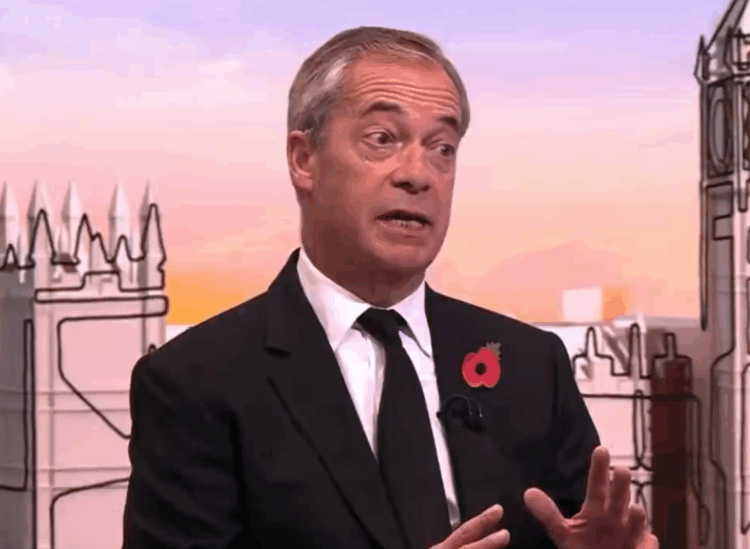
‘It’s just not true’ – Laura Kuenssberg grills Nigel Farage
In 2016, Nigel Farage argued that Turkey joining the European Union would increase the burden on the UK taxpayer. He claimed, among other things, that the nation was ‘being fast-tracked into the EU’, and also took a swipe at the aid payments the UK has sent them over the years.
However, no evidence – either before the referendum or after – suggests Turkey has at any point being earmarked for fast-track membership. In fact, Turkey first applied to join the EU way back in 1987, and still remains outside the organisation. A 39-year wait certainly doesn’t suggest anything has been hastened.
Watch: Nigel Farage confronted over EU-Turkey claim
On her flagship BBC show, Kuenssberg badgered Farage on the matter, telling him on four separate occasions that the claim ‘was not true’. Despite attempting to double-down, the Reform leader couldn’t escape her line of questioning, and instead attempted to explain how the situation had changed.
Support for Brexit has hit the skids
Later this month, Prime Minister Andy Burnham will head to the UK-EU summit, with the sole purpose of aligning Britain closer with its European neighbours. It’s understood that new agreements between both parties could be worth up to £17 billion – potentially undoing some of the Brexit-induced damage.
Since officially coming into effect in 2020, the barriers Brexit has posed to trade and business has been attributed to an economic slump in the UK, with some experts estimated that the country’s GDP took a hit of 6-8% over the past five years – equating to dozens of billions of pounds in lost revenue.
The longer it goes on, the more unpopular it becomes. Polling from IPSOS, released last week, shows that Brits are warmer on rejoining the bloc than ever before. Over 56% of participants said they would vote to reverse Brexit, with just three in 10 of these polled saying they wanted to stay out of the EU.
It is against this backdrop that Nigel Farage now finds himself walking an ever-narrowing tightrope. Critical support for Brexit is being undone by lived experience, and unflattering financial data. And the fibs used to prop it all up no longer stand up to scrutiny – as demonstrated earlier this morning.
Nigel Farage Caught Out Over One of His Biggest Brexit Lies
Nigel Farage has come under renewed scrutiny after being challenged over one of his most controversial claims during the 2016 Brexit referendum campaign. The Reform UK leader was confronted by BBC presenter Laura Kuenssberg over his assertion that Turkey was being fast-tracked into the European Union, a claim that has remained a significant part of the debate surrounding the UK’s decision to leave the bloc.
During an interview on the BBC’s Sunday with Laura Kuenssberg, Farage was questioned about his repeated warnings that Turkey would soon become an EU member, potentially allowing millions of Turkish citizens to move freely into Britain.
However, rather than providing convincing evidence that Turkey was being fast-tracked, Farage defended his original position and attempted to justify it by referring to the financial assistance Britain and other European countries had provided to Turkey.
The exchange quickly attracted attention, particularly because Turkey has still not joined the European Union, despite beginning its membership journey several decades ago.
For critics of Brexit, the interview has revived questions about the accuracy of some of the most influential arguments used to persuade British voters to support leaving the EU.
Laura Kuenssberg Challenges Farage Over Turkey
The confrontation centred on Farage’s claims during the 2016 referendum campaign.
At the time, Turkey had a population of approximately 76 million people. Brexit campaigners repeatedly raised the prospect of Turkish membership as a reason for Britain to leave the European Union.
Farage argued that Turkey was being fast-tracked towards membership and suggested that British taxpayers could face additional financial responsibilities as a result.
However, Kuenssberg directly challenged that argument during the interview.
She reminded Farage that he had claimed Turkey was being fast-tracked into the EU and questioned whether that assertion had ever been accurate.
Her challenge was particularly direct:
“You said that Turkey was being fast-tracked into the EU, that wasn’t right, was it?”
Farage rejected the suggestion.
He responded by referring to billions of pounds in European pre-accession assistance provided to Turkey.
Kuenssberg continued to challenge him, repeating that Turkey had not been fast-tracked into membership.
Despite the questioning, Farage maintained that his original claim was correct.
The exchange highlighted an important distinction between financial assistance provided to a candidate country and actual progress towards EU membership.
Turkey Has Been Waiting Decades to Join the EU
One of the biggest problems with Farage’s argument is the history of Turkey’s relationship with the European Union.
Turkey first applied to join the European Economic Community in 1987.
It was officially recognised as an EU candidate country in 1999, and formal accession negotiations began in 2005.
However, negotiations have experienced repeated political difficulties and have made little meaningful progress in recent years.
Disagreements over democratic standards, human rights, Cyprus and other political issues have contributed to the stagnation.
Turkey remains outside the European Union.
This history makes the suggestion that the country was being fast-tracked into membership particularly questionable.
Although Turkey had aspirations to join the bloc and received financial assistance intended to support reforms and accession preparations, that does not establish that membership was imminent.
Indeed, the lengthy accession process demonstrates the considerable obstacles facing Turkey.
Farage’s critics argue that presenting Turkish membership as an imminent prospect during the referendum campaign gave British voters a misleading impression of the situation.
The Brexit Campaign and the Politics of Fear
The Turkey controversy was part of a wider debate about immigration and national sovereignty during the 2016 referendum.
The possibility of Turkey joining the EU became a particularly controversial campaign issue because of concerns about freedom of movement.
Brexit campaigners argued that British borders could become more difficult to control if Turkey eventually became a member.
However, EU accession is not automatic.
Every candidate country must satisfy extensive political, economic and legal requirements. Membership also requires the agreement of existing member states.
Britain would therefore have retained the ability to oppose Turkish accession while it remained an EU member.
This was an important detail that voters needed to understand when evaluating the claims made during the referendum.
The debate illustrates how complicated international membership negotiations can become political campaign slogans.
For some Brexit supporters, the Turkey argument represented a legitimate concern about future EU enlargement. For critics, it exaggerated the likelihood and immediacy of Turkish membership.
The distinction between a country’s long-term ambition and an imminent political development is essential when assessing the accuracy of campaign claims.
The £350 Million NHS Promise Returns to the Debate
Farage’s Turkey comments have also revived wider questions about the promises made during the Brexit campaign.
One of the most recognisable arguments was the claim that leaving the European Union would allow Britain to spend an additional £350 million per week on the National Health Service.
The figure appeared prominently on the Vote Leave campaign bus and became one of the defining images of the referendum.
However, the claim was widely criticised because it did not properly account for the UK’s rebate and other financial adjustments.
Although Britain did make payments to the EU, the amount that could realistically have been redirected towards domestic public services was considerably smaller.
After Brexit, the promised £350 million per week did not materialise as an additional NHS budget.
Prime Minister Keir Starmer has previously used this example to criticise Farage’s record on Brexit, arguing that several prominent promises made during the campaign were not fulfilled.
Brexit’s Economic Consequences Remain Controversial
The renewed confrontation comes amid continuing debate about the economic consequences of Britain’s departure from the European Union.
Since the UK formally left the EU’s single market and customs union in January 2021, businesses have faced additional administrative requirements when trading with European countries.
Exporters, manufacturers and smaller businesses have had to navigate new customs procedures, regulatory requirements and documentation.
Supporters of Brexit argue that Britain has gained greater freedom to negotiate trade agreements and establish independent regulations.
Critics, however, point to additional trade barriers, reduced access to European markets and weaker investment as evidence of the economic costs of leaving.
There is considerable disagreement among economists about the precise scale of Brexit’s impact, but independent economic assessments have generally identified a negative effect on long-term UK productivity and trade compared with remaining in the EU.
The debate is particularly relevant as successive British governments consider closer economic cooperation with European partners.
Public Opinion Towards Brexit Is Changing
Another important development is the changing public mood towards Brexit.
Recent polling has indicated growing support for closer relations with the European Union, with some surveys suggesting that a majority of British voters would now prefer to reverse the decision to leave.
However, support for rejoining the EU is not necessarily identical to support for a closer relationship with Brussels.
Some voters want improved trade arrangements and cooperation without full membership, while others believe that rejoining would offer greater economic and political benefits.
The distinction is important because the political debate has moved beyond the simple Leave-versus-Remain division of 2016.
For Farage, this changing environment presents a challenge.
He remains one of the most prominent defenders of Brexit, but he must now defend the original arguments against the experience of the years since Britain left the European Union.
Conclusion: A Difficult Moment for One of Brexit’s Biggest Advocates
Nigel Farage’s confrontation with Laura Kuenssberg has reopened an important chapter in Britain’s political history.
His claim that Turkey was being fast-tracked into the European Union was challenged because the country’s accession process was neither imminent nor progressing at the pace his comments suggested.
Despite the questioning, Farage maintained his position and pointed to European financial assistance as evidence supporting his argument.
However, financial support for a candidate country is not the same as fast-tracked EU membership.
The episode also highlights the importance of examining political promises against historical records and verifiable evidence.
Brexit was one of the most consequential decisions in modern British history, affecting the country’s economy, international relationships and political direction.
The arguments used to secure public support for leaving the European Union therefore deserve continued scrutiny.
For Farage, the challenge is clear: defending Brexit today requires more than repeating the arguments of 2016. It requires answering difficult questions about whether those arguments accurately reflected the circumstances at the time and whether the promises made to voters have been fulfilled.