

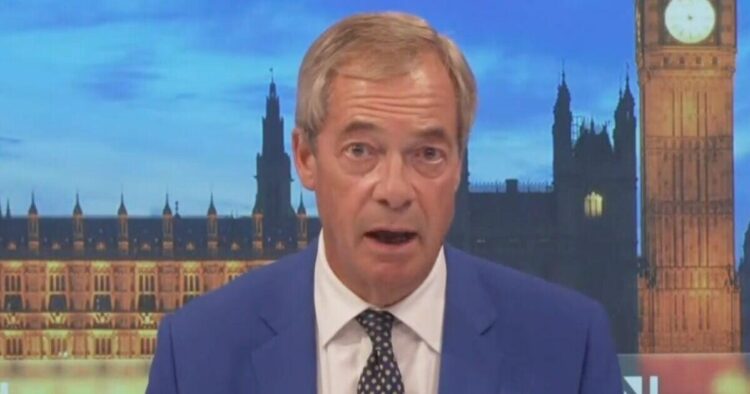
Photo: Twitter/X
Nice one, Nostradamus. Nigel Farage has been brutally mocked online on Wednesday morning, following a disastrous night for Donald Trump and the Republican Party. The Democrats have taken control of both the House and the Senate, flipping several red states in the 2026 Midterm Elections.
‘He won’t get absolutely smashed’, Nigel Farage said, hours before Donald Trump got absolutely smashed in the midterms
Trump heartlands of Texas, Kansas, and Ohio all comprehensively rejected the current administration and candidates endorsed by POTUS. The scale of the victory means, for the first time since the 80-year-old returned to office, his power and ability to force-through policies will be limited.
The near-certainty of a lame duck presidency certainly doesn’t come without risk, and a wounded Donald Trump is a dangerous thing indeed. There are fears that there could be significant escalations against Iran, compounded by substantial capitulations to Russia and its aggression towards Ukraine.
However, none of that takes away from the resounding defeat that has just been handed to the Republican leader. Democrats mobilised. Americans made their voices heard. And, quite frankly, anyone with even an iota of foresight could have seen this battering from a mile away.
Then, there’s Nigel Farage. The Reform leader, who has been Trump’s leading acolyte in the UK, failed to remove the blinkers on Tuesday. Speaking on GB News, he was bullish about Mr. Trump pulling off another surprise election victory. His judgment, however, appeared woefully impaired.
Don’t quit the dayjob! Reform annihilated over Trump prediction
Farage confidently stated that Trump ‘would not get absolutely smashed’. He did. There was also prediction that Americans would be ‘in for a big surprise’. And no, he wasn’t referring to a state like Kansas turning blue for the first time in over 90 years. Nigel was adamant that it would all come good.
Alas, he would be left bitterly disappointed. The whole statement is a hilarious post-mortem of misplaced hubris – especially given that Nigel Farage thought Elon Musk’s half-a-billion dollar war chest would make a difference. ‘Must has not spent his own money for fun’, he argued.
Well. He may as well have done…
“I don’t go with the consensus that Donald Trump is going to get absolutely smashed. I think this Republican Party is way better than it was 10 years ago when he first became president. And Elon Musk hasn’t chucked in $450 million dollars of his own money for fun. He’s helping.”
“Of course, the Iran War and the cost of fuel are not good. But look at the opponents! Who leads the Democrats? You’ve now got this new hard left coming in. So I think for all those reasons, we’re in for a big surprise tonight – Trump won in 2016, and that was against all the odds.” | Nigel Farage
Nigel Farage Drops an All-Time Stinker After Predicting Trump ‘Would Not Get Smashed’ in Midterms
Nigel Farage has faced widespread criticism after his confident prediction about Donald Trump’s performance in the 2026 US midterm elections proved dramatically wrong. The Reform UK leader had dismissed expectations of a Republican defeat, insisting that Trump and his allies would outperform predictions. However, the election results delivered a major setback for the Republican Party, leaving Farage having to acknowledge that his political forecast was incorrect.
The embarrassing episode has also renewed questions about Farage’s close relationship with the American president and the political consequences of his continued association with the MAGA movement.
Speaking on his GB News programme shortly before Americans went to the polls on 3 November 2026, Farage rejected the widely held expectation that Republicans would suffer heavy losses.
“I don’t go with that consensus that Trump is going to get absolutely smashed,” he declared.
Farage went further, suggesting that Republicans possessed stronger campaign organisation, better political data and considerable financial resources. He specifically highlighted Elon Musk’s financial involvement, arguing that the billionaire would not have committed hundreds of millions of dollars without expecting a political return.
“We’re in for a big surprise tonight,” Farage predicted.
Unfortunately for the Reform UK leader, the surprise was not the one he had anticipated.
Democrats subsequently secured major victories in both chambers of Congress, producing a significant electoral defeat for Trump’s Republican Party. Farage’s confident prediction was quickly transformed into a source of political embarrassment.
Farage Admits: ‘I Was Wrong’
Following the election results, Farage was forced to acknowledge that his prediction had failed.
Speaking to broadcasters on 5 November, the Reform leader admitted that he had misjudged the political situation.
“Over the years I’ve made many big calls on politics. I’ve got many more right than I’ve gotten wrong,” he explained.
He then conceded: “I got this wrong.”
Farage also described the Republican performance as a “complete wipeout” and an “absolute shellacking”.
His explanation focused partly on the financial and technological resources available to Trump’s campaign. He had believed that Musk’s money, combined with improved campaign organisation and voter mobilisation, would help Republicans limit their losses.
However, the election outcome demonstrated that financial resources and campaign technology do not necessarily guarantee electoral success.
The admission attracted considerable attention because Farage had publicly dismissed the predictions of political analysts shortly before the vote.
For a politician who has built much of his reputation on making bold electoral predictions, the episode created an uncomfortable moment.
Trump’s Defeat Creates Political Problems for Farage
The election result matters to Farage for reasons extending beyond his failed prediction.
The Reform UK leader has cultivated a close political relationship with Donald Trump for years. Both politicians have presented themselves as challengers to established political institutions and have attracted voters through criticism of mainstream political parties.
Farage has frequently praised Trump’s political communication, campaigning techniques and ability to mobilise supporters.
However, Trump’s declining political fortunes could create difficulties for Farage, particularly when the British politician is attempting to convince voters that Reform UK represents a credible alternative to Labour and the Conservatives.
The relationship is potentially complicated by public attitudes towards Trump in Britain.
While some Reform supporters admire the American president, other British voters may view his political style and policies negatively. Farage’s close association with Trump could therefore become an issue during future election campaigns.
The Republican defeat also raises questions about whether the political strategies associated with the MAGA movement can be successfully transferred to British politics.
The political, economic and social circumstances of the United States are very different from those of the United Kingdom. Strategies that attract American voters do not necessarily produce the same results in Britain.
Farage may therefore need to reconsider how prominently he associates himself with Trump and American conservative politics.
The Iran War Becomes Another Problem
Perhaps an even more difficult issue for Farage is his previous position on the US-led war against Iran.
During the early stages of the conflict, Farage expressed support for the Americans, arguing that Britain should stand alongside its closest international ally.
However, the war subsequently became a significant political liability for Trump.
Rising fuel prices and concerns about the economic consequences of military intervention contributed to Republican difficulties during the midterm elections.
Trump himself acknowledged that the conflict had contributed to the Republican defeat.
Farage has since attempted to distance himself from the idea of supporting an extended military campaign.
Speaking after the election, he explained that although he initially believed Britain should support the United States, he had never supported an endless war.
He also acknowledged that the conflict had been a mistake.
Importantly, Farage identified the failure to honour political promises as one of the central lessons of the Republican defeat.
His argument was that Trump had broken his promise to avoid further foreign wars.
This represents a notable change in emphasis from his earlier expressions of support for the American military action.
Elon Musk’s Money Could Not Guarantee Victory
Another particularly interesting aspect of Farage’s failed prediction concerns his reliance on Elon Musk’s financial influence.
Before the election, Farage highlighted Musk’s reported $450 million financial contribution to Republican political efforts.
His argument was straightforward: such a substantial financial commitment would surely help Republicans achieve a stronger result than opinion polls suggested.
However, the election demonstrated the limitations of relying on financial resources as an indicator of political success.
Money can help political campaigns purchase advertising, organise events, employ staff and communicate with voters. Nevertheless, it cannot automatically persuade people to support a particular candidate or party.
Economic dissatisfaction, public confidence, political leadership and the consequences of government decisions can all influence voting behaviour.
The experience could also have implications for Reform UK.
Farage has recently attracted attention because of substantial political donations from wealthy supporters. Christopher Harborne and Ben Delo have pledged donations worth approximately £36 million to Reform UK.
These contributions have raised questions about the influence of wealthy donors in British politics.
The American experience provides a reminder that financial strength and political popularity are not necessarily the same thing.
Farage himself acknowledged that money alone does not guarantee success, emphasising the importance of political messages and the candidates presented to voters.
Reform UK Is Also Facing Pressure at Home
The American election defeat comes at a particularly sensitive moment for Reform UK.
Recent British opinion polls have indicated that the party’s support has weakened, with Labour recovering ground and the Conservatives competing more closely with Farage’s organisation.
The decline has raised questions about whether Reform can maintain the momentum that previously made it a major force in British politics.
Senior Reform figures have reportedly recognised that the American experience contains important lessons for their own political strategy.
One particular concern is the cost of living.
According to reporting by the Financial Times, Reform officials believe that Trump lost sight of domestic economic concerns while focusing heavily on foreign policy.
They want Reform UK to concentrate more strongly on household finances, economic pressures and the everyday problems facing British voters.
This is significant because immigration and national identity have traditionally been central to Farage’s political messaging.
Although these subjects remain important to his supporters, economic issues could become increasingly influential in determining how voters assess the party.
Reform must therefore demonstrate that it can address practical economic concerns rather than relying exclusively on criticism of its political opponents.
Could Farage’s Friendship with Trump Become a Political Liability?
The question of Farage’s relationship with Trump is now attracting renewed attention.
For years, the Reform leader has presented his connections with prominent American conservatives as an advantage. His friendship with Trump has provided international visibility and reinforced his image as a politician operating beyond Britain’s traditional political establishment.
However, the American president’s political difficulties could change how that relationship is perceived.
Political opponents have already used Farage’s failed prediction to question his judgement.
Labour politicians have also criticised his earlier support for the Iran war, arguing that the consequences of the conflict should make voters reconsider his political priorities.
Meanwhile, Rupert Lowe, leader of Restore Britain, has used the controversy to attack Farage from the right.
The competition between these political figures illustrates the divisions developing within Britain’s right-wing political movement.
Nevertheless, it would be premature to assume that Trump’s defeat will automatically destroy Farage’s support.
Rob Ford, a professor of politics at the University of Manchester, has suggested that Reform voters may not be particularly concerned about American political developments.
This is an important distinction. British voters generally make decisions based on domestic issues, including taxation, employment, immigration, public services and economic conditions.
Consequently, the long-term impact of Trump’s defeat on Reform UK remains uncertain.
Conclusion: A Warning for Nigel Farage
Nigel Farage’s prediction that Donald Trump would avoid a major Republican defeat has become an uncomfortable episode for the Reform UK leader.
His confidence was evident when he appeared on GB News shortly before the American midterm elections, dismissing expectations of a Republican collapse and predicting a surprise victory.
The actual results forced him to admit that he was wrong.
However, the significance of the episode extends beyond one unsuccessful political prediction.
Trump’s defeat has raised questions about Farage’s international political alliances, his previous support for the Iran war and the influence of wealthy donors on electoral success.
It has also highlighted the importance of domestic economic concerns, an issue that Reform UK increasingly recognises it must address.
For Farage, the challenge now is to demonstrate that his political ambitions are not dependent on the fortunes of Donald Trump or the American MAGA movement.
His supporters may continue to value his political independence and confrontational approach. But other voters will want to see credible economic proposals, effective leadership and a clear vision for Britain’s future.
Ultimately, the American midterms provide a reminder that political confidence, financial backing and international friendships cannot guarantee electoral success.
Farage may have been wrong about Trump, but the more important question is what lessons he will take from the experience as he attempts to strengthen Reform UK’s position in British politics.