
Celebrity baker and presenter Nadiya Hussain has waded into the debate surrounding Ed Sheeran and his Loop Tour following his return to the stage on Saturday night.
Mr Sheeran has faced an onslaught of criticism from fans, famous faces, and pro-Palestine activists after deciding to continue with his tour despite organisers removing rapper Macklemore from the billing over “Free Palestine” messaging during his sets.
The A Team singer took to the stage alone at Philadelphia’s Lincoln Financial Field on Saturday evening after his backing band and other support acts quit the tour in solidarity with Macklemore.
Mr Sheeran chose to address the saga directly. “I’ve had to take and make difficult decisions, and I am making mistakes, and I’m so, so sorry,” he said.
Nadiya Hussain shared a scathing post about Ed Sheeran with her one million Instagram followers
|INSTAGRAM/NADIYA HUSSAIN/HIGHER LOVE WITH MEGAN
Mr Sheeran told the Philadelphia audience that he had never aspired to be a politically outspoken performer, but the situation “put me in the middle of an important and passionate argument about freedom of speech and the most complex political issue on the planet.”
He stressed that his live shows had always been intended as welcoming spaces for all, and that honouring his commitment to fans was fundamental to his identity – that was why he had chosen to press ahead with the tour on his own.
Turning to the conflict itself, he described the attack on Israel during the Nova Music Festival on October 7 as “horrific,” saying it had “compounded centuries of Jewish pain.”
On the situation in Gaza, he added: “What is happening in Gaza is catastrophic and unjustifiable and disproportionate.” He branded the scale of civilian and child casualties “heartbreaking” and insisted that the “systemic injustice” unfolding in the West Bank “cannot be overlooked.”
When it came to Macklemore’s dismissal and billionaire venue owner Robert Kraft’s involvement in the decision, he warned that the notion of venues demanding to pre-approve what artists say or perform on stage should “never happen in the free world.”
Later in the show, he said the past seven days had been “the worst week of his life”, claimed he’d been abandoned by friends and family members, and revealed the ordeal led to him contemplating whether to quit as an artist or not.
He also revealed he was working behind the scenes to figure out the best ways he can assist with the crisis in the region.
Making her feelings on Mr Sheeran’s statements known, Ms Hussain was clearly unimpressed as she published a scathing post from Megan Cooper, a “Trauma-Informed Holistic Coach & Therapist”, on her own page.
In the social media post, Ms Cooper said to the camera: “We’re all waking up to Ed Sheeran’s statement on stage, and I’m not going to go into what he said, but I do want to focus on one specific point.”
She prefaced her opinion by saying she was a “deeply emotional person” whose “job is to hold space for human expression and emotion” before adding that she wasn’t being “discompassionate towards Ed’s individual experience.”
In the clip, Ms Cooper went on: “But for those of us in white bodies, we need to understand and educate ourselves on white tears.
“White tears is a cultural tactic using emotion, consciously or unconsciously, to deflect accountability, to gain sympathy, and to centre self in conflict and challenge, particularly during discussions around racism and oppression.
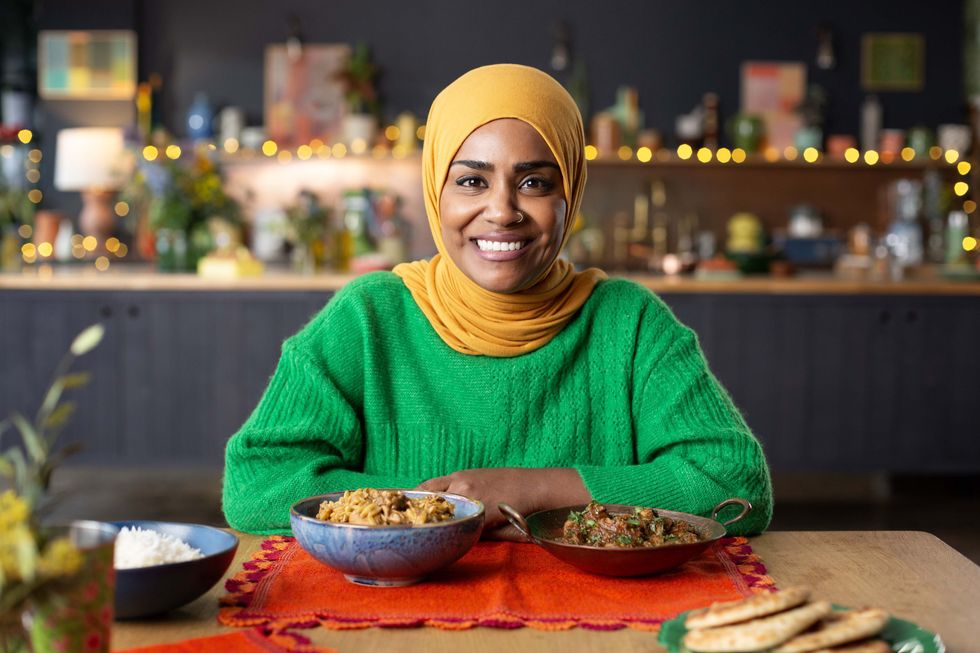 Nadiya Hussain was the face of a number of BBC cooking shows | BBC
“What happens is we become the victim. Our emotion is now prized above the actual issue, in this case, genocide. What this shines a light on is whose tears get to be seen, listened to, and heard in our society, and whose don’t.”
In the case of Mr Sheeran, Ms Cooper claimed: “Not only does emotion meet whiteness, but it also meets patriarchy”.
She went on: “So what we have is not just tears, it’s power. If the tears of Palestinians and black and brown and indigenous communities carried as much gravity, genocide would not happen.”
She signed off by saying people “in white bodies” need “to educate and inform ourselves so that we don’t replicate systems of harm whilst we are trying to dismantle them”.
Great British Bake Off winner Ms Hussain published the clip to her one million Instagram followers via her Stories.
This isn’t the first time Ms Hussain has waded into the ongoing conversation surrounding Palestine, regularly using her social media platform to promote pro-Palestinian causes and condemn Israel’s military actions in Gaza.
Since winning Bake Off in 2015, Ms Hussain went on to enjoy a successful career on the BBC as the face of a number of cooking shows before her departure from the corporation last year.
Ms Hussain went on to claim that her “opinions” and the fact that she no longer “fitted in a box” played a part in her exit.
She joins a long list of stars who’ve criticised Mr Sheeran’s actions over the past week, including Billy Bragg, Paloma Faith, Lewis Hamilton, and many more.
Nadiya Hussain Shares Post Accusing Ed Sheeran of ‘White Tears’ and ‘Becoming the Victim’ After Tour Return
Nadiya Hussain has become involved in the growing controversy surrounding Ed Sheeran after sharing a video on social media that accused the singer of displaying “white tears” and making himself “the victim” while addressing the backlash surrounding his US tour.
The former Great British Bake Off winner shared the video with her approximately one million Instagram followers without adding a personal caption. The video was made by therapist Megan Cooper, who discussed the concept of “white tears” in the context of racism, oppression and the Israel-Gaza conflict.
Hussain’s decision to share the material came shortly after Sheeran returned to the stage in Philadelphia and delivered an emotional speech about the controversy surrounding his tour.
The dispute began after American rapper Macklemore, who had been scheduled as a support act for Sheeran’s tour, made pro-Palestinian statements during his performances. Macklemore has previously spoken publicly in support of Palestinians, including using the phrase “Free Palestine” during performances.
Sheeran subsequently faced criticism after Macklemore was removed from the tour. The singer has maintained that the decision was made by the promoter rather than by him personally. Several other performers associated with the tour subsequently withdrew, leaving Sheeran to continue the tour without the original group of supporting acts.
The controversy placed Sheeran in an increasingly difficult position.
The singer has historically avoided presenting himself as a political performer. During his Philadelphia concert, however, he said that the situation had forced him to speak publicly because he regarded the conflict as a humanitarian issue.
Sheeran acknowledged that he had made mistakes in dealing with the situation and apologised to his audience.
“I’ve had to take and make difficult decisions, and I am making mistakes, and I’m so, so sorry,” he told concertgoers.
He also addressed both the October 7 attacks in Israel and the situation in Gaza.
Sheeran described the Hamas attack at the Nova music festival as horrific and said that it compounded longstanding Jewish suffering. At the same time, he described the situation in Gaza as “catastrophic and unjustifiable” and expressed concern about the loss of civilian and children’s lives.
The singer’s comments represented a significant departure from his usual approach to politics.
Sheeran said that he had spent much of his career trying not to act as a political commentator because he wanted his concerts to focus on music, unity and humanity rather than political division.
However, he argued that the situation in Gaza was fundamentally humanitarian and that he could no longer remain silent about his feelings.
His emotional response subsequently became another part of the controversy.
During the concert, Sheeran became visibly upset while discussing the pressure he had experienced during the previous week. He said that he had felt as though friends, family and people around him had abandoned him.
He then pointed to the thousands of people who had still attended his Philadelphia concert.
Sheeran told the crowd that he had seen ticket sales continuing rather than mass cancellations and interpreted the attendance as evidence that the audience had not abandoned him.
The singer became emotional again towards the end of the performance as he thanked fans for supporting him.
It was this aspect of his speech that the video shared by Hussain addressed.
Cooper’s video argued that emotional reactions by white people in discussions about racism and oppression can sometimes shift attention away from the underlying issue. She described “white tears” as a cultural concept in which emotion may be used consciously or unconsciously to gain sympathy, deflect accountability or place the person expressing the emotion at the centre of a conflict.
She argued that, in the context of the Gaza debate, attention should remain focused on the suffering of Palestinians and other communities affected by violence and oppression.
Hussain did not add a written statement explaining why she shared the video.
That distinction is important.
The accusation contained in the video was made by Cooper, not directly by Hussain in a written statement accompanying the post. Hussain’s decision to share it nevertheless brought the argument to a much wider audience because of her large social-media following.
The development has generated further discussion about the role of celebrities in political debates.
Hussain, who won The Great British Bake Off in 2015, has previously spoken publicly about her Muslim identity and issues affecting minority communities. Her decision to amplify Cooper’s message therefore attracted considerable attention.
Sheeran’s situation is somewhat different.
The singer has repeatedly stressed that he does not regard himself as an activist musician. Yet his decision to address the Israel-Gaza conflict on stage demonstrates the difficulty public figures can face when political controversies intersect with their professional lives.
The Macklemore dispute placed Sheeran in the middle of an argument about freedom of expression.
On one side, critics questioned why Macklemore’s political statements had resulted in him losing his position on the tour. On the other, Sheeran has argued that decisions about performers and tour arrangements were not necessarily his personal decisions.
During his Philadelphia speech, Sheeran said he was concerned about the idea that venues or organisers might pre-approve the content artists are allowed to perform.
He argued that freedom of expression should be protected, particularly in countries that describe themselves as free societies.
The situation also illustrates the complicated relationship between entertainment and politics.
Artists regularly perform for audiences with different political beliefs, religions and backgrounds. Some attempt to keep their concerts politically neutral, while others regard their public platforms as an opportunity to discuss issues they consider important.
Sheeran has generally belonged to the first category.
His statement in Philadelphia suggested that the events surrounding Macklemore had changed the circumstances.
He told fans that he had not wanted to become an activist musician but felt that he had been placed in the middle of an important debate.
He also emphasised that his concerts were intended to be places where people with different beliefs could come together.
For Sheeran, continuing the tour therefore appeared to be both a professional and personal decision.
The emotional tone of his speech has itself become controversial.
Supporters of the singer can interpret his tears as an expression of genuine distress after an exceptionally difficult period. Critics, including the argument presented in the video shared by Hussain, can interpret the same emotional display differently, arguing that attention should remain focused on those directly experiencing the consequences of the conflict.
Those are competing interpretations of the same event.
The available evidence does not establish what Sheeran’s internal motivations were when he became emotional on stage. What is documented is that he described feeling abandoned by people around him, apologised for mistakes and spoke about the humanitarian consequences of the conflict.
Hussain’s social-media post has consequently added another layer to an already complicated dispute.
The controversy is no longer simply about Macklemore’s removal from the tour. It now includes questions about freedom of expression, celebrity responsibility, the Israel-Gaza conflict and how public figures respond when their personal emotions become part of a political controversy.
The response from other celebrities has also demonstrated how divided the entertainment industry can be over the issue.
Some performers have criticised the treatment of Macklemore, while others have defended Sheeran or questioned the decision to turn a concert into a political discussion.
Meanwhile, Sheeran has made clear that he intends to continue his tour.
The Philadelphia concert was particularly significant because it was the first performance since the dispute escalated. Despite the controversy, thousands of people attended.
Sheeran told the audience that their presence gave him hope and reaffirmed his commitment to live music.
The singer’s comments also reflected his desire to return the focus to music.
He apologised to fans for having to spend part of the concert discussing the controversy, acknowledging that some people had bought tickets expecting an evening centred on entertainment rather than politics.
Yet the debate surrounding the tour shows how difficult that separation can be.
When a major artist becomes involved in a dispute involving another performer, freedom of speech and an international conflict, avoiding politics can become almost impossible.
Hussain’s decision to share Cooper’s video demonstrates how the controversy has extended beyond the music industry.
It has become part of a much broader public debate over whose voices receive attention, how emotional responses are interpreted and whether celebrities should use their platforms to discuss international conflicts.
For now, neither Hussain nor Sheeran has offered an extensive direct response to the other’s position.
Hussain’s contribution has been to amplify Cooper’s criticism, while Sheeran has continued to explain his own position directly to concert audiences.
The controversy is therefore likely to continue as the tour progresses.
At its centre are several difficult questions: how should artists respond when political issues affect their professional relationships? Where should the line be drawn between artistic freedom and commercial decisions? And when celebrities speak publicly about humanitarian crises, how should audiences interpret their emotional responses?
There are no simple answers.
What is clear is that Ed Sheeran’s return to the stage has not ended the controversy surrounding his US tour. Instead, his emotional speech has generated a new debate, with Nadiya Hussain’s decision to share Megan Cooper’s video bringing renewed attention to the argument over “white tears”, accountability and the humanitarian crisis in Gaza.
As the tour continues, Sheeran’s stated focus remains on performing for his audiences, while critics continue to scrutinise the decisions and statements surrounding the controversy.
The episode is another example of how quickly the boundaries between music, celebrity, politics and international affairs can disappear when a public figure becomes involved in a deeply divisive global issue.