

Labour MPs Warn Andy Burnham Against a Snap General Election
Labour MPs Warn Andy Burnham Against a Snap General Election
Andy Burnham is facing growing pressure from Labour MPs to resist any temptation to call a snap General Election, amid warnings that an early contest could produce political “carnage” for the party and put dozens of newly elected MPs at risk.
The concern comes at a particularly sensitive moment for Labour. After taking over as Prime Minister, Burnham has benefited from an improvement in the party’s polling position, creating speculation that his advisers could be tempted to take advantage of the political momentum and seek a fresh mandate from voters.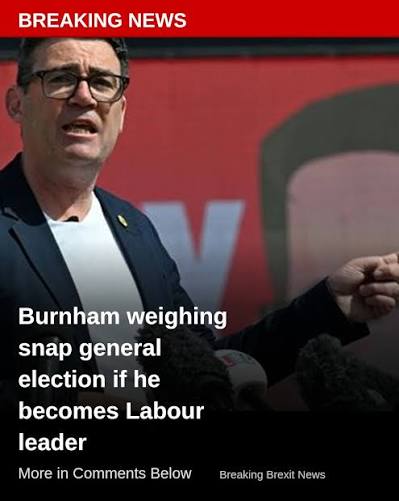
On paper, the argument for an early election is understandable. A new Prime Minister who enjoys an initial rise in popularity may believe that the best time to seek the country’s support is before political difficulties accumulate. Opposition parties may also be divided, creating an opportunity for Labour to strengthen its position.
But for many Labour MPs, particularly those with relatively small majorities, the calculation is very different.
They are not looking at the headline national figures. They are looking at their own constituencies.
For dozens of MPs elected only recently, an early election could mean returning to the voters before they have had enough time to establish themselves locally. Some won their seats with relatively narrow margins and could be vulnerable to challenges from Reform UK, the Conservatives, the Greens or other parties.
The fear is therefore that Burnham could win a stronger personal mandate while simultaneously losing a large number of Labour MPs.
That would create an extraordinary political paradox. A Prime Minister could call an election because the national picture appears favourable, only to emerge with a much smaller parliamentary majority.
Recent modelling has illustrated just how sensitive the result could be. Labour could potentially increase its Commons majority if its polling advantage grew substantially, but even such a result could involve significant losses among marginal Labour MPs. A small movement in the opposite direction could produce a dramatically weaker Parliament for Burnham.
This is why Labour backbenchers are reportedly urging the Prime Minister to concentrate on governing rather than gambling his position on an early election.
One Labour MP warned that politicians should not become too excited by a temporary improvement in polling. The message is particularly relevant because opinion polls can change quickly, especially during the early months of a new government.
A political bounce is not the same thing as a durable electoral realignment.
The experience of previous British governments provides an obvious warning. Theresa May called a snap election in 2017 after entering Downing Street with a substantial advantage over Labour. She expected the election to strengthen her authority and increase her parliamentary majority. Instead, the Conservatives lost their majority and were forced into a confidence-and-supply arrangement with the Democratic Unionist Party.
That episode remains one of the clearest reminders that elections are inherently unpredictable.
A Prime Minister may control the timing of an election, but cannot control how voters respond once the campaign begins.
This is particularly important in today’s fragmented political environment.
British politics is no longer dominated by a straightforward Labour-versus-Conservative contest. Reform UK has established itself as a major force on the right, while the Liberal Democrats, Greens and regional parties also compete for votes. A small change in support can therefore have very different consequences across individual constituencies.
Under Britain’s first-past-the-post system, national vote share does not translate directly into parliamentary seats.
A party can increase its overall support and still lose seats if that support is distributed inefficiently. Conversely, a relatively modest share of the vote can produce a large number of MPs if it is concentrated in the right constituencies.
For Labour MPs sitting in marginal seats, this makes an early election particularly dangerous.
Many of the party’s newer MPs were elected during the previous general election amid a dramatic shift in the political landscape. Some benefited from the collapse of Conservative support rather than building enormous personal majorities. If Conservative and Reform voters coordinate, or if Labour’s support falls even slightly, those seats could become highly competitive.
The danger is greatest in areas where Labour’s traditional support has weakened.
The party’s historic coalition has become more complicated. Working-class voters in parts of northern and central England have become increasingly willing to support parties other than Labour, while younger and metropolitan voters can be attracted by the Greens or Liberal Democrats.
Burnham’s challenge is therefore much bigger than simply maintaining a favourable national poll.
He needs to understand where Labour’s support is coming from and whether it is stable.
A short period of popularity following a change of leadership can be misleading. New governments frequently receive an initial burst of public attention and goodwill. Voters may welcome a change in tone or leadership without necessarily having made a permanent decision about how they will vote at the next election.
That distinction matters enormously.
If Burnham were to call an election and the campaign exposed divisions inside Labour, the initial bounce could disappear rapidly. A difficult economic announcement, an unpopular policy, a controversy involving a minister or a strong performance by an opposition leader could alter the political landscape within weeks.
There is also a practical consideration.
Britain is facing difficult economic choices. Public finances remain under pressure, while voters continue to be concerned about household costs, housing, public services and the wider economic outlook. A government needs time to implement policies before it can convincingly demonstrate whether those policies work.
Calling an election too early could prevent Labour from receiving the political benefit of successful reforms.
If Burnham’s Government believes that its programme can improve living standards, strengthen public services and rebuild confidence, allowing several years for those policies to take effect may be strategically wiser than seeking immediate electoral approval.
The Prime Minister also inherited a political mandate from the previous Labour government. Although Burnham’s arrival at Downing Street represents a major change in leadership, an immediate election could raise questions about why voters should be asked to return to the polls so soon after the previous contest.
That argument has already emerged in public debate. Critics could accuse Burnham of putting personal political ambition ahead of stability.
Supporters would respond that a new Prime Minister should have the opportunity to seek a direct mandate.
Both arguments have merit.
A Prime Minister who enters Downing Street following a change in governing-party leadership does not necessarily possess the same political authority as someone who has personally led their party to victory in a general election. Seeking a fresh mandate can therefore be constitutionally defensible.
However, Britain does not require a new election every time a governing party changes its leader.
Governments are elected to serve parliamentary terms, and political stability has its own value.
For Labour MPs, the most immediate issue is their own political survival.
An election held several years earlier than necessary could force many politicians into an unexpectedly difficult campaign. New MPs who have only recently begun building relationships with constituents could find themselves fighting for their seats almost immediately.
That is why the word “carnage” has become so politically powerful.
It captures the fear that an election designed to strengthen Burnham could instead destroy much of the parliamentary generation that Labour has only just elected.
The consequences would extend beyond individual MPs.
A large number of Labour losses could weaken Burnham’s ability to pass legislation. It could embolden internal critics and make parliamentary management more difficult. A smaller majority would also increase the influence of rebellious backbenchers.
Ironically, a Prime Minister seeking a stronger mandate could end up with less freedom to govern.
The risk becomes even greater if Labour loses its majority altogether.
A fragmented Parliament could produce months of instability, complicated negotiations and uncertainty over government policy. Financial markets could react negatively to prolonged political uncertainty, while businesses and households might delay decisions because they cannot predict the direction of government.
That would be precisely the opposite of what a new Prime Minister would want.
Burnham’s supporters could argue that waiting also carries risks.
Political popularity is temporary. Opposition parties could recover. Reform UK and the Conservatives could eventually resolve their competition for right-of-centre voters. Economic conditions could deteriorate. Internal Labour disputes could become more visible.
There is no guarantee that today’s favourable political circumstances will still exist in two or three years.
That is the strongest argument for an early election.
But the counterargument is equally powerful: there is no guarantee that today’s favourable circumstances are strong enough to produce a comfortable majority.
A Prime Minister should not confuse being ahead in the polls with being securely ahead.
The history of British elections is filled with examples of leaders who underestimated voters. Campaigns can transform political narratives, and constituency-level results can differ dramatically from national polling.
Burnham therefore faces a classic political dilemma.
If he waits, he risks losing the advantage of his current popularity.
If he goes early, he risks turning a potentially comfortable governing position into a dangerous electoral gamble.
For Labour MPs, the preferred answer is clear: govern first and campaign later.
They want Burnham to use his time in Downing Street to demonstrate that Labour can deliver. If the Government improves the economy, strengthens public services and addresses concerns about immigration, housing and living costs, the Prime Minister may enter the next election with something more valuable than a temporary polling bounce: a record of achievement.
That would provide a much stronger foundation for an election campaign.
It would also allow vulnerable MPs to establish themselves with constituents and demonstrate what they have done in Parliament.
For Burnham personally, patience could therefore be more valuable than speed.
The Prime Minister has already shown that he wants to present himself as a different kind of political leader, one focused on optimism, national renewal and practical government. Calling an election almost immediately could undermine that message by making his premiership appear primarily concerned with political advantage.
By contrast, rejecting an early election would allow him to argue that the Government is focused on governing rather than campaigning.
Ultimately, Labour’s fear of “carnage” is not simply about individual careers. It reflects a wider uncertainty about the changing nature of British politics.
The old assumptions about safe seats and predictable voting patterns have weakened. Constituencies that once appeared secure can now change hands. New political movements can gain support rapidly. Voters are increasingly willing to move between parties.
In such an environment, calling an early election is a particularly high-risk strategy.
Burnham may have a political opportunity today, but opportunity is not the same as certainty.
The safest course may be to resist the excitement generated by improving polls and concentrate on the difficult business of governing. If Labour succeeds, the Prime Minister will eventually have a stronger record to present to voters. If the Government fails, an early election would not necessarily save it.
The warnings from Labour MPs should therefore be taken seriously.
They are effectively telling Burnham that the biggest danger is not losing an election today. It is calling one unnecessarily.
A government with a large majority already possesses the parliamentary authority to pursue its programme. There is no urgent constitutional requirement to put the country through another national campaign.
For the Prime Minister, patience could ultimately prove more politically rewarding than ambition.
The temptation of a snap election will remain as long as Labour’s poll numbers look encouraging. But politics is rarely as simple as a single set of figures.
For dozens of Labour MPs, their message to Burnham is unmistakable: do not gamble a large parliamentary majority for the sake of a bigger one.
The country needs government, they argue, not another immediate election campaign.
And if the Prime Minister listens, he may discover that the most effective way to win the next election is not to call it early—but to spend the years before it proving that his Government deserves to win.
:::{“fallbackMarkdown”:””,”reference”:{“matched_text”:” “,”prefix”:null,”start_idx”:13578,”end_idx”:13578,”safe_urls”:[],”refs”:[],”alt”:””,”prompt_text”:null,”type”:”sources_footnote”,”sources”:[],”has_images”:false},”showLoginRequiredCard”:false}