

Sir Keir Starmer is suffering “further embarrassment” after a migrant deported to France under the “one in, one out” deal with France has returned to Britain.
Speaking to GB News, Home and Security Editor Mark White predicted the migrant could “come back again” if he is once again removed under the same scheme.
Uncovered the The Guardian, the small boat migrant from Iran was flown to France as part of the UK’s deportation flights on September 18, but returned just a month later on the October 18.
The man has been detained again by the Home Office, and will be returned to France for a second time.
Keir Starmer has suffered further embarrassment with his migrant exchange deal as one migrant has returned to Britain
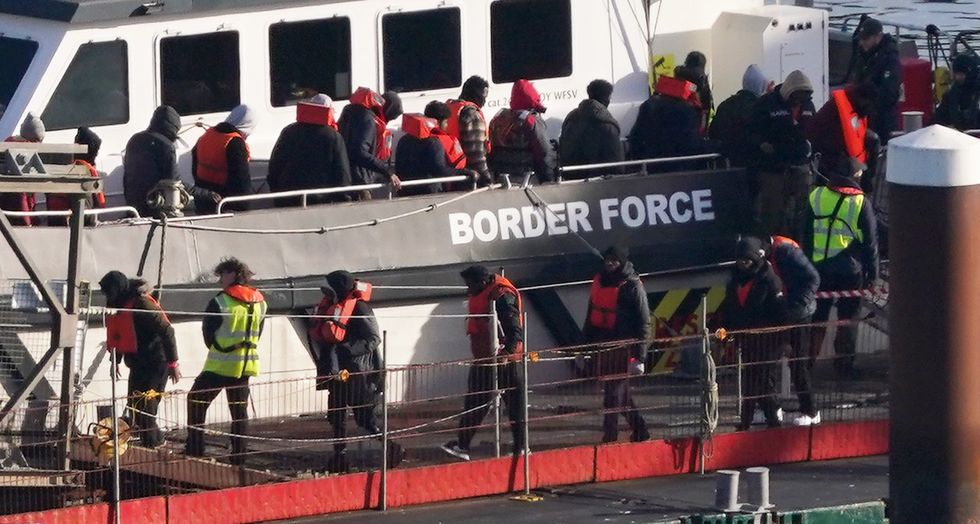
The illegal migrant claimed he was a victim of modern slavery in northern France
PA
Revealing details shared with him by a source close to the incident, Mark said: “This is a migrant, my sources have told me, and it was confirmed that this migrant was earmarked for deportation on the 6th of August, when he arrived across the Channel on that date.
“He is an Iranian national, he was sent back on the 18th of September, and then has returned back just a month later on the 18th of October. Now he’s in detention again, and his process of being returned to France will be expedited.”
Casting doubt on the ability of French authorities to detain the migrant properly, Mark concluded: “But are the French going to keep him in custody again? I doubt it.
Mark told GB News that the migrant ‘could return again’ under the laws of the exchange deal
The man hoping to claim asylum in the UK said he believed France was not safe for him and says he is a victim of modern slavery in northern France.
Home Office sources confirmed that one person sent to France under the UK-France treaty is now back in the UK.
In a statement, a Home Office spokesman said: “We will not accept any abuse of our borders. We will do everything in our power to remove those without the legal right to be here.
“Individuals who are returned under the pilot and subsequently attempt to re-enter the UK illegally will (be) removed.”
Keir Starmer Issued Stark Warning Over Migrant Who Returned to UK Under ‘One In, One Out’ Deal
The United Kingdom’s immigration policy has come under renewed scrutiny following reports that a migrant returned to Britain after being removed under the controversial ‘one in, one out’ agreement with France. The incident has raised important questions about the effectiveness of the government’s immigration arrangements, border security and the ability of authorities to prevent irregular migration. Prime Minister Keir Starmer is facing pressure to explain how such a situation could occur and what measures are being taken to ensure that the agreement achieves its intended objectives. The controversy has also reignited wider discussions about public confidence in the asylum system and the government’s responsibility to manage immigration effectively.
First of all, small boat crossings across the English Channel have become one of the most challenging issues facing successive British governments. Thousands of migrants have attempted to reach the United Kingdom using small and often overcrowded vessels. These journeys can be extremely dangerous because of unpredictable weather, strong currents and busy shipping routes. Many migrants depend on criminal smuggling networks that charge substantial sums of money to organise crossings, frequently exposing vulnerable people to serious risks.
The Labour government has promised to tackle these criminal networks and reduce the number of dangerous Channel crossings. Since taking office in July 2024, Keir Starmer has argued that stronger international cooperation is necessary to address irregular migration. Rather than relying exclusively on deterrence policies, his government has focused on intelligence sharing, police cooperation and agreements with European partners. However, continued arrivals have maintained pressure on ministers to demonstrate that their approach is producing measurable results.
The ‘one in, one out’ agreement with France was introduced as part of this wider strategy. Under the arrangement, certain migrants arriving in Britain through irregular routes can be returned to France, while an equivalent number of eligible individuals can enter Britain through an authorised legal pathway. The intention is to discourage dangerous crossings by demonstrating that irregular arrival does not automatically provide permission to remain in the country.
The agreement also attempts to establish a more structured approach to migration management. Individuals entering through legal routes can have their circumstances assessed before travelling, while those returned to France are subject to the relevant immigration procedures. Supporters of the policy argue that this combination of enforcement and legal migration could help reduce the influence of smuggling gangs and improve cooperation between Britain and France.
However, reports that a migrant returned under the agreement subsequently made their way back to Britain have raised concerns about enforcement. If individuals can return after being removed, questions naturally arise about the effectiveness of border checks, identification procedures and the arrangements governing future entry. Critics argue that the government must explain how authorities monitor individuals who have already been returned and what happens when they attempt to enter Britain again.
For Keir Starmer, the incident presents an important political challenge. The Prime Minister has repeatedly emphasised the need to restore control over Britain’s borders and improve the asylum system. Therefore, any apparent failure involving the return agreement is likely to attract questions from opposition politicians and members of the public. Conservative critics may argue that the arrangement is too limited to address the scale of irregular migration, while demanding stronger enforcement measures and clearer guarantees against repeated illegal entry.
Nevertheless, it is important to distinguish between an individual incident and the overall performance of an immigration agreement. The circumstances surrounding a migrant’s return must be examined carefully. Authorities need to establish how the individual re-entered the country, whether the relevant procedures were followed and whether any legal protections or exceptional circumstances applied. Without these details, it would be premature to conclude that the entire agreement has failed.
Another important issue concerns the financial cost of immigration enforcement. The government spends considerable public money on border operations, asylum accommodation, administrative processing and the management of immigration cases. Delays in processing applications can increase costs because individuals may remain in temporary accommodation for extended periods. Many taxpayers want reassurance that public money is being spent effectively and that immigration policies produce practical results.
The humanitarian dimension must also be considered. People crossing the Channel may be escaping conflict, persecution or serious economic hardship. Some have experienced dangerous journeys before reaching northern France. Although not every migrant qualifies for refugee protection, asylum applications must be assessed individually and in accordance with international legal obligations. The government must therefore balance border enforcement with the responsibility to protect individuals who genuinely face persecution or serious harm.
Furthermore, the relationship between Britain and France remains essential to addressing irregular migration. Since many crossings begin along the French coastline, British authorities cannot resolve the problem through domestic measures alone. Both countries need effective cooperation involving intelligence sharing, law enforcement and the identification of criminal smuggling organisations. The return agreement is one element of this wider relationship, but its success depends on practical implementation and continued diplomatic cooperation.
There are several measures that could improve the effectiveness of the system. Firstly, the government should provide transparent information about the number of migrants returned and the circumstances surrounding any subsequent attempts to enter Britain. Secondly, border authorities should strengthen identification and information-sharing procedures. Thirdly, asylum applications should be processed efficiently so that individuals who qualify for protection receive decisions without unnecessary delays. Finally, people who have no legal right to remain should be subject to appropriate and lawful removal procedures.
Public confidence will also depend on the government’s willingness to acknowledge problems and explain how they are being addressed. Political promises alone cannot resolve the difficulties associated with irregular migration. Voters want evidence that policies are working, that criminal networks are being disrupted and that immigration procedures are being applied consistently. Regular reporting and independent scrutiny could help establish whether the agreement is achieving its objectives.
In conclusion, the reported return of a migrant to Britain after removal under the ‘one in, one out’ agreement has raised important questions about Keir Starmer’s immigration strategy. The incident highlights the practical difficulties of enforcing migration agreements and maintaining effective border controls. Although international cooperation with France offers a potential mechanism for managing irregular arrivals, its effectiveness depends on reliable procedures, proper monitoring and clear legal arrangements. Ultimately, the British government must demonstrate that its immigration policies are both effective and fair. Protecting national borders, disrupting criminal smuggling networks and fulfilling humanitarian responsibilities must remain central to any long-term solution.