


 Harry Redknapp has sparked a major national conversation after sharing his views on Britain’s migration challenges. His comments have divided opinion, with some praising his honesty while others question the debate around immigration and border policy.
Harry Redknapp’s Migration Remarks Ignite Fierce Debate Over Britain’s Borders, Identity and Political Silence
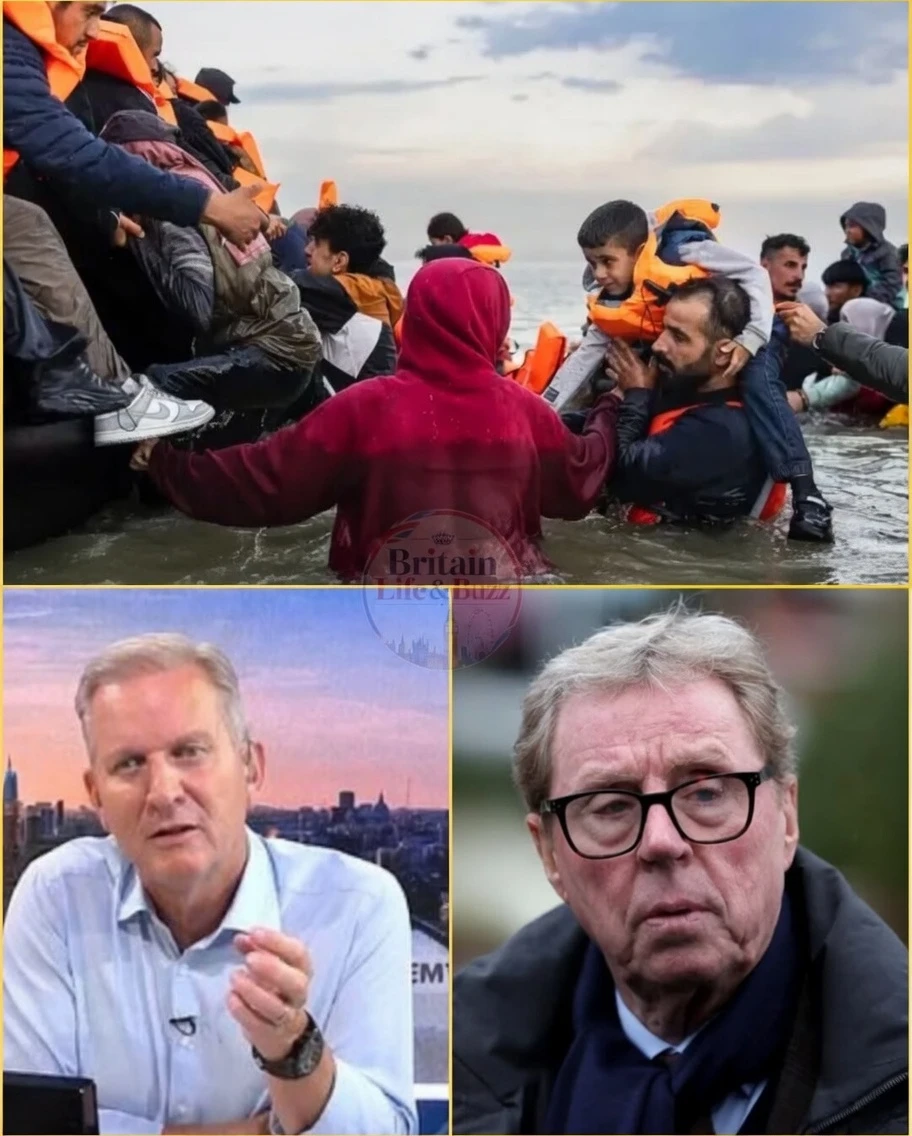
Harry Redknapp has spent much of his public life discussing football rather than immigration, border enforcement or national identity. Yet the former Tottenham Hotspur, Portsmouth and West Ham manager has now found himself at the centre of one of Britain’s most emotionally charged political conversations after delivering a blunt assessment of the country’s migration situation. His intervention has divided viewers, generated intense discussion online and raised a familiar but difficult question: when a well-known public figure speaks in uncompromising language about immigration, is he expressing concerns that politicians have failed to confront, or is he simplifying an extraordinarily complex national challenge?
The controversy followed Redknapp’s appearance on TalkTV, where he reacted to reports and footage concerning migrants attempting to enter the Spanish territory of Ceuta in North Africa. During the discussion, he claimed that Britain had become “overrun” by illegal migrants and spoke critically about changes he believed he had witnessed in Bournemouth, the coastal town with which he has long been associated. His description was immediately powerful, partly because Redknapp is not normally regarded as a professional political campaigner. He is better known as an outspoken football personality whose language is informal, emotional and direct.
That directness explains why the remarks gained attention so quickly. Supporters argued that Redknapp was articulating anxieties felt by people who believe that irregular migration has become poorly controlled and that public authorities are reluctant to acknowledge the scale of the problem. To them, his comments were not carefully rehearsed political messaging but the spontaneous frustration of someone describing what he genuinely believed he could see around him. They praised him for speaking without the cautious language normally used by ministers, civil servants and media commentators.
Critics, however, focused on the language he chose. The word “overrun” is not a neutral administrative term. It creates an image of invasion, loss of control and overwhelming numbers. Opponents argued that such rhetoric risks treating migrants as a single threatening group rather than distinguishing between asylum seekers, refugees, legal workers, international students, families, victims of trafficking and people entering the country without permission. They also questioned how anyone could determine a person’s legal status simply by seeing them in a town centre, hotel or public space.
Redknapp’s defenders insist that concentrating too heavily on terminology can become a way of avoiding the underlying question. They argue that communities experience migration not as a collection of legal definitions but through visible changes in housing demand, school enrolment, access to health services, hotel accommodation, employment patterns and neighbourhood demographics. From this perspective, it is possible to reject hostility towards migrants while still believing that governments have allowed arrivals to exceed the capacity of local services and infrastructure.
Housing is particularly central to that argument. Britain already faces a serious shortage of affordable homes in many regions, and local councils frequently struggle to provide temporary accommodation for residents experiencing homelessness. In that environment, reports of asylum seekers being housed in hotels can produce resentment, especially when taxpayers are told that the system is expensive, slow and difficult to manage. Critics of government policy say the resulting anger is predictable because ministers have failed both to process claims efficiently and to explain clearly how accommodation decisions are made.
Those defending migrants respond that newcomers are often blamed for structural problems that existed long before their arrival. Britain’s housing shortage cannot be explained solely through immigration. Planning restrictions, inadequate construction, high land prices, reduced social housing stock and decades of inconsistent government policy have all contributed to the crisis. From this viewpoint, blaming migrants may provide a politically convenient target while allowing decision-makers to escape responsibility for deeper failures.
Redknapp’s intervention also demonstrates how migration has moved beyond party politics and entered popular culture. Football personalities, television presenters, business leaders and celebrities increasingly comment on questions that were once left primarily to elected officials. Their audiences may trust them precisely because they are not politicians. A retired football manager speaking in ordinary language can sometimes connect with millions of people more effectively than a minister presenting a detailed policy statement.
However, celebrity involvement creates its own risks. Famous individuals possess enormous platforms but may not have access to complete statistics, legal expertise or operational knowledge about border enforcement. A phrase delivered during a television conversation can travel across social media without the surrounding context. It may be transformed into headlines, political graphics and short video clips designed to provoke the strongest possible reaction. Within hours, a complicated discussion about migration can become a symbolic battle between those who believe Britain is being silenced and those who believe vulnerable people are being demonised.
The reaction to Redknapp also reflects a wider decline in public trust. Many voters no longer believe official promises that migration will be controlled, asylum applications processed quickly or small-boat crossings significantly reduced. Repeated government announcements have created expectations that have not always been matched by visible results. This gap between political rhetoric and public experience has allowed frustration to grow across different sections of the electorate.
For years, successive British governments have attempted to appear both firm and humane. They have promised secure borders while recognising obligations to protect people fleeing persecution. They have promoted skilled migration to support economic growth while promising to reduce overall numbers. They have condemned people-smuggling gangs while struggling to create a system capable of making rapid, enforceable decisions. The result has often been a policy framework that satisfies neither side.
Those demanding tougher action argue that a state unable to control entry into its territory will eventually lose public consent for immigration altogether. They support faster removals for people whose claims are rejected, stronger enforcement against illegal employment, tougher penalties for smugglers and new agreements with countries of origin. Some also want Britain to reconsider legal constraints that can delay deportations.
Opponents of that approach warn that speed must not replace fairness. Asylum decisions can involve people who have escaped war, political persecution, religious violence, forced marriage, torture or trafficking. Returning someone to danger after an inadequate investigation could have irreversible consequences. They argue that Britain must improve efficiency without abandoning due process, human rights or its international responsibilities.
The language used in the debate is therefore almost as important as the policy itself. Describing the system as broken may be a criticism of government. Describing a country as “overrun” can be understood as a description of lost control, but it can also be heard as a judgment about the people who have arrived. That ambiguity helps explain why Redknapp’s comments produced such sharply different reactions. His supporters heard honesty. His critics heard dehumanisation.
There is also a generational and regional dimension. Attitudes towards migration vary depending on where people live, what changes they have experienced and whether they believe they have benefited economically. Residents of prosperous, diverse cities may regard migration as a normal part of modern British life. People in coastal towns or deprived communities may feel that population change has occurred without sufficient investment in public services. Neither experience represents the whole country, but both influence the national debate.
Bournemouth itself has become symbolically important in coverage of Redknapp’s remarks because he presented it as an example of visible social change. Yet any assessment of a town must be handled carefully. A person’s emotional impression of a neighbourhood may be sincere without providing reliable evidence about immigration status, crime, employment or long-term demographic trends. The challenge for journalists and politicians is to take local concerns seriously while testing claims against verifiable information.
The argument is not simply between people who favour immigration and people who oppose it. Many Britons appear to occupy a more complicated position. They may support refugees, appreciate migrant workers and value a multicultural society while also demanding stronger border enforcement and lower overall numbers. They may object to inflammatory rhetoric while remaining deeply dissatisfied with government policy. Treating the public as divided into only two hostile camps risks misunderstanding the concerns of the political centre.
Redknapp’s remarks have therefore become bigger than Redknapp himself. They have opened a debate about who is permitted to discuss immigration, what language is acceptable and whether elite caution has created space for increasingly dramatic interventions. When mainstream institutions fail to communicate honestly, public frustration does not disappear. It often finds expression through celebrities, viral videos, protest movements and political outsiders.
The most constructive response would not be to declare Redknapp entirely courageous or entirely irresponsible. It would be to examine the conditions that gave his words such impact. Why do so many people believe Britain has lost control of its borders? Why do migrants and minority communities fear that they are being held responsible for every failure in housing, healthcare and public safety? Why has the government struggled to build a system that is both credible and compassionate?
Britain ultimately needs a migration policy that separates humanitarian protection from economic migration, accelerates decisions, removes individuals who have no lawful basis to remain and creates safe, controlled routes where appropriate. It also needs investment in housing, local government, healthcare and integration so that population change does not leave communities competing for scarce resources. Border control without administrative competence will fail. Compassion without enforceable rules will also lose public confidence.
Harry Redknapp may not possess the technical answers to those challenges, and he has not claimed to be an immigration expert. Nevertheless, the reaction to his comments reveals how powerful the issue has become. For some, he said what millions have been afraid to say. For others, he used language that risks deepening suspicion and division. Between those positions lies the real task facing Britain: building a system in which borders are controlled, lawful migrants are respected, refugees are protected and legitimate public concerns can be discussed without turning human beings into political weapons.
The controversy is unlikely to end with one television appearance. Migration remains connected to national identity, economic security, public services, international law and trust in government. Redknapp’s comments have merely brought those tensions back into the spotlight. The question now is whether Britain’s leaders can transform public anger into workable policy—or whether another explosive media debate will pass without resolving the failures that caused it.
Harry Redknapp Sparks National Debate After Sharing His Views on Britain’s Migration Challenges
Harry Redknapp has become the subject of renewed public discussion after his views on Britain’s migration challenges prompted wider questions about border control, national identity and the pressures facing communities across the country. The former football manager is widely recognised for his decades in professional football, but when well-known figures speak about politically sensitive issues, their comments can reach audiences far beyond the usual political debate.
Immigration remains one of the most divisive issues in British public life. It touches on the economy, housing, healthcare, public spending, cultural identity and the government’s ability to enforce its own rules. As a result, comments from prominent personalities can quickly become part of a much larger argument about the direction in which the country is heading.
However, the discussion surrounding Redknapp also highlights an important distinction: public interest in a personality’s views is not the same as evidence that every claim circulating about those views is accurate. Without a verified transcript or full account of his remarks, it would be wrong to attribute specific statements or policy demands to him. The wider issues raised by the debate can nevertheless be examined in detail.
Why Immigration Remains a Major National Issue
Immigration has remained near the centre of Britain’s political conversation for years, with successive governments promising to improve border control and manage migration more effectively.
For some people, the central concern is the scale of migration and whether public services can keep pace with population growth. Housing shortages, pressure on local healthcare services and competition for certain jobs can create frustration, particularly in communities where residents feel that investment has not kept up with demand.
Others focus on the difference between legal migration and irregular entry. They argue that the government should maintain clear visa requirements, make asylum decisions promptly and return people who have no legal right to remain when removal is lawful and practical.
These concerns have helped make immigration a defining issue for political parties seeking to convince voters that they can deliver effective government.
Yet the debate is not simply about whether immigration should increase or decrease. It is also about which forms of migration Britain needs, how the rules should be enforced and how the country should balance economic requirements with its legal responsibilities.
The Difference Between Legal Migration and Small Boat Crossings
Public discussions often combine several distinct issues under the single heading of immigration. This can make it difficult to understand which policies would address a particular concern.
Legal migration includes people arriving through approved work, study and family routes. Their eligibility depends on the relevant immigration rules, which can include salary thresholds, sponsorship requirements, financial conditions and other criteria.
Small boat crossings across the English Channel raise a different set of questions. These journeys are frequently organised by smuggling networks and can expose passengers to serious danger. People who arrive irregularly may seek asylum, and their claims must be considered according to the applicable law.
Not everyone who arrives by small boat will have the same circumstances or the same legal outcome. Some claims may succeed, while others may be refused. The challenge for the government is to make decisions efficiently, prevent exploitation by criminal networks and ensure that people who have no lawful basis to remain can be returned where legally possible.
Reducing legal work visas, therefore, is not automatically a solution to irregular crossings. Equally, stronger action against smugglers does not by itself settle questions about how many international workers or students Britain should admit.
A serious national conversation needs to distinguish between these different systems rather than treating them as one problem with one solution.
The Pressure on Housing and Public Services
Housing has become one of the most visible points of tension in the immigration debate. In many parts of Britain, people face high rents, limited availability and long waits for suitable accommodation. Population growth can increase demand, although the relationship between migration and housing affordability also depends on construction rates, planning decisions, household formation, investment and the distribution of homes.
Supporters of lower immigration argue that reducing the pace of population growth could give local authorities more time to expand housing and public infrastructure. They also argue that governments should be required to demonstrate that population changes are being matched by adequate investment.
Critics respond that restricting migration cannot substitute for building more homes, improving transport links or addressing long-standing shortages in public services. They also point out that migrants work in construction, healthcare and other sectors that help deliver the infrastructure and services the country needs.
Both arguments raise questions that require evidence at local and national levels. The effect of migration is not identical in every area, and national figures do not necessarily explain the pressures experienced by a particular town or neighbourhood.
If politicians want to restore public confidence, they must explain how housing and services will be funded, where additional capacity will be created and how local communities will benefit.
The Economic Argument: What Does Britain Need?
Immigration also plays a role in Britain’s labour market. Employers in several sectors recruit internationally because they cannot always find enough suitably qualified workers within the domestic workforce.
Healthcare is a prominent example. Training doctors, nurses and other professionals takes time, while retaining existing staff depends on working conditions, pay, career development and the availability of suitable facilities. Similar challenges arise in social care, engineering, agriculture and other industries.
Those who advocate lower migration argue that employers should have stronger incentives to train British workers and improve employment conditions rather than relying on overseas recruitment. They believe that a more selective system could encourage investment in domestic skills.
Those who oppose sweeping restrictions warn that cutting recruitment too quickly could leave essential vacancies unfilled, raise costs for businesses and disrupt services. They argue that domestic training and retention policies must be developed before employers lose access to workers they currently depend on.
The practical question is not simply whether immigration brings benefits or costs. It is how the balance changes across different occupations, regions and visa categories, and whether government policy can address disadvantages while retaining necessary skills.
A credible migration strategy must therefore be connected to education, workforce planning and economic policy.
Why Celebrity Opinions Can Influence the Debate
Public figures often attract attention because audiences already recognise them from sport, entertainment or other areas of public life. Their comments can introduce political questions to people who do not regularly follow parliamentary debates or policy announcements.
Redknapp’s long career in football has made him a familiar figure to many British households. That familiarity can help explain why discussion of his views may attract interest, particularly when the subject involves an issue as emotionally charged as immigration.
However, popularity in one field does not automatically establish expertise in another. A public figure can raise questions worth discussing, but claims about migration figures, public spending, crime, employment or asylum policy should still be evaluated against reliable evidence.
The same standard should apply regardless of whether a comment comes from a celebrity, a politician, an academic or a campaign group. Public attention can begin a discussion, but it cannot replace the work required to establish whether a claim is accurate.
This distinction is particularly important online, where short clips, headlines and second-hand descriptions can remove comments from their original context. A measured discussion should begin with what was actually said and then examine the evidence behind the arguments.
The Political Consequences
Immigration has created challenges for both Labour and the Conservatives, while Reform UK has sought to build support around demands for tighter borders and lower migration.
For Labour, the challenge is to demonstrate that its policies can reduce pressure on the immigration system where intended, improve the handling of asylum claims and meet the country’s economic needs. Voters who want stricter controls may judge the government by results rather than by announcements alone.
The Conservatives face questions about their own record in government, including whether their previous policies delivered the reductions and enforcement improvements they promised. Their ability to regain public confidence depends partly on explaining what they would do differently.
Reform UK has made immigration a central part of its political message, presenting tougher controls as a response to public frustration. Its proposals also face scrutiny over implementation, legal constraints, economic consequences and the resources required to carry them out.
Other parties approach the issue differently, placing varying emphasis on economic migration, humanitarian protection, integration and the rights of individuals and families.
These differences demonstrate why immigration is unlikely to disappear from British politics soon. The debate concerns not only numbers but also trust, fairness and the government’s ability to explain its decisions.
Finding a Practical Way Forward
Britain’s migration debate is unlikely to be resolved by slogans alone. A workable strategy would need clear rules, reliable data, timely decisions and effective enforcement.
It would also require a realistic assessment of labour-market needs. If the government wants employers to rely less on international recruitment, it must consider how training places will expand, how vacancies will be filled and how working conditions can improve. If certain visa routes remain necessary, ministers should explain why and establish transparent criteria for their use.
The asylum system needs similar clarity. Decisions should be made without unnecessary delays, people who qualify for protection should receive it, and unsuccessful applicants should be dealt with according to the law. Cooperation with other countries and action against smuggling networks are also important elements of managing irregular migration.
Finally, local communities need clear information about the pressures they face and the resources available to respond. National policy should recognise that the effects of migration vary by location and that housing, healthcare and infrastructure cannot be separated from wider economic planning.
A Debate That Extends Beyond One Public Figure
The discussion surrounding Harry Redknapp reflects the extent to which immigration has become a subject of national concern. When a familiar public figure is associated with the issue, the conversation can quickly extend beyond the original comments and into broader questions about Britain’s future.
But the most useful debate is one that distinguishes verified statements from speculation and practical policy from political rhetoric. It should recognise legitimate concerns about border control and public-service capacity while avoiding unsupported generalisations about migrants as a group.
Britain must decide what kind of immigration system it wants, which skills and family routes it will retain, how it will fulfil its legal obligations and how it will maintain public confidence in the rules.
Those decisions require evidence, accountability and a willingness to acknowledge difficult trade-offs. Whether the latest discussion remains in the headlines for days or develops into a wider political argument, the underlying questions will continue to demand serious answers.
Ultimately, the measure of any migration policy will not be how forcefully it is presented in public, but whether it can be implemented fairly, achieve its stated objectives and serve the country’s long-term interests.