
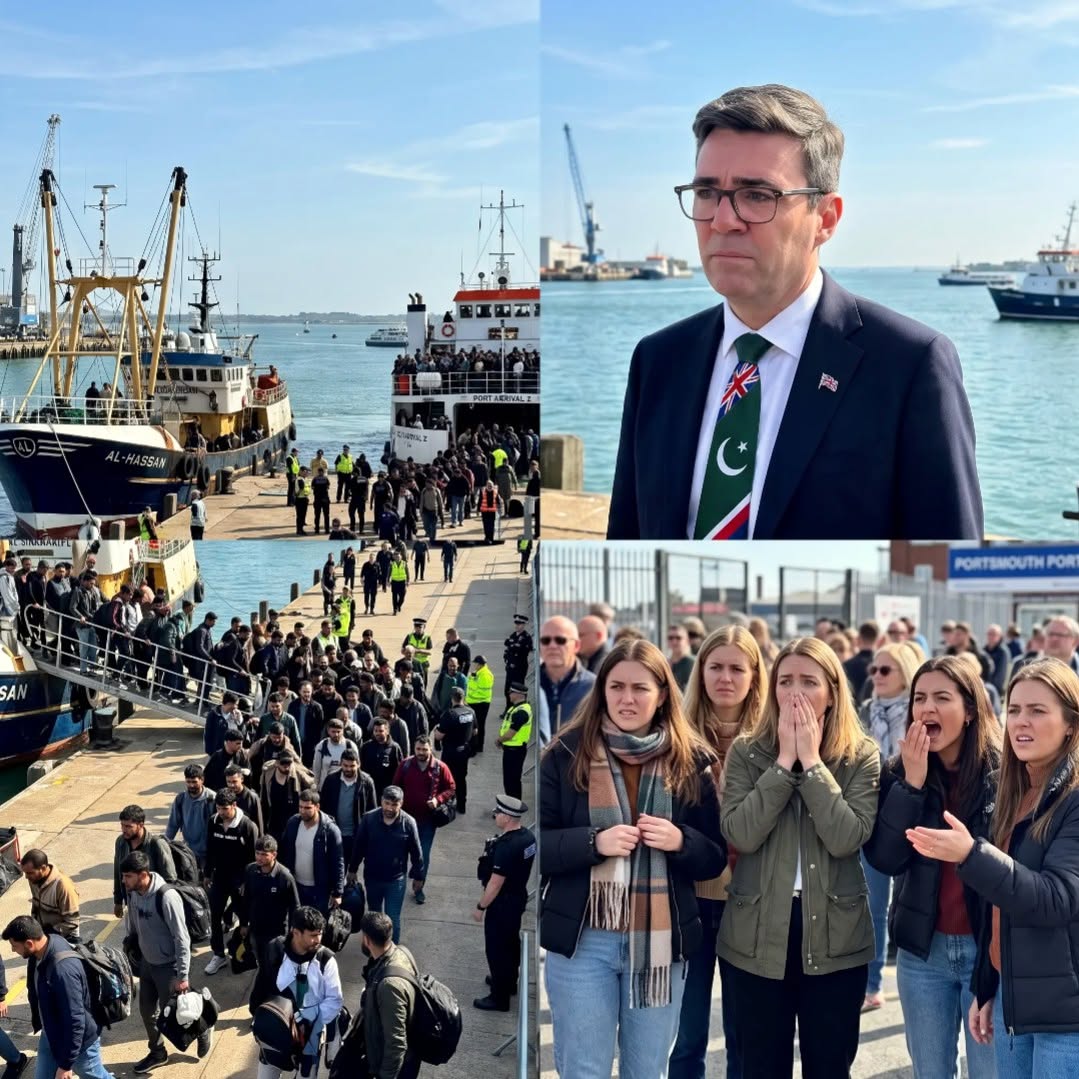
‘Enough Is Enough’: Calls for Ten-Year Immigration Pause Ignite New Battle Over Britain’s Borders
A blistering attack on Britain’s immigration system is fuelling a fresh political argument over border control, asylum accommodation and whether the country should consider the radical step of dramatically restricting immigration for as long as a decade.
The message, circulating in uncompromising language online, portrays Britain’s immigration system not merely as being “under pressure” but as fundamentally broken. It accuses the Labour government of losing control of both the border and the financial cost of accommodating asylum seekers, while dismissing legitimate public concerns as extremist.
At the centre of the argument is a striking demand: a ten-year immigration pause.
Such a proposal would represent an extraordinary change in British policy. But exactly what a “pause” would mean is unclear. Would it apply to workers, international students, family visas and refugees? Would doctors and nurses be excluded? What about highly skilled employees recruited by British companies?
Those unanswered questions demonstrate the difference between a powerful political slogan and a workable immigration system.
Yet the anger behind the proposal reflects concerns that governments cannot simply ignore.
The Asylum Accommodation Problem
One of the strongest sources of public frustration has been the use of hotels to accommodate asylum seekers.
When the asylum system cannot process claims quickly enough and dedicated accommodation is insufficient, governments have relied on hotels and other temporary facilities.
For critics, the arrangement represents almost everything they believe is wrong with immigration policy.
It is expensive.
It can place large numbers of asylum seekers in communities with little warning.
Local councils and residents may feel they have limited influence over decisions.
Hotels that would otherwise accommodate tourists or business visitors can be removed from normal commercial use.
The political impact can therefore be significant even in communities where there is little evidence of serious disorder involving residents of the accommodation.
That distinction matters.
People can legitimately object to the cost, scale or location of asylum accommodation without assuming that every person living there represents a threat.
Are Migrants Receiving ‘Private Lets and the Full Works’?
Claims about generous taxpayer-funded support require similar context.
People receiving asylum support can be housed in different forms of accommodation while their claims are considered.
But asylum accommodation should not be confused with an unrestricted package of benefits unavailable to British citizens.
Different immigration categories also have different rights.
An asylum seeker awaiting a decision is legally different from a recognized refugee.
A person who entered the country without authorization is different again from someone whose visa has expired, while a foreign national legally working in Britain falls into another category entirely.
Using “migrants” to describe all of them can obscure rather than clarify the debate.
The underlying financial question remains legitimate: how much should taxpayers be expected to spend because immigration and asylum cases have not been resolved quickly enough?
That is a question ministers need to answer with transparent figures.
‘If You Break In, You Don’t Jump the Queue’
The idea that irregular arrival allows someone to “jump the queue” has become one of the most powerful arguments in the border debate.
It appeals to a straightforward sense of fairness.
People applying for visas from overseas can spend substantial amounts of money, provide documentation and wait for permission before entering Britain.
Seeing someone arrive by small boat can therefore appear fundamentally unfair.
But asylum law complicates the comparison.
An asylum claim is not simply another application for an ordinary immigration visa.
People seeking protection may have their claims examined after reaching the UK. Some ultimately receive protection; others are rejected and may become liable for removal.
That does not settle the political argument over whether Britain should accept asylum applications from people arriving irregularly.
It simply means that “illegal arrival” and “no legitimate asylum claim” are not automatically the same thing.
A functioning system has to determine which cases are genuine—and do so quickly.
Labour Faces the ‘Loss of Control’ Charge
The political danger for Prime Minister Andy Burnham and Home Secretary Shabana Mahmood is that immigration is judged primarily through visible outcomes.
Ministers can announce enforcement operations, agreements with France, action against smugglers and increased returns.
But voters are more likely to ask simpler questions.
Are small boats still arriving?
Are asylum hotels still operating?
How long do cases take?
Are people with rejected claims actually leaving?
How much is the system costing?
If the public does not see improvement in those areas, government claims of progress can struggle to gain traction.
That does not necessarily prove that ministers have “lost control.”
It does mean they face a credibility problem if official improvements fail to translate into changes voters can see.
What About the ‘Far Right’ Label?
Another element of the criticism concerns political language.
Some people who object to immigration policy believe their concerns are too quickly characterized as extremist or “far right.”
There is an important distinction here.
Opposition to high immigration is not, by itself, evidence of extremism.
Neither is demanding tighter borders, faster deportation of people without permission to remain or lower legal migration.
Those are legitimate positions in democratic politics.
At the same time, genuine far-right organizations and individuals do participate in immigration protests, and authorities have a responsibility to distinguish peaceful political activism from intimidation, racism and violence.
The danger comes when either side collapses those categories.
Calling every immigration critic an extremist can silence legitimate debate.
Pretending extremism never exists within anti-immigration movements can be equally misleading.
Are People Being Policed for Their Opinions?
The claim that police have time to pursue “mums on Facebook” while failing to control Britain’s borders combines two separate issues: immigration enforcement and freedom of expression.
British law protects robust political speech.
People can criticize immigration, the government, religion, asylum policy and individual politicians.
But freedom of expression is not unlimited. Threats, harassment and certain other unlawful communications can potentially lead to police action depending on their content and circumstances.
Whether police strike the correct balance is a legitimate subject for public scrutiny.
But an arrest or investigation relating to online communications should not automatically be characterized as punishment merely for holding an unpopular opinion.
Individual cases need to be examined on their facts.
Could Britain Actually Stop Immigration for Ten Years?
This is where the proposal becomes much more complicated.
A literal ten-year halt to immigration would affect far more than small boats.
British employers recruit workers internationally.
The NHS and social-care sector employ substantial numbers of overseas-born staff.
Universities depend heavily on international students.
British citizens marry foreign nationals.
Companies transfer specialists between countries.
Refugee protection creates separate legal obligations.
A genuine blanket moratorium would therefore have enormous consequences.
Supporters might respond that this is precisely the point: Britain needs a dramatic intervention to reduce population pressures on housing, infrastructure and public services.
Opponents would warn of labour shortages, university funding problems, slower economic growth and difficulties recruiting essential workers.
A more targeted version could instead sharply reduce selected visa categories while retaining exceptions for strategically important skills and humanitarian obligations.
But that would no longer be a complete immigration pause.
Legal and Irregular Migration Must Be Separated
Perhaps the greatest weakness in Britain’s immigration debate is the tendency to treat every form of migration as the same problem.
Reducing Channel crossings requires border enforcement, cooperation with European countries, action against smugglers and credible return arrangements.
Reducing work migration requires changing visa rules.
Reducing international student numbers requires education policy.
Reducing asylum costs requires faster decisions and less expensive accommodation.
These policies overlap, but they are not interchangeable.
Closing a worker visa route will not automatically stop a dinghy leaving France.
Stopping a dinghy will not reduce the number of international students.
Closing an asylum hotel does not necessarily mean its former residents have been removed from Britain.
Anger Is Real, but Policy Requires More Than Anger
The language surrounding the latest intervention is deliberately confrontational.
That may resonate with voters who believe Westminster has ignored them for too long.
But governing requires turning frustration into specific choices.
How low should migration fall?
Which categories should remain open?
How quickly should asylum claims be decided?
Where should asylum seekers live while decisions are made?
What should happen after a rejected claim?
How should Britain meet labour shortages if overseas recruitment is sharply reduced?
And how much economic disruption would voters accept in exchange for lower immigration?
Those are harder questions than declaring the system “finished.”
But they are the questions any government—or opposition party proposing a radical alternative—eventually has to answer.
Britain’s immigration debate has reached a point where dismissing public concern is unlikely to work. Neither will pretending every migrant, asylum seeker and irregular arrival represents the same problem.
The demand for a ten-year pause captures the intensity of public frustration.
Whether it could become serious policy is another matter entirely.
The ultimate test for Burnham’s government will not be whether it can win the argument on social media. It will be whether voters eventually see a system in which legal migration is controlled, asylum decisions are made quickly, people without a right to remain are returned where legally possible, and communities believe their concerns are being heard.
Until then, the accusation that Britain has lost control of immigration will remain one of the most potent—and contested—arguments in British politics.
“STOP GASLIGHTING THE PUBLIC!” — Furious Migrant Row Erupts Live on GB News
A heated debate over Britain’s migrant crisis erupted on GB News after Labour MP Barry Gardiner clashed with political commentator Matt Goodwin over Channel crossings, government immigration policy and the future of asylum arrangements.
The confrontation, broadcast on Michelle Dewberry’s programme on 6 October 2026, came after protests in Gosport, Hampshire, following the arrival of a boat carrying up to 149 migrants over the weekend. The argument quickly moved beyond the immediate incident, exposing a wider disagreement over whether the government’s approach to migration is delivering meaningful results.
Goodwin accused Labour of “gaslighting the public”, arguing that ministers were focusing on falling small-boat arrival figures while preparing to expand additional legal routes for refugees. Gardiner rejected the accusation and challenged Goodwin’s claims about how the immigration system could be changed.
The exchange highlighted a central problem for the government: how to demonstrate that it has control over migration while explaining the different routes through which people can enter Britain and claim protection.
Gosport protests bring migration back into the spotlight
The argument followed unrest in Gosport after a boat carrying migrants arrived in the area on 4 October.
According to contemporary reporting, police confirmed that six people had been arrested during disturbances associated with protests. The arrival prompted renewed discussion about how authorities manage people rescued or intercepted while crossing the English Channel.
Gardiner said the migrants were not being housed in Gosport and were instead being taken to Kent for security and biometric checks. He argued that the authorities were seeking to process those involved while minimising disruption to local residents.
His explanation was intended to distinguish the arrival itself from the question of where the individuals would ultimately be accommodated.
However, the incident became a focal point for people who believe that the government’s approach to irregular migration remains inadequate. For some residents and campaigners, the repeated arrival of small boats represents a failure to prevent unauthorised entry, regardless of what happens after people reach British territory.
Others stress that people rescued at sea must be handled safely and that asylum claims need to be processed according to the law.
The resulting debate reflects the difficulty of separating immediate operational questions from wider arguments about border security, asylum policy and public confidence.
Goodwin accuses Labour of misleading the public
During the GB News discussion, Goodwin challenged Gardiner’s emphasis on declining small-boat arrivals.
Gardiner argued that government measures had reduced crossings from just over 34,000 to fewer than 19,500, presenting the figures as evidence that the government’s approach was producing results.
Goodwin responded that the figures related specifically to small-boat crossings and did not tell the whole story about migration policy. He also pointed to the government’s plans for new capped, safe and legal refugee routes.
“Can we get back to reality for a minute?” Goodwin demanded during the exchange, before accusing the Labour MP of misleading viewers.
His argument was that the public should assess migration policy by considering both irregular arrivals and the number of people who might enter through additional authorised routes.
That is a legitimate distinction to examine when evaluating the overall effects of policy. A decline in small-boat arrivals does not, by itself, establish that total immigration has fallen by the same amount. Equally, the existence of a legal resettlement route does not mean that everyone entering through it would otherwise have attempted an irregular crossing.
The different categories need to be measured separately before drawing conclusions about the overall direction of migration.
Labour defends the distinction between legal and irregular routes
Gardiner pushed back against Goodwin’s criticism, defending the government’s approach and arguing that leaving the European Convention on Human Rights would not automatically solve the practical difficulties involved in returning people who have no right to remain.
The argument touches on one of the most contentious questions in British immigration policy: whether the main obstacles to removals are domestic legislation, international legal obligations, diplomatic arrangements with other countries or the practical limitations of the asylum system.
Critics of the current approach argue that legal appeals and human-rights protections can make removals too slow and difficult. Some politicians have therefore called for Britain to leave the European Convention on Human Rights or change the way its obligations are applied.
Gardiner countered that leaving the convention would not give Britain unlimited powers. Other countries would still need to cooperate with the UK, and practical arrangements would still be necessary to identify individuals and secure their return.
He also argued that Britain’s departure from the European Union had removed arrangements that previously helped facilitate the return of certain asylum seekers to other European countries.
That point is part of a wider debate about the consequences of Brexit for immigration enforcement. The precise legal mechanisms and agreements involved matter, because leaving one legal framework does not automatically recreate the cooperation that existed under another.
The exchange illustrated how the immigration debate often combines legal principles with operational questions that cannot be resolved by a single policy announcement.
New refugee routes intensify the controversy
Goodwin’s criticism also focused on proposals associated with Home Secretary Shabana Mahmood to establish capped, safe and legal routes for refugees.
Under the proposed approach discussed in the programme, communities and selected universities would be able to sponsor eligible refugees to come to Britain. A separate employer-sponsored route was also expected to be developed.
Supporters of such arrangements argue that controlled routes can provide protection to vulnerable people without requiring them to make dangerous journeys or rely on people-smuggling networks.
A capped system could also allow the government to set limits, establish eligibility requirements and plan support in advance.
Critics, however, question whether additional routes could increase pressure on housing and public services, particularly in areas already experiencing shortages. They also argue that the government must explain how these programmes fit with its commitments to reduce irregular migration.
The central issue is whether safe and legal routes complement effective border enforcement or create additional pressures that the government has not adequately addressed.
The answer depends on the design of the scheme, the number of places available, the eligibility rules, the funding arrangements and the government’s ability to enforce existing immigration law.
A proposal to establish a legal route should therefore be assessed on its own terms rather than treated as proof that irregular migration is either increasing or decreasing.
Why the statistics matter
Numbers played a central role in the GB News confrontation, but the figures require careful interpretation.
Gardiner referred to a reduction in small-boat arrivals from more than 34,000 to fewer than 19,500. The significance of that comparison depends on the dates covered and whether the figures represent annual totals, year-to-date numbers or another reporting period.
Comparisons also need to account for changes in weather, enforcement activity, smuggling networks and patterns of migration across Europe.
Small-boat arrivals are only one part of the UK’s migration picture. Legal work and study visas, family migration, asylum claims and refugee resettlement all follow different routes and are measured using different statistics.
A decline in one category cannot automatically establish a decline in all categories. Similarly, an increase in the number of people arriving through one route does not necessarily mean that other routes have increased.
For the public to evaluate the government’s performance, ministers need to provide clear, comparable data and explain what the numbers do and do not demonstrate.
Political commentators also have a responsibility to distinguish established figures from estimates and arguments about what those figures mean.
The political consequences for Labour
The confrontation presents Labour with a difficult communications challenge.
The government wants to demonstrate that it is reducing irregular crossings and improving control over the asylum system. At the same time, it must explain why it believes certain legal routes should remain available or be expanded.
If ministers emphasise lower small-boat numbers without adequately explaining the wider migration picture, critics can argue that the government is presenting an incomplete account.
But if political opponents treat every refugee resettlement place as equivalent to an irregular Channel crossing, they risk obscuring important differences between legal categories.
Labour’s task is to show how its policies fit together: preventing dangerous journeys, disrupting smuggling networks, processing asylum claims efficiently, returning people who have no right to remain where legally possible, and protecting those who qualify for refugee status.
Those objectives can involve difficult trade-offs. They also require cooperation with foreign governments, reliable administration and sufficient resources.
The GB News argument demonstrated that public confidence depends not only on the policies themselves but also on whether people believe ministers are explaining the situation honestly.
Reform UK and the demand for tougher enforcement
The row also reflects the wider political pressure exerted by Reform UK and other advocates of stricter immigration controls.
Reform has argued that Britain needs a more forceful approach to border security, faster removals and changes to the legal framework governing deportations.
Supporters say these proposals respond to public frustration over irregular arrivals and the costs associated with asylum accommodation. Critics question whether the proposed measures are practical, affordable and compatible with Britain’s legal obligations.
The debate is particularly intense in communities where residents believe that decisions about accommodation and local services have been made without sufficient consultation.
However, policy claims should be judged by their details. Announcing a target for removals is not the same as demonstrating that the necessary agreements, facilities and procedures are available to achieve it.
Likewise, defending the existing legal framework does not remove the need to address delays, administrative failures or unsuccessful asylum claims.
The public debate would benefit from a clearer distinction between political promises and measures that have demonstrably changed the operation of the system.
A debate that is far from over
The clash between Goodwin and Gardiner was more than a television argument. It reflected a fundamental disagreement about how Britain should balance border enforcement, legal obligations, refugee protection and public confidence.
Goodwin argued that the government was presenting an incomplete picture by concentrating on falling small-boat numbers while considering additional legal routes. Gardiner defended the distinction between different forms of migration and challenged the suggestion that leaving the European Convention on Human Rights would automatically solve the problem of removals.
Both sides raised questions that deserve scrutiny, but the strength of their claims depends on evidence rather than the intensity of the exchange.
The government must show whether its measures are reducing irregular crossings, speeding up decisions and improving returns. Opponents must explain how their alternatives would work in practice and what legal and operational consequences they would carry.
For residents, the most important outcome is whether the immigration system becomes more predictable, properly enforced and transparent.
As the argument continues, the challenge for Britain is to move beyond accusations and establish what the figures actually show, which policies are working and where further changes are necessary. Only then can the public make a properly informed judgment about the government’s record on migration.