

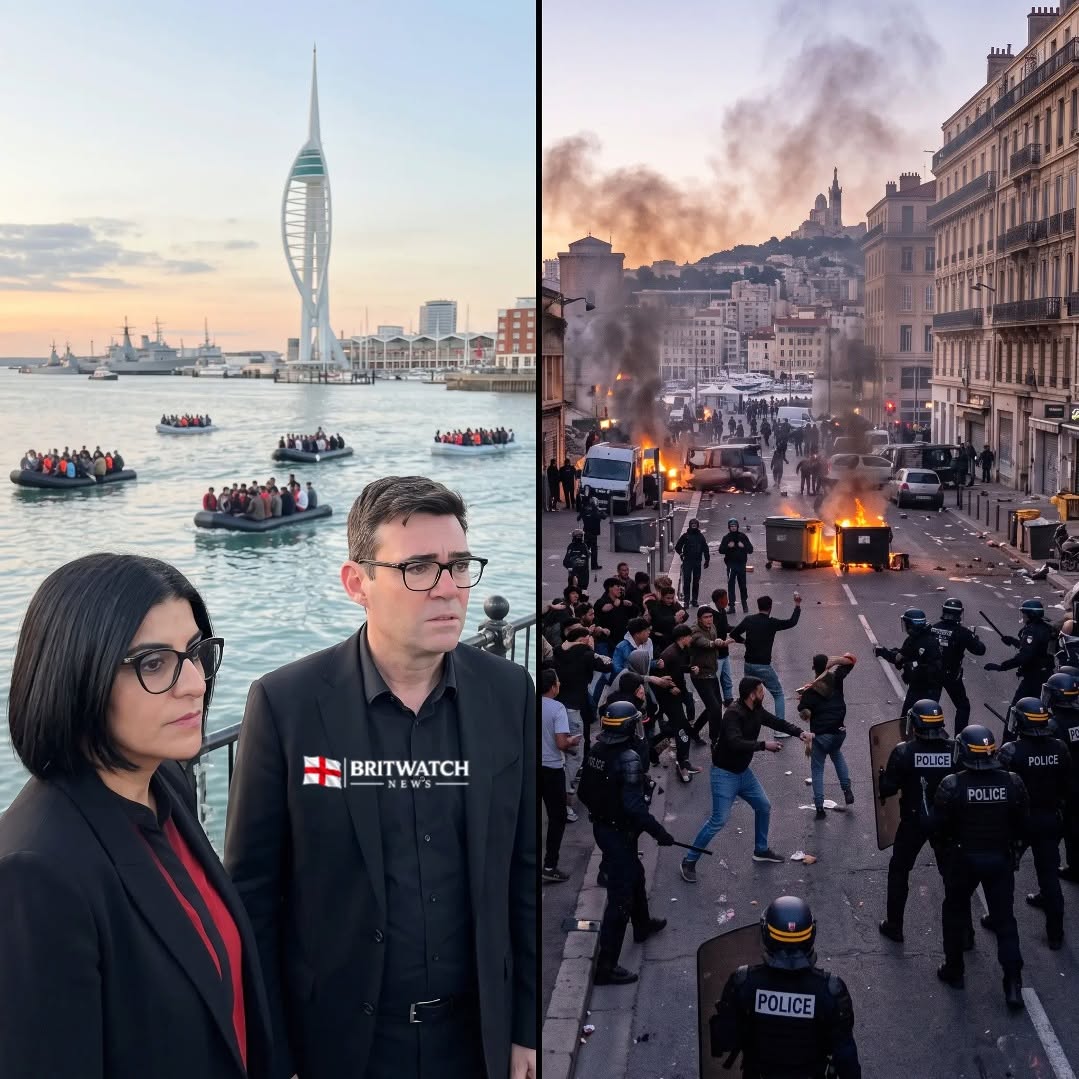
Scenes of burning barricades, clashes with police and disrupted schools across France have become the latest ammunition in Britain’s increasingly intense debate over immigration and integration.
Hundreds of arrests have been made as a student protest movement that began over deteriorating conditions in French schools spread across the country and, in some places, descended into serious disorder.
The unrest has coincided with a politically sensitive announcement in Britain: Labour is reopening the UK Resettlement Scheme and creating additional capped “safe and legal” routes for refugees.
For critics of the government, the timing raises an obvious question.
Is Britain risking importing the social tensions visible across the Channel?
For Labour, that comparison is fundamentally misleading. Ministers argue that controlled humanitarian resettlement, involving security checks and predetermined limits, is very different from unmanaged migration — and that safe routes can actually reduce incentives for people to use smugglers and dangerous Channel crossings.
The disagreement reflects a much larger argument about migration: admitting people is one question, but successfully integrating them is another.
What Is Actually Happening in France?
The scale of the French disorder is substantial.
On September 30, Interior Minister Laurent Nuñez said 356 high schools had been affected by blockades or disruption. Police detained 625 people that day, while 83 police officers and gendarmes were injured.
Education Minister Édouard Geffray said 119 students and education workers had been injured since the protests began, including 34 members of staff.
The protests began primarily over education.
Students have demanded the replacement of absent teachers, more resources, repairs to deteriorating school buildings, smaller classes and what they describe as decent learning conditions. They have also complained about pressure associated with France’s Parcoursup university-admissions system.
But some demonstrations have moved far beyond peaceful school protests.
Authorities have reported burning bins, fireworks and projectiles being used against police. Hydrochloric acid was reportedly used in at least some attacks on officers. A deliberate fire damaged the entrance hall of the Nelson Mandela lycée in Nantes.
By October 1, French ministers were openly describing parts of the movement as “urban violence.”
That is a serious escalation.
It does not, however, mean that every student involved in the demonstrations participated in violence. Reporting from French and international media has documented both peaceful demonstrators and much smaller groups engaged in serious disorder.
Is This Primarily a Migration Riot?
This is where some of the strongest claims circulating in British political commentary run ahead of the available evidence.
There is currently no reliable data showing that the French school unrest is principally being driven by second- or third-generation migrants.
The movement began among high-school students protesting education policy and has spread across schools in multiple French cities and regions.
Some of the most serious disorder has occurred in diverse suburbs, including areas with large immigrant-background populations. But that does not establish the ancestry or immigration status of everyone committing violence.
Nor does the presence of political or Palestinian flags at some demonstrations prove that the wider unrest is fundamentally an immigration revolt.
A serious analysis therefore needs to distinguish two questions.
France clearly has longstanding difficulties involving integration, inequality and tensions in some disadvantaged suburbs.
But proving that those factors caused the current national school protests requires more evidence than images of individual rioters.
The Controversy Around La France Insoumise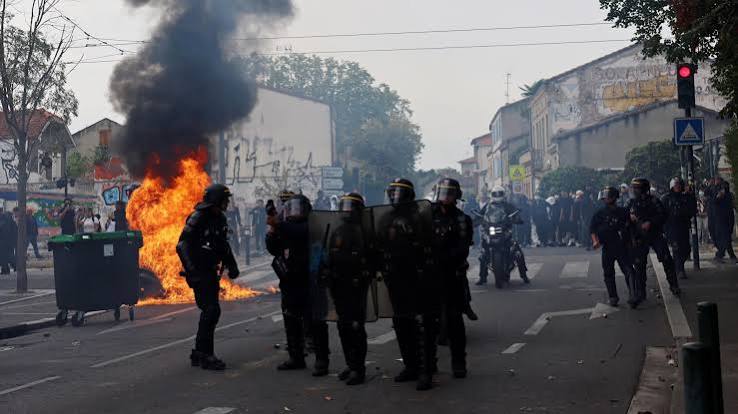
France’s hard-left La France Insoumise, or LFI, has strongly supported the protesting students and accused the government of excessive repression.
That has produced its own controversy.
Bally Bagayoko, the LFI mayor of Saint-Denis, came under scrutiny after videos showed him near a burning rubbish container during a school blockade.
Short clips circulated online suggesting that he had participated in setting the fire.
Longer footage examined by French fact-checkers instead indicated that Bagayoko had attempted to move the burning bin away and prevent further damage.
But a separate controversy around his rhetoric is real.
Bagayoko stated that violence could, under some circumstances, be “legitimate.” Paris police prefect Patrice Faure subsequently referred comments attributed to him to prosecutors for possible “provocation to commit an offence.” Bagayoko has defended his remarks while also saying violence was not his movement’s method of action.
That distinction matters.
The claim that the mayor personally helped ignite fires appears unsupported by fuller footage.
The criticism of his comments about potentially “legitimate” violence, however, is based on statements he actually made.
What Is Labour Proposing in Britain?
Against this backdrop, Home Secretary Shabana Mahmood used Labour’s 2026 party conference to announce new humanitarian routes into Britain.
The government is reopening the UK Resettlement Scheme and creating new community, student and eventually employment sponsorship pathways.
Mahmood repeatedly stressed that the routes would be “capped and controlled.”
The reopened UK Resettlement Scheme will operate with the UN Refugee Agency and other humanitarian organisations.
The Home Office says approximately one quarter of initial referrals are expected to consist of Afghan women and girls and Palestinian refugees.
That is narrower than claims that Britain is simply opening its borders to unlimited numbers from Afghanistan, Sudan, Eritrea and Palestine.
Existing British resettlement schemes have historically accepted refugees from a broad range of countries, including Sudan and Eritrea, but referrals are made according to vulnerability and programme eligibility rather than a general right for anyone from those countries to move to Britain.
Safe Routes Are Not the Same as Open Borders
A “safe and legal route” has a specific meaning in British immigration policy.
It is a government-authorised humanitarian pathway through which eligible people can travel legally rather than entering clandestinely.
Such routes are not the same as allowing people overseas to lodge ordinary asylum claims remotely.
Official Home Office guidance explicitly distinguishes humanitarian resettlement from the general asylum process.
Participants can be identified before travelling and may undergo eligibility and security checks.
Supporters therefore argue that such schemes provide considerably more control than irregular Channel crossings.
They also argue that the UK can choose both the number of people admitted and the categories prioritised.
Critics respond that even controlled migration creates housing, integration and public-service costs after people arrive.
That argument cannot be answered simply by calling the routes either compassionate or dangerous.
The outcomes depend heavily on numbers, selection, housing and long-term integration.
Britain Already Uses Humanitarian Routes on a Significant Scale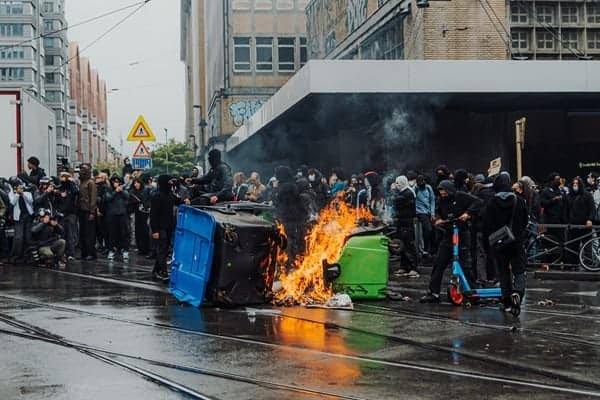
Safe and legal migration is not a completely new Labour policy.
Britain has operated humanitarian programmes for Ukrainians, Afghans, Hong Kong British Nationals Overseas and other refugees under successive governments.
Home Office statistics show that 124,930 grants of leave were made under safe and legal humanitarian routes in the year ending June 2026, although 69% of these were granted to people already in Britain extending their status rather than entirely new arrivals.
That context is important.
Labour is expanding and reopening elements of an existing system rather than inventing humanitarian migration from scratch.
The meaningful political question is therefore how large the future programmes become and whether integration policies keep pace.
France Does Offer Britain a Warning — But Perhaps a Broader One
Critics are right about one principle: immigration and integration are not synonymous.
Granting legal residence or citizenship does not automatically create social cohesion.
Countries accepting migrants need credible expectations surrounding language, employment, education, respect for law and participation in the wider society.
Governments also need to confront deprivation, segregation and poor public services that can reinforce alienation.
France provides ample evidence of the difficulties that can emerge when some communities feel disconnected from state institutions.
But it would be simplistic to describe every episode of French unrest as the inevitable result of immigration.
The current protests began over deteriorating education conditions, teacher shortages and overcrowding — issues affecting French-born pupils of many backgrounds.
The violence may reveal deeper social fractures.
It does not prove a single cause.
Integration Must Include Rules as Well as Support
There is nevertheless an important argument beneath the political rhetoric.
A sustainable migration system cannot concern itself only with getting people safely across a border.
It must also consider what happens afterwards.
That can include expectations to obey British law, opportunities and incentives to learn English, access to employment, civic education and clear consequences for serious offending.
Britain is entitled to require everyone living within its borders — whether born in Birmingham or arriving from abroad — to follow the same criminal law.
Where non-citizens commit serious crimes, immigration consequences can also arise under existing law depending on status and circumstances.
But calls to deport people merely because they hold unpopular religious or political beliefs raise separate legal questions.
Supporting conservative religious views, for example, is not itself equivalent to committing violence.
The Real Policy Test for Labour
Labour’s argument is that safe routes offer a controlled alternative to irregular migration.
Its critics argue that control at the border means little without successful integration afterwards.
Both points contain something important.
A capped system with pre-travel selection is clearly different from unmanaged small-boat arrivals.
But legal entry alone does not guarantee successful integration.
If Labour wants public support for expanded humanitarian routes, it will have to demonstrate more than compassion.
It will need to show that numbers remain genuinely capped, security screening is credible, local services can cope and newcomers are expected to participate in British society rather than live permanently apart from it.
France’s current unrest should therefore be taken seriously.
But the lesson is not as simple as “France accepted migrants, therefore migration caused the riots.”
A more defensible warning is this:
Migration policy does not end at the border.
Without effective integration, functioning schools, economic opportunity, equal enforcement of the law and a shared sense of civic responsibility, social tensions can deepen over generations.
Whether Labour’s new safe routes avoid those problems will depend not simply on whom Britain admits, but on what happens after they arrive.
France’s School Unrest Fuels a New British Debate Over Migration, Integration and Labour’s Safe Routes
France’s wave of school protests has become part of a wider political debate about social cohesion, immigration and the responsibilities of government. In Britain, the unrest is being watched through the lens of Labour’s approach to migration, the pressure on public services and the continuing dispute over how to create safe, legal routes for people seeking asylum.
The events in France do not offer a simple blueprint for Britain. The demonstrations began with concerns about education, including teacher shortages, overcrowded classrooms and deteriorating school facilities. Yet the spread of protests, confrontations with police and disruption to schools have encouraged politicians across Europe to ask deeper questions about inequality, integration and the relationship between young people and the state.
The central issue is whether governments can address legitimate grievances before frustration develops into wider disorder.
Protests Rooted in Education
France’s high-school protests expanded rapidly after beginning in the Paris suburb of Créteil in September 2026. By October 1, more than 1,000 high schools had reportedly been affected by strikes or demonstrations, with hundreds of blockades recorded. The unrest also brought serious incidents, including fires, clashes and damage to school buildings. French authorities reported injuries among students and education staff, while police made large numbers of arrests. Le Monde reported on the scale of the protests and the competing explanations for the movement.
However, the demonstrations cannot be understood solely through images of burning rubbish bins or confrontations with officers.
Students have described missing teachers, deteriorating buildings, crowded classrooms and uncertainty about their educational futures. Some have also criticised the pressures associated with applying for higher education. These complaints point towards a problem that extends beyond public order: whether schools have the resources to provide young people with a fair opportunity to succeed.
The violence has complicated the movement. Disruption can prevent other pupils from attending lessons and place teachers, school leaders and emergency workers at risk. At the same time, treating every participant as responsible for the actions of violent individuals risks overlooking the concerns that brought many students onto the streets.
French Prime Minister Sébastien Lecornu acknowledged young people’s anxieties in a televised address in October, while warning that the government could not simply meet every demand for additional spending. The challenge for the authorities is to restore normal school life without dismissing the underlying problems. Le Monde’s reporting on the government’s response describes the tension between calls for dialogue and constraints on public finances.
Why Britain Is Watching
In Britain, the French unrest has become relevant to arguments about integration and the pressures facing public institutions. Conservative politicians have warned that social tensions could intensify if the government fails to manage immigration and establish confidence in the rules governing settlement.
Kemi Badenoch, the Conservative leader, argued in October that Britain could face France-style civil unrest unless stronger action was taken on immigration. Her position reflects a broader Conservative argument that governments must demonstrate control over borders and ensure that immigration policy has public support.
Labour faces a different but related challenge. It must respond to concerns about irregular migration while maintaining its commitment to lawful procedures, international obligations and social cohesion. The government also faces pressure to show that schools, housing, healthcare and other public services can meet the needs of existing communities as well as newcomers.
These questions should not be confused with the causes of the French school protests. The demonstrations began over educational conditions, and the available reporting does not establish immigration as their primary cause. Connecting the unrest to migration is a political interpretation, not a complete explanation of what happened in French schools.
Nevertheless, the debate highlights a concern shared by many European countries: when public services appear unable to meet demand, confidence in political institutions can weaken. That loss of confidence can then become a subject of fierce competition between political parties.
Labour’s Safe Routes Under Pressure
One of the most difficult questions for the British government concerns the distinction between irregular entry and access to legal asylum procedures.
The phrase “safe routes” refers to lawful pathways through which eligible people may seek protection or enter a country under established schemes. Supporters argue that such routes can reduce reliance on dangerous journeys, weaken smugglers’ business models and give authorities greater oversight of arrivals.
Critics question whether legal pathways can work as intended if their availability is limited, if decisions take too long or if irregular arrivals believe that reaching British territory offers a better prospect of remaining in the country. The government therefore faces pressure to demonstrate both that legal routes are meaningful and that irregular crossings have consequences under the law.
The UK-France migration agreement has been a central part of this debate. The pilot scheme launched in July 2025 operated on a “one in, one out” basis: Britain could return certain people who arrived by small boat to France while admitting an asylum seeker through a legal route. The arrangement was intended to combine enforcement with a controlled pathway for protection.
But the scheme encountered difficulties. In September 2026, Le Monde reported that France intended to end the pilot agreement as it approached its expiry date, despite British efforts to extend it. The report also noted that tens of thousands of people had attempted to cross the Channel in 2025 and that further crossings had occurred during 2026. Read the report on the agreement’s planned end.
For Labour, the reported decision creates a practical and political problem. A policy designed to combine returns with legal admission cannot deliver its intended results without sustained cooperation from France. If the arrangement ends without a replacement, ministers will need to explain what alternative measures will discourage dangerous crossings and preserve credible legal routes.
The difficulty is not simply a question of appearing tough. Border enforcement depends on operational capacity, intelligence-sharing, cooperation with neighbouring countries and workable arrangements for processing asylum claims. A policy that announces ambitious targets but cannot be implemented consistently risks undermining public confidence.
Integration Is More Than Border Control
The French protests also raise a broader question about what integration means in practice.
Successful integration cannot be measured exclusively by the number of people admitted or removed. It also depends on whether schools, local authorities, employers and communities can support participation in public life. Language learning, access to education, employment opportunities and clear expectations about civic responsibilities can all influence whether newcomers become part of their local communities.
At the same time, the difficulties faced by disadvantaged pupils should not automatically be attributed to migration. School shortages, poor facilities and unequal educational opportunities can have longstanding causes, including funding decisions, staffing problems and regional disparities. Treating immigration as the sole explanation for such problems could divert attention from the policies needed to solve them.
The same principle applies to public order. Violence and intimidation must be addressed, but peaceful protest and criticism of government policy remain distinct from criminal damage or attacks on others. A credible response requires authorities to distinguish between these situations rather than treating an entire generation or community as responsible for every incident.
Britain’s political debate would benefit from the same distinction. The government can enforce immigration rules while also examining whether public services are adequately funded, whether asylum decisions are made efficiently and whether people who are legally entitled to protection receive appropriate support.
A Test of Political Credibility
Labour’s challenge is to demonstrate that its migration policy is coherent across several areas at once. It must explain how irregular crossings will be reduced, how returns can be carried out lawfully, how international partnerships will be maintained and how people eligible for protection can access safe routes.
It must also respond to concerns in communities where housing shortages, pressure on local services or uncertainty about government policy have become contentious political issues. Acknowledging these concerns does not require accepting every claim made by opponents. Equally, dismissing public anxiety as inherently unreasonable will not make it disappear.
France’s experience suggests that a narrow response focused only on policing may struggle to resolve grievances that have accumulated over time. But the opposite approach—assuming that dialogue alone can prevent violence—also has limits. Governments must protect public safety while creating credible ways for legitimate complaints to be heard.
For British ministers, the lesson is not that school protests in France prove immigration causes unrest. The more defensible conclusion is that public confidence depends on institutions being able to perform their basic functions, explain their decisions and respond to problems before they become entrenched.
The Debate Ahead
The arguments over migration, integration and safe routes are unlikely to disappear. They involve competing responsibilities: protecting borders, meeting legal obligations, supporting local communities and ensuring that people fleeing danger can pursue protection through established procedures.
France’s school unrest has brought these tensions into sharper public view, even though the protests themselves began with education and the future facing young people. In Britain, the political consequences will depend on how effectively the government separates evidence from speculation and policy outcomes from campaign rhetoric.
For Labour, the immediate test is practical. Can it maintain cooperation with France, reduce dangerous Channel crossings, provide credible legal pathways and demonstrate that immigration rules are being applied consistently?
The answer will be judged not by slogans alone, but by measurable results, transparent decisions and the government’s ability to explain how its policies work. France’s experience offers a warning about the cost of allowing public frustration to deepen. It does not provide a single cause or a ready-made solution for Britain’s own challenges.