
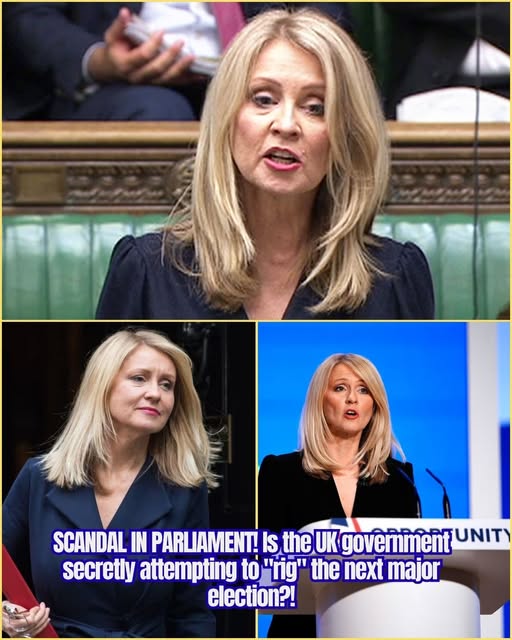
Esther McVey Accuses Labour of ‘Vote Rigging’ in Heated Commons Clash Over Votes at 16
A heated confrontation in the House of Commons has reopened one of Britain’s most contentious electoral debates after Conservative MP Esther McVey accused Labour of pursuing “vote rigging” through its plan to give 16- and 17-year-olds the right to vote.
McVey challenged the Government over what she described as a fundamental inconsistency in the way British law treats teenagers.
Her argument was simple but politically explosive: if Parliament believes people under 18 require legal protections preventing them from making certain major decisions, why should 16-year-olds simultaneously be considered mature enough to help choose the country’s government?
Labour MPs immediately challenged that reasoning, pointing out that Britain has never applied one universal age to every legal right and responsibility.
The clash turned a debate over the Representation of the People Bill into a much broader argument about adulthood, democratic participation — and whether changing the electorate amounts to electoral manipulation.
But one distinction is essential from the beginning.
McVey did accuse Labour of “vote rigging.” That is a verified parliamentary statement.
There is, however, no evidence in the parliamentary record establishing that the Government is literally attempting to rig an election. That remains McVey’s political interpretation of Labour’s policy.
What Labour is actually proposing
The Representation of the People Bill would lower the voting age from 18 to 16 for elections currently controlled by Westminster electoral law.
That includes UK parliamentary elections and local elections in England.
It would bring those elections closer to the position already established in Scotland and Wales, where 16- and 17-year-olds can participate in devolved and local elections.
Labour did not introduce the proposal unexpectedly after entering government.
Votes at 16 was a manifesto commitment, and the Government subsequently confirmed its intention to legislate for the change before the next general election.
The Government argues that people aged 16 and 17 are affected by decisions on education, employment, housing, taxation, public services and the environment and should therefore have a voice in choosing those making those decisions.
Ministers also argue that allowing people to begin voting earlier could encourage lifelong participation in democracy.
McVey strongly rejects that case.
McVey’s “double standard” argument
During the September 2 Commons debate, McVey focused heavily on the different age thresholds operating throughout British law.
She noted that 16-year-olds cannot legally purchase alcohol, cigarettes or vapes.
They cannot obtain a tattoo.
In England and Wales, the minimum age for marriage and civil partnership was raised to 18 after Parliament removed the previous ability of 16- and 17-year-olds to marry with parental consent.
McVey also highlighted proposed restrictions affecting young people’s access to social media.
The Government announced in June that children under 16 would be prohibited from using social-media platforms, with the measure expected to come into force in spring 2027.
For McVey, these policies expose an obvious contradiction.
Parliament increasingly treats under-18s as requiring protection in significant areas of life, she argued, while Labour simultaneously wants to give them one of democracy’s most consequential responsibilities.
Her conclusion was not merely that the policy was inconsistent.
She suggested Labour’s real motivation was electoral advantage, describing the policy as “vote rigging”.
Labour’s counterattack
Labour MP Chris Curtis challenged McVey’s logic directly.
If every right and responsibility had to begin at exactly the same age, he asked, should Britain also prevent people aged 16 to 18 from working?
Should the minimum driving age — currently 17 for cars — also be raised to 18?
The question exposed an important weakness in the idea that Britain has one simple legal threshold separating childhood from adulthood.
McVey acknowledged that inconsistencies exist but maintained that voting should remain at 18. She then returned to her accusation that Labour’s motivation was political rather than democratic.
The Government has made essentially the opposite argument.
Responding separately to parliamentary questions about the issue, ministers have explicitly said there is “no single definition” of the age at which somebody becomes an adult across UK law.
Different age thresholds exist for different purposes.
Lowering the voting age would also not change the definition of a child under major pieces of children legislation.
Does Labour expect younger voters to support it?
This is where the accusation of electoral self-interest becomes politically interesting.
Opponents suspect Labour believes younger voters are more likely to support parties of the left and centre than the Conservatives.
If that assumption is correct, expanding the electorate to include 16- and 17-year-olds could potentially alter electoral outcomes.
But benefiting politically from a change is not the same thing as proving that the change constitutes election rigging.
Governments regularly change electoral law.
The relevant democratic questions are whether changes are enacted transparently through Parliament, whether the rules apply equally to eligible voters and whether elections themselves remain freely contested.
There is also no guarantee that today’s voting preferences among young people will remain unchanged.
Reform UK, the Greens, Liberal Democrats, Labour and other parties would all be free to compete for those new voters.
Indeed, extending the franchise could force parties to devote considerably more attention to policies affecting younger people.
How many new voters are involved?
McVey referred during the Commons debate to approximately 1.7 million 16- and 17-year-olds receiving the vote.
The Commons Library also describes the policy as potentially enfranchising around 1.7 million young people, although precise eligibility depends on factors including nationality and registration.
That is substantial enough to matter politically.
Yet it represents an expansion of the franchise rather than the creation of votes for a particular party.
A newly enfranchised 16-year-old would be entitled to vote Labour, Conservative, Reform, Liberal Democrat, Green or for another eligible candidate — or not to vote at all.
What does the evidence from Scotland tell us?
Britain does not have to consider votes at 16 entirely in theory.
Scotland has allowed 16- and 17-year-olds to vote in Scottish Parliament and local elections since legislation passed in 2015, following their participation in the 2014 independence referendum.
Wales subsequently lowered its voting age for Senedd and local elections.
Supporters say these experiences demonstrate that younger voters can participate meaningfully.
Critics question whether early participation necessarily translates into consistently higher turnout throughout adulthood.
Even research commissioned by the UK Government has cautioned against justifying votes at 16 purely on the assumption that it will automatically generate permanently higher turnout.
The debate therefore involves a genuine disagreement over democratic principle rather than a simple factual question.
Public opinion is not settled
Nor is the British public united behind the proposal.
The House of Commons Library notes that polling has generally found more people opposing than supporting votes at 16, although younger people are considerably more supportive of the change.
Politically, Conservatives and Reform UK oppose lowering the voting age, while most other parties represented in the Commons support it.
That makes the issue partisan — but not simply Labour versus everyone else.
The Liberal Democrats, for example, have supported lowering the voting age for many years.
Parliament has now backed the Bill
The proposal has also progressed substantially beyond political discussion.
The Representation of the People Bill was introduced in February 2026 and passed its Commons third reading on September 2 by 411 votes to 102.
McVey voted against it.
The size of that majority matters when evaluating claims that the measure is simply a secret Labour manoeuvre.
Whatever one thinks of its merits, the reform has been publicly debated, scrutinised and voted on in Parliament.
The social-media comparison
The comparison with social media nevertheless creates an awkward political question for Labour.
The Government says children under 16 require protection from potential harms associated with social-media platforms, while simultaneously arguing that 16 is an appropriate threshold for participation in national elections.
Opponents see contradiction.
Supporters see different activities requiring different thresholds.
Voting takes place periodically, does not require entering a financial contract and is conducted within a regulated democratic system.
Social-media use, by contrast, can involve continuous exposure to algorithms, strangers, addictive design features and harmful content.
Whether those differences justify separate age limits is ultimately a political judgement.
“Vote rigging” or expansion of democracy?
That is the central divide.
McVey sees Labour lowering the voting age while tightening protections elsewhere and concludes that electoral advantage is the obvious explanation.
Labour sees an electorate containing young people affected by government decisions but denied a political voice and calls enfranchising them democratic reform.
Neither argument is proved simply by repeating its strongest slogan.
Calling the proposal “vote rigging” does not demonstrate that an election is being fraudulently manipulated.
Calling votes at 16 an automatic democratic improvement does not answer legitimate questions about maturity, political knowledge or why different responsibilities begin at different ages.
What can be established is much clearer.
Labour promised votes at 16 before the legislation was introduced.
The proposal would add a substantial number of younger voters.
McVey genuinely accused the Government of pursuing “vote rigging”.
Labour MPs genuinely challenged her consistency argument.
And Parliament has openly debated the proposal before approving the Bill at third reading by a large majority.
The real question, therefore, is not whether Britain is secretly “rigging” an election.
It is whether 16 is the right age for democratic citizenship — and whether voting should be judged by the same maturity threshold Britain applies to marriage, alcohol, tattoos or social media.
On that question, Westminster — and the country — remains deeply divided.
SCANDAL IN PARLIAMENT! Is the UK Government Secretly Attempting to “Rig” the Next Major Election?
A fierce political debate is developing over the future of Britain’s electoral system, with the government facing questions about proposed changes that could affect who votes, how voters prove their identity and how political parties raise money.
The controversy has prompted a serious question: are ministers modernising Britain’s elections to make them more accessible and secure, or are they moving too quickly with reforms that could influence the political landscape before the next general election?
The answer requires looking beyond the dramatic accusations and examining what the proposed legislation actually contains.
There is currently no verified evidence establishing that the government is secretly attempting to rig the next general election. However, the scale of the reforms and the disagreements surrounding them have created a legitimate debate about transparency, fairness and public confidence in the democratic process.
The Electoral Reform Bill at the Centre of the Storm
The government’s Representation of the People Bill contains several substantial proposals designed to change how elections operate across the United Kingdom.
Among the most significant measures are extending voting rights to 16- and 17-year-olds in UK parliamentary elections, expanding acceptable forms of voter identification, improving electoral registration and tightening rules governing political donations.
The legislation also proposes stronger enforcement powers for the Electoral Commission and additional protections against intimidation directed at candidates, campaigners and electoral staff. <Cite refs={[“turn748920search2″,”turn748920search6”]}/>
Ministers argue that these changes are intended to protect democracy, make participation easier and reduce the risk of improper foreign financial influence.
The government has also pointed to weaknesses in existing arrangements for monitoring political donations, particularly where money could potentially be channelled through complicated corporate structures or other intermediaries.
Supporters of reform say that electoral rules must evolve as political campaigning becomes increasingly digital and international.
Critics, however, are asking whether the government has adequately considered the consequences of changing several important parts of the electoral system at the same time.
Their concerns focus not only on the substance of the proposals but also on the speed of parliamentary scrutiny and the need to preserve confidence in the independence of election administration.
Why Voter Identification Has Become a Flashpoint
One of the most contentious issues concerns the rules governing voter identification.
The government proposes allowing additional forms of identification, including eligible bank cards, to be accepted at polling stations.
Ministers argue that expanding the list of acceptable documents could reduce unnecessary barriers for legitimate voters while retaining safeguards against electoral fraud.
The proposal has attracted criticism from people concerned about whether bank cards provide sufficient protection against impersonation and whether polling staff will have clear, consistent procedures for checking them.
The Electoral Commission has previously raised concerns about the security and public-confidence implications of using bank cards as voter identification. <Cite refs={[“turn748920search2″,”turn748920search6”]}/>
The debate also reflects a broader disagreement about how voter identification should work.
Those who favour strict requirements emphasise the importance of preventing fraud and ensuring that each ballot is cast by an eligible voter.
Those who favour more flexible rules argue that legitimate voters should not lose the opportunity to participate because they lack a particular document.
Both objectives matter. The challenge is to design a system that protects the integrity of the ballot without creating unnecessary obstacles for eligible citizens.
The existence of disagreement over these rules does not establish that the government intends to manipulate an election. It does mean that the details of implementation deserve careful examination.
Votes at 16: A Change With Political Consequences
Another major proposal would extend the right to vote in UK parliamentary elections to people aged 16 and 17.
Supporters argue that younger people should have a voice in decisions affecting education, employment, housing, climate policy and the long-term economic outlook.
They also contend that introducing voting at a younger age could encourage political engagement and help establish voting as a regular civic habit.
Opponents have questioned whether the voting age should be changed without a broader review of the age thresholds used for other legal responsibilities.
There is also an inevitable political dimension to the debate. Expanding the electorate changes the number and demographic composition of eligible voters, and political parties may consider how the newly eligible group responds to their policies.
But a change in the electorate is not the same as manipulating votes.
A democratic reform should be assessed according to its legal basis, fairness, transparency and application across parties—not simply according to which political organisation expects to benefit from it.
The key test is whether the new rules provide eligible citizens with equal opportunities to participate and whether the process is administered impartially.
The Question of Political Donations
The government has also proposed tighter controls on political finance, including additional checks on donors and restrictions intended to prevent foreign money from influencing British elections.
The reforms follow concerns raised in the independent Rycroft Review, which examined foreign financial interference in UK politics.
In its July 2026 response, the government accepted the review’s recommendations and committed to strengthening transparency, enforcement and protections against financial interference. <Cite refs={[“turn748920search3″,”turn748920search6”]}/>
These measures could have important consequences for political parties that depend on large donations or complex fundraising arrangements.
Supporters argue that stricter checks are necessary to ensure that political funding comes from legitimate sources and that the public can understand who is financing campaigns.
Critics may question whether enforcement powers are sufficiently independent, whether the rules are proportionate and whether all political parties will be treated consistently.
Those are questions that Parliament and the relevant regulators should examine carefully.
A robust system must prevent unlawful funding without allowing financial regulations to become a tool for selectively disadvantaging political opponents.
Clear definitions, consistent enforcement and transparent reporting are therefore essential.
A Separate Controversy Over the Speed of Reform
The political argument has intensified over the government’s handling of the legislation.
Reporting by The Guardian on 11 October 2026 described criticism of plans to accelerate parliamentary consideration of the reforms, including proposals that could reduce the time available for scrutiny in the House of Lords. The report also discussed the controversy over photo identification and the expansion of acceptable documents. <Cite refs={[“turn748920search4”]}/>
The concern is that substantial changes to election rules should receive enough time for parliamentarians, specialists and the public to examine their consequences.
Supporters of faster legislation may argue that the government has a mandate to implement its programme and that electoral vulnerabilities should be addressed before the next general election.
Critics may counter that major changes require extensive consultation, particularly when they affect the rules through which political power is awarded.
Neither argument removes the need for evidence.
The relevant questions include whether parliamentary procedures are being followed, whether independent experts have been consulted, whether concerns are being addressed and whether the final rules can be implemented consistently.
The government’s stated intention is to have reforms in place before the next UK parliamentary general election. That makes scrutiny of the timetable especially important.
What Would Actually Constitute Election Rigging?
The term “rigging” is frequently used in heated political arguments, but it describes something much more serious than an unpopular change to election law.
Evidence of deliberate manipulation might include systematic interference with vote counting, unlawful exclusion of eligible voters, intentional falsification of results or the selective application of rules to benefit a particular party.
A claim of this nature requires specific evidence.
A government introducing legislation through Parliament, even legislation that attracts substantial criticism, does not by itself demonstrate an attempt to rig an election.
Equally, the fact that reforms have been presented as improving democratic participation does not mean every detail should be accepted without scrutiny.
The appropriate response is to examine the legislation, assess its likely effects, listen to independent electoral experts and establish whether the rules will be administered fairly.
Public confidence is strengthened when the government explains its decisions clearly and independent institutions are able to perform their responsibilities without improper interference.
The Role of the Electoral Commission
The independence and effectiveness of electoral oversight are central to the dispute.
The Electoral Commission is responsible for regulating political finance and supporting the integrity of elections within its statutory remit. Any expansion of its powers must be accompanied by clear accountability arrangements and sufficient resources.
The commission has previously expressed concerns about the government’s ability to direct its priorities through a formal strategy and policy statement.
The House of Commons Library reported that the government subsequently agreed to repeal the relevant power as part of the legislative process, recognising the importance of preserving the commission’s operational independence. <Cite refs={[“turn748920search5”]}/>
This issue demonstrates why the details of institutional oversight matter.
Election regulators must be able to enforce the law consistently, investigate credible complaints and explain their decisions. Their independence is important not only when they investigate opposition parties but also when questions arise about the governing party itself.
The public should be able to trust that complaints are assessed according to evidence and law rather than political convenience.
What Happens Before the Next General Election?
The next UK general election must take place within the current Parliament’s legal timetable, unless an earlier election is called. Parliament’s own guidance explains that the prime minister can request the dissolution of Parliament and that the maximum parliamentary term is governed by law. <Cite refs={[“turn748920search7”]}/>
Before that election, the government will need to explain how the new rules will work, while Parliament must complete the relevant legislative stages.
Election administrators will also need clear instructions, training and sufficient time to prepare for any changes that are enacted.
Voters should be able to find reliable information about registration, identification requirements, eligibility and the procedures for casting a ballot.
Political parties should have access to the same published rules, and complaints should be handled through established legal and regulatory processes.
These safeguards are more useful than unsupported predictions about who will benefit from the changes.
A Democratic Test That Demands Transparency
The accusations surrounding Britain’s electoral reforms reflect a wider problem in modern politics: when public trust is already fragile, even complex technical changes can quickly become evidence in a much larger argument about political legitimacy.
The government’s proposals involve significant questions about access to voting, financial transparency and the oversight of political parties. They deserve detailed scrutiny, especially where critics have identified concerns about security, implementation or the speed of parliamentary consideration.
But there is an important distinction between challenging the fairness of a proposed law and claiming that ministers are secretly conspiring to rig an election.
The first can be examined through legislation, evidence and independent analysis. The second requires proof of deliberate wrongdoing.
For now, the available evidence establishes a major political dispute over electoral reform, not proof of a secret plan to manipulate the next general election.
The real test will be whether the government can demonstrate that its changes are fair, transparent and consistently enforced—and whether independent oversight gives voters confidence that their ballots will be counted under rules that apply equally to everyone.
In a democracy, that confidence is not a minor administrative detail. It is one of the foundations of legitimate government.