

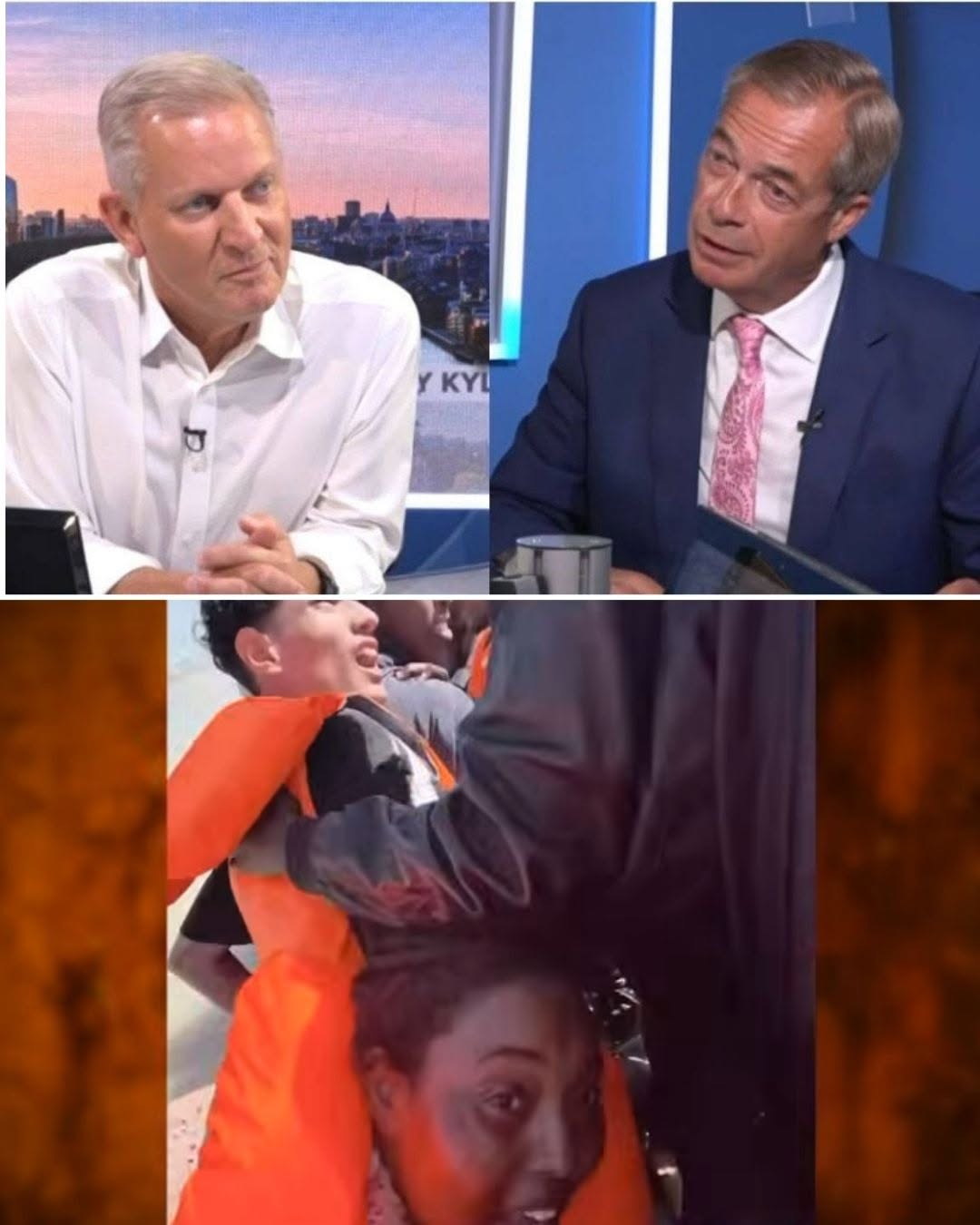
Nigel Farage Raises Questions Over UK-Funded French Border Operations as £500 Million Channel Security Controversy Fuels Debate
UK POLITICS | BORDER SECURITY & IMMIGRATION | 8 October 2026
Fresh controversy surrounding Britain’s financial support for French border enforcement has renewed questions about how effectively the two countries are tackling illegal people-smuggling operations in the English Channel, following claims that newly circulated footage raises concerns about the conduct of French police.
The allegations, amplified in political commentary associated with Nigel Farage, suggest that footage recorded near the French coastline may reveal troubling interactions between law enforcement officers and individuals suspected of involvement in migrant-smuggling activities.
Some online posts have described the situation as a £500 million border betrayal, accusing authorities of failing to deliver effective enforcement despite substantial British financial commitments.
However, several central elements of these claims remain unverified. The material provided does not include authenticated footage, an official investigative report or independently confirmed evidence establishing that French police knowingly assisted criminal smugglers.
Nor does it establish that £500 million was improperly spent or that either government deliberately concealed misconduct.
Nevertheless, the controversy raises legitimate questions about public spending, international border cooperation, operational transparency and political accountability.
Why Britain Pays France to Strengthen Border Security
For years, the United Kingdom and France have worked together to prevent dangerous small-boat crossings across the English Channel.
The cooperation reflects the geographical reality that many attempted crossings begin along the northern French coastline, while their intended destination is Britain.
Both governments have invested resources in surveillance, coastal patrols, intelligence-sharing and operations targeting organised smuggling networks.
A major agreement announced in March 2023 committed Britain to providing approximately £478 million over three years to support French border enforcement and related measures.
The arrangement was intended to strengthen operational capacity, increase personnel and improve technology used to identify and prevent irregular departures.
That commitment is frequently rounded to approximately £500 million in political debate.
However, the existence of substantial funding does not establish that the money was wasted, misappropriated or used for improper purposes.
Determining whether the investment has delivered value for money requires examination of expenditure records, operational results and the effectiveness of measures implemented under the agreement.
The Alleged Footage at the Centre of the Controversy
The latest claims focus on footage said to show French police interacting with individuals involved in small-boat departures.
According to the circulating description, the images supposedly reveal behaviour inconsistent with the enforcement objectives supported by British taxpayers.
However, the exact content, location, recording date and circumstances of the alleged footage have not been independently established in the material provided.
These details are essential.
An encounter between police officers and individuals near a migrant departure site does not automatically prove cooperation with smugglers.
Officers may be conducting surveillance, gathering intelligence, responding to safety concerns or operating under legal restrictions governing interventions at sea.
Equally, if credible evidence were to demonstrate deliberate assistance to criminal networks, such conduct would warrant serious investigation.
The appropriate response depends on what the footage actually shows, whether it has been authenticated and how the actions depicted relate to the relevant operational procedures.
Without that context, allegations of corruption or a deliberate cover-up would be premature.
Nigel Farage and the Political Response
Nigel Farage has consistently criticised Britain’s approach to irregular Channel migration, arguing that successive governments have failed to establish effective control over small-boat arrivals.
As a prominent figure in Reform UK, he has used the issue to challenge government policy and question whether international enforcement arrangements are delivering meaningful results.
The allegations concerning French border operations fit within that broader political argument.
Supporters of Farage’s position contend that British taxpayers are entitled to clear evidence demonstrating how public money is spent and what outcomes have been achieved.
They argue that continued crossings raise legitimate questions about whether existing agreements provide sufficient deterrence.
Critics of this approach caution against drawing sweeping conclusions from isolated incidents or incomplete video recordings.
They maintain that border enforcement involves complicated operational decisions, particularly when officers must consider maritime safety and the risk of injury or death.
The specific claim that Farage has exposed a deliberate cover-up has not been substantiated by the information supplied.
Any such allegation would require evidence demonstrating both misconduct and intentional efforts to conceal it.
The Difficult Reality of Channel Enforcement
Preventing small-boat crossings is more complicated than simply deploying additional officers along the coastline.
Smuggling networks often change departure locations, operating methods and transport arrangements in response to enforcement activity.
Some departures take place in difficult weather conditions or in locations where intervention may present significant safety risks.
French authorities must also operate within domestic law and applicable human rights obligations.
Once a vessel enters the water, attempts to stop it can create dangerous situations, particularly when passengers are crowded into unsuitable boats.
These operational challenges do not eliminate the need for accountability.
However, they demonstrate why individual incidents must be examined carefully before conclusions are drawn about police intentions or the effectiveness of an entire border strategy.
What Does the £500 Million Figure Actually Mean?
The financial dimension is central to the controversy.
The frequently cited £500 million figure broadly reflects the scale of Britain’s three-year funding commitment announced in 2023 rather than, by itself, evidence of a newly discovered financial scandal.
A proper assessment would need to establish how much money was disbursed, which programmes received funding and what results were achieved.
Relevant measures could include additional patrol capacity, surveillance equipment, disrupted smuggling operations and changes in departure patterns.
However, the number of migrants reaching Britain cannot be used as the sole measure of success.
Arrival figures may also be affected by weather, changes in smuggling tactics, demand for migration and enforcement activity elsewhere.
A credible evaluation should therefore examine both operational performance and financial accountability.
The Human Cost Behind the Political Debate
The English Channel remains a dangerous migration route.
People attempting the crossing often travel in overcrowded vessels with inadequate safety equipment, exposing themselves to serious risks.
Fatal incidents have repeatedly demonstrated the dangers associated with these journeys.
For governments, preventing deaths and disrupting criminal smuggling networks are important objectives alongside enforcing immigration laws.
Critics of current policy argue that stronger deterrence is necessary to reduce departures.
Humanitarian organisations emphasise that enforcement must be accompanied by appropriate protections and fair asylum procedures.
These priorities need not be mutually exclusive, although balancing them presents difficult practical and legal questions.
Any assessment of police operations should therefore consider both enforcement responsibilities and the safety of people involved.
Why Transparency Matters
The controversy highlights the importance of transparency in international security agreements funded by public money.
British taxpayers have a legitimate interest in understanding how substantial financial commitments are managed and whether agreed objectives are being achieved.
Similarly, French authorities have an interest in ensuring that allegations concerning their officers are assessed fairly and on the basis of reliable evidence.
If authenticated footage raises credible concerns about misconduct, appropriate investigative bodies should examine it.
That process should include establishing the recording’s authenticity, identifying the officers involved where appropriate and determining whether operational rules were followed.
However, transparency also requires resisting conclusions unsupported by evidence.
A dramatic online caption cannot substitute for an independent investigation.
What Happens Next?
Further clarity will depend on whether the alleged footage becomes available in an authenticated form and whether relevant authorities provide an explanation of the events depicted.
Questions about the funding agreement may also be addressed through parliamentary scrutiny, official financial reporting and independent evaluation of border enforcement outcomes.
Politicians, including Farage, may continue pressing for greater accountability over the effectiveness of UK-French cooperation.
But the credibility of any allegations will depend on verifiable facts rather than the intensity of political reaction.
Conclusion: Serious Questions, but No Proven £500 Million Betrayal
The controversy surrounding British funding for French border enforcement reflects longstanding frustration over irregular Channel crossings and the effectiveness of international cooperation.
The approximately £478 million commitment announced in 2023 represents a substantial use of public resources and deserves rigorous scrutiny.
However, the available information does not establish that French police deliberately collaborated with smugglers, that British funding was unlawfully diverted or that a government cover-up occurred.
The central question is whether the UK-France border agreement has delivered measurable improvements in enforcement, public safety and the disruption of criminal smuggling networks.
Answering that question requires transparent financial records, reliable operational data and independently verified evidence.
If credible evidence of misconduct emerges, it should be investigated thoroughly and impartially.
Until then, allegations of a £500 million betrayal should be distinguished from confirmed facts.
Britain’s border security challenges deserve serious public debate, but meaningful accountability depends on evidence rather than sensational claims.
Ultimately, the effectiveness of Channel enforcement will be judged not by dramatic headlines, but by whether the governments involved can demonstrate that public money is being used responsibly, criminal networks are being disrupted and dangerous crossings are being reduced.
EXPOSED: THE £500M BORDER BETRAYAL! Secret Footage Just Leaked, and It Changes EVERYTHING You Know About the Channel Crisis!
Britain’s Channel migration crisis has returned to the centre of the political storm, with renewed questions over the hundreds of millions of pounds committed to border enforcement in northern France. The agreement between London and Paris was presented as a major effort to stop dangerous small-boat crossings, disrupt people-smuggling networks and restore public confidence in border controls.
But one question continues to dominate the debate: what exactly is Britain getting for its money?
The headline-grabbing claim of a secret footage leak has added another layer of intrigue to the controversy. However, no independently verified footage establishing a new scandal has been identified in the material available for this article. The real, documented story is already significant: a £662 million UK-France funding agreement, including £500 million for existing enforcement operations and a further £161 million for measures whose funding depends on their effectiveness.
The agreement was announced on 23 April 2026 by the British Home Office. It is intended to strengthen policing, surveillance and intelligence operations along the northern French coast. The official announcement sets out the funding and operational commitments.
For the government, the deal represents an attempt to make border enforcement more effective. For critics, it raises difficult questions about accountability, results and whether years of spending have delivered the changes the public was promised.
The £500 Million Question
The central issue is not whether the UK and France need to cooperate. Both countries face challenges involving organised smuggling networks, dangerous sea journeys and the movement of people across the Channel.
The question is whether the money allocated to that cooperation is producing measurable results.
Under the three-year agreement covering 2026 to 2029, Britain is committing £500 million to strengthen existing controls in northern France. A further £161 million is available for additional tactics, with funding linked to the effectiveness of those measures.
The plan includes increasing the number of personnel funded under the arrangement from 907 in the previous cycle to 1,392 in the new one. It also provides for specialist police units, expanded intelligence operations and greater use of drones, helicopters and electronic surveillance.
The British government says these resources will help prevent small boats from launching and make it harder for criminal networks to organise crossings.
Yet the distinction between money spent, operations conducted and crossings prevented is crucial. A large budget does not automatically demonstrate success. Ministers must be able to explain how resources are being used, what outcomes have been achieved and whether the results justify the cost.
The House of Commons Library’s briefing on UK-France border cooperation, published on 13 May 2026, confirms the scale of the new agreement and reviews the history of joint enforcement efforts. It also notes that the outcomes of regular strategic reviews are not published in full. Read the parliamentary research briefing.
That lack of publicly available detail about some assessments makes transparent reporting especially important.
Why the Channel Crisis Remains So Difficult to Solve
Small-boat crossings have become one of Britain’s most contentious political issues because they combine border enforcement, asylum policy, public spending and serious risks to human life.
In 2025, 41,472 people arrived in the UK by small boat, according to the House of Commons Library. That was the second-highest annual total since records began and a 13 per cent increase on 2024.
The figures illustrate the scale of the challenge facing successive governments. They also explain why spending on French coastal enforcement has attracted such close scrutiny.
The government argues that stronger policing and intelligence-sharing can prevent departures before boats reach the water. French authorities have expanded their operations, while the agreement also targets the networks supplying boats, engines and transport.
But enforcement takes place in a constantly changing environment. Smuggling organisations can alter their methods, move between launch locations or use different types of vessels. Successful disruption in one area may lead to attempts elsewhere.
Weather also affects the number of crossings. Periods of calmer seas can create more opportunities for departures, while rough conditions can reduce them. Consequently, a fall in arrivals over a short period does not necessarily prove that a particular policy caused the decline.
A serious evaluation must examine longer-term trends, enforcement activity, changes in smuggling methods and the circumstances influencing people’s decisions.
What Ministers Have Said About Value for Money
The government has acknowledged that the agreement costs more than its predecessor and has defended the additional funding on the grounds that it can be directed towards tactics considered effective.
During evidence to a parliamentary committee on 15 September 2026, Home Secretary Shabana Mahmood described the three-year commitment as £662 million. She argued that the new arrangement offered greater flexibility to direct funding towards enforcement measures that make a difference.
Mahmood highlighted additional officers, specialist policing and changes to operational tactics. She also emphasised that cooperation with France must be treated as a shared responsibility rather than a problem for Britain alone.
The committee questioned how value for money would be measured and whether the results justified the additional expenditure. Those questions are central to parliamentary oversight: the government must explain not just what it has funded, but what the funding has achieved.
The agreement includes a mechanism to redirect funding if new measures fail to produce sufficient results under the joint evaluation process. That provides a framework for reassessing ineffective tactics, although its practical value depends on how performance is measured and how clearly the findings are communicated.
For taxpayers, the important issue is whether the system can demonstrate a meaningful connection between spending and outcomes.
The Controversy Over Returns and Legal Routes
The border debate also involves the UK’s former “one in, one out” pilot scheme with France.
Introduced in 2025, the arrangement allowed Britain to return certain people who arrived by small boat to France while admitting an equivalent number of eligible asylum seekers through an authorised route.
The policy was intended to demonstrate that irregular crossings could lead to return while a controlled legal pathway remained available.
However, the scheme was limited in scale compared with the total number of Channel arrivals. In September 2026, Reuters reported that the two governments were negotiating its possible termination, with France reluctant to extend the arrangement beyond its planned expiry. The report also described disagreements over the factors encouraging people to travel to Britain. Reuters reported on the negotiations.
The pilot’s difficulties illustrate why no single policy can resolve the entire Channel crisis. Returns require legal and administrative arrangements, cooperation between governments and sufficient capacity to process cases. Safe routes also need clear eligibility rules and effective implementation.
At the same time, dangerous crossings cannot be addressed solely by debating legal pathways. Authorities must also investigate criminal networks, protect people at sea and ensure that asylum decisions are handled lawfully.
The effectiveness of the overall approach depends on how these elements work together.
Is There Evidence of a Border Betrayal?
The term “betrayal” is a political accusation, not an established finding arising from the funding agreement.
Critics are entitled to question whether the government has delivered sufficient results for the money spent. They can demand clearer figures, stronger oversight and explanations of why crossings continue despite substantial investment.
But the continued existence of crossings does not, by itself, prove that the funding has been misused or that officials have deliberately misled the public.
Establishing wrongdoing would require evidence supporting the specific allegation. Similarly, claims that secret footage has exposed misconduct should be supported by the original recording, verified details about its provenance and independent confirmation of what it shows.
Without that evidence, it would be misleading to present an alleged leak as proof of a scandal.
The more concrete questions are already substantial. How many departures have been prevented? How many organised smuggling networks have been disrupted? What proportion of the additional funding has been spent? What measures are being used to assess effectiveness? And what happens when an intervention fails to produce the expected results?
These are questions that can be investigated through parliamentary scrutiny, official records and independent reporting.
The Political Consequences for Labour
For Labour, the agreement is both a security policy and a test of political credibility.
The government has committed considerable resources to reducing irregular crossings. If the public sees little improvement, ministers will face pressure to explain why the strategy is not delivering the expected results.
Opposition parties, including Reform UK and the Conservatives, can use those questions to challenge Labour’s approach to immigration. They may argue for stricter enforcement, faster removals or a different relationship with France.
However, alternative proposals also need to be examined in detail. Their likely costs, legal implications and practical feasibility matter just as much as the criticisms they make of existing policy.
The political debate should therefore focus on evidence rather than assuming that either increased spending or tougher rhetoric guarantees success.
What Happens Next?
The £662 million agreement places a clear responsibility on both governments to demonstrate that their cooperation is effective.
Britain needs credible reporting on the use of public funds, meaningful measures of operational performance and a willingness to redirect resources when particular tactics fail. France, meanwhile, must balance enforcement responsibilities with its legal obligations to protect life and manage its own border operations.
The Channel crisis will not be resolved by one agreement alone. Smuggling networks adapt, international cooperation can become politically difficult, and the factors influencing asylum seekers’ journeys are complex.
The allegation of a secret footage leak remains unverified here. But the underlying question is undeniable: can the government show taxpayers that its substantial investment is delivering results?
That is the real test facing ministers. The public deserves transparent evidence, clear explanations and measurable outcomes—not merely dramatic headlines or promises of decisive action.