

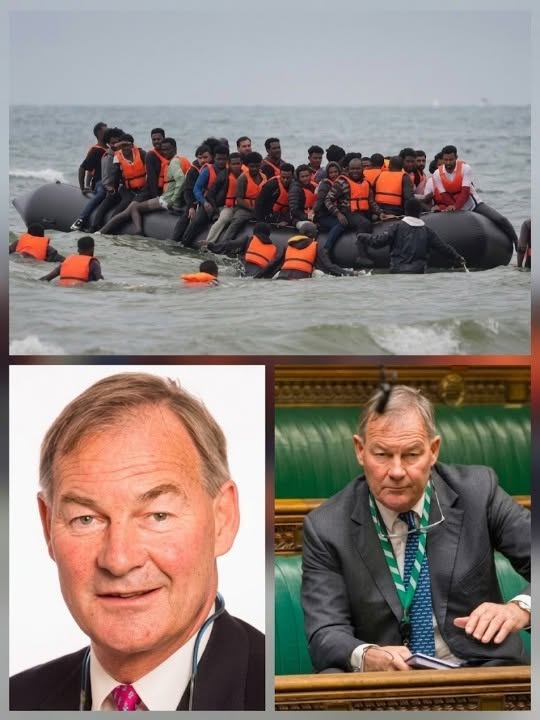
Rupert Lowe Calls for Benefits Ban on Foreign Nationals as Welfare Row Erupts in Parliament
LONDON — Rupert Lowe has called for foreign nationals to be barred from claiming UK welfare benefits and argued that migrants who cannot financially support themselves should be required to leave the country, triggering a sharp confrontation in Parliament over immigration, fairness and the purpose of Britain’s welfare state.
The Restore Britain MP for Great Yarmouth put the issue directly to ministers during Work and Pensions questions in the House of Commons, arguing that billions of pounds currently associated with Universal Credit claims involving foreign nationals should instead remain with British taxpayers.
His intervention produced an immediate rejection from the government.
But beneath the heated exchange lies a much more complicated question than the political slogans suggest: who can actually claim benefits in Britain today, how much is being spent, and what would Lowe’s proposal mean for foreign nationals who have lived and worked in the UK for years?
Lowe Calls for a Sweeping Benefits Ban
Speaking in the Commons on April 27, Lowe cited a figure of £10.1 billion out of £61.2 billion in Universal Credit expenditure during 2024 as being associated with foreign nationals.
He then proposed a far-reaching solution.
Lowe said Britain should prohibit foreigners from claiming benefits and remove migrants who were unable to financially support themselves. He argued that the resulting savings should effectively be returned to British taxpayers.
That position is consistent with the policy Lowe has continued to promote publicly.
In a more recent statement, he said ending benefits for foreign nationals was something he had advocated before it became politically fashionable and added that people unable to support themselves financially should be removed from Britain.
Restore Britain has presented the proposal as part of a broader welfare overhaul.
The principle is straightforward: British welfare should primarily support British citizens, while foreign nationals living in the country should be expected to maintain themselves and their families.
But implementing such a rule would represent a major departure from the current system.
Government Pushes Back on the £10.1 Billion Claim
The government’s response in Parliament was unusually direct.
Work and Pensions Minister Andrew Western said he “fundamentally” disagreed with Lowe’s approach, particularly when applied to people who had lived in Britain for years, worked, paid taxes and subsequently needed financial assistance.
The minister also challenged Lowe’s £10.1 billion figure.
According to Western, the calculation conflated benefit expenditure involving households containing a foreign national with money actually paid directly to foreign nationals.
A household may contain people of different nationalities. Some individual claimants within households classified in the data as having a foreign national may actually be British or Irish citizens.
Western therefore described Lowe’s interpretation as a significant overestimate.
That distinction is crucial when evaluating the scale of the proposal.
It does not mean foreign nationals receive no Universal Credit. Some legally do.
But it means the £10.1 billion figure cannot simply be described as £10.1 billion handed directly to foreign citizens.
Can Any Foreign National Currently Claim Benefits?
No.
One of the biggest misconceptions surrounding the debate is that arriving in Britain automatically provides access to the welfare system.
Current immigration rules generally work in the opposite direction.
The government states that most non-UK nationals receive immigration permission containing a No Recourse to Public Funds, or NRPF, condition.
That normally prevents them from claiming mainstream taxpayer-funded benefits.
Migrants with permission to access public funds must still satisfy the relevant benefit rules, including residency requirements. The government says settlement — usually obtained after several years — is the stage at which many migrants become eligible for public funds.
There are exceptions.
Refugees, people granted certain forms of protection, some people under the EU Settlement Scheme and others with qualifying immigration statuses may be eligible.
Contribution-based benefits are another important distinction.
Someone who has paid sufficient National Insurance contributions may qualify for benefits such as New Style Jobseeker’s Allowance even where some mainstream public funds are unavailable.
What About Illegal Migrants?
Here the existing rules are clearer.
People living in Britain without valid immigration status are not entitled to ordinary Department for Work and Pensions public-fund benefits.
The DWP confirmed this explicitly in response to an earlier parliamentary question from Lowe.
The government has also stated that people with pending asylum applications generally do not claim mainstream benefits such as Universal Credit. Instead, eligible asylum seekers who would otherwise be destitute may receive separate Home Office asylum support.
Refused asylum seekers and people without lawful immigration status are likewise generally prohibited from accessing mainstream public-fund benefits, although limited forms of support can exist under specific legal circumstances.
This makes the terminology particularly important.
“Foreign national,” “illegal migrant,” “asylum seeker,” “refugee” and “settled migrant” are not interchangeable categories.
They carry very different legal rights.
Lowe Wants to Go Much Further
Lowe’s proposal would therefore not merely prevent illegal migrants from claiming Universal Credit — they are already generally barred from doing so.
His position is substantially broader.
He has proposed removing access to benefits for all foreign nationals, including Universal Credit, social housing and disability benefits, while maintaining that people living in Britain as guests should support themselves.
That could potentially affect people who have lived legally in Britain for many years and paid significant amounts of income tax and National Insurance.
This is the central disagreement between Lowe and the government.
Lowe frames welfare as a national safety net that should principally be reserved for citizens.
The government argues that immigration status and existing eligibility rules already restrict access and that people who have contributed to Britain over many years should not necessarily be excluded simply because they do not hold British citizenship.
The Difficult Question of Contribution
Consider a hypothetical worker who has legally lived in Britain for 15 years.
They have paid income tax and National Insurance throughout that period but have never acquired British citizenship.
If they lose their job or become seriously ill, should they receive the same welfare protection as a British colleague who paid identical taxes?
Under Lowe’s citizenship-based approach, the answer could be no.
Under the existing system, the answer depends on immigration status, residency requirements, the benefit involved and other eligibility conditions.
This illustrates why the debate cannot be reduced simply to “British taxpayers versus foreigners.”
Some foreign nationals are themselves British taxpayers.
The political question is whether contributing financially to the country should eventually create entitlement to its social safety net, or whether citizenship should be the decisive dividing line.
Would Removing Benefits Reduce Immigration?
Lowe and supporters of tighter welfare restrictions argue that generous benefit systems can create incentives for migration.
His parliamentary motion on the issue describes access to benefits as a potential immigration “pull factor” and calls for legislation prohibiting foreign nationals from claiming UK welfare benefits.
Determining the actual effect would require evidence about why different categories of migrants come to Britain.
Many temporary migrants already have NRPF restrictions, meaning they cannot normally rely on Universal Credit or other specified benefits.
That complicates claims that unrestricted welfare access is a general feature of Britain’s immigration system.
A Debate Likely to Grow
Lowe’s intervention nevertheless touches on an increasingly prominent question in British politics.
Who should Britain’s welfare state exist to protect?
One position emphasises citizenship and argues that scarce public resources should primarily be reserved for British nationals.
Another emphasises contribution and legal residence, arguing that someone who has worked and paid into the system for years should not automatically lose access to support because of nationality.
The current system sits somewhere between those positions.
Most temporary migrants cannot access public funds. People without lawful immigration status are generally excluded. But certain legally resident foreign nationals — particularly those with settled status or other qualifying immigration status — can receive benefits if they meet the same eligibility requirements imposed on other claimants.
That is why Lowe’s proposal represents more than a crackdown on illegal immigration.
It would potentially redraw the boundary of Britain’s welfare state around citizenship itself.
And that leaves Parliament with a fundamental question that is unlikely to disappear:
Should welfare entitlement ultimately depend on the passport someone holds — or on their legal status, residence, contributions and individual circumstances?
Explosive Scenes in Parliament as Rupert Lowe Demands a Crackdown on Benefits for Non-Citizens
Britain’s increasingly heated debate over immigration, welfare spending and public finances has taken another dramatic turn, with calls for tougher restrictions on benefits for non-citizens placing renewed pressure on the political establishment. Rupert Lowe, known for his hard-line positions on immigration and government accountability, has become a prominent voice in arguments over who should qualify for taxpayer-funded support and how the country should enforce its existing rules.
The controversy reflects a wider frustration among voters who believe that the government must do more to control public spending, address the housing shortage and ensure that welfare entitlements are applied fairly. Supporters of stricter restrictions argue that British taxpayers deserve greater transparency and that access to certain benefits should be closely linked to citizenship, lawful residence and contributions to the country.
However, the question is considerably more complicated than a simple division between citizens and non-citizens. Britain’s welfare system already distinguishes between different immigration statuses, residence rights and benefit categories. Any significant reform would therefore require careful consideration of existing legislation, financial consequences and the circumstances of people who have legally settled in the United Kingdom.
Rupert Lowe Puts Welfare Policy Under the Spotlight
Rupert Lowe has built his political profile around challenging established political thinking, particularly on immigration, national sovereignty and the use of public money. His approach appeals to voters who believe successive governments have failed to respond adequately to concerns about border enforcement and the cost of public services.
The question of benefit eligibility fits directly into that political argument.
For supporters of tougher restrictions, public assistance should operate according to clear rules that distinguish between those who have established a qualifying right to receive support and those who have not. They argue that ministers must demonstrate that public money is being distributed responsibly and that the welfare system is not undermined by inconsistent enforcement.
Such arguments have gained political attention as households continue to face pressure from housing costs, energy bills and the wider cost of living. When people struggle to make ends meet, questions about eligibility for taxpayer-funded support can become particularly contentious.
Yet it is important to distinguish between a verified parliamentary exchange and the broader political debate. Without a confirmed transcript or official record of the specific confrontation described in the headline, the precise remarks, reactions and proposals should not be treated as established facts.
The underlying policy question, however, is clear: should Britain impose further restrictions on the benefits available to people who do not hold British citizenship?
Who Qualifies for Benefits in Britain?
The phrase “non-citizens” covers a wide range of people with very different legal circumstances.
Some foreign nationals live in Britain on temporary work visas or student visas. Others have indefinite leave to remain, settled status under applicable arrangements, refugee status or another form of lawful residence. Some people are awaiting decisions on asylum applications, while others may have no current permission to remain.
These distinctions matter because entitlement to public funds depends on the individual’s circumstances and the particular benefit involved.
Certain immigration conditions prohibit access to specified public funds. Other people may qualify for benefits if they satisfy the relevant residence, contribution or income requirements. Eligibility for one type of support does not automatically establish eligibility for every other benefit.
A comprehensive crackdown would therefore need to identify precisely which categories of people would be affected and which entitlements would change.
A blanket restriction on all non-citizens could also affect people who have lived and worked in Britain for many years, paid taxes and national insurance contributions, and established families in local communities.
That raises questions about fairness, economic incentives and the relationship between citizenship and long-term residence.
Supporters of stricter rules may argue that citizenship should carry additional privileges. Critics may respond that lawful residence, contributions and existing legal rights must also be recognised.
The debate cannot be resolved accurately without examining the specific rules and proposed changes.
The Cost of Welfare and Pressure on Taxpayers
Public spending is central to the controversy.
Britain’s welfare system supports people facing unemployment, disability, low incomes, caring responsibilities and other circumstances defined by law. These programmes represent a substantial commitment of public resources, making eligibility rules and administrative oversight important issues for Parliament.
Those advocating tighter restrictions argue that the government should ensure that benefits are paid only when the relevant conditions are satisfied. They also want clearer information about the costs associated with different categories of claimants and the effectiveness of existing controls.
However, the fiscal consequences of changing eligibility rules cannot be assumed.
A restriction might reduce expenditure in one area while producing additional costs elsewhere. For example, changes affecting families could influence local authority support, housing pressures or the circumstances of dependent children. Administrative systems would also need to verify eligibility and handle disputes or appeals.
To assess whether a proposal would save money, the government would need to publish credible estimates covering both direct savings and the costs of implementation.
It would also need to explain whether any savings would be used to reduce borrowing, improve public services or support other priorities.
Without such information, claims about the financial impact of a crackdown remain political arguments rather than demonstrated outcomes.
Immigration and the Housing Crisis
The benefits debate is closely connected to Britain’s housing shortage.
In many parts of the country, people face high rents, limited affordable housing and long waits for suitable accommodation. Younger households struggle to save for deposits, while some families remain in overcrowded homes because they cannot afford to move.
These pressures can encourage public debate about how housing and welfare resources are allocated.
Some politicians argue that stricter immigration controls and tighter eligibility rules would reduce pressure on public services and make it easier for the government to prioritise eligible residents.
However, Britain’s housing shortage has multiple causes, including inadequate construction in some areas, planning constraints, infrastructure limitations and affordability problems. Immigration can influence housing demand, but it is not the sole explanation for the difficulties faced by households.
The relationship between welfare restrictions and housing affordability is similarly complex. Reducing eligibility for a particular benefit does not automatically create additional homes or make private rents cheaper.
A comprehensive housing strategy would need to address supply, planning, infrastructure and affordable construction alongside any changes to immigration or welfare policy.
For Lowe and other advocates of tougher restrictions, the challenge is to show how their proposals would deliver measurable improvements rather than simply express dissatisfaction with the existing system.
The Government Faces Difficult Questions
Any proposal to restrict benefits for non-citizens would place pressure on ministers to clarify their position.
The government would need to explain which categories of residents should qualify for assistance, whether existing rules are being enforced effectively and what additional restrictions would achieve.
There would also be questions about the distinction between contribution-based entitlements and means-tested support. A person who has paid national insurance contributions for years may have a different claim to certain benefits from someone who has recently arrived and has no qualifying entitlement.
The government would need to consider how reforms would affect employers, public services and people who have established legal rights to live in Britain.
Another issue is the treatment of families. Children may have different citizenship or immigration statuses from their parents, creating circumstances in which a simple rule could have unintended consequences.
Any legislation would need to define its scope clearly and include appropriate procedures for determining eligibility.
If ministers believe that current restrictions are sufficient, they would need to explain how they ensure compliance. If they believe new restrictions are necessary, they should set out the expected benefits, costs and legal implications.
Clear answers would help Parliament and the public assess the merits of competing proposals.
The Political Challenge for Labour and the Conservatives
The controversy presents challenges for both major parties.
Labour must balance public concerns about immigration and public spending with its commitments to social protection, economic stability and the provision of essential services. If voters believe that the welfare system is unfair or poorly administered, ministers may face pressure to demonstrate that existing rules are effective.