

Comfortable Victory, but Uncomfortable Numbers for Labour in Greater Manchester
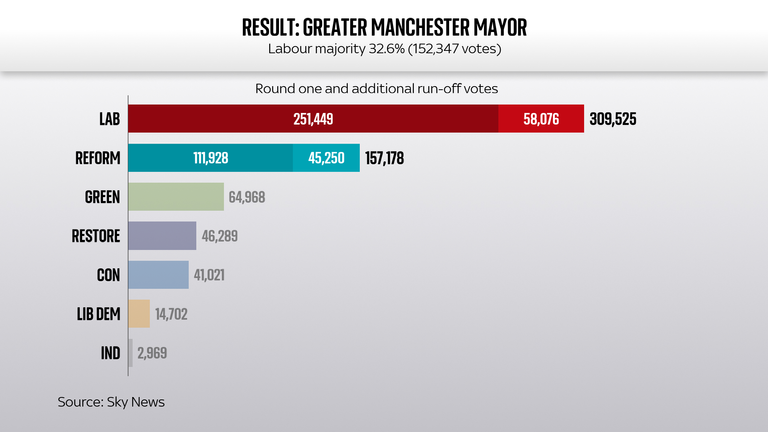
Labour’s victory in the Greater Manchester mayoral election was, on the surface, an impressive success. Bev Craig comfortably retained the mayoralty for the party after succeeding Andy Burnham, defeating Reform UK by a wide margin in the final count. The result allowed Labour to claim an important political victory in one of its traditional strongholds and demonstrated that the party remained capable of winning elections in major urban areas. However, beneath the headline of victory lay a more complicated political story. While Labour won convincingly, the voting figures revealed signs of weakening support compared with previous elections. Lower vote shares, reduced turnout, and the growing appeal of rival parties suggested that Labour cannot afford to become complacent. The election therefore represents both a victory and a warning for the governing party.
The most obvious reason for Labour’s celebration was the final outcome. Bev Craig secured the Greater Manchester mayoralty by a comfortable margin after second-preference votes were counted, ensuring that Labour maintained control of one of England’s most influential combined authorities. Her campaign focused on practical local issues such as affordable housing, public transport, economic development, and investment in local communities. Craig also benefited from Labour’s long-established organizational strength across Greater Manchester, where the party has traditionally dominated local government. Winning such an important mayoralty reinforced Labour’s reputation as the leading political force in the region.
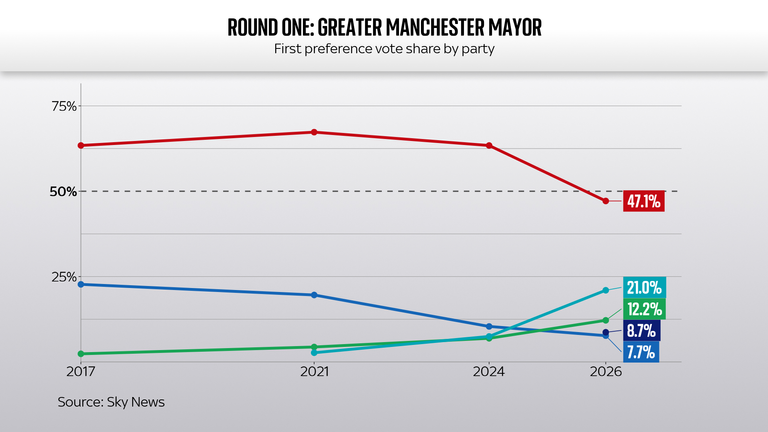
Nevertheless, the numbers behind the victory tell a less encouraging story. Craig received only about 47% of first-preference votes, well below the level achieved by her predecessor Andy Burnham in previous elections. Compared with Burnham’s strong performance in 2024, Labour’s first-preference support declined significantly. Although the supplementary voting system eventually produced a decisive victory after second preferences were distributed, the initial figures indicated that many voters who had previously supported Labour either switched to other parties or chose not to vote at all. Political analysts therefore described the result as both reassuring and concerning for Labour at the same time.
One important factor behind this decline was the absence of Andy Burnham himself. Burnham had become one of Britain’s most popular regional politicians during his years as Mayor of Greater Manchester. His personal popularity often exceeded that of the Labour Party nationally, allowing him to attract support beyond Labour’s traditional voter base. Many voters viewed him as an independent-minded leader who successfully defended Greater Manchester’s interests during difficult periods such as the COVID-19 pandemic. When Burnham left local politics to become Prime Minister, Labour inevitably lost a candidate with exceptional personal appeal. Bev Craig entered the campaign with considerably lower public recognition, making it harder to replicate Burnham’s remarkable electoral success.
Another significant issue was the growing strength of Reform UK. Although Reform ultimately lost by a substantial margin, the party secured a strong second-place finish and continued to expand its support in areas that were once considered safely Labour. Reform appealed particularly to voters concerned about immigration, the cost of living, public services, and dissatisfaction with mainstream political parties. Its performance reflected wider national trends in which populist parties have increasingly challenged the traditional dominance of Labour and the Conservatives. Even where Labour remained comfortably ahead, Reform’s ability to attract a significant share of first-preference votes highlighted changing political loyalties among working-class communities.
Low voter turnout also complicated Labour’s victory. Only around one-quarter of eligible voters participated in the election, making it one of the lowest turnouts since the Greater Manchester mayoralty was established. Low participation raises important questions about democratic legitimacy. Although Labour won according to electoral rules, the relatively small proportion of the electorate that voted suggests widespread political disengagement. Some voters may have felt that the outcome was already predictable in a traditionally Labour region, while others may have become increasingly frustrated with politics in general. Regardless of the explanation, declining turnout presents a challenge not only for Labour but for British democracy more broadly.
The election also demonstrated the importance of electoral systems. Under the supplementary vote system, candidates who fail to secure an outright majority in the first round benefit from second-preference votes cast for eliminated candidates. Bev Craig received strong support from voters whose first preference had been Green or Liberal Democrat candidates, allowing her final margin of victory to expand considerably. This result suggests that Labour continues to occupy a central position within the broader progressive political coalition. However, relying heavily on second-preference transfers may not always provide a secure foundation for future elections, especially if political alliances become more fragmented.
For Labour nationally, the Greater Manchester result offers both encouragement and caution. On one hand, retaining such a prominent mayoralty demonstrates that the party remains highly competitive in large metropolitan areas. Winning elections continues to matter, and governing parties often benefit from maintaining visible regional leadership. On the other hand, declining vote shares suggest that Labour cannot assume lifelong loyalty from traditional supporters. Economic pressures, housing shortages, rising living costs, and concerns over public services continue to influence voting behavior. If these issues remain unresolved, voters may become increasingly willing to support alternative parties.
The Conservatives also face uncomfortable conclusions from the election. Once the principal challenger to Labour in many northern regions, the Conservative Party played only a limited role in the campaign and failed to establish itself as the main opposition. Instead, Reform UK increasingly occupied that position by appealing to dissatisfied voters across working-class communities. This shift reflects broader political realignment occurring across the United Kingdom, where traditional two-party competition is gradually giving way to a more fragmented electoral landscape. The emergence of multiple competitive parties makes future elections less predictable than in previous decades.
Greater Manchester itself remains politically significant because it represents one of England’s largest metropolitan economies and often serves as an indicator of wider political trends in urban Britain. Changes in voting patterns there may foreshadow developments elsewhere. Labour’s reduced support could signal growing expectations among voters who now demand stronger performance from governments rather than relying on historical party loyalties. Citizens increasingly evaluate politicians according to practical achievements on transport, healthcare, housing, crime reduction, and economic opportunity rather than ideological identity alone.
Looking ahead, Labour’s challenge will be to transform electoral victory into sustained public confidence. Bev Craig now faces high expectations as mayor. Success will depend not only on maintaining Burnham’s legacy but also on establishing her own political identity through effective leadership and visible improvements in people’s daily lives. Delivering affordable housing, improving transport infrastructure, attracting investment, and supporting local businesses will all be essential if Labour hopes to rebuild the level of support previously enjoyed under Burnham’s leadership.
In conclusion, Labour’s victory in Greater Manchester was undoubtedly an important political achievement, but the detailed election results reveal important warning signs. While Bev Craig comfortably retained the mayoralty, the party experienced a noticeable decline in first-preference support compared with previous elections, faced stronger competition from Reform UK, and benefited from a low-turnout election. These trends suggest that Labour cannot rely solely on historical dominance or popular personalities to secure future victories. Instead, the party must continue delivering effective government, responding to voters’ concerns, and adapting to an increasingly competitive political environment. The Greater Manchester election therefore illustrates a broader lesson in democratic politics: winning elections is important, but understanding the changing attitudes behind the numbers is even more essential for long-term success.