
Across the United Kingdom, a fierce wave of patriotism is surging as citizens take direct action against the public display of Muslim-associated flags, particularly Palestinian banners. Tensions escalate sharply between British patriots, pro-Palestine activists, and leftist groups, igniting a heated national debate over identity and sovereignty.
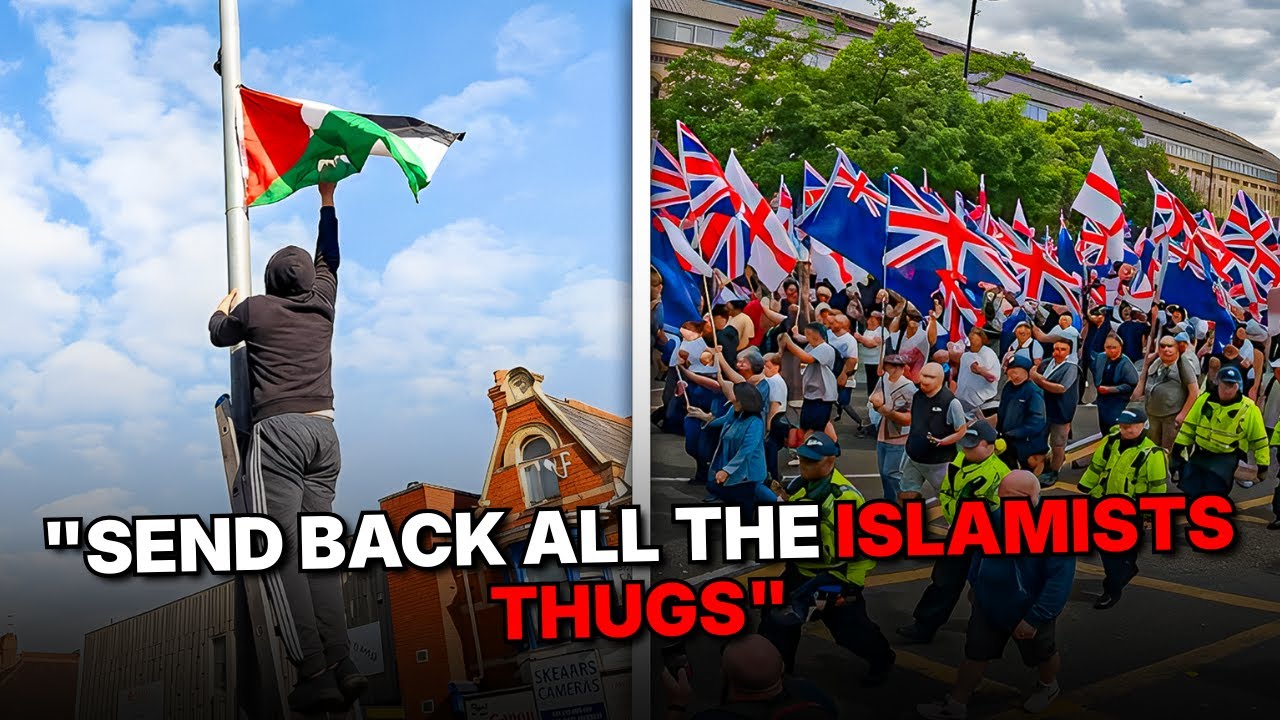 Outraged Britons are removing Palestinian flags from lamp posts, monuments, and council properties, declaring their streets belong solely to British identity. The movement follows widespread frustration over local authorities’ refusal to take down foreign flags while removing English and UK banners, fueling accusations of blatant double standards.
In London’s Tower Hamlets and beyond, flags symbolizing overseas conflicts have become flashpoints. Councils have been criticized for tolerating Palestinian flags on public property while citing “neutrality” or “safety” to justify the removal of the Union Jack. These inconsistencies have sparked a backlash affirming that British symbols should be prioritized.
The street-level pushback is raw and dramatic. 𝓿𝒾𝓇𝒶𝓁 clips show groups tearing down Palestinian flags amid chants asserting “This is England,” underscoring a reclaiming of public space. For many, flag removal represents more than symbolism; it’s an urgent reclaiming of belonging and national pride amid a perceived cultural siege.
This bold counter-movement extends beyond mere flag disputes. Protesters recently scaled the Iranian embassy, replacing the Islamic Republic’s flag with a symbol from pre-1979 Iran, signaling opposition to foreign regimes seen as hostile. Meanwhile, actions such as a Malaysian restaurant placing an Israeli flag on the floor for patrons to tread on highlight escalating expressions of discontent.
 Britain now faces a pivotal challenge balancing freedom of expression against growing demands for civic unity. Public spaces once neutral have become battlegrounds where flags carry deep political meaning. Patriot groups warn that flags associated with foreign conflicts should not overshadow British heritage and values.
Political voices have amplified this concern. Conservative leaders and commentators accuse councils of endorsing “two-tier flag bias,” where British emblems are removed but Palestinian and other foreign flags remain entrenched. Calls grow for policies banning foreign flags on taxpayer-funded properties to restore national identity.
Despite authorities’ attempts to restrict protests and arrests at demonstrations, pro-Palestine activists continue organizing rallies supporting their cause. University campuses and city centers witness persistent waves of marches carrying Palestinian flags, framing their activism as global justice rather than local disturbance.
Amid the turmoil, ordinary Britons express confusion and frustration over uneven law enforcement. Reports of arrests for flying English flags while foreign banners remain untouched add complexity to the controversy. This inconsistency inflames public sentiment and drives more citizens to take action themselves.

The struggle over flags serves as a poignant symbol of a larger cultural conflict. Older generations view the surge of foreign emblems as an erosion of a shared British narrative long taken for granted. Younger citizens wrestle with empathy for global causes yet recognize the escalating street tensions erupting over these symbols.
This surge of patriotism, marked by direct action and defiant chants, underscores a demand for British public life to reflect national identity first. As flags fly and fall, Britain stands at a crossroads over who controls the narrative of its streets and the meaning of belonging in a rapidly changing society.
The volatile atmosphere reflects deeper societal fractures. Public spaces once filled with uncontroversial British symbols now pulse with competing political statements. For many, a simple piece of cloth encapsulates the urgent, raw emotions tied to Britain’s identity crisis in a globalized world.
 As conservatism rallies against perceived erosion of traditional British values, and activists insist on global justice, the country grapples with how to reconcile these fierce emotions. The debate over flags has become a lightning rod for conflicts spanning immigration, governance, and cultural belonging.
Immediate concerns center on how local governments enforce flag policies. Calls for a standardized approach arise amid accusations of partiality. Meanwhile, grassroots actions continue unabated, with patriotic groups determined to assert dominion over public symbols, fueling clashes that could escalate further.
Police find themselves 𝒄𝒂𝓊𝓰𝒉𝓉 in a delicate balancing act: maintaining order while respecting freedom of expression in an emotionally charged environment. Despite arrests and bans, protests persist, signaling no quick resolution to this escalating cultural confrontation.
At its core, the flag controversy symbolizes the existential question of Britain’s identity — whose values should dominate public life, and how to preserve cohesion amid multicultural and geopolitical pressures. The streets have become arenas where this question plays out nightly in fervent, sometimes volatile displays.
As events unfold rapidly, this breaking story spotlights a nation wrestling with its past, present, and future identity. Flag removals and counter-protests are not just clashes over fabric but battles over belonging, sovereignty, and the soul of Britain itself. The country watches with bated breath as patriotism ignites new conflicts.
A NATIONAL IDENTITY CRISIS: UK PATRIOTS LAUNCH BOLD CAMPAIGN TO REMOVE MUSLIM FLAGS, SPARKING HEATED CLASHES AND A CULTURAL BATTLEFIELD OVER BRITAIN’S HERITAGE, VALUES AND NATIONAL BELONGING!
Britain is facing an increasingly heated national debate over identity, immigration, religion, and the meaning of belonging, as campaigners challenge the growing visibility of religious and political symbols in public spaces.
What began as disagreements about flags, street displays, and community identity has developed into a much wider political argument about the future of modern Britain.
Across different towns and cities, questions about national heritage, cultural integration, religious freedom, and the appearance of public spaces have become increasingly controversial.
Some campaigners argue that British national symbols and traditions deserve greater recognition, particularly at a time when many people feel that their country’s identity is changing rapidly.
Others warn that targeting religious symbols or flags associated with Muslim communities risks creating hostility towards ordinary people because of their faith.
The disagreement has placed politicians, local authorities, community organisations, and police forces under growing pressure to respond.
At the heart of the controversy is a fundamental question: how can Britain protect its national identity while ensuring that everyone living in the country enjoys the same rights and freedoms?
For many campaigners, the Union Jack and the flags of England, Scotland, Wales, and Northern Ireland represent generations of history, sacrifice, and national pride.
They believe these symbols should be visible and celebrated throughout the country.
However, Britain is also home to millions of people from different religious, ethnic, and cultural backgrounds.
Muslim communities have become an established part of British society, contributing to businesses, healthcare, education, public services, and local communities.
The challenge is finding a way for these different identities to coexist without turning public spaces into battlegrounds.
THE CAMPAIGN THAT HAS REIGNITED BRITAIN’S IDENTITY DEBATE
Campaigns promoting British flags and national symbols have gained attention amid wider disagreements about immigration and cultural change.
Supporters argue that displaying the national flag is a legitimate expression of patriotism and belonging.
They want communities to celebrate British history and recognise the traditions that have shaped the country.
Some campaigners have also questioned the display of foreign national flags and religious symbols in public areas, arguing that local authorities should apply consistent rules to everyone.
However, the controversy becomes considerably more complicated when campaigns specifically target Muslim flags or religious symbols.
Islam is a religion, not a foreign political movement, and Muslims in Britain have diverse nationalities, political opinions, and cultural traditions.
A campaign against unlawful displays of flags or unauthorised public installations is different from a campaign designed to remove symbols simply because they are associated with a particular religion.
That distinction is essential.
WHY THE UNION JACK HAS BECOME SUCH A POWERFUL SYMBOL
The Union Jack represents the political union of the United Kingdom and has a long history connected with British institutions, military service, and national celebrations.
For many people, displaying the flag is an expression of pride in their country.
It can represent family history, public service, sporting achievements, and a shared sense of national identity.
Recent political disagreements have encouraged more people to display British flags in residential areas and public spaces.
For some, this represents a desire to reconnect with national traditions.
For others, the increasing use of flags during politically charged demonstrations raises questions about whether national symbols are being used to unite communities or divide them.
Neither interpretation should automatically be imposed on everyone displaying a flag.
Patriotism can be expressed in many different ways, and people should not be judged solely by the symbols they choose to display.
MUSLIM COMMUNITIES RESPOND TO THE CONTROVERSY
The debate has understandably caused concern among British Muslims.
For many Muslim families, Britain is not simply a place where they happen to live.
It is their home.
They were born in British towns and cities, attended British schools, served in British institutions, and built their lives alongside neighbours from different backgrounds.
They may identify strongly with their religious traditions while also feeling completely British.
The suggestion that Muslim religious symbols automatically represent a challenge to British national identity risks overlooking this reality.
At the same time, Muslim community leaders have a responsibility to engage constructively with concerns about integration, extremism, and respect for shared democratic values.
A successful multicultural society requires mutual understanding.
Religious freedom must be respected, but so must the rights of others to express different political and cultural opinions.
LOCAL AUTHORITIES FACE DIFFICULT DECISIONS
Councils across Britain can face difficult questions when flags, banners, and other displays appear in public spaces.
The rules depend on where the display is located, whether permission is required, and whether the installation creates safety or obstruction concerns.
A flag displayed on private property is not automatically subject to the same rules as one installed on public infrastructure.
Local authorities must therefore consider each situation individually.
They should apply regulations consistently, regardless of whether a display represents British patriotism, another national identity, or a religious community.
This is important because selective enforcement could deepen public distrust.
If a council removes one display while allowing an equivalent display elsewhere without a clear explanation, residents may reasonably question the fairness of its decisions.
Transparency and consistency are essential.
POLICE CAUGHT BETWEEN PROTESTERS AND COUNTER-PROTESTERS
When disagreements over flags and religious identity develop into demonstrations, police forces can face significant public order challenges.
Officers must protect peaceful protesters, prevent violence, and ensure that opposing groups can exercise their legal rights.
They must also respond to threats, assaults, intimidation, and damage to property.
The presence of different political and religious groups can make these situations particularly sensitive.
However, peaceful displays of national or religious symbols are not automatically unlawful.
Likewise, disagreement with a particular symbol does not give anyone the right to threaten or attack the person displaying it.
Police decisions must be based on evidence and applicable law rather than the popularity of the political message.
A MUCH BIGGER QUESTION ABOUT BRITAIN’S FUTURE
The argument surrounding national flags reflects deeper concerns about the direction of British society.
Immigration, housing, economic pressures, public services, and changing demographics have all contributed to a wider discussion about national identity.
Some people feel that political leaders have failed to explain how cultural integration should work.
Others believe that politicians have allowed legitimate concerns to become entangled with prejudice and hostility towards minority communities.
The reality is that Britain has always experienced cultural change.
Its history includes centuries of migration, international trade, religious disagreement, and political transformation.
Modern British identity has been shaped by people from many different backgrounds.
This does not mean that national traditions are unimportant.
It means that national identity can be preserved while recognising the contributions of people who have different religious and cultural identities.
WHAT SHOULD HAPPEN NEXT?
The government and local authorities face an important responsibility.
They should defend freedom of expression, apply public-space regulations fairly, and ensure that peaceful demonstrations remain possible.
They should also challenge intimidation and discrimination, regardless of who is responsible.
Community leaders must encourage constructive dialogue rather than allowing disagreements to become permanent divisions.
British national symbols should be celebrated without being used as instruments of hostility.
Religious freedom should be protected without requiring everyone to share the same beliefs.
These principles are not contradictory.
They are essential foundations of a democratic society.
THE BIG QUESTION IS WHETHER BRITAIN CAN REBUILD A SHARED SENSE OF NATIONAL BELONGING WITHOUT TURNING CULTURAL DIFFERENCES INTO A PERMANENT POLITICAL BATTLE.
For campaigners, the challenge is to express patriotism through peaceful democratic action.
For Muslim communities, it is to ensure that their religious identity can coexist with their place in British society.
For politicians, it is to demonstrate leadership rather than exploit divisions for short-term political advantage.
And for ordinary citizens, the most important principle remains that people should be judged by their actions, not simply by their religion, ethnicity, or background.
Britain’s identity debate is far from over.
But the country’s future will depend not on which community can dominate public spaces, but on whether people with different backgrounds can share the same streets, respect the same laws, and recognise that they all have a stake in the future of the United Kingdom.