
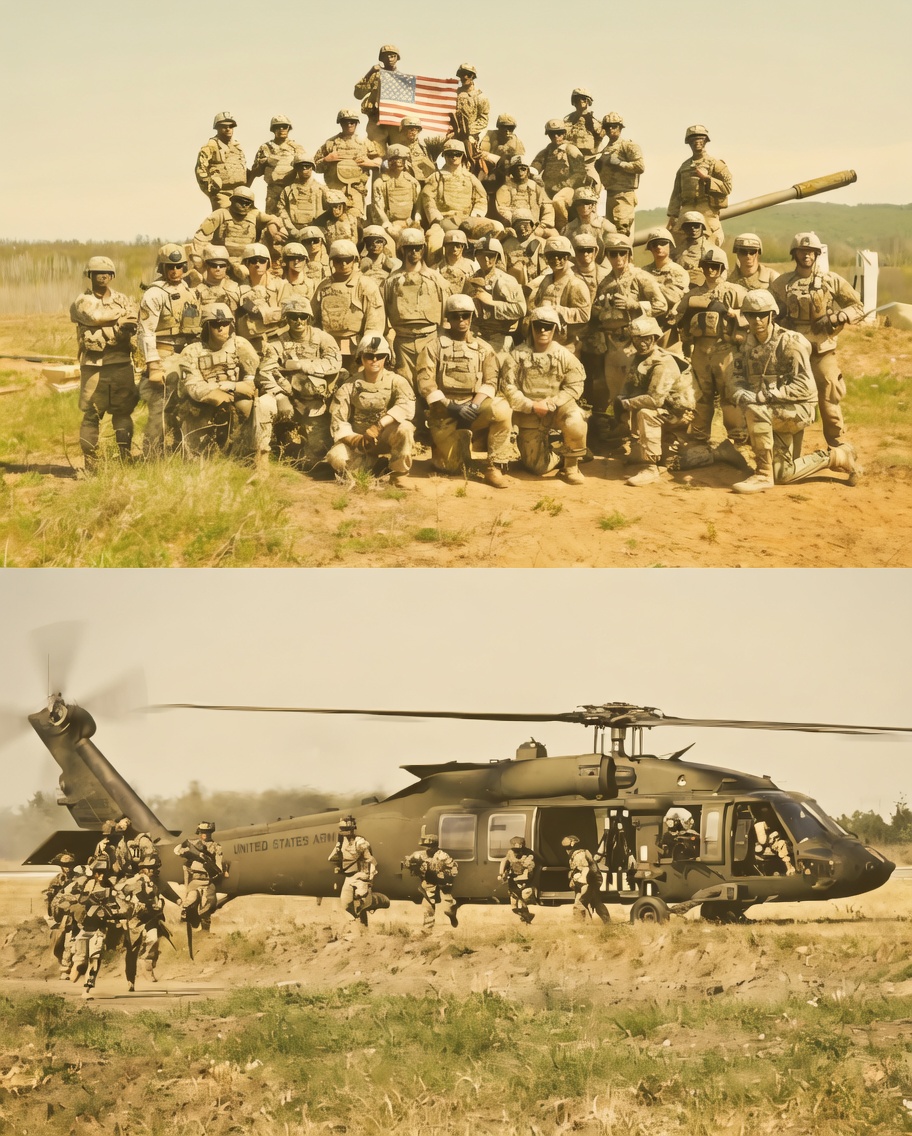
A letter by the Special Air Service Regimental Association, representing serving and former special forces troops, was sent to Northern Ireland Secretary Hilary Benn to warn the legislation does not provide adequate safeguards for veterans.
Labour withdrew plans to introduce the Legacy Act by the previous Conservative Government, which would grant immunity to Northern Ireland veterans.
New plans include a commission set up to investigate Troubles-related killings.
Critics have warned that it would expose veterans to “vexatious” legal claims and potentially see elderly former soldiers brought through the courts.
A former paratrooper in his 70s and known as Soldier F was cleared last month of murdering civilians on Bloody Sunday after a judge found the evidence against him fell “well short”.
The letter by the association, which was drafted by London legal firm Sidley Austin, said its “clients” were gearing up to “challenge” the Government over the bill, the Telegraph reported.
It further warned its clients’ “current position is that if the bill is enacted in anything like its current state, it will be subject to challenge”.
Northern Ireland Secretary Hilary Benn has been sent the lette
Under its new plan, the Government has insisted that veterans have six key protections, including anonymity and ensuring no veteran is forced to travel to Northern Ireland to give evidence.
New rules have also been added which allows inquests to occur into the deaths of hundreds of British soldiers killed during the conflict.
Critics say the shift could pave the way for former IRA members to “rewrite history” by changing historic versions of events to align with their “narrative”.
The association said the bill was “manifestly deficient in the protections it offers to former service personnel, police officers, and members of the security services”.
Veterans who served in the British Army during the Northern Ireland troubles took part in a protes
“Repeated reassurances have been given by the Government that veterans be supplied with specific protections in law to mitigate the effect of the repeal of the conditional immunities provided by the Legacy Act… [but] in fact, the bill contains almost no protection beyond those which already exist in law,” the letter stated.
Shadow Armed Forces Minister Mark Francois said: “Call me old-fashioned but the SAS traditionally protect the Government, rather than trying to sue them”.
“After the recent letter from the ‘nine senior generals’ – calling Labour’s legacy plans ‘a direct threat to national security’ this further action, by the SAS Regimental Association, shows just how angry veterans and particularly former special forces soldiers are, about Hilary Benn’s extremely dangerous proposals,” he sad.
“Perhaps this will be a case of Who Sues Wins?”
Nine of Britain’s top retired military chiefs launched an attack against the Prime Minister last week.
They said special forces troops were quitting out of fear they could be taken into court decades down the line for missions they carried out on behalf of the Government.
Tory MP Sir David Davis, a former SAS reservist, commented on the claims during Prime Minister’s Questions on Wednesday, saying: “The most acute damage is being felt by the Special Air Service; it is already affecting their recruitment, retention, morale, and operational effectiveness”.
He added that as a result, lawyers acting for the association “have sent a letter before action” to the Northern Ireland secretary.
Labour’s bill passed to the next stage.
A vote on Tuesday saw 320 MPs in favour and 105 against.
Mr Benn told MPs: “I don’t agree with that assessment” after being asked about the claims the bill was a national security threat.
He said there was “nothing in this bill that can be described as a direct threat to national security”
SAS SOLDIERS THREATEN LEGAL ACTION OVER LABOUR’S TROUBLES BILL – FRESH POLITICAL STORM ERUPTS AS VETERANS WARN OF HISTORIC INJUSTICE!
A major political confrontation is developing over Labour’s controversial Northern Ireland Troubles legislation, with former members of Britain’s elite military forces reportedly threatening legal action over proposals that could reopen the door to prosecutions connected to the conflict.
The dispute has reignited one of the most painful chapters in British history, placing veterans, victims’ families, politicians, and human rights campaigners on opposing sides of an increasingly bitter argument.
At the centre of the controversy is the government’s attempt to replace the previous Conservative administration’s Northern Ireland Legacy Act with a new framework designed to address unresolved cases from the Troubles.
For former soldiers who served in Northern Ireland, the legislation raises deeply personal questions about whether those who risked their lives carrying out military operations could face renewed investigations and criminal proceedings decades after the events in question.
For families who lost loved ones during the Troubles, however, the issue is equally profound.
They argue that victims deserve truth, justice, and meaningful answers, regardless of whether the alleged perpetrators were members of republican or loyalist organisations or representatives of the British state.
The disagreement has placed the Labour government under enormous pressure.
Prime Minister Keir Starmer previously promised to repeal and replace the controversial legacy legislation, arguing that its provisions failed to deliver an acceptable system of accountability for victims and survivors.
However, veterans’ organisations fear that the replacement arrangements could expose former service personnel to prolonged legal uncertainty.
The threat of legal action from former SAS personnel has therefore become another major flashpoint in an already deeply divisive political debate.
WHY THE TROUBLES BILL HAS SPARKED SUCH AN EXPLOSIVE REACTION
The Troubles were a prolonged period of political and sectarian violence in Northern Ireland, generally dated from the late 1960s until the Good Friday Agreement of 1998.
The conflict involved republican paramilitary organisations, loyalist paramilitary organisations, British security forces, and other actors.
Thousands of people lost their lives, while many more suffered injuries, trauma, and lasting consequences.
British soldiers were deployed to Northern Ireland during the conflict, including members of specialist military units.
The SAS operated in the region during particularly sensitive security operations.
Some former personnel have subsequently faced investigations into historical incidents.
For veterans, the prospect of further legal proceedings decades after their service raises questions about fairness, evidence, accountability, and the treatment of former military personnel.
The government, however, faces a different responsibility.
It must establish a system capable of investigating historical deaths and serious allegations while respecting the legal rights of victims, witnesses, and those accused of wrongdoing.
This is why the proposed legislation has attracted such intense scrutiny.
THE NORTHERN IRELAND LEGACY ACT BECOMES THE CENTRE OF THE BATTLE
The previous Conservative government introduced the Northern Ireland Troubles (Legacy and Reconciliation) Act 2023.
The legislation established the Independent Commission for Reconciliation and Information Recovery, known as the ICRIR.
Its original framework included conditional immunity provisions for individuals who cooperated with the commission by providing information about Troubles-related deaths and serious injuries.
The immunity arrangements proved deeply controversial.
Victims’ organisations, political parties in Northern Ireland, and the Irish government raised objections.
Critics argued that the arrangements risked preventing victims from obtaining justice through ordinary criminal proceedings.
The legislation also faced legal challenges.
In February 2024, the Northern Ireland High Court ruled that aspects of the Act were incompatible with the European Convention on Human Rights.
Subsequent legal proceedings and government changes further complicated its implementation.
For veterans, however, the Act represented an attempt to establish a system that could bring some finality to decades of unresolved cases.
The prospect of replacing it has therefore generated considerable concern among former members of the armed forces.
LABOUR’S REPLACEMENT PLANS FACE INTENSE SCRUTINY
Labour has promised a different approach to dealing with the legacy of the Troubles.
The government’s stated objective is to establish a framework that restores confidence among victims and families while ensuring that investigations are conducted independently and fairly.
The replacement legislation is intended to address concerns surrounding the previous immunity arrangements and improve the process for obtaining information about historical deaths.
However, the government must navigate several competing obligations.
It must protect the rights of victims and their relatives.
It must ensure that allegations against former soldiers are properly investigated.
It must also protect veterans from unjustified or politically motivated proceedings.
These objectives are not necessarily incompatible, but achieving them requires careful legislation and credible independent oversight.
Former service personnel argue that investigations must be based on reliable evidence and that veterans should not face endless uncertainty simply because they served during a difficult period of British history.
<Cite refs={[“turn792382search0″,”turn792382search4”]}/>
WHY FORMER SAS PERSONNEL ARE CONSIDERING LEGAL ACTION
The reported threat of legal proceedings reflects wider concerns among veterans about the government’s approach to historical investigations.
Former members of the SAS and other military units fear that changes to the legacy framework could expose them to additional legal uncertainty.
Their concerns centre on several issues.
First, they want assurances that historical allegations will be assessed according to consistent legal standards.
Second, they argue that former soldiers should not be subjected to repeated investigations without new or compelling evidence.
Third, they want protection against the misuse of legal proceedings for political purposes.
Finally, they believe the government must recognise the extraordinary circumstances in which military personnel were required to operate during the Troubles.
However, military service does not provide automatic immunity from criminal responsibility.
Any allegation of unlawful killing or serious misconduct must be considered according to the law.
Equally, allegations cannot be treated as established facts simply because they have been made.
A fair system must protect both the rights of veterans and the rights of victims.
VETERANS SAY THEY DESERVE FAIR TREATMENT
For many former soldiers, the issue goes beyond the wording of a single piece of legislation.
It concerns the relationship between the British state and those who served on its behalf.
Veterans argue that they were deployed under difficult and dangerous circumstances and that the government has a responsibility to ensure they are treated fairly after leaving military service.
Many believe that historical investigations have placed an excessive burden on former personnel and their families.
They also question whether politicians fully understand the operational circumstances faced by soldiers during the Troubles.
Supporters of veterans argue that the government should establish clear safeguards against repetitive or unsupported investigations.
However, victims’ families warn that excessive protections could undermine the search for truth.
They argue that people who suffered during the conflict have already waited decades for answers.
For those families, the passage of time should not automatically remove the possibility of accountability.
This is the central moral and political conflict surrounding the legislation.
THE POLITICAL CONSEQUENCES FOR STARMER
The dispute presents another difficult challenge for Labour.
Starmer previously worked as a human rights lawyer and has repeatedly emphasised the importance of the rule of law.
His government must now demonstrate that it can translate those principles into legislation that commands confidence among veterans, victims, and communities across Northern Ireland.
If the replacement framework is seen as excessively favourable to former soldiers, the government could face criticism from victims’ organisations.
If it is viewed as exposing veterans to unfair or endless investigations, Labour could face a backlash from military communities and veterans’ representatives.
The political consequences could be significant.
Northern Ireland remains particularly sensitive to questions surrounding the Troubles, and any legislative changes risk reopening old divisions.
The government therefore needs to proceed carefully and explain precisely how the new arrangements will operate.
THE WIDER QUESTION OF JUSTICE AND HISTORICAL ACCOUNTABILITY
The Troubles left a legacy that cannot be resolved through legislation alone.
Thousands of families continue to live with unanswered questions.
Some want criminal prosecutions.
Others want access to historical documents and official records.
Many simply want the truth about what happened to their relatives.
Former soldiers also want clarity about their actions and the circumstances in which they served.
The challenge is to create a system that can investigate historical cases without automatically favouring one group over another.
Republican paramilitary members, loyalist paramilitary members, former soldiers, and state officials must all be subject to the law.
Justice cannot depend on political convenience or the identity of the person under investigation.
A credible legacy system must therefore be independent, transparent, and capable of treating all parties consistently.
A CONFRONTATION THAT COULD SHAPE BRITAIN’S RELATIONSHIP WITH ITS VETERANS
The reported legal threat from former SAS personnel has brought the Troubles Bill back into the national spotlight.
It has also highlighted the difficult relationship between military service, historical accountability, and the responsibilities of government.
For Labour, the challenge is to produce legislation that genuinely addresses the failures of the previous system without creating another generation of legal uncertainty.
For veterans, the priority is ensuring that their service does not become grounds for unfair treatment.
For victims’ families, the demand remains simple: truth, dignity, and justice after decades of waiting.
The government cannot ignore any of these responsibilities.
THE BIG QUESTION NOW IS WHETHER LABOUR CAN DELIVER A TROUBLES LEGACY FRAMEWORK THAT PROTECTS VICTIMS’ RIGHTS WHILE PROVIDING FAIR AND EFFECTIVE LEGAL SAFEGUARDS FOR FORMER BRITISH SOLDIERS.
The coming parliamentary debates could prove decisive.
The outcome will affect not only former SAS personnel but also thousands of families whose lives were changed by the Troubles.
And the government will ultimately be judged on whether its legislation delivers something that has remained painfully elusive for decades: a fair process capable of establishing the truth without sacrificing justice.