

Three years later, most of them were still there. On January 30th, 1945, 121 Rangers, 14 Alamo Scouts, and 200 Filipino guerrillas walked 30 miles through enemy territory to reach them. They killed 530 Japanese soldiers in 30 minutes. They brought 516 men home. The United States lost two men.
Inside Cabanatuan, the garrison kept a rule. If one prisoner escaped, 10 others from his group were executed. The rule ended escape attempts entirely. The camp that had held 5,000 men in 1942 had been emptied in stages, not by rescue, but by disease and by transfers to slave labor sites in Japan. Men shipped to mines and factories from which many did not return.
By January of 1945, the camp held a fraction of the men who had arrived 3 years earlier. They had been inside those fences for 34 months. Most of them had stopped expecting anyone to come. But the raid on Cabanatuan had not begun on January 30th, 1945. It had begun in December of 1944 when 139 American prisoners of war in a camp at Palawan were herded into air raid shelters by their Japanese guards, soaked with aviation fuel, and burned alive.
The guards who did it had received word that American forces were approaching. The prisoners who survived Palawan by swimming into the ocean had told their story to the intelligence officers who debriefed them. The pattern was recognized. Cabanatuan was next. It was not a military operation designed to hold ground or destroy enemy forces.
It was a decision made against the specific knowledge that the men inside that camp would be burned alive if the Americans waited one more day. Cabanatuan, 7:00 in the evening of January 30th, 1945. 121 Rangers 20 yards from the main gate, lying in a ditch, invisible in the darkness and the last light of day.
The P-61 Black Widow called hard to get making passes over the camp at 10 ft of altitude, ripping shingles from the roof with the wake of its propellers, the Japanese guards standing with their heads tilted back watching the sky. The Company C Rangers in position. The signal. The next 30 minutes would settle a debt 3 years old.
I spent 8 hours writing, editing, and researching this story to verify every number and every decision exactly right because the raid at Cabanatuan is the most successful prisoner rescue operation in American military history. And because the men who were rescued had been waiting since April of 1942 for someone to come through the gate.
If this story matters to you, subscribe to the channel. Just subscribe. That is all. Thank you. The surrender of Bataan on April 9th, 1942 was the largest surrender of American-led forces in United States military history. It ended a 3-month defense conducted by American and Filipino forces against a Japanese army that had superiority in numbers, in air power, and in naval support.
The defenders had been told that relief was coming, that supplies were being assembled, that the Pacific Fleet would return and break the siege. The relief did not come. The supplies did not arrive. The Pacific Fleet had been at the bottom of Pearl Harbor for 4 months. General Douglas MacArthur had left for Australia by submarine in March under presidential orders, leaving Lieutenant General Jonathan Wainwright in command of a force that had been on half rations since January and quarter rations since March, that
had been fighting malaria and dysentery and beriberi alongside the Japanese, and that was running out of ammunition at a rate that made the final outcome clear to everyone in a position to count the available shells. When King surrendered on the morning of April 9th, he did not have authorization from Wainwright to do so.
He made the decision himself in the specific and painful knowledge that continuing would mean the deaths of the men under his command from the next Japanese assault, rather than from the conditions that were already killing them more slowly. He surrendered because the alternative was worse. He was correct about that.
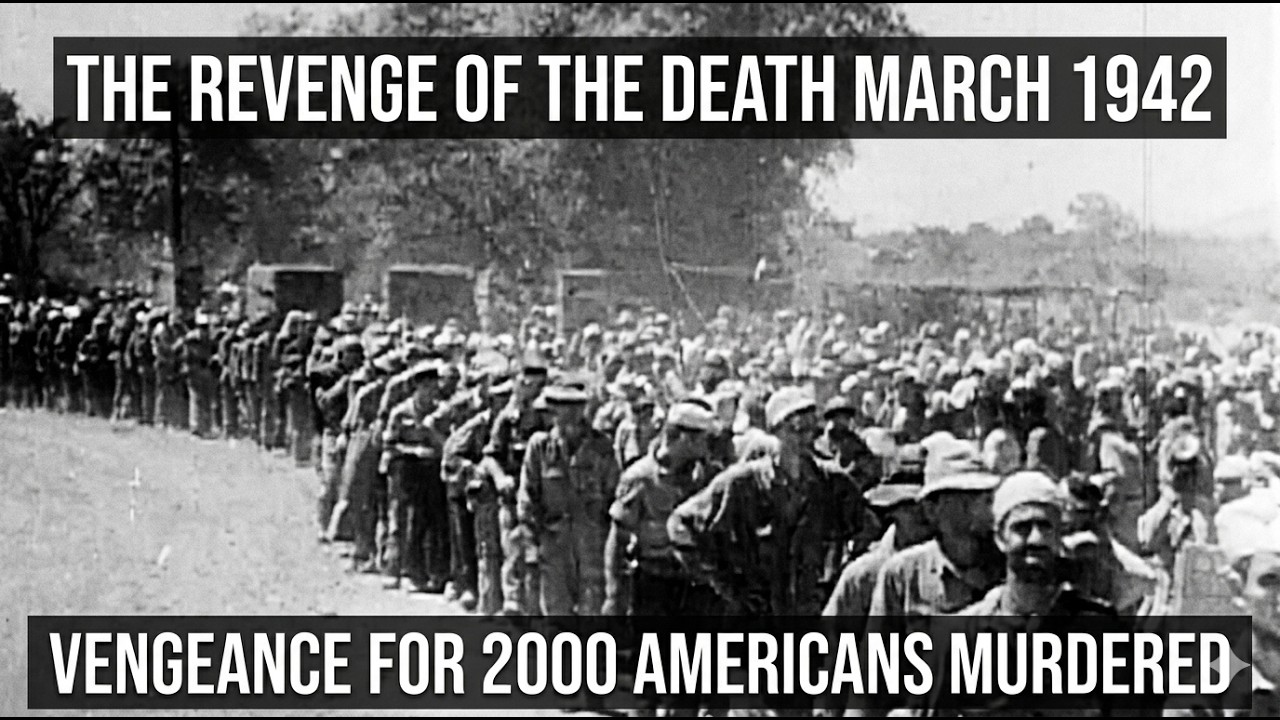
The 72,000 prisoners the Japanese took on Bataan were marched north to the railhead at San Fernando. The march became the most documented atrocity of the Pacific War. Japanese soldiers who found American or Filipino soldiers unable to continue walking shot them or bayoneted them on the road and left the bodies where they fell.
Prisoners who sat down were killed. Prisoners who sought water from Filipino civilians along the road were beaten or killed. Trucks moving north on the road ran over who had fallen and did not stop. The march in April heat without adequate water and without food produced the deaths of more than 1,000 Americans and many thousands of Filipinos in the 5 days of walking.
The survivors rode boxcars to Capas, packed 100 to a car, then marched the remaining miles to Camp O’Donnell. Camp O’Donnell was the first of the major prison facilities, and in the weeks after Bataan, it killed men faster than combat had. 3,000 Americans died at O’Donnell from disease, starvation, and the systematic withholding of medical treatment.
A separate compound held 50,000 Filipino prisoners across a creek, and the mortality there was still worse. The survivors were transferred to Cabanatuan in the summer of 1942. At its peak, the camp held more than 5,000 American prisoners. It was built on a site that had been a Philippine Army training installation on a flat plane in Central Luzon, where the open ground around the perimeter gave the guards clear fields of fire and eliminated any possibility of surprise by an external force.
The Japanese had chosen the site with that consideration in mind. What the camp produced over the next 3 years was what camps of its kind always produced, a systematic reduction of the prisoner population through disease, malnutrition, execution, and what the prisoners called the 10-man rule. If a prisoner escaped, 10 others from his group were killed.

The rule eliminated escape attempts almost entirely because the mathematics of it were too clear to ignore. A man who escaped and saved himself condemned 10 others. The conditions at Cabanatuan were documented by the prisoners in letters and diaries that survived the war, and the documentation is specific. Men died of malaria, dysentery, beriberi, pellagra, and diseases that had no individual names because they resulted from the combination of malnutrition and the tropical environment.
Men were beaten by guards for minor infractions and for no infractions at all. Prisoners caught attempting to escape were tied to posts with wire at their knees and ankles and left in the sun without water for 2 days, then marched to the cemetery and made to dig their own graves. The camp had a cemetery that grew steadily larger through 1942 and 1943.
The Japanese rotated control of the prisoners through multiple commanders, and the conditions varied somewhat depending on who was in charge, but the fundamental situation of too many men, too little food, inadequate medical supplies, and no accountability for what happened to the prisoners was constant. By the time the war turned against Japan in 1943 and 1944, the camp’s population was being systematically reduced, not by improvements in conditions, but by transfers to the Japanese home islands and occupied territories.
Slave labor for mines, for construction, for factories that needed the kind of workers who did not need to be paid and could be replaced. The Japanese shipped most of the prisoners out of Cabanatuan as the war continued to Formosa, to Manchuria, to Japan itself. By late 1944, the population of the camp had fallen from 5,000 to approximately 500.
These were the men too sick to survive the transport to Japan, the men the Japanese had determined were not worth moving. They were the survivors of the Bataan Death March and 3 years of Cabanatuan, and they were the men who would be at the camp on January 30th, 1945. In December of 1944, the garrison at Puerto Princesa on the island of Palawan received word that American forces were approaching.
The garrison commander ordered 139 American prisoners who had been held there as labor for an airfield construction project to take shelter in three covered trenches. When the prisoners were inside, Japanese guards poured aviation fuel into the trenches and ignited it. Some prisoners tried to escape the fire by running.
They were shot by guards positioned around the perimeter. 11 survived by reaching the ocean and swimming to a beach where Filipino guerrillas found them. They reached American lines in January of 1945 and told their story. American intelligence officers listening to the Palawan survivors recognized what they were being told.
This was not an isolated incident. It was a policy decision implemented when Japanese forces believed they could not hold prisoners against an American advance. The camps on Luzon were now at risk as MacArthur’s forces pushed south from Lingayen Gulf. Cabanatuan was 25 miles from the front line and directly in the path of the American advance.
The prisoners inside had between days and weeks before the pattern repeated itself. Major Robert Lapham, commanding American guerrilla forces in central Luzon, had been receiving reports on the camp’s condition for months. He had been pushing for a rescue mission since October. When the intelligence picture became urgent in late January, he rode 30 miles on horseback through Japanese-controlled territory to reach the Sixth Army’s headquarters at Guimba and make his case in person.
The Sixth Army intelligence officer, Colonel Horton White, recommended that the recently formed Sixth Ranger Battalion be given the mission. Lieutenant Colonel Henry Mucci, commanding the Rangers, was called in. He was 32 years old, a West Point graduate, and he had been waiting for a mission worthy of his battalion since arriving in the Philippines.
Mucci selected Captain Robert Prince to lead the assault force. Prince had never commanded men in combat. He would be 26 years old 3 days after the raid. Mucci gave him 90 Rangers from Company C. Two platoons from Company F under Lieutenant John Murphy would provide support fire on the guard towers and barracks from the perimeter.
14 Alamo Scouts under Teams Nellist and Rounsaville would go in 36 hours ahead for final reconnaissance. 200 Filipino guerrillas under Captains Juan Pajota and Eduardo Joson would provide blocking forces on the two roads to prevent the Japanese forces in Cabanatuan City, estimated at between 5,000 and 7,000 men, from reinforcing the camp during the raid.
Pajota’s assignment was the most critical of the support elements. He would position his guerrillas at the bridge over the Cabu River on the road from the east, through which the most likely Japanese reinforcement route ran. His men would have to stop or delay any Japanese force that attempted to cross that bridge, regardless of size, for the time required to complete the raid and begin the movement of prisoners toward American lines.
The guerrillas blocking a river crossing against a potential force 10 times their number, while Rangers extracted 500 weakened prisoners across open terrain, was the specific scenario the entire plan depended on working. The problem the plan had to solve was straightforward and nearly impossible. The camp sat on a flat plain from which the surrounding terrain had been cleared to provide the guards with unobstructed fields of fire.
To reach the main gate, the assault force would have to crawl across approximately 1 mile of open ground in daylight or near darkness. Any Japanese guard who looked in the right direction at the wrong moment would see them. There would be no second attempt. The solution came from Major Rowali, the assistant to the 6th Army G-2.
Captain Pajota had observed that when American aircraft overflew the prison, the Japanese guards stopped what they were doing and watched the sky, continuing to look up even after the planes had passed. Rowali proposed that an aircraft could be used to hold the guards’ attention during the final approach.
Muci approved the idea. An Army Air Corps P-61 Black Widow night fighter was assigned, piloted by Captain Kenneth Schriber. The aircraft was named Hard to Get. Its mission was to circle the camp repeatedly, flying low enough to compel attention while the assault force moved into position. Mucci set the time of attack for 7:45 in the evening, 15 minutes before full dark.
He needed that final window of light for the Rangers to identify their specific targets once inside the compound. Too early, and the assault force would be visible on the open ground during its approach. Too late, and the Rangers could not see well enough to execute the raid inside the camp without killing prisoners.
On the morning of January 28th, the force departed Guimba. They were moving through territory held by Japanese forces in numbers vastly exceeding their own. Between the front lines and Cabanatuan City, the intelligence estimate placed 7,000 Japanese soldiers, most of them concentrated near the road that passed the camp.
The Rangers and scouts moved in single file through rice paddies and along creek beds, guided by Filipino civilians who had been watching the camp and knew the safe routes. The Alamo scouts arrived at the camp 36 hours before the assault. Four two-man teams positioned themselves in the tall grass and the bamboo thicket surrounding the compound, observing and recording.
They counted guard positions. They mapped the patrol patterns. They identified which buildings held prisoners and which held Japanese soldiers. They noted the location of the structures that the intelligence brief had identified as possibly housing tanks. What the scouts confirmed was that the intelligence estimate was essentially accurate.
Approximately 275 Japanese guards were in the camp. The prisoners, numbering approximately 500, were confined in barracks in the western half of the compound. The guards occupied the eastern half. The main gate was in the center. The perimeter was marked by guard towers at the corners and pillboxes along the fence line.
The scouts also confirmed the detail that made the entire operation possible. The guards were on a regular schedule, predictable in their movements, and when aircraft flew over, they watched them every time, without exception. On the afternoon of January 30th, the Rangers lay in the grass 1 mile from the camp and waited. There were caribou grazing in the field.
A road crossing their approach route had Japanese traffic moving through it periodically throughout the afternoon. And the assault force lay still, faces down until each vehicle passed. Filipino children walking home in the late afternoon passed within yards of the concealed Rangers and did not know they were there.
The Rangers did not move. Earlier that day, two Filipino boys had been sent to the prisoner side of the camp with rocks, each wrapped in a note. “Be ready to go out.” The prisoners who found the notes thought they were a prank or a trap. The notes were disregarded. The prisoners went about their day, not knowing that 121 men were lying in the grass a mile away, waiting for the light to change.
At dusk, Captain Prince gave the signal. The assault force began its crawl across the open ground. 1 mile. The P-61 arrived over the camp as the Rangers were crawling. The aircraft made its passes at 10 ft of altitude, engine backfiring deliberately, shingles tearing loose from the roof of the guard barracks.
The Japanese guards stood at their positions and watched the sky. The Rangers crawled. At 7:25, Company C was 20 yd from the front gate, in a ditch, in darkness, in position. At 7:40, Captain Murphy’s support platoon signaled readiness. At 7:45, the signal flare went up. The assault began. Every guard tower and pillbox in their sector was neutralized within 15 seconds.
The gunners who had been watching the P-61 had no time to process what was happening before it was done. A ranger used a .45 caliber pistol to destroy the lock on the main gate rather than wait for wire cutters. The gate opened. Company C poured through. Inside the compound, the Japanese guards who survived the opening seconds of fire ran for their weapons, for cover, for exits.
There were not many options available to them. The raiders who had entered through the main gate moved through the compound in organized groups following the map the Alamo Scouts had prepared. Bazooka teams destroyed the buildings the intelligence brief had identified as possibly containing tanks. Machine gunners covered the guard barracks.
Individual rangers kicked open the doors of the Japanese officers quarters and cleared them. The Japanese garrison at Cabanatuan was destroyed in approximately 30 minutes of fighting. The prisoners were harder. When the firing started, most of the men in the prisoner barracks did not understand what was happening.
They had been in Japanese custody for 3 years. Their experience of armed men arriving at night was not a positive one. Several prisoners described afterward the moment they heard the shooting and concluded the Japanese had decided to kill them. Some hid under their bunks. Some pressed themselves into corners.
One group of prisoners had already formulated an escape plan for that same evening and was preparing to attempt it when the firing began and they initially believed the shooting was somehow a response to their preparations. The rangers who entered the prisoner area found men hiding from them and had to physically coax them toward the exits.
Some prisoners were too weak to walk. The rangers who had been told every prisoner would go out were now carrying men who could not move under their own power, loading them onto the backs of fellow rangers, passing them toward the gate while the fighting continued in the eastern half of the compound.
Captain Prince leading the assault walked through the barracks calling out to the prisoners. He told them he was American. He told them the Japanese were being killed. He told them it was time to go. One prisoner, a man who had been at Cabanatuan since the Bataan Death March 3 years earlier, looked at Prince and asked him where he was from.
Prince told him. The prisoner said nothing more and followed him toward the gate. At approximately 8:15, Prince fired the withdrawal flare. The compound had been cleared. The prisoners were moving through the gate. The Japanese at the camp were dead or dying or running. One British civilian prisoner, weakened by dysentery, had hidden in the latrine at the sound of the first shots and had not come out.
He would be found by Filipino guerrillas after midnight and returned to American lines. 516 men came out of the main gate of the Cabanatuan prisoner of war camp on the evening of January 30th, 1945. Outside the camp, Captain Pajota was fighting the battle that determined whether any of them would survive the night.
A Japanese infantry battalion of approximately 300 men was moving from Cabanatuan City toward the camp when Pajota’s guerrillas engaged them at the bridge over the Cabu River. Pajota had positioned his men to catch the Japanese column in a crossfire the moment they attempted to cross. The guerrillas opened fire when the column was fully on the approach to the bridge, catching them in the initial burst before any organized response was possible.
The Japanese who were not killed in the first seconds of the ambush attempted to charge across the creek bed to break through Pajota’s line. The guerrillas held. The fighting at the Cabu bridge continued for the entire duration of the raid and for some time after. Pajota’s 200 men holding a Japanese force that outnumbered them against a defensive position that prevented reinforcement from reaching the camp.
When Pajota finally broke contact and withdrew, his guerrillas had killed more than 300 Japanese soldiers while losing nine men wounded. None killed. The column of prisoners and Rangers moved north through the darkness toward American lines. The carabao carts that had been assembled by Filipino families in the surrounding villages began appearing along the route.
One cart and then another and then more. Local people who had watched the Japanese occupy their country for 3 years coming out with the only transportation available to carry men who could not walk. By the time the column reached the village of Plateros, there were more than 100 carts. Filipino doctors set up a treatment station in a school building.
Rangers redistributed the prisoners into groups that those who could walk could manage and sent them ahead to the next village in relays. The column reached American lines at Talavera on January 31st. Every man who had been in the camp on the evening of January 30th was either in the column or accounted for. Two of the recovered prisoners died during the march.
One from a heart attack. One from the exertion that 3 years of malnutrition had made fatal. The operation had been designed for all 516 to come out. 514 made it to American lines alive. April 9th, 1942. Bataan surrenders. 72,000 prisoners begin the death march. More than 20,000 die. Summer 1942. Survivors transferred to Cabanatuan.
Population reaches 5,000 at its peak. 1942 to 1944. Systematic reduction through disease, execution, and transfers to Japanese home islands as slave labor. Population falls to approximately 500. December 1944. Japanese guards at Puerto Princesa, Palawan, burn 139 American prisoners alive. 11 survived to reach American lines.
October 20th, 1944. MacArthur returns to Leyte. “I shall return.” Fulfilled. January 9th, 1945. American forces land at Lingayen Gulf, Luzon. January 27th. Cabanatuan confirmed at 25 mi from front line. Japanese division withdrawing on road past camp. Rescue authorized. January 28th.
Muchi and Rangers depart Guimba with Alamo Scouts and Filipino guerrillas. January 28th to 29th. Alamo Scouts reach camp, conduct 36 hours of reconnaissance. January 30th afternoon. Rangers lie in open terrain 1 mi from camp waiting for dark. Filipino boys throw rocks with notes. “Be ready to go out.” Prisoners think it is a prank. 1945 hours. P-61.
Hard to get begins diversion passes over camp. Rangers crawl final mile. 1945 hours. Murphy’s platoon opens fire. All guard towers neutralized in 15 seconds. Approximately 2015 hours. Prince fires withdrawal flare. 516 prisoners moving through the gate. Throughout the night, Pajota holds Cabu bridge against Japanese reinforcements.
300 Japanese killed. Nine guerrillas wounded. January 31st. Column reaches American lines at Talavera. 514 prisoners delivered alive. February 2nd, 1945. News of the rescue released to the American public. March 8th, 1945. 280 POWs arrive in San Francisco Bay aboard USS General A.E. Anderson. The technical explanation for why 121 Rangers, 14 Scouts, and 200 Filipino guerrillas could accomplish in 30 minutes what 3 years of imprisonment had prevented begins with the specific element that made every other element possible,
the P-61. The problem of the open terrain surrounding Cabanatuan had no conventional military solution. A force approaching across flat, cleared ground in daylight or even in partial light would be seen from the guard towers before it reached a position from which the assault could succeed. The guards would raise the alarm.
The Japanese forces in Cabanatuan City, between 5,000 and 7,000 men, would be alerted and moving toward the camp before the raiders reached the gate. The prisoners would be killed or the rescue force would be destroyed in the open by a force that outnumbered it massively or both. The P-61 converted the terrain problem from an obstacle into an advantage.
The observation that Japanese guards invariably watched American aircraft when they appeared had been noted by Captain Pajota and communicated through the guerrilla network. What it meant in tactical terms was that the open ground that made approach impossible under normal conditions was traversable during the window created by a low-flying aircraft.
A guard who is watching an aircraft is not scanning the perimeter. A guard in a tower whose attention is directed upward is not looking at the ground. The crawl across a mile of open terrain that would have been impossible under observation became possible when every guard was looking at the sky.
The P-61’s contribution was not incidental to the plan. It was the plan. Every other element, the composition of the assault force, the timing of the attack, the positioning of the blocking forces, was built around the assumption that the aircraft would hold the guards’ attention for the time required for Company C to reach the gate.
When the aircraft worked as designed, everything else followed. When Murphy’s platoon opened fire at 7:45, the guards who had been watching the P-61 had not yet registered that Rangers were 20 yd from the main gate. The second factor was the simultaneity of the attack. The plan required that fire be placed on every Japanese defensive position in the company’s sector within the first seconds of the engagement.
A defensive position that received fire immediately had no window in which to communicate an alarm or organize a response. A defensive position that took fire 15 or 20 seconds after the attack began had exactly that window. 15 seconds was enough time to fire a weapon, blow a whistle, or reach a telephone. Muci and Prince had designed the assault to close every position within the first 15 seconds.
The training that the Rangers had conducted at Guimba in the days before the raid had rehearsed that specific timing repeatedly. When Murphy’s men opened fire, the timing worked. The third factor was Pajota at the bridge. The Japanese force in Cabanatuan City significantly outnumbered the raid force and would have been capable of overwhelming the Rangers and the guerrillas if it had been able to respond.
Pajota’s mission was to ensure it could not respond. His positioning of the guerrillas at the Cabu bridge, his timing, and the aggressiveness of his initial fire converted what could have been a reinforcement route into a killing ground. The Japanese who attempted to cross that bridge encountered fire they could not advance through.
The 300 Japanese killed at the bridge were soldiers who would otherwise have been at the camp within the time required to destroy the rescue operation. The three factors, the P-61, the simultaneous fire, and Pajota’s blocking force operated together to produce a window of approximately 30 minutes in which the camp could be entered, cleared, and evacuated before any organized Japanese response could reach it.
The window was calculated in advance and executed within the calculated parameters. What the Palawan massacre had established for the intelligence officers and commanders who read the survivors accounts in January of 1945 was the specific threat that made the Cabanatuan operation urgent. The Japanese military had a documented pattern of killing prisoners to prevent them from being rescued or from providing intelligence to the advancing American forces.
Palawan had not been an isolated event. Earlier in the war, Japanese forces had killed prisoners in other locations as American forces approached. The pattern was visible to those who were looking for it, and by January of 1945, the intelligence community was looking for it. The men at Cabanatuan were in danger, not in the abstract, but in the specific sense of days.
The Japanese division withdrawing on the road past the camp was moving. Once it had passed, the camp would be without the protection of proximity to a substantial Japanese force, and the guards would be left with the decision that the guards at Palawan had made. Intelligence indicated the withdrawal would be complete within a week.
The rescue operation was approved on the day the intelligence was confirmed. The two Rangers who died at Cabanatuan were Captain James Fisher and Corporal Roy Sweezy. Fisher was killed in the assault on the camp. Sweezy was killed during the withdrawal. They are part of the final accounting of the operation.
Two Rangers killed, nine Filipino guerrillas wounded, 514 prisoners delivered to American lines alive. The ratio is the number that defines the operation. Two dead rescuers to 514 living prisoners. Military operations are not evaluated purely by their ratios, but the ratio at Cabanatuan is specific enough to be stated without qualification.
It was the most successful prisoner rescue operation in American military history by any measure applied to it. The news was released to the American public on February 2nd, 1945. The reaction reflected the specific emotional weight the prisoners carried in American consciousness. The Bataan surrender had been a national trauma, the largest defeat in American military history.
The abandonment of men who had fought for 3 months without reinforcement or resupply, the beginning of a captivity whose brutality had been understood only partially, but understood clearly enough. The news that 500 of those men had been brought home produced a response that exceeded what military victories typically generated. Several of the Rangers and Scouts were sent on bond drive tours across the United States.
MacArthur wrote to Mucci, “No incident of the campaign in the Pacific has given me such satisfaction as the release of the prisoners of war at Cabanatuan.” President Roosevelt met with some of the rescued prisoners on February 11th, 280 of the recovered prisoners boarded the transport USS General A.E.
Anderson at Leyte for passage to the United States via New Guinea. The Japanese propaganda radio announced that submarines and aircraft would intercept the Anderson in the Pacific. The threats were not carried out. On March 8th, 1945, the Anderson entered San Francisco Bay. The men who had been on the Bataan Death March in April of 1942, who had spent 3 years at Cabanatuan, who had hidden under their bunks when they heard the shooting on January 30th because they thought the Japanese were coming to kill them, came off the ship in San Francisco.
Most of them had to be helped down the gangplank. The liberation of Cabanatuan prompted similar operations against other Japanese prisoner of war camps across Luzon in the weeks that followed as MacArthur’s forces advanced. The pattern established at Cabanatuan, the combination of Rangers or airborne infantry with Alamo Scouts for reconnaissance and Filipino guerrillas for support, was applied to multiple subsequent rescue missions.
The success at Cabanatuan had demonstrated that the operations were possible and had identified the specific combination of elements that made them work. Hundreds of additional prisoners were recovered from other camps in the weeks following January 30th. The men at Cabanatuan had waited 3 years for someone to come through the gate.
They had survived the Bataan Death March, Camp O’Donnell, and 3 years in a camp that had killed thousands of the men who had arrived there with them. They had watched the camp’s population fall from 5,000 to 500 as the Japanese shipped their fellow prisoners to slave labor sites from which many did not return.
They had developed the specific psychological adaptation of men who understand that rescue is unlikely and that survival requires not thinking too clearly about what tomorrow might bring. When the Rangers came through the gate on the evening of January 30th, many of them did not believe it was real. Some thought it was a Japanese trick to draw them into the open.
Some thought they were hallucinating from malnutrition. The Rangers who moved through the barracks calling out in American accents telling them it was time to go were not immediately convincing to men whose last 3 years had trained them not to believe that things could get better. They believed it when they saw the carabao carts.
They believed it when they recognized the design of the uniforms. They believed it when a Ranger from the same town spoke to them by name. Captain Fisher and Corporal Sweezy did not come home. 514 other men did. Two Filipino boys threw rocks at the camp fence that afternoon with notes that nobody believed.
121 Rangers, 14 Scouts, and 200 guerrillas walked 30 miles to make the notes true. No one left behind. Subscribe to this channel right now and turn on notifications because every week we bring you the stories that the histories reduced to a paragraph about a prisoner rescue mission in the Philippines without telling you that the Japanese had burned 139 Americans alive at Palawan the month before.
And the intelligence community knew Cabanatuan was next. Or that the prisoners hid under their bunks when the Rangers came through the gate because 3 years of captivity had made them incapable of believing it was real. Or that Captain Fisher and Corporal Sweezy died making sure 514 other men could get onto a ship in San Francisco.
Hit subscribe now. Then hit like so this reaches more people who should know the name Cabanatuan and what 30 minutes cost. Drop a comment below telling us where you are watching from. We will see you in the next one.