
Speaking to GB News, the Reform UK leader said he has been given “no chance to respond” to frequent PMQs jibes by Sir Keir Starmer and the like.
During Wednesday’s session, the leader of Reform chose to witness PMQs from the public gallery and said he will “continue to do so” until he is called to stand.
Outlining his decision, Mr Farage told GB News: “This Parliament is the most unrepresentative of where politics in the country is today, and the arguments are today in the history of Parliament.
Nigel Farage has hit out at Keir Starmer as he defended his protest against PMQs
GB NEWS
Weighing in on Mr Farage’s decision to protest, GB News Senior Political Commentator Nigel Nelson argued that it is his “duty” as party leader to remain in the Chamber.
Nigel explained: “I take your point, however, I do think Nigel, as a party leader, part of that duty should be to be in the Chamber of the House of Commons, not sitting up on up in the gallery.
“If the Speaker were to call you, he couldn’t call you from up in the gallery.”
Mr Farage interjected, stating: “He could, actually. The last time it happened was 1953.”
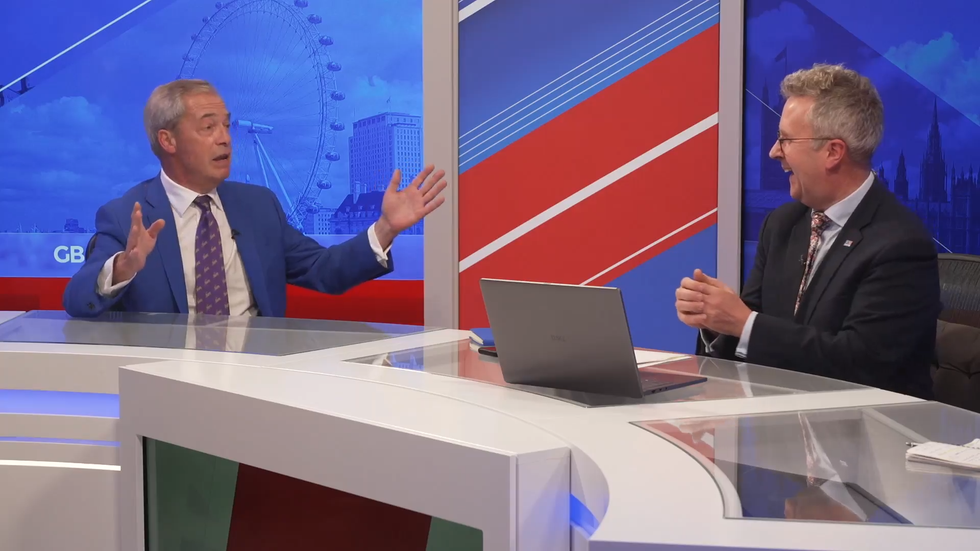
Mr Farage told GB News that he ‘could be called from the gallery by the Speaker’, noting that it last happened in 1953.
As Nigel continued to argue that the Chamber is the “right place” for Mr Farage to be, the Reform leader hit back: “I’m not going to be a punch bag for the leaders of the other parties with no chance to respond. Period. I’m on strike from PMQs in the Chamber.”
Offering his verdict on the protest, GB News presenter Christopher Hope argued that even if he asked the Speaker to “call him more often”, he may receive “complaints from the Greens, the Lib Dems and the Independents”.
Mr Farage told Christopher: “That they are not attacked. The point about parliamentary debate is people can say what they like, but you must get the chance to respond.
“I can make a point of order at the end, but that’s not the same thing, and they are not attacked by the Prime Minister every single week.”
Nigel Farage Furiously Doubles Down on PMQs Protest: ‘I Will NOT Be a Punching Bag!’
Reform UK leader Nigel Farage has intensified his criticism of the parliamentary process following a controversial protest during Prime Minister’s Questions (PMQs). Declaring that he would not become a “punching bag”, Farage has challenged the way political debates are conducted in the House of Commons and questioned whether opposition politicians receive fair opportunities to hold the government accountable. His comments have attracted considerable attention and reignited discussions about parliamentary democracy, political representation and the growing influence of Reform UK. The incident also highlights the increasingly confrontational relationship between Britain’s political parties at a time when voters are demanding answers to major national challenges.
First of all, Prime Minister’s Questions is an important part of the British parliamentary system. Every week, the Prime Minister appears in the House of Commons to answer questions from MPs about government decisions, public services and national policies. The session provides an opportunity for opposition politicians to challenge the government’s performance and demand explanations about controversial decisions. It is also an important opportunity for the public to observe how political leaders respond under pressure.
However, PMQs is often characterised by shouting, interruptions and intense political exchanges. Supporters of this confrontational atmosphere argue that it demonstrates the strength of parliamentary democracy because elected representatives are able to challenge those in power directly. Critics, on the other hand, believe that excessive shouting can undermine serious discussion and prevent important policy questions from receiving proper attention.
Nigel Farage has become one of the most recognisable figures in British politics. As leader of Reform UK and MP for Clacton, he has built his political reputation around issues such as immigration, national sovereignty, taxation and opposition to established political institutions. His party achieved a significant breakthrough in the July 2024 general election, winning five parliamentary seats while receiving more than four million votes across the country.
Despite this electoral support, Reform UK’s parliamentary representation remained relatively small compared with Labour and the Conservatives. This difference has contributed to debates about whether the UK’s first-past-the-post electoral system accurately reflects the political preferences of voters. Farage and his supporters have frequently argued that millions of people who voted for Reform UK deserve stronger representation in national political discussions.
The PMQs protest has brought these concerns into sharper focus. Farage’s statement that he would not be a “punching bag” reflects his objection to what he considers an unfair political environment. He has sought to present himself as a politician willing to challenge established conventions rather than simply accepting the treatment of smaller opposition parties within Westminster.
One of the main subjects behind the disagreement is the government’s approach to immigration. Reform UK has repeatedly criticised Labour’s handling of small boat crossings across the English Channel. Farage argues that the government needs stronger border controls, more effective deportation arrangements and tougher action against criminal smuggling organisations. He has also questioned whether existing agreements with France are capable of reducing irregular migration significantly.
The Labour government, led by Prime Minister Keir Starmer, has defended its approach by emphasising international cooperation and action against people-smuggling networks. Ministers argue that immigration is a complicated challenge that cannot be resolved through political slogans alone. They have also highlighted the need to improve asylum processing and ensure that individuals who have no legal right to remain in Britain are subject to appropriate removal procedures.
Another major issue concerns the cost of living. Many British households continue to experience financial pressure because of housing costs, energy bills, food prices and other essential expenses. Reform UK has attempted to attract voters who believe that established political parties have failed to address these problems effectively. Farage has frequently criticised taxation and government spending, arguing that ordinary working people should not face additional financial burdens while public services remain under pressure.
The controversy also highlights the growing competition between Reform UK and the Conservative Party. Both parties appeal to sections of the electorate concerned about immigration, national identity and economic policy. However, their political histories and approaches are different. Farage has attempted to position Reform UK as an alternative to the traditional political establishment, while the Conservatives continue to defend their record in government and present their own proposals for national reform.
Suella Braverman and other Conservative figures have also attracted attention through their comments about Farage and parliamentary representation. Their support for giving him greater opportunities to challenge the Prime Minister demonstrates how immigration and political representation have become increasingly important issues within Britain’s right-wing political debate.
Nevertheless, parliamentary procedures must be respected regardless of the political popularity of individual MPs. The Speaker of the House of Commons is responsible for maintaining order, selecting speakers and ensuring that debates follow established rules. Although political parties can argue for changes to parliamentary arrangements, these decisions must be considered within the wider framework of democratic accountability.
There is also an important distinction between political confrontation and effective scrutiny. Strong criticism can encourage ministers to explain their decisions, but meaningful parliamentary debate requires accurate information and constructive questions. Voters ultimately want to know how political decisions will affect their lives rather than simply watching politicians exchange personal insults.
Furthermore, the growing popularity of political figures such as Farage demonstrates how social media has transformed political communication. Politicians can now communicate directly with millions of people, publish immediate responses to parliamentary events and build support outside traditional media organisations. This can make political debate more accessible, although it can also encourage confrontational language and the rapid spread of misleading information.
In conclusion, Nigel Farage’s refusal to become a “punching bag” during the PMQs controversy reflects wider disagreements about political representation, parliamentary procedures and the treatment of smaller opposition parties. His comments have drawn attention to the position of Reform UK within Westminster and the expectations of millions of its supporters. However, parliamentary democracy depends on more than political confrontation. It requires fair procedures, meaningful scrutiny and a willingness to address difficult national questions. Ultimately, the purpose of Prime Minister’s Questions should be to hold the government accountable and ensure that the concerns of British voters are properly represented.