

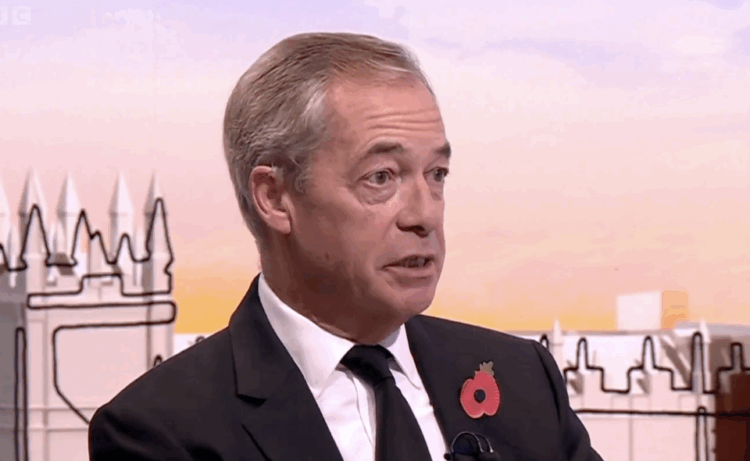
Britain’s most establishment politician has once again whinged about the “establishment,” as Nigel Farage suggested the parliamentary standards commissioner will find against him over his undisclosed £5m gift.
Parliament’s standards commissioner Daniel Greenberg continues to carry out an investigation into Farage over whether he should have declared the money from crypto billionaire Christopher Harborne when the Reform UK leader became an MP in July 2024.
During an appearance on the BBC’s Sunday with Laura Kuenssberg, Farage seemed to question Greenberg’s impartiality, as he referred to the commissioner as the “establishment.”
When he was asked by Kuenssberg if he expected Greenberg to conclude he had breached parliamentary rules, Farage replied: “Do I think the establishment would find against me, the leader of an insurgent party? What a question to ask.”
In September, Farage was interviewed by Greenberg for around 30 minutes as part of his investigation, ITV News reports.
Under Commons rules, new MPs are required to register any gifts worth more than £300 they received in the previous 12 months, except where it “could not be reasonably thought by others” to relate to their political activities.
The parliamentary standards committee is made up of four Labour MPs, two Tory MPs and one Liberal Democrat MP, as well as seven members of the public. As commissioner, Greenberg is required to uphold impartiality in investigations.
Farage has said the money from Harborne, which he received in April 2024, was so that he could pay for security for the rest of his life. He also described the money as a “reward” for his Brexit campaigning.
The Clacton MP denies any wrongdoing.
Speaking to Kuenssberg, Farage said it was “a farce” that he couldn’t speak freely about the confidential investigation.
Farage said: “Under the rules of Parliament, if I even answer your question, I will receive a letter of rebuke from the Standards Commissioner. This is the farce of it: You can say what you like, people can write what they like, I’m not allowed to respond.”
He added: “But to hell with it: Yes, I have been interviewed about it, and you know what?”
“If Ann Widdecombe’s murder at the age of 78 doesn’t justify me being able to pay for my security to whatever level is needed for the rest of my life then I don’t know what is.”
Farage Claims ‘Establishment’ Will Find Against Him in £5m Gift Investigation
Nigel Farage has raised fresh questions about the independence of Parliament’s standards watchdog after suggesting that the investigation into an undeclared £5 million gift he received from a wealthy cryptocurrency businessman will inevitably result in a ruling against him.
The Reform UK leader made the remarks during an appearance on the BBC’s Sunday with Laura Kuenssberg on 8 November 2026. Rather than simply answering questions about the substantial payment, Farage questioned whether the parliamentary authorities would treat him fairly because he leads what he described as an “insurgent party”.
The investigation concerns a £5 million gift from cryptocurrency billionaire Christopher Harborne, received by Farage shortly before the 2024 general election.
Farage insists that the money was a personal gift intended to cover his security expenses. However, questions have emerged about why the payment was not declared when he subsequently entered Parliament.
The investigation is being conducted by Parliamentary Commissioner for Standards Daniel Greenberg, who interviewed Farage for approximately 30 minutes in September.
The controversy has become particularly significant because the outcome could have consequences for Farage’s position as an MP representing Clacton.
Farage Questions Whether the ‘Establishment’ Will Treat Him Fairly
During the BBC interview, Laura Kuenssberg questioned Farage about the investigation and whether he expected the parliamentary standards commissioner to rule against him.
His response was striking.
“Do I think the establishment would find against me, the leader of an insurgent party? What a question to ask.”
The comment appeared to suggest that Farage believes his political position could influence the investigation’s outcome.
He also complained about the confidentiality rules governing parliamentary standards investigations.
Farage argued that he was unable to respond freely to allegations and criticism while the investigation remained ongoing.
He described the situation as a “farce”, saying:
“Under the rules of Parliament, if I even answer your question, I will receive a letter of rebuke from the Standards Commissioner.”
He added that other people could discuss the investigation publicly while he was restricted from responding.
However, parliamentary confidentiality requirements are designed to protect the integrity of investigations and prevent public pressure from influencing the process.
Farage’s criticism has therefore raised a broader question about the balance between an MP’s right to defend themselves publicly and the need for an independent disciplinary procedure.
What Is the £5 Million Gift Investigation About?
The controversy centres on money Farage received from Christopher Harborne, a wealthy British cryptocurrency investor based in Thailand.
Harborne gave Farage £5 million in April 2024, shortly before the general election in which Farage eventually became the MP for Clacton.
Under House of Commons rules, newly elected MPs must register certain gifts and financial benefits worth more than £300 received during the 12 months before their election.
There is an important exception: benefits that could not reasonably be considered related to parliamentary membership or political activities do not necessarily have to be declared.
The central question facing the investigation is whether Harborne’s £5 million payment fell within that exception.
Farage has maintained that the money was an unconditional personal gift intended to cover his security expenses. He has argued that he needed substantial protection because of threats against his life and that he obtained legal advice before deciding not to declare the payment.
However, his explanations have attracted scrutiny because he has previously offered a different description of the money.
In an interview with The Sun in May 2026, Farage reportedly described the payment as a reward for his 27 years of campaigning for Brexit.
He subsequently insisted that the gift was unconditional and that he could spend it however he wished.
These different explanations have become central to the controversy because the purpose and circumstances surrounding a financial gift can be relevant when determining whether it should have been registered.
The investigation must establish the relevant facts rather than simply accept either Farage’s explanation or the accusations made by his political opponents.
Who Is Christopher Harborne?
Harborne is a wealthy businessman with interests in cryptocurrency and aviation. He has become one of Reform UK’s most significant financial supporters.
His financial relationship with Farage has attracted considerable attention because of the size of the payment and its timing.
Harborne has also made substantial donations to Reform UK.
Together with another cryptocurrency billionaire, Ben Delo, he has contributed to a major fundraising effort that has renewed debate about the influence of wealthy individuals on British political parties.
The issue extends beyond Farage personally.
It raises questions about transparency, political donations and whether existing regulations provide sufficient protection against excessive financial influence in British democracy.
Critics argue that large political donations can create an imbalance between wealthy individuals and ordinary citizens.
Others maintain that individuals should remain free to support political parties financially, provided that donations comply with the law and applicable reporting requirements.
The controversy surrounding the £5 million gift has therefore become part of a wider debate about political finance in the United Kingdom.
Is the Parliamentary Watchdog Really Part of the ‘Establishment’?
Farage’s suggestion that the establishment will rule against him has also drawn attention to the structure of Parliament’s standards system.
The Parliamentary Commissioner for Standards, Daniel Greenberg, is responsible for investigating potential breaches of MPs’ conduct rules.
The commissioner operates independently in carrying out investigations.
The Commons Standards Committee also plays an important role in considering standards matters. Its membership includes MPs from different political parties as well as seven lay members of the public.
These public members are intended to provide an independent perspective on parliamentary standards.
The presence of external members is particularly relevant to Farage’s suggestion that the process is simply an establishment mechanism directed against political outsiders.
There is currently no publicly established evidence that the commissioner has decided the outcome because of Farage’s political identity.
Equally, the fact that an investigation exists does not mean that Farage has already been found guilty of misconduct.
The appropriate question is whether the evidence establishes a breach of the parliamentary rules.
The investigation should therefore be judged by its findings, evidence and procedures rather than by assumptions about the political affiliations of those involved.
Could Farage Lose His Clacton Seat?
One of the most serious potential consequences concerns Farage’s parliamentary position.
If the investigation establishes that he breached the rules, the matter could be referred to the Standards Committee, which has the power to recommend disciplinary sanctions.
A particularly serious breach could result in a suspension from the House of Commons.
Under the recall rules, an MP suspended for at least 10 sitting days can become subject to a recall petition in their constituency.
If the petition receives the required support from registered voters, a by-election must be held.
This means Farage could potentially face another electoral contest in Clacton.
However, it is important to understand that an investigation finding against an MP does not automatically trigger a by-election. The severity of any sanction and the subsequent recall process are crucial.
Farage has already experienced political controversy surrounding his parliamentary position. In July 2026, he announced his resignation as Clacton’s MP and subsequently fought a by-election, which he won in August.
The standards investigation was paused during that election process and subsequently resumed following his return to Parliament.
A further recall process would create another period of political uncertainty for Reform UK and its leader.
The Investigation Has Taken Longer Than Expected
The length of the investigation has also attracted attention.
According to the Financial Times on 11 November 2026, the inquiry had been running for approximately six months, or more than 100 working days, allowing for a period of suspension.
The newspaper reported that this was longer than the average 63 working days for investigations conducted during 2024–25.
The delay has reportedly caused frustration among some Reform UK insiders, particularly as the party faces wider political challenges.
However, a lengthy investigation does not itself demonstrate wrongdoing or political interference. Complex financial and parliamentary standards cases can require careful examination of evidence and legal arguments.
Farage has already been interviewed by the commissioner, but the final outcome remains outstanding according to the latest reporting.
A Difficult Test for Reform UK’s Leadership
The controversy presents a wider challenge for Reform UK.
Farage has built his political career around attacking what he describes as an unaccountable political establishment. He frequently argues that ordinary people are treated differently from powerful politicians and institutions.
However, the £5 million investigation places his own financial transparency under scrutiny.
For a party that regularly criticises the conduct of traditional political organisations, demonstrating high standards of financial accountability is particularly important.
Reform UK must also consider the consequences of having its political identity closely associated with one individual.
Farage remains the party’s most recognisable figure. Any serious controversy involving him therefore has the potential to affect the organisation as a whole.
The party has not been found responsible for wrongdoing simply because its leader is being investigated. Nevertheless, the case raises legitimate questions about the standards expected of senior political figures.
Conclusion: Farage Must Answer the Questions
Nigel Farage’s suggestion that the parliamentary establishment will find against him has added another dimension to the controversy surrounding his £5 million gift.
Rather than focusing exclusively on the circumstances of the payment, the Reform UK leader has questioned whether the parliamentary standards process can treat him fairly.
But the fundamental issue remains straightforward: should the £5 million payment from Christopher Harborne have been declared under parliamentary rules?
Farage maintains that it was a personal gift intended to protect his security and that he followed legal advice. Critics point to the size of the payment, its timing and his different explanations of its purpose.
The parliamentary investigation must establish which interpretation is supported by the evidence.
For British democracy, the case is about more than one politician or one exceptionally large financial gift. It concerns transparency, accountability and whether the same standards apply to everyone entering Parliament.
Farage has repeatedly demanded accountability from Britain’s political establishment. He now faces an opportunity to demonstrate that he is equally prepared to accept scrutiny of his own financial affairs.
Ultimately, the most important question is not whether Farage believes the establishment is against him. It is whether the evidence shows that parliamentary rules were followed.